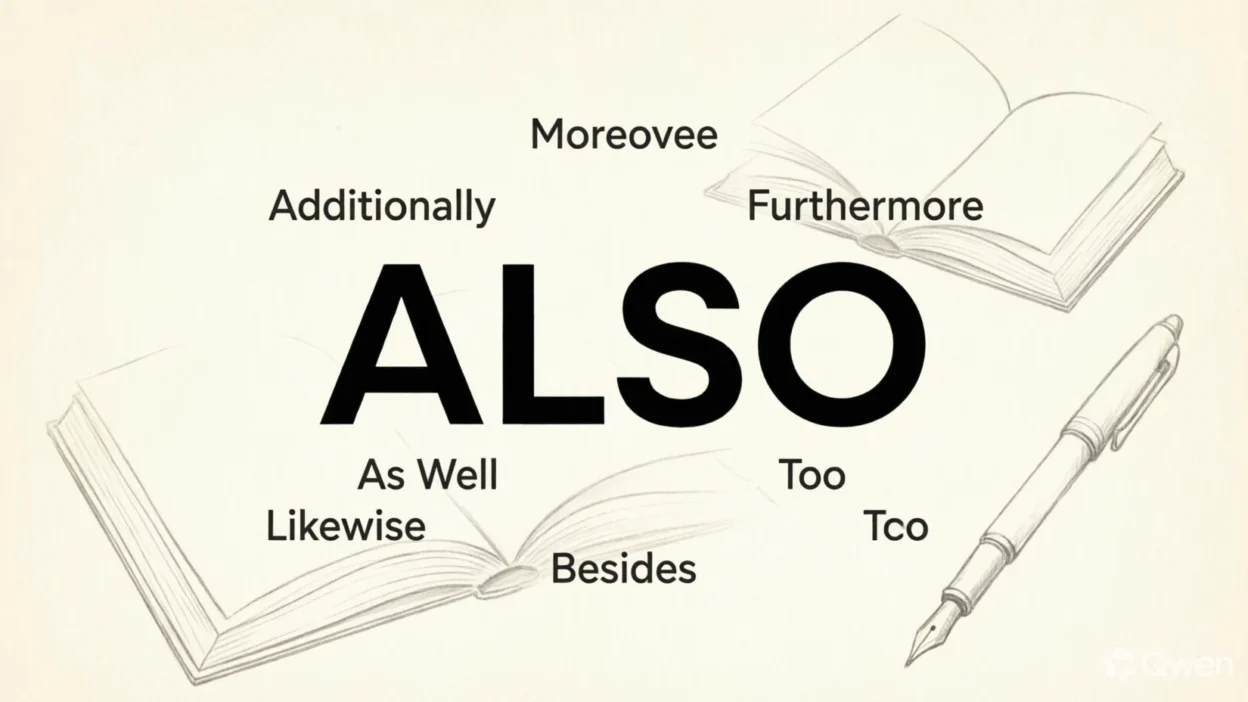
Finding another word for also can make your writing more natural, varied, and precise. Common alternatives include too, as well, additionally, furthermore, moreover, in addition, likewise, besides, and what is more. The best choice depends on the sentence, tone, and relationship between your ideas.
If you are a student, ESL learner, writer, or content creator, understanding these alternatives can help you avoid repetition and communicate your ideas more clearly.
Quick Answer: What Is Another Word for Also?
The most common alternatives for also are:
- Too
- As well
- Additionally
- Furthermore
- Moreover
- In addition
- Likewise
- Besides
- What is more
- Plus
For everyday conversation, too and as well are usually the easiest choices. For formal writing, additionally, furthermore, moreover, and in addition are often more appropriate.
What Does “Also” Mean?
Also is an adverb that means in addition, too, or as well. We use it when we want to add another fact, idea, person, action, or piece of information.
For example:
Here, also adds another activity to the first statement.
Another example is:
The word also connects two positive qualities of the hotel.
How Do You Use “Also” in a Sentence?
The position of also can change depending on the sentence.
Before the Main Verb
With most main verbs, also usually comes before the verb.
After the Verb “To Be”
When the main verb is a form of be, also normally comes after it.
Between an Auxiliary and Main Verb
When there is an auxiliary verb, also commonly comes between the auxiliary and main verb.
At the Beginning of a Sentence
In formal or carefully structured writing, also can appear at the beginning.
However, alternatives such as additionally or furthermore may sound more polished in formal writing.
30 Alternatives for “Also”
Below are 30 useful words and phrases that can replace also. They are not all interchangeable in every sentence, so pay attention to the tone and context.
1. Too
Simple meaning: In addition; as well.
Example:
I like coffee, and I like tea too.
Best usage/context:
Very common in everyday speech and informal writing. It usually appears at the end of a sentence or clause.
2. As Well
Simple meaning: Also; in addition.
Example:
She speaks French as well.
Best usage/context:
Natural in everyday English. Like too, it often comes at the end of a sentence.
3. Additionally
Simple meaning: In addition to something already mentioned.
Example:
The course is affordable. Additionally, it offers flexible classes.
Best usage/context:
Useful in formal writing, reports, essays, articles, and professional communication.
4. Furthermore
Simple meaning: In addition; adding another supporting point.
Example:
The plan is affordable. Furthermore, it is easy to implement.
Best usage/context:
Best for formal writing when adding a related point that strengthens the previous idea.
5. Moreover
Simple meaning: In addition; even more importantly.
Example:
The product is inexpensive. Moreover, it is easy to use.
Best usage/context:
Formal writing. It often introduces an additional point that gives extra support or importance.
6. In Addition
Simple meaning: Besides what has already been mentioned.
Example:
In addition to studying, she works part-time.
Best usage/context:
Excellent for academic, professional, and formal writing.
7. Likewise
Simple meaning: In the same way; similarly.
Example:
John enjoys classical music. Likewise, his sister loves it.
Best usage/context:
Use it when the second idea is similar to or corresponds with the first. It is not a direct replacement for also in every sentence.
8. Similarly
Simple meaning: In a similar way.
Example:
The first experiment produced positive results. Similarly, the second experiment was successful.
Best usage/context:
Useful when comparing two similar situations, actions, or results.
9. Besides
Simple meaning: In addition to; apart from that.
Example:
Besides English, she speaks Spanish.
Best usage/context:
Common in conversation and general writing. It can sometimes introduce a reason or additional argument.
10. What Is More
Simple meaning: In addition; adding another point.
Example:
The restaurant is affordable. What is more, the food is excellent.
Best usage/context:
Good for polished general writing when you want to emphasize an additional positive or important point.
11. Plus
Simple meaning: In addition to something.
Example:
The phone is fast, plus it has an excellent camera.
Best usage/context:
Informal and conversational writing. Avoid overusing it in formal academic work.
12. On Top of That
Simple meaning: In addition to everything already mentioned.
Example:
The apartment is spacious, and on top of that, it has a beautiful view.
Best usage/context:
Informal conversations, blogs, personal writing, and conversational content.
13. As Well as
Simple meaning: In addition to.
Example:
She studies mathematics as well as science.
Best usage/context:
Useful when connecting two nouns, activities, or ideas within one sentence.
14. Along With
Simple meaning: Together with; in addition to.
Example:
The package includes a charger along with a protective case.
Best usage/context:
Useful when adding another person, object, feature, or item to a sentence.
15. Together With
Simple meaning: In combination with; accompanied by.
Example:
The manager, together with her team, attended the meeting.
Best usage/context:
Best when emphasizing that two people, groups, or things are included together.
16. Over and Above
Simple meaning: In addition to something expected or already provided.
Example:
The company offered a bonus over and above the regular salary.
Best usage/context:
Useful when discussing something extra beyond a normal amount, requirement, or expectation.
17. Not to Mention
Simple meaning: Adding another relevant point, often an especially notable one.
Example:
The hotel is close to the beach, not to mention its excellent service.
Best usage/context:
Conversational and persuasive writing. It often highlights an additional advantage.
18. To Boot
Simple meaning: In addition; as an extra benefit.
Example:
The jacket is warm and stylish to boot.
Best usage/context:
Informal and somewhat idiomatic. It is less common in modern everyday English than too or as well.
19. Equally
Simple meaning: To the same degree; also.
Example:
The second option is equally attractive.
Best usage/context:
Use it when you want to show that another person, thing, or idea has the same importance, quality, or degree.
20. Correspondingly
Simple meaning: In a matching or related way.
Example:
Demand increased, and prices rose correspondingly.
Best usage/context:
Formal and technical writing, particularly when two changes or situations are connected.
21. Further
Simple meaning: In addition or to a greater extent.
Example:
Further, the study examined the effects on children.
Best usage/context:
Can be used as a formal transition in some writing, although furthermore or additionally is often clearer.
22. Further to
Simple meaning: In addition to something previously mentioned.
Example:
Further to our discussion, I have attached the revised document.
Best usage/context:
Formal business and professional correspondence, especially in British English.
23. Added to That
Simple meaning: In addition to that.
Example:
The journey was long. Added to that, the weather was extremely hot.
Best usage/context:
Natural in conversational and explanatory writing.
24. In Addition to This
Simple meaning: Besides this; as another point.
Example:
In addition to this, students receive free learning materials.
Best usage/context:
Formal and academic writing when referring back to an earlier point.
25. In Addition to That
Simple meaning: Besides that.
Example:
The room was small. In addition to that, it had very little natural light.
Best usage/context:
Useful when adding another fact or problem to something already discussed.
26. At the Same Time
Simple meaning: Also or simultaneously, depending on context.
Example:
The plan saves money while, at the same time, improving efficiency.
Best usage/context:
Use carefully. It is not a direct synonym for also; it often expresses two conditions happening together.
27. By the Same Token
Simple meaning: For the same reason or in a similar way.
Example:
Good communication builds trust. By the same token, poor communication can damage it.
Best usage/context:
Formal or thoughtful writing when connecting a new point through the same reasoning.
28. Not Only That
Simple meaning: There is another point in addition to the previous one.
Example:
The book is informative. Not only that, it is entertaining.
Best usage/context:
Conversational, persuasive, and expressive writing.
29. And
Simple meaning: Used to connect another idea or item.
Example:
She bought a notebook and a pen.
Best usage/context:
One of the simplest ways to add information. It is often better than forcing a synonym for also into a sentence.
30. In Like Manner
Simple meaning: In the same or similar way.
Example:
The first group completed the task successfully. The second group performed in like manner.
Best usage/context:
Very formal and relatively uncommon. It is more appropriate for specialized or formal writing than everyday conversation.
Comparison Table: Another Word for “Also”
| Alternative | Meaning | Tone | Best Use |
|---|---|---|---|
| Too | As well | Informal/neutral | Everyday speech |
| As well | Also | Neutral | Conversation and general writing |
| Additionally | In addition | Formal | Essays and reports |
| Furthermore | In addition | Formal | Academic writing |
| Moreover | In addition, importantly | Formal | Formal arguments |
| In addition | Besides | Neutral/formal | Academic and professional writing |
| Likewise | In the same way | Neutral/formal | Similar ideas |
| Similarly | In a similar way | Neutral/formal | Comparisons |
| Besides | In addition to | Neutral | General writing |
| What is more | Another important point | Neutral/formal | Persuasive writing |
| Plus | In addition | Informal | Conversation |
| On top of that | In addition | Informal | Conversational writing |
| As well as | In addition to | Neutral | Connecting ideas |
| Along with | Together with | Neutral | Adding people or things |
| Together with | Accompanied by | Neutral/formal | Formal descriptions |
| Over and above | Beyond | Formal | Extra benefits |
| Not to mention | Adding another point | Informal/neutral | Emphasis |
| To boot | In addition | Informal | Casual writing |
| Equally | To the same degree | Formal/neutral | Equal importance |
| Correspondingly | In a matching way | Formal | Technical contexts |
| Further | In addition | Formal | Structured writing |
| Further to | Following/in addition to | Formal | Business correspondence |
| Added to that | In addition | Neutral | Explanations |
| In addition to this | Besides this | Formal | Essays/reports |
| In addition to that | Besides that | Neutral/formal | Adding information |
| At the same time | Simultaneously | Neutral | Related conditions |
| By the same token | Similarly | Formal | Reasoned arguments |
| Not only that | Another point | Informal/neutral | Emphasis |
| And | Connects ideas | Neutral | General English |
| In like manner | Similarly | Very formal | Specialized writing |
“Also” vs. “Too” vs. “As Well”
These three alternatives are especially common, but their positions in a sentence are different.
Also
Also commonly appears before the main verb.
Too
Too often appears at the end.
As Well
As well usually appears at the end.
All three sentences communicate a similar idea.
“Also” vs. “Additionally”
Also is more flexible and common in everyday English.
Additionally sounds more formal.
For casual conversation, also is usually the better choice. For reports, essays, and professional documents, additionally may create a more formal tone.
“Also” vs. “Furthermore”
Although these words can both add information, furthermore is more formal and often introduces an additional supporting argument.
Using also would be simpler:
Choose furthermore when the extra point strengthens an argument or formal explanation.
“Also” vs. “Moreover”
Moreover is another formal alternative. It often suggests that the added point is particularly significant.
In contrast:
The second sentence sounds more neutral and conversational.
How to Choose the Right Synonym for “Also”
The best alternative depends on tone, meaning, and intent.
For Casual Conversation
Use:
- Too
- As well
- Plus
- Besides
- On top of that
- Not only that
Example:
These choices sound natural when speaking with friends or writing informal messages.
For Academic Writing
Use:
- Additionally
- Furthermore
- Moreover
- In addition
- Similarly
- Consequently related transitions where appropriate
Example:
These expressions help organize ideas without sounding overly conversational.
For Professional Writing
Use:
- Additionally
- Furthermore
- In addition
- Moreover
- Further to
Example:
Choose the word that matches the relationship between your ideas rather than simply replacing also.
When You Mean “In the Same Way”
Use:
- Likewise
- Similarly
- By the same token
- In like manner
Example:
Here, likewise is more accurate than simply using also because the two situations are similar.
When You Mean “Together With”
Use:
- Along with
- Together with
- As well as
Example:
These expressions are useful when adding people, objects, or activities.
When You Want to Emphasize an Extra Point
Use:
- Moreover
- Furthermore
- What is more
- Not to mention
- On top of that
Example:
These expressions make the additional point more noticeable.
Common Mistakes When Replacing “Also”
Mistake 1: Using “Likewise” Everywhere
Likewise does not simply mean also in every situation.
Incorrect:
This can sound unnatural if you simply mean that you bought bread in addition to something else.
Better:
Use likewise when you mean in the same way or similarly.
Mistake 2: Making Informal Writing Too Formal
Words such as furthermore and moreover can sound unnecessarily formal in casual conversation.
Instead of:
A natural conversational version is:
Mistake 3: Using “Too” in the Wrong Position
In standard English, too commonly appears near the end of an affirmative sentence.
Natural:
Less natural in many contexts:
A better sentence would be:
Mistake 4: Treating Every Alternative as an Exact Synonym
Words such as similarly, equally, correspondingly, and at the same time carry additional meanings.
For example:
This means the second student’s performance was similar to another student’s performance. It does not simply mean the second student also performed.
Mistake 5: Overusing Formal Transitions
Using moreover, furthermore, and additionally in every paragraph can make writing feel repetitive.
Sometimes the simplest choice is best:
Clear, natural writing does not require a sophisticated transition in every sentence.
Quick Usage Guide
If you want to say “also” in…
Everyday conversation:
Use too or as well.
Academic writing:
Use additionally, furthermore, or in addition.
A formal argument:
Use moreover or furthermore.
A comparison:
Use similarly or likewise.
A casual explanation:
Use besides, plus, or on top of that.
To add something together with another thing:
Use along with, together with, or as well as.
To emphasize an extra advantage:
Use what is more or not to mention.
FAQs:
What is the most common synonym for “also”?
The most common alternatives are too, as well, and additionally. Too and as well are especially common in everyday English, while additionally is more suitable for formal writing.
What is a formal word for “also”?
Common formal alternatives include additionally, furthermore, moreover, and in addition. The best option depends on the relationship between the ideas you are connecting.
Can “too” replace “also”?
Yes, in many sentences. For example, “I also like music” and “I like music too” have essentially the same meaning. However, their usual positions in a sentence differ.
Is “as well” the same as “also”?
In many contexts, yes. For example, “She speaks English as well” means approximately the same as “She also speaks English.” As well is particularly common at the end of a sentence.
What is another word for “also” in academic writing?
Additionally, furthermore, moreover, and in addition are strong choices for academic writing. Choose based on whether you simply want to add information or emphasize an important supporting point.
Is “moreover” stronger than “also”?
Often, yes. Moreover usually sounds more formal and can emphasize that the additional information is important to the argument. Also is more neutral.
What is another word for “also” in an essay?
Good choices include additionally, furthermore, moreover, and in addition. However, you do not need to replace every instance of also. Natural repetition is sometimes better than awkward variation.
Can “likewise” mean “also”?
Sometimes, but not always. Likewise usually means in the same way or similarly. Use it when the second idea has a meaningful similarity to the first.
Conclusion
There are many useful alternatives to also, but the best choice depends on the sentence and context. For everyday English, too and as well are simple and natural. For academic and professional writing, additionally, furthermore, moreover, and in addition are useful choices.
Remember that synonyms do not always have exactly the same meaning. Likewise and similarly emphasize similarity, while along with and together with emphasize combination. Choosing the right expression makes your writing clearer, more natural, and more precise.
When in doubt, keep it simple. Also, too, and as well are perfectly good English, and you should only choose a more specialized alternative when it genuinely improves the sentence.

I am Olivia Brooks, a language enthusiast and writer at SynonymsHive. I enjoy creating clear, engaging content about synonyms, vocabulary, and word meanings, helping readers improve their writing and communicate with confidence every day.