
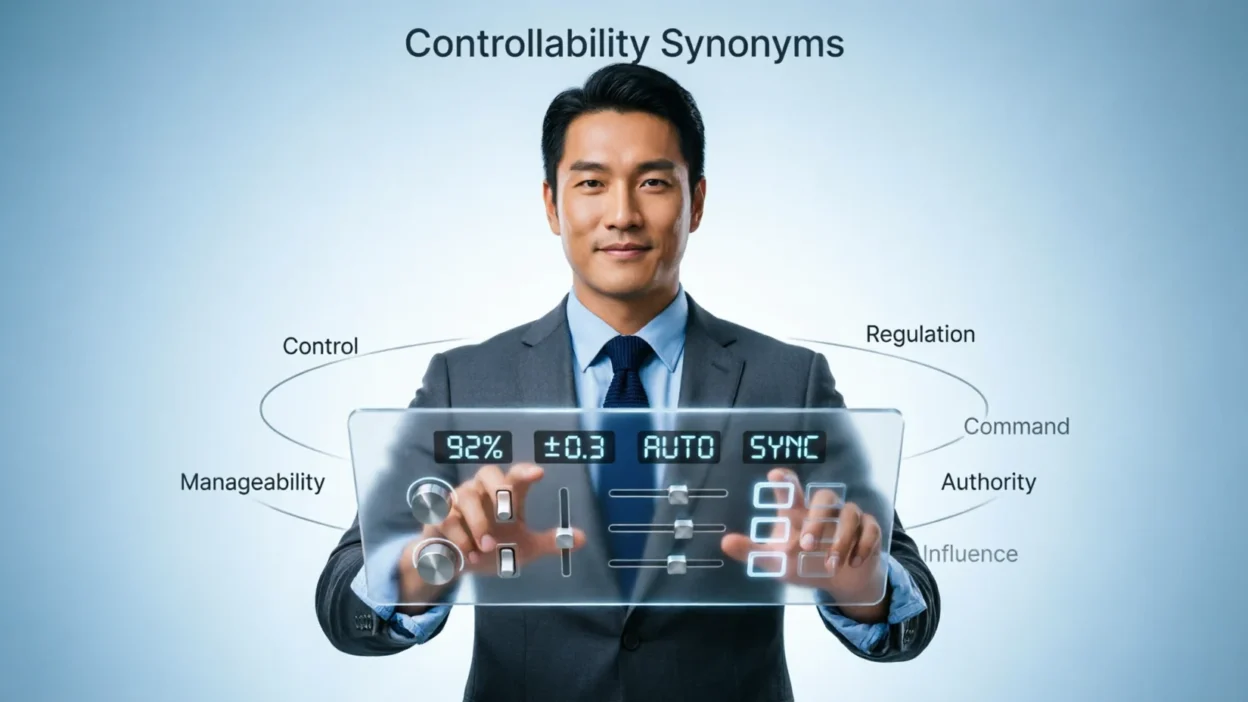
When you need a controllability synonym, the right word depends on what you mean by the ability to control something. Common alternatives include manageability, control, governability, regulation, influence, and command. Some words describe how easy something is to control, while others describe the power or authority to control it.
Quick Answer
Controllability means the degree to which something can be controlled, managed, regulated, or influenced.
Depending on the context, useful synonyms include:
- Manageability — how easy something is to manage
- Control — the power to direct or influence something
- Governability — how easily something can be governed
- Regulation — control through rules or standards
- Influence — the ability to affect something
- Command — authority or power to direct
- Supervision — overseeing something to keep it under control
- Steerability — how easily something can be directed
The best synonym depends on whether you are discussing people, systems, machines, behavior, processes, risks, or situations.
What Does Controllability Mean?
Controllability is the quality or degree of being controllable. In simple English, it describes how possible or easy it is to control, manage, direct, or influence something.
For example:
Here, controllability refers to how easily the vehicle can be directed or controlled.
The word is commonly used in technical, scientific, business, engineering, management, and everyday contexts.
Controllability as a Noun
“Controllability” is a noun formed from controllable.
- Control → the act or power of directing something
- Controllable → able to be controlled
- Controllability → the degree or quality of being controllable
Is Controllability the Same as Control?
Not exactly.
Control usually refers to the actual power or act of directing something.
Controllability refers to how possible, practical, or easy that control is.
For example:
- “The manager has control over the project.”
- “The project has good controllability because its risks can be monitored and adjusted.”
30 Synonyms for Controllability
There is no single perfect replacement for controllability in every sentence. The following words and phrases cover its major meanings.
1. Manageability
Simple meaning: How easy something is to manage or deal with.
Example:
“The manageability of the project improved after the team reduced its scope.”
Best usage/context: Projects, workloads, problems, tasks, and situations.
2. Control
Simple meaning: The power or ability to direct something.
Example:
“The new system gives users greater control over their data.”
Best usage/context: General and everyday situations.
3. Governability
Simple meaning: The degree to which something can be governed or directed.
Example:
“The governability of the organization depends on clear rules.”
Best usage/context: Government, institutions, organizations, and political science.
4. Regulation
Simple meaning: The act of controlling something through rules or standards.
Example:
“Strict regulation helps control industrial pollution.”
Best usage/context: Laws, industries, safety, finance, and public policy.
5. Regulation Capacity
Simple meaning: The ability to regulate or keep something within desired limits.
Example:
“The device has strong regulation capacity under changing conditions.”
Best usage/context: Technical and engineering writing.
6. Manageability
Simple meaning: The quality of being easy enough to manage.
Example:
“The smaller class size improved the manageability of the lessons.”
Best usage/context: Education, work, projects, and daily tasks.
7. Governability
Simple meaning: How easily something can be governed.
Example:
“Clear institutional structures can improve governability.”
Best usage/context: Organizations, governments, and institutions.
8. Directability
Simple meaning: The ability to be directed toward a desired action or result.
Example:
“The directability of the robotic arm allows precise movements.”
Best usage/context: Machines, robots, systems, and technical contexts.
9. Steerability
Simple meaning: How easily something can be guided or steered.
Example:
“The boat’s steerability was excellent in rough water.”
Best usage/context: Vehicles, boats, aircraft, robots, and physical systems.
10. Adjustability
Simple meaning: The ability to be changed or adjusted as needed.
Example:
“The adjustability of the system makes it suitable for different users.”
Best usage/context: Machines, settings, systems, furniture, and processes.
11. Modifiability
Simple meaning: The ability to be changed or modified.
Example:
“The software’s modifiability makes future updates easier.”
Best usage/context: Software, systems, designs, and technical writing.
12. Adaptability
Simple meaning: The ability to change in response to different conditions.
Example:
“The adaptability of the system allows it to handle unexpected changes.”
Best usage/context: People, organizations, systems, and technology.
13. Influence
Simple meaning: The power to affect something without necessarily controlling it completely.
Example:
“Economic conditions have a strong influence on consumer behavior.”
Best usage/context: Behavior, decisions, social situations, and external factors.
14. Command
Simple meaning: The authority or power to direct something.
Example:
“The pilot maintained command of the aircraft.”
Best usage/context: Authority, leadership, military, and professional settings.
15. Authority
Simple meaning: The official power to make decisions or give orders.
Example:
“The supervisor has authority over the department.”
Best usage/context: Leadership, organizations, law, and administration.
16. Supervision
Simple meaning: The act of watching and guiding something or someone.
Example:
“The workers completed the task under close supervision.”
Best usage/context: Employees, children, workplaces, education, and safety.
17. Oversight
Simple meaning: Careful monitoring or supervision.
Example:
“Financial oversight helps prevent unnecessary spending.”
Best usage/context: Business, government, finance, compliance, and management.
18. Regulation Capacity
Simple meaning: The ability to keep something controlled within acceptable limits.
Example:
“The machine’s regulation capacity prevents excessive temperature changes.”
Best usage/context: Engineering, science, and technical systems.
19. Restraint
Simple meaning: The ability to keep something within limits.
Example:
“Effective restraint prevented the situation from becoming more serious.”
Best usage/context: Behavior, emotions, physical movement, and risk.
20. Moderation
Simple meaning: Keeping something within reasonable limits.
Example:
“Moderation can help maintain a balanced workload.”
Best usage/context: Behavior, consumption, discussions, and policies.
21. Regulation Ability
Simple meaning: The ability to control or regulate something.
Example:
“The body’s regulation ability helps maintain stable internal conditions.”
Best usage/context: Biology, medicine, engineering, and general explanations.
22. Controllability
Simple meaning: The degree to which something can be controlled.
Example:
“The aircraft was tested for stability and controllability.”
Best usage/context: Technical writing when the original concept itself is needed.
23. Responsiveness
Simple meaning: How readily something responds to control or changes.
Example:
“The responsiveness of the system allows operators to make quick adjustments.”
Best usage/context: Technology, vehicles, systems, and customer service.
24. Operability
Simple meaning: How easily something can be operated or made to function.
Example:
“The new interface improves the operability of the equipment.”
Best usage/context: Machines, software, equipment, and technical systems.
25. Stability
Simple meaning: The ability to remain steady and controlled.
Example:
“The stability of the platform makes it easier to operate.”
Best usage/context: Engineering, finance, systems, physical structures, and organizations.
26. Predictability
Simple meaning: The degree to which something behaves in an expected way.
Example:
“Greater predictability makes the process easier to manage.”
Best usage/context: Systems, behavior, business, and planning.
27. Constrainability
Simple meaning: The ability to be restricted or kept within limits.
Example:
“The constrainability of the process depends on several external factors.”
Best usage/context: Specialized technical or theoretical writing.
28. Commandability
Simple meaning: The ability to be directed or commanded.
Example:
“The system’s commandability is important for remote operations.”
Best usage/context: Specialized technical contexts involving machines or systems.
29. Handling
Simple meaning: The ease with which something can be controlled, operated, or managed.
Example:
“The improved handling of the vehicle increased driver confidence.”
Best usage/context: Vehicles, equipment, objects, and practical situations.
30. Ease of Control
Simple meaning: How easy it is to control something.
Example:
“The new design provides greater ease of control.”
Best usage/context: Clear, beginner-friendly writing and technical explanations.
Comparison Table: Controllability Synonyms
| Synonym | Main idea | Best context | Formality |
|---|---|---|---|
| Manageability | Ease of managing | Projects, tasks | Neutral |
| Control | Power to direct | General | Neutral |
| Governability | Ease of governing | Institutions | Formal |
| Regulation | Control through rules | Laws, industries | Formal |
| Influence | Ability to affect | People, behavior | Neutral |
| Command | Authority to direct | Leadership | Formal |
| Authority | Official power | Organizations | Formal |
| Supervision | Monitoring and guidance | Workplaces | Neutral |
| Oversight | Careful monitoring | Business, government | Formal |
| Steerability | Ease of steering | Vehicles, robots | Technical |
| Directability | Ease of directing | Machines, systems | Technical |
| Adjustability | Ability to change settings | Devices, systems | Neutral |
| Modifiability | Ability to modify | Software, designs | Technical |
| Adaptability | Ability to adjust to change | People, systems | Neutral |
| Restraint | Keeping within limits | Behavior, risk | Formal |
| Moderation | Keeping within reasonable limits | Behavior, consumption | Neutral |
| Operability | Ease of operation | Equipment | Technical |
| Stability | Ability to remain controlled | Systems, structures | Neutral |
| Predictability | Expected behavior | Processes, systems | Neutral |
| Ease of control | How easy control is | General/technical | Neutral |
How to Choose the Right Controllability Synonym
The best synonym depends on meaning, tone, and intent.
For General Writing
Use:
- Control
- Manageability
- Ease of control
- Handling
Example:
These choices are simple and natural for most readers.
For Technical Writing
Use:
- Steerability
- Directability
- Adjustability
- Modifiability
- Operability
- Responsiveness
Example:
These words are more precise when describing machines, software, vehicles, or engineered systems.
For Business and Management
Use:
- Manageability
- Supervision
- Oversight
- Authority
- Control
Example:
For Government and Institutions
Use:
- Governability
- Regulation
- Authority
- Oversight
- Control
Example:
When You Mean “Ability to Influence”
Use influence rather than control.
There is an important difference:
This does not necessarily mean parents have complete control over those choices.
When You Mean “Easy to Manage”
Use manageability.
This is often the most natural replacement when controllability means how easy something is to handle.
Controllability vs. Manageability
These two words are closely related but are not interchangeable in every context.
Controllability focuses on whether something can be controlled and to what degree.
Manageability focuses more on whether something is easy or practical to manage.
Compare:
- “The aircraft’s controllability was tested.”
- “The project’s manageability improved after the deadline was extended.”
The first concerns control of a technical system. The second concerns the practical difficulty of handling a project.
Controllability vs. Influence
Influence is weaker than control.
If you influence something, you affect it, but you may not be able to determine the final outcome.
For example:
Weather does not necessarily control every aspect of crop production, so influence is more appropriate.
Controllability vs. Stability
Stability and controllability are also different.
- Stability describes the ability to remain steady.
- Controllability describes the ability to be directed or controlled.
A system can be stable but difficult to control, or responsive to control while requiring careful management.
Common Usage Mistakes
1. Using “control” for every situation
Although control is a close synonym, it does not always replace controllability naturally.
Less precise:
More natural in a technical context:
2. Confusing control with influence
Influence does not necessarily mean complete control.
This means the manager affected the decision, not necessarily that they had final authority over it.
3. Using “manageability” for technical control
Manageability works well for tasks and workloads, but steerability, directability, or controllability may be more precise for a machine.
4. Assuming all synonyms have the same strength
Words such as authority, command, influence, and supervision describe different kinds of control.
For example:
- Authority = official power
- Command = power to direct
- Influence = ability to affect
- Supervision = monitoring and guiding
- Control = ability to direct or determine
- Manageability = ease of handling
FAQs:
What is the closest synonym for controllability?
Manageability, control, and ease of control can be close alternatives, depending on the sentence. In technical contexts, steerability, directability, or adjustability may be more precise.
What does controllability mean in simple words?
Controllability means how easily or effectively something can be controlled, directed, or influenced.
Is manageability a synonym for controllability?
It can be, but the meanings are not identical. Manageability emphasizes how easy something is to handle, while controllability emphasizes whether and how effectively something can be controlled.
What is the opposite of controllability?
Possible opposites include uncontrollability, unmanageability, instability, or lack of control, depending on the context.
What is a formal synonym for controllability?
Governability, regulation, regulatory capacity, and manageability can work in formal contexts, but the appropriate choice depends on what is being controlled.
What is a technical synonym for controllability?
Technical alternatives include steerability, directability, adjustability, operability, and responsiveness.
Can “influence” replace “controllability”?
Sometimes, but not always. Influence means having an effect on something, whereas controllability generally suggests a greater ability to direct or regulate the outcome.
What is a simple phrase instead of controllability?
Ease of control is a clear and beginner-friendly phrase that can replace controllability in many contexts.
Conclusion
The best controllability synonym depends on exactly what you want to express. If you mean how easy something is to manage, choose manageability.
If you mean the power to direct something, use control or command. For the ability to affect something without complete control, influence is more accurate.
In technical contexts, words such as steerability, directability, adjustability, modifiability, and operability can provide more specific meanings. Choosing the right synonym makes your writing clearer, more natural, and more precise.

I am Andrew Foster, a passionate language writer who enjoys helping readers discover the right synonyms and improve their vocabulary. I create clear, accurate, and engaging content that makes learning English simple, practical, and enjoyable.