
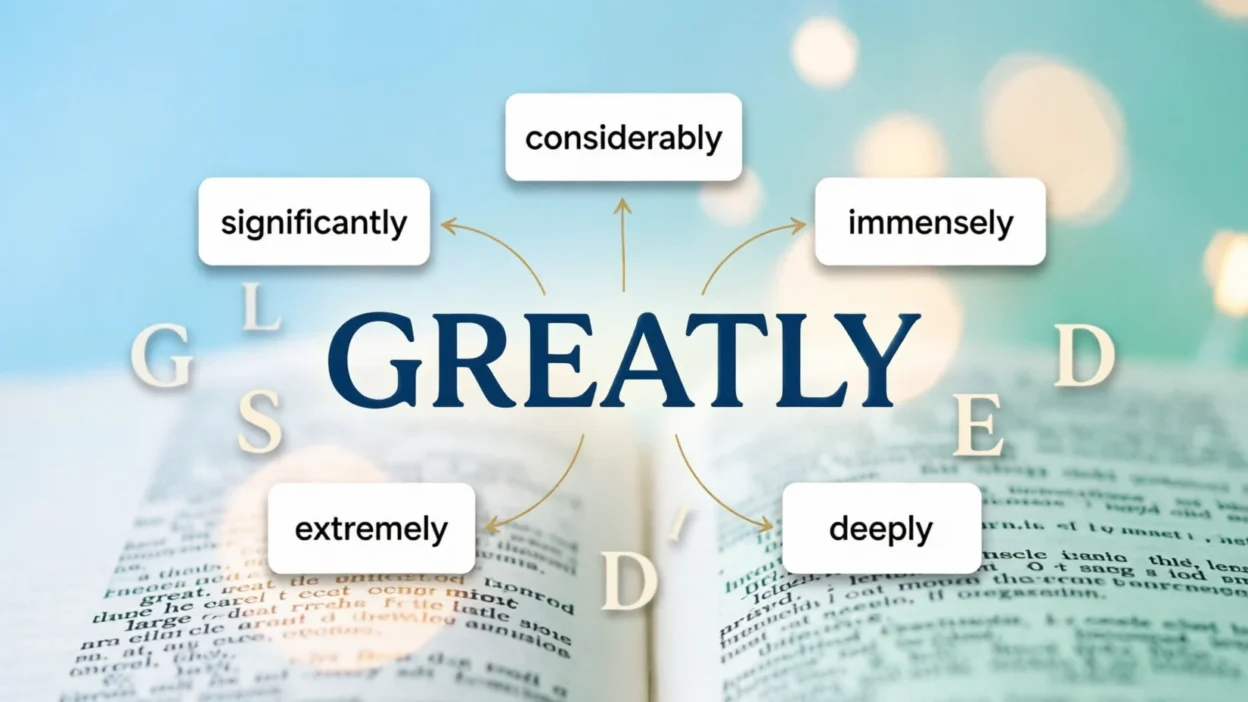
Finding the right greatly synonym can make your writing clearer, more natural, and more expressive. Words such as considerably, significantly, immensely, deeply, enormously, and profoundly can replace “greatly,” but each has a slightly different meaning and tone.
A good synonym depends on what you want to express. For example, “greatly appreciated” means highly appreciated, while “greatly increased” usually means increased by a large amount. Choosing the right alternative helps you communicate your exact meaning.
Quick Answer: What Is a Synonym for Greatly?
Common synonyms for greatly include considerably, significantly, immensely, enormously, extremely, deeply, profoundly, substantially, tremendously, and highly. The best choice depends on the context.
- Greatly appreciated → highly appreciated
- Greatly increased → significantly increased
- Greatly affected → profoundly affected
- Greatly enjoyed → thoroughly enjoyed
- Greatly improved → considerably improved
What Does “Greatly” Mean?
Greatly is an adverb that means to a large degree, by a large amount, or very much.
It is used to show that something has happened to a strong or significant extent.
Examples of “Greatly”
- Your advice greatly helped me.
- The new system greatly improved efficiency.
- She was greatly impressed by the performance.
- His work has greatly influenced modern writers.
- We greatly appreciate your support.
The exact meaning changes slightly depending on the verb that follows it.
For example, “greatly increased” focuses on amount, while “greatly admired” focuses on degree of feeling or respect.
30 Synonyms for Greatly
Below are 30 useful alternatives to “greatly,” along with their meanings, examples, and best contexts.
1. Considerably
Simple meaning: By a large amount or to a noticeable degree.
Example: The cost of the project has considerably increased.
Best usage/context: Formal writing, reports, academic writing, and discussions about measurable changes.
2. Significantly
Simple meaning: By an important or noticeable amount.
Example: The results significantly improved after the new method was introduced.
Best usage/context: Academic, professional, scientific, and analytical writing.
3. Immensely
Simple meaning: To a very great degree.
Example: She was immensely grateful for their support.
Best usage/context: Strong emotions, appreciation, enjoyment, or admiration.
4. Enormously
Simple meaning: To a very large degree or amount.
Example: The discovery enormously benefited the scientific community.
Best usage/context: Strong emphasis on size, impact, benefit, or degree.
5. Tremendously
Simple meaning: To an extremely large degree.
Example: His confidence has tremendously increased over the past year.
Best usage/context: Informal and semi-formal writing, especially when emphasizing major change or improvement.
6. Substantially
Simple meaning: By a large or important amount.
Example: The company substantially reduced its operating costs.
Best usage/context: Business, economics, academic writing, reports, and formal discussions.
7. Profoundly
Simple meaning: In a very deep or powerful way.
Example: The experience profoundly changed her outlook on life.
Best usage/context: Emotions, beliefs, experiences, ideas, and lasting effects.
8. Deeply
Simple meaning: In a strong or sincere way.
Example: We are deeply grateful for your kindness.
Best usage/context: Feelings, emotions, appreciation, concern, regret, and personal experiences.
9. Extremely
Simple meaning: To a very high degree.
Example: The instructions were extremely helpful.
Best usage/context: Everyday English and situations requiring strong emphasis.
10. Highly
Simple meaning: To a great degree.
Example: She is highly respected by her colleagues.
Best usage/context: Respect, praise, ability, recommendation, quality, and professional contexts.
11. Remarkably
Simple meaning: In an unusually noticeable or impressive way.
Example: The patient remarkably recovered after the treatment.
Best usage/context: Unexpected results, impressive achievements, unusual changes, and observations.
12. Vastly
Simple meaning: By a very large amount or degree.
Example: The internet has vastly changed the way people communicate.
Best usage/context: Large differences, major changes, and broad comparisons.
13. Exceptionally
Simple meaning: To an unusually high degree.
Example: The restaurant provides exceptionally good service.
Best usage/context: Praise, quality, performance, ability, and achievement.
14. Thoroughly
Simple meaning: Completely or in a detailed way.
Example: We thoroughly enjoyed the concert.
Best usage/context: Activities, enjoyment, examination, preparation, research, and completion.
15. Seriously
Simple meaning: To a significant or considerable degree.
Example: The accident seriously affected his ability to work.
Best usage/context: Problems, consequences, risks, injuries, concerns, and negative effects.
16. Dramatically
Simple meaning: In a sudden, striking, or very noticeable way.
Example: The number of visitors dramatically increased this year.
Best usage/context: Major changes, statistics, trends, and noticeable developments.
17. Markedly
Simple meaning: In a clearly noticeable way.
Example: Her writing skills have markedly improved.
Best usage/context: Formal and academic writing, especially when describing measurable or observable differences.
18. Radically
Simple meaning: In a very significant or fundamental way.
Example: Technology has radically transformed modern communication.
Best usage/context: Fundamental changes in systems, ideas, policies, methods, or society.
19. Intensely
Simple meaning: In a very strong or powerful way.
Example: He intensely disliked the unfair treatment.
Best usage/context: Strong emotions, physical experiences, reactions, and sensations.
20. Heavily
Simple meaning: To a large degree or with a strong effect.
Example: The region was heavily affected by the storm.
Best usage/context: Effects, dependence, investment, influence, damage, and physical conditions.
21. Noticeably
Simple meaning: In a way that can easily be noticed.
Example: Her pronunciation has noticeably improved.
Best usage/context: Observable changes, behavior, appearance, performance, and development.
22. Materially
Simple meaning: In a significant or important way.
Example: The new evidence materially changed the investigation.
Best usage/context: Formal, legal, business, financial, and analytical writing.
23. Powerfully
Simple meaning: In a strong or effective way.
Example: The documentary powerfully communicated its message.
Best usage/context: Communication, storytelling, arguments, art, speeches, and emotional impact.
24. Wonderfully
Simple meaning: In a very pleasing or excellent way.
Example: The children wonderfully performed in the school play.
Best usage/context: Praise, positive experiences, performances, and informal writing.
25. Exceedingly
Simple meaning: To an unusually high degree.
Example: The instructions were exceedingly clear.
Best usage/context: Formal or literary English. It is less common in casual conversation.
26. Greatly Enough
Simple meaning: To a sufficiently large degree.
Example: The explanation did not help greatly enough to solve the problem.
Best usage/context: Limited contexts where you specifically want to discuss whether an effect was sufficient. “Greatly enough” is less natural than many alternatives.
27. Highly Significantly
Simple meaning: In a very important or noticeable way.
Example: The findings highly significantly differed between the groups.
Best usage/context: Generally avoid this combination in ordinary writing because “highly significantly” can sound awkward. “Significantly” or “very significantly” may be more appropriate depending on the intended meaning.
28. Overwhelmingly
Simple meaning: To a very strong or dominant degree.
Example: The proposal was overwhelmingly supported by the committee.
Best usage/context: Strong support, agreement, preference, evidence, or majority response.
29. Incredibly
Simple meaning: To an unusually high degree.
Example: The book was incredibly useful for beginners.
Best usage/context: Everyday and informal English, especially for strong positive or negative emphasis.
30. Monumentally
Simple meaning: To an extremely large or important degree.
Example: The decision monumentally changed the organization.
Best usage/context: Strong rhetorical emphasis. It is less common and often more dramatic than “greatly.”
Comparison Table: Greatly Synonyms at a Glance
| Synonym | Main Meaning | Tone | Common Context |
|---|---|---|---|
| Considerably | By a large amount | Formal | Reports, changes |
| Significantly | Importantly or noticeably | Formal | Academic, analytical |
| Immensely | To a very great degree | Strong | Feelings, appreciation |
| Enormously | To a very large degree | Strong | Impact, amount |
| Tremendously | To an extremely large degree | Neutral | Improvement, change |
| Substantially | By a significant amount | Formal | Business, research |
| Profoundly | In a deep way | Formal | Effects, emotions |
| Deeply | In a strong emotional way | Neutral | Feelings |
| Extremely | To a very high degree | Neutral | General use |
| Highly | To a great degree | Neutral/Formal | Respect, quality |
| Remarkably | In an impressive way | Neutral | Results, achievements |
| Vastly | By a very large amount | Formal | Comparisons, changes |
| Exceptionally | Unusually highly | Formal | Quality, performance |
| Thoroughly | Completely | Neutral | Activities, research |
| Seriously | To a significant degree | Neutral | Problems, consequences |
| Dramatically | In a striking way | Neutral | Trends, changes |
| Markedly | Clearly noticeably | Formal | Academic writing |
| Radically | Fundamentally | Strong/Formal | Major transformations |
| Intensely | Very strongly | Neutral | Feelings, experiences |
| Heavily | To a large degree | Neutral | Effects, influence |
| Noticeably | In an observable way | Neutral | Changes |
| Materially | In an important way | Formal | Legal, business |
| Powerfully | In a strong/effective way | Neutral | Communication |
| Wonderfully | In a pleasing way | Informal | Praise |
| Exceedingly | To an unusually high degree | Formal/Literary | Formal descriptions |
| Overwhelmingly | To a dominant degree | Strong | Support, agreement |
| Incredibly | To an unusually high degree | Informal | Everyday emphasis |
| Monumentally | To an extremely important degree | Dramatic | Rhetorical emphasis |
How to Choose the Right Synonym for Greatly
Not every synonym for “greatly” works naturally in every sentence. The best choice depends on meaning, tone, and intent.
For Formal and Academic Writing
Choose:
- Significantly
- Considerably
- Substantially
- Markedly
- Materially
- Vastly
Example:
Instead of:
You could write:
This sounds more precise in an academic or professional context.
For Strong Emotions
Choose:
- Deeply
- Profoundly
- Intensely
- Immensely
- Extremely
Examples:
- I am deeply grateful for your support.
- The experience profoundly affected her.
- He was immensely proud of his daughter.
For Major Changes
Choose:
- Dramatically
- Radically
- Substantially
- Vastly
- Tremendously
- Significantly
Example:
“Dramatically” highlights the noticeable nature of the change, while “significantly” sounds more neutral and analytical.
For Praise and Positive Descriptions
Choose:
- Highly
- Exceptionally
- Remarkably
- Wonderfully
- Incredibly
Examples:
- She is highly respected.
- The hotel provided exceptionally good service.
- The students performed remarkably well.
For Complete or Detailed Actions
Choose:
- Thoroughly
- Completely where appropriate
- Fully where appropriate
For example:
Here, “thoroughly” does not simply mean “very much.” It means the examination was done carefully and completely.
Greatly vs. Significantly
Greatly and significantly can sometimes be interchangeable, but they are not always identical.
“Greatly” usually emphasizes degree or extent.
“Significantly” often emphasizes an important or measurable difference.
For formal writing, “significantly” is often more precise when discussing measurable results.
Greatly vs. Deeply
These words are especially different when talking about emotions.
Both are correct, but deeply often gives the sentence a more sincere or emotional feeling.
“Greatly” is broader, while “deeply” is especially natural with feelings and personal reactions.
Greatly vs. Extremely
Extremely usually means “to a very high degree.”
“Greatly” does not work naturally in the same sentence:
Instead, you could say:
This shows why synonyms cannot always be substituted mechanically.
Greatly vs. Considerably
Both words can describe a large change.
The second sentence sounds more formal and analytical.
Considerably is particularly useful when describing measurable differences in cost, size, quantity, performance, or degree.
Common Usage Mistakes
1. Assuming Every Synonym Can Replace “Greatly”
Synonyms often have different grammatical patterns.
For example:
“Thoroughly enjoyed” is much more natural:
2. Using “Greatly” Before Every Adjective
“Greatly” is generally used with verbs and certain participles or expressions.
Instead of:
Use
or:
3. Confusing “Greatly” With “Great”
“Greatly” is an adverb, while “great” is usually an adjective.
- Great: She is a great writer.
- Greatly: Her work has greatly influenced readers.
4. Overusing Strong Synonyms
Words such as immensely, overwhelmingly, monumentally, and profoundly are strong.
Using them in every sentence can make writing sound exaggerated.
Choose a stronger word only when the context supports it.
5. Using Informal Words in Formal Writing
Words such as incredibly and wonderfully are common in everyday English but may be less suitable for highly formal analytical writing.
For professional or academic contexts, consider:
- significantly
- considerably
- substantially
- markedly
- materially
FAQs:
What is the best synonym for greatly?
There is no single best synonym for every situation. Considerably, significantly, immensely, substantially, deeply, and extremely are among the most useful alternatives, depending on the sentence.
What is a formal synonym for greatly?
Common formal alternatives include significantly, considerably, substantially, markedly, materially, and profoundly.
What is another word for greatly appreciated?
Depending on the intended tone, you can say highly appreciated, deeply appreciated, sincerely appreciated, or immensely appreciated.
For example:
What is a synonym for greatly increased?
Useful alternatives include significantly increased, considerably increased, substantially increased, dramatically increased, and markedly increased.
The best choice depends on whether you want to emphasize size, importance, or suddenness.
What is a synonym for greatly affected?
Possible alternatives include deeply affected, profoundly affected, seriously affected, significantly affected, and strongly affected.
“Profoundly affected” is especially suitable when describing a deep or lasting impact.
Can “extremely” replace “greatly”?
Sometimes, but not always.
For example:
can become:
But:
is unnatural.
The correct synonym depends on the verb and meaning.
Is “deeply” stronger than “greatly”?
Not necessarily. They emphasize different aspects.
Greatly usually expresses a high degree or large extent, while deeply often emphasizes emotional or profound impact.
What is the difference between greatly and significantly?
“Greatly” means to a large degree or amount. “Significantly” means in an important, noticeable, or statistically meaningful way, depending on context.
For academic and analytical writing, “significantly” can be more precise when discussing measurable findings.
Conclusion
Choosing the right greatly synonym depends on the meaning you want to communicate. Significantly, considerably, substantially, and markedly work well for formal and analytical writing. Deeply, profoundly, and intensely are useful for emotions and powerful experiences. Extremely, incredibly, and wonderfully are more natural in everyday or conversational contexts.
The key is to consider the verb, tone, degree, and purpose of your sentence. A good synonym should not only mean something similar to “greatly” but should also sound natural in its specific context.

I’m Nathan Collins, a language enthusiast passionate about exploring synonyms and improving everyday writing. I create clear, accurate, and helpful content that helps readers expand vocabulary and communicate with confidence.