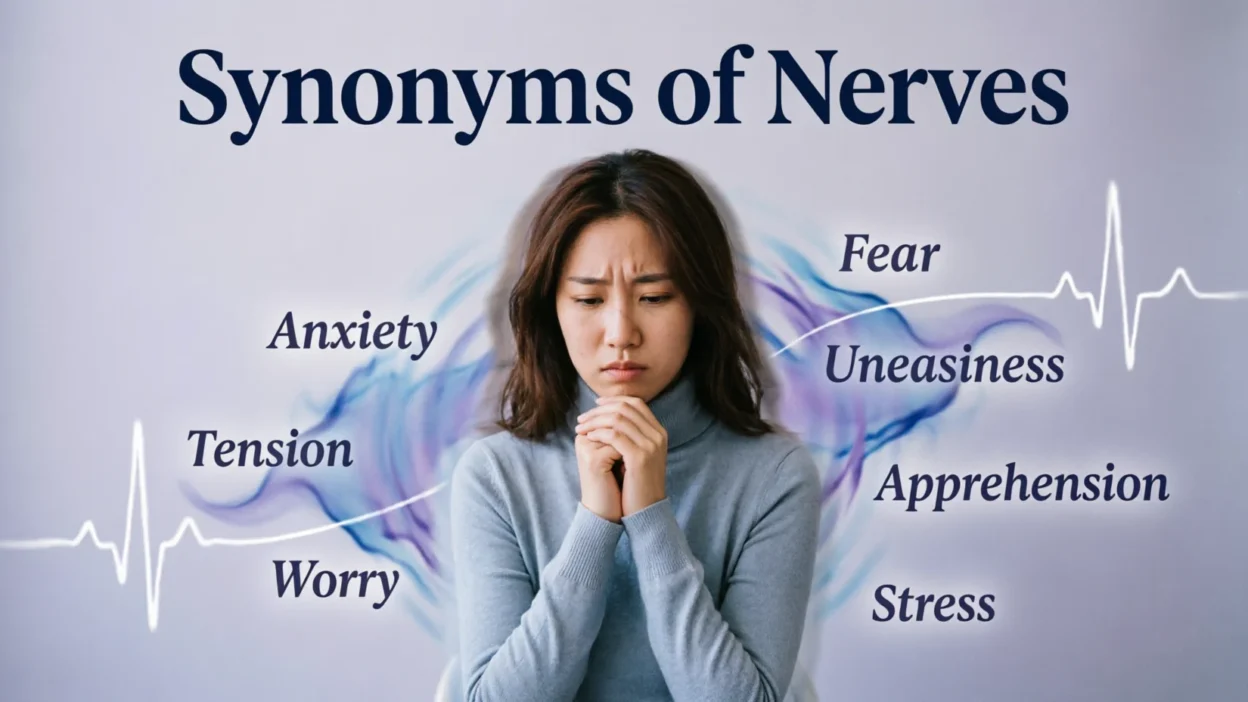
When looking for synonyms of nerves, the best word depends on what you mean. Anxiety, nervousness, tension, apprehension, uneasiness, and jitters can all describe a nervous feeling, but each has a slightly different tone.
In everyday English, nervousness is often the closest general synonym, while jitters sounds informal and apprehension suggests worry about something that may happen.
Quick Answer
The most useful synonyms of nerves include:
nervousness, anxiety, apprehension, uneasiness, tension, worry, fear, concern, stress, jitters, agitation, restlessness, insecurity, dread, alarm, unease, trepidation, disquiet, distress, turmoil, excitement, anticipation, discomfort, uncertainty, worry, panic, fright, nervous tension, stage fright, and butterflies.
The right choice depends on whether you want to express mild discomfort, serious fear, emotional pressure, or excitement before an important event.
What Does “Nerves” Mean?
The word nerves can have several meanings in English.
When we say someone has nerves, we often mean they feel worried, anxious, frightened, or tense.
For example:
Here, nerves means a feeling of nervousness or anxiety.
However, nerves can also refer to the parts of the body that carry messages between the brain, spinal cord, and other parts of the body. The synonyms in this article mainly focus on the emotional meaning of nerves.
Nerves as an Emotional Feeling
When someone says:
- “I have nerves before an interview.”
- “The exam is giving me nerves.”
- “He was struggling with nerves before the match.”
they are talking about anxiety, tension, worry, or nervousness.
The exact synonym should match the intensity and situation.
30 Synonyms of Nerves
1. Nervousness
Simple meaning: The feeling of being worried, tense, or uneasy.
Example: Her nervousness disappeared once the presentation began.
Best usage/context: A general and neutral replacement for nerves.
2. Anxiety
Simple meaning: Strong worry or concern, often about something uncertain.
Example: He felt anxiety before receiving his exam results.
Best usage/context: Useful when the nervous feeling involves persistent worry.
3. Apprehension
Simple meaning: A worried or uneasy feeling about something that may happen.
Example: She approached the interview with some apprehension.
Best usage/context: Formal writing and situations involving concern about the future.
4. Uneasiness
Simple meaning: A mild feeling that something is uncomfortable or not quite right.
Example: He felt a growing sense of uneasiness during the meeting.
Best usage/context: Mild nervousness or discomfort.
5. Tension
Simple meaning: A feeling of mental or emotional pressure.
Example: There was noticeable tension before the announcement.
Best usage/context: Stressful situations, conflicts, competitions, and high-pressure moments.
6. Worry
Simple meaning: Thinking about something with concern or fear.
Example: Her worry about the interview kept her awake.
Best usage/context: Everyday English and ordinary concerns.
7. Fear
Simple meaning: A strong feeling caused by danger, threat, or the possibility of harm.
Example: His fear made it difficult to speak in front of the crowd.
Best usage/context: Stronger emotions involving perceived danger or serious concern.
8. Concern
Simple meaning: A feeling of worry about something important.
Example: There was growing concern about the difficult situation.
Best usage/context: Neutral and formal writing.
9. Stress
Simple meaning: Mental or emotional pressure caused by difficult circumstances.
Example: Work-related stress made her feel constantly nervous.
Best usage/context: School, work, deadlines, responsibilities, and demanding situations.
10. Jitters
Simple meaning: A nervous, shaky, or excited feeling.
Example: I always get the jitters before an important test.
Best usage/context: Informal conversations.
11. Agitation
Simple meaning: A state of nervous excitement, disturbance, or restlessness.
Example: The unexpected news caused considerable agitation.
Best usage/context: More formal contexts and stronger emotional disturbance.
12. Restlessness
Simple meaning: An inability to relax or remain calm.
Example: His restlessness increased as the interview time approached.
Best usage/context: When nervousness makes someone unable to sit still or relax.
13. Insecurity
Simple meaning: A lack of confidence or certainty.
Example: Her insecurity made her nervous about speaking publicly.
Best usage/context: Nervousness caused by self-doubt or lack of confidence.
14. Dread
Simple meaning: A strong feeling of fear about something expected to happen.
Example: He felt dread as the deadline approached.
Best usage/context: Strong negative anticipation.
15. Alarm
Simple meaning: A sudden feeling of fear or concern.
Example: The strange noise caused immediate alarm.
Best usage/context: Sudden or unexpected situations.
16. Unease
Simple meaning: A feeling of discomfort, worry, or nervousness.
Example: She experienced a sense of unease while waiting for the decision.
Best usage/context: Neutral-to-formal writing when describing subtle nervousness.
17. Trepidation
Simple meaning: Fear or anxiety about something that is going to happen.
Example: He entered the examination room with some trepidation.
Best usage/context: Formal or literary writing.
18. Disquiet
Simple meaning: A feeling of worry or disturbance.
Example: The announcement created disquiet among the employees.
Best usage/context: Formal writing and serious situations.
19. Distress
Simple meaning: Strong emotional suffering or discomfort.
Example: The uncertainty caused considerable distress.
Best usage/context: More serious emotional difficulty rather than ordinary nervousness.
20. Turmoil
Simple meaning: A state of intense confusion or emotional disturbance.
Example: She experienced emotional turmoil before making the decision.
Best usage/context: Strong and complicated emotional situations.
21. Excitement
Simple meaning: A strong feeling of enthusiasm or anticipation.
Example: The players felt excitement before the final match.
Best usage/context: When “nerves” contain positive anticipation rather than fear.
22. Anticipation
Simple meaning: A feeling of expecting something to happen.
Example: There was a mixture of anticipation and nervousness before the event.
Best usage/context: Waiting for an important, exciting, or uncertain event.
23. Discomfort
Simple meaning: A feeling of being physically or emotionally uncomfortable.
Example: She felt emotional discomfort when speaking to the unfamiliar audience.
Best usage/context: Mild nervousness or awkward situations.
24. Uncertainty
Simple meaning: A lack of confidence about what will happen.
Example: The uncertainty surrounding the decision made him nervous.
Best usage/context: Situations where the unknown causes anxiety.
25. Panic
Simple meaning: A sudden and overwhelming feeling of fear.
Example: He began to panic when he realized he had forgotten his notes.
Best usage/context: Very strong nervousness or fear. It is usually too strong for ordinary nerves.
26. Fright
Simple meaning: A sudden feeling of fear.
Example: The unexpected announcement gave her a fright.
Best usage/context: Sudden fear rather than ordinary pre-event nervousness.
27. Nervous Tension
Simple meaning: Emotional pressure accompanied by nervousness.
Example: The nervous tension in the room was obvious.
Best usage/context: Formal descriptions of stressful environments or situations.
28. Stage Fright
Simple meaning: Nervousness or fear about performing or speaking before an audience.
Example: She overcame her stage fright after several practice sessions.
Best usage/context: Public speaking, acting, presentations, performances, and competitions.
29. Butterflies
Simple meaning: A nervous feeling in the stomach, often before an important event.
Example: I had butterflies in my stomach before my first interview.
Best usage/context: Friendly and informal conversations.
30. Trepidation
Simple meaning: A mixture of fear and nervous anticipation.
Example: She accepted the new responsibility with excitement and trepidation.
Best usage/context: Formal, literary, or thoughtful writing.
Comparison Table: Which Synonym Fits Best?
| Synonym | Strength | Tone | Best Context |
|---|---|---|---|
| Nervousness | Mild–Medium | Neutral | General use |
| Anxiety | Medium–Strong | Neutral | Worry and uncertainty |
| Apprehension | Medium | Formal | Concern about the future |
| Uneasiness | Mild | Neutral | Subtle discomfort |
| Tension | Medium | Neutral | Pressure and stressful situations |
| Worry | Mild–Medium | Everyday | General concerns |
| Fear | Strong | Neutral | Threat or danger |
| Concern | Mild–Medium | Formal | Important issues |
| Stress | Medium | Neutral | Pressure and demands |
| Jitters | Mild–Medium | Informal | Tests, interviews, events |
| Restlessness | Mild–Medium | Neutral | Difficulty relaxing |
| Dread | Strong | Neutral | Fear of an expected event |
| Trepidation | Medium–Strong | Formal | Nervous anticipation |
| Disquiet | Medium | Formal | Serious unease |
| Panic | Very strong | Neutral | Overwhelming fear |
| Stage fright | Medium–Strong | Specific | Public performance |
| Butterflies | Mild | Informal | Excited nervousness |
| Excitement | Positive | Neutral | Happy anticipation |
| Anticipation | Neutral | Neutral | Expecting an event |
| Insecurity | Medium | Neutral | Lack of confidence |
How to Choose the Right Synonym for Nerves
Not every synonym of nerves works in every sentence. Think about intensity, emotion, tone, and purpose before choosing a replacement.
For Mild Nervousness
Choose:
- uneasiness
- unease
- discomfort
- nervousness
- butterflies
These work well when someone feels slightly uncomfortable but is not extremely afraid.
Example:
I had a few butterflies before my presentation.
For Strong Fear
Choose:
- fear
- dread
- panic
- fright
- alarm
These words suggest a stronger emotional reaction.
Example:
She felt dread when she realized she had to perform alone.
For Formal Writing
Choose:
- apprehension
- trepidation
- disquiet
- concern
- unease
These choices can make academic, professional, or serious writing more precise.
Example:
The proposal was received with some apprehension.
For Everyday Conversation
Choose:
- nervousness
- worry
- jitters
- butterflies
- stress
These are natural choices for casual speech.
Example:
I always get the jitters before an exam.
When Nervousness Comes From Pressure
Choose:
- stress
- tension
- nervous tension
- anxiety
- distress
These words are particularly useful for work, school, deadlines, competitions, and demanding situations.
When Nerves Come From Lack of Confidence
Choose:
- insecurity
- self-doubt
- apprehension
- uncertainty
- nervousness
For example:
Her insecurity made her nervous during the interview.
Nerves vs. Nervousness
Nerves and nervousness are closely related, but they are not always interchangeable.
Nerves is often used informally to describe nervous feelings before an event.
Nervousness is the more general noun describing the state or feeling of being nervous.
In many situations, nervousness is the safest direct synonym for nerves.
Nerves vs. Anxiety
These words overlap, but anxiety can describe a deeper or more persistent feeling of worry.
This usually refers to temporary nervousness.
This can describe broader or longer-lasting worry.
Therefore, don’t automatically replace every use of nerves with anxiety.
Nerves vs. Stress
Stress is usually connected to pressure or difficult demands, while nerves often describe the emotional reaction to an upcoming event
The two can occur together, but they emphasize different things.
Nerves vs. Jitters
Jitters is informal and often describes temporary nervous excitement.
It sounds more conversational than apprehension, trepidation, or disquiet.
Common Mistakes When Using Synonyms of Nerves
1. Using “panic” for every nervous feeling
Panic is much stronger than ordinary nervousness.
Incorrect in many mild situations:
Better:
Use panic when the emotional reaction is genuinely intense.
2. Treating “excitement” and “fear” as identical
Nerves can contain both positive and negative emotions.
Someone waiting for a wedding may feel nervous because they are excited. Someone waiting for bad news may feel nervous because they are afraid.
Choose excitement for positive anticipation and fear for perceived danger.
3. Using informal words in formal writing
Words such as jitters and butterflies are natural in conversation but may sound too casual in academic writing.
For formal writing, consider:
- apprehension
- unease
- concern
- trepidation
4. Assuming every synonym has the same strength
Compare:
uneasiness → anxiety → dread → panic
These words can represent increasingly strong emotional reactions.
Choosing the right intensity makes your writing more accurate.
5. Confusing “nerves” with physical nerves
Nerves can also mean the biological structures that transmit signals throughout the body.
For example:
In this meaning, emotional synonyms such as anxiety or nervousness do not work.
FAQs:
What is the best synonym for nerves?
Nervousness is usually the closest general synonym for the emotional meaning of nerves. Depending on context, anxiety, apprehension, tension, uneasiness, jitters, or trepidation may be more precise.
What is a simple synonym for nerves?
Simple alternatives include worry, nervousness, fear, stress, tension, unease, and anxiety.
What is a synonym for nerves before an exam?
Good choices include nervousness, anxiety, jitters, stress, butterflies, and apprehension.
For casual English, jitters and butterflies sound natural.
What is a formal synonym for nerves?
Apprehension, trepidation, unease, disquiet, and concern can work well in formal writing, depending on the exact meaning.
What is a synonym for nervousness and anxiety?
Common overlapping terms include unease, apprehension, worry, tension, stress, concern, and trepidation.
However, they are not perfect substitutes in every context.
What is a synonym for nervous excitement?
Anticipation, excitement, jitters, butterflies, and eagerness can describe nervous excitement, depending on whether the feeling is positive, negative, or mixed.
What is the difference between nerves and anxiety?
Nerves often describes temporary nervousness, especially before an event. Anxiety can describe broader or more persistent worry and may be stronger in meaning.
Is “fear” a synonym for nerves?
Sometimes, but not always. Fear generally suggests a stronger reaction to danger or threat, while nerves can describe mild nervousness before an ordinary event such as an interview or presentation.
Conclusion
The best synonyms of nerves depend on the feeling you want to express. Nervousness is the closest general choice, while anxiety emphasizes worry, apprehension suggests concern about the future, tension highlights pressure, and jitters describes informal nervous excitement.
For stronger emotions, words such as dread, fear, fright, and panic are more appropriate. For mild or positive nervousness, unease, butterflies, excitement, and anticipation may be better choices.
Understanding these small differences helps you choose vocabulary that sounds natural and communicates exactly what you mean.

I’m Nathan Collins, a language enthusiast passionate about exploring synonyms and improving everyday writing. I create clear, accurate, and helpful content that helps readers expand vocabulary and communicate with confidence.