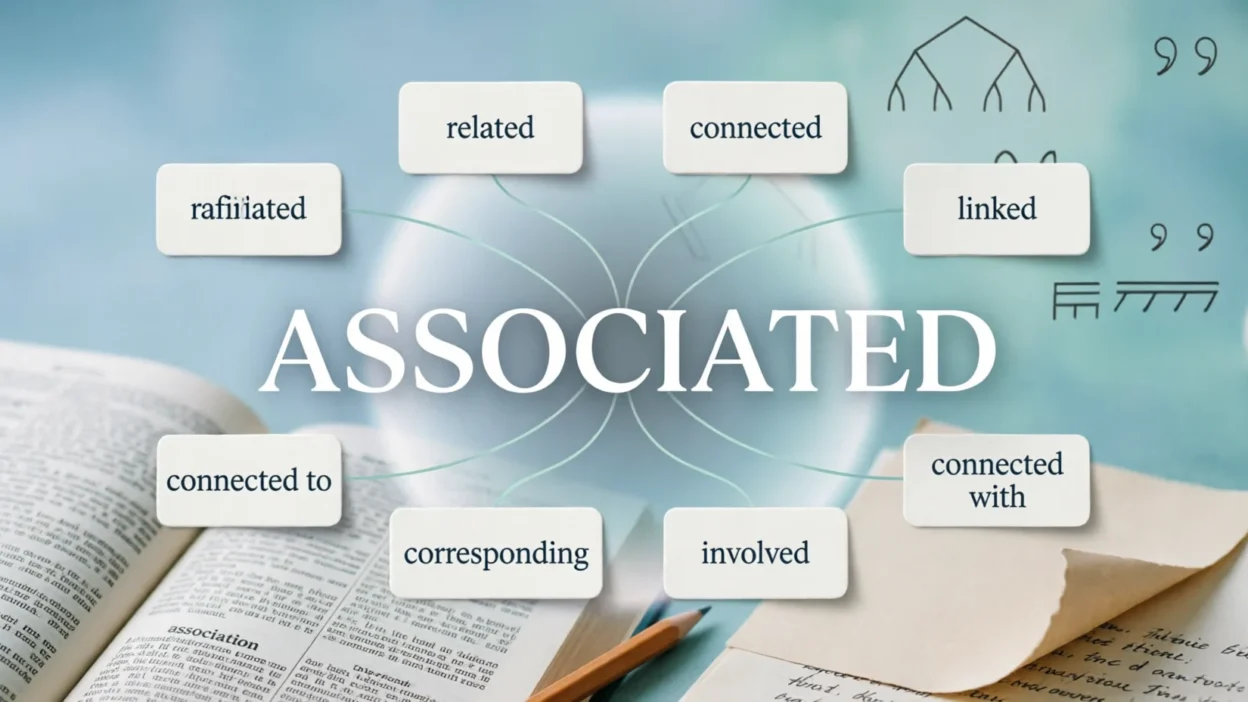
When you need an associated synonym, the best alternative depends on the exact meaning you want. Words such as related, connected, linked, affiliated, relevant, corresponding, and accompanying can replace associated in different contexts. However, these words are not always interchangeable because each carries a slightly different meaning or tone.
Quick Answer
The most common synonyms for associated are related, connected, linked, affiliated, relevant, corresponding, accompanying, allied, tied, and involved. Use related for a general connection, connected for a direct relationship, affiliated for an organizational relationship, and relevant when something is closely connected to a particular subject or situation.
Meaning of Associated
The word associated generally means connected with, related to, or linked to someone or something.
For example:
“Exercise is associated with a healthier lifestyle.”
Here, associated means that exercise has a connection with a healthier lifestyle.
Associated as an Adjective
When associated describes something, it usually indicates a relationship or connection.
Example:
“The risks associated with driving at night should be considered.”
Here, associated with means connected with.
Associated as a Verb
Associated can also be the past tense or past participle of associate.
Example:
“People often associated the building with the old theater.”
In this sentence, associated means connected one thing in their minds with another.
30 Synonyms for Associated
The right synonym depends on whether you mean a general relationship, a formal affiliation, a logical connection, or something that accompanies another thing.
1. Related
Simple meaning: Connected in some way.
Example:
“These two topics are closely related.”
Best usage/context: General writing, education, explanations, and everyday English.
2. Connected
Simple meaning: Having a direct or meaningful relationship.
Example:
“The two problems are connected.”
Best usage/context: Everyday conversation, academic writing, and situations involving a clear relationship.
3. Linked
Simple meaning: Joined or connected with something else.
Example:
“Poor sleep is often linked to reduced concentration.”
Best usage/context: Research, journalism, academic writing, and discussions of relationships between factors.
4. Affiliated
Simple meaning: Officially connected with an organization or group.
Example:
“She works for an affiliated research institute.”
Best usage/context: Organizations, universities, companies, professional groups, and institutions.
5. Relevant
Simple meaning: Directly connected to the subject being discussed.
Example:
“Please provide any relevant information.”
Best usage/context: Academic, professional, legal, and formal writing.
6. Connected With
Simple meaning: Having a relationship with something.
Example:
“The symptoms were connected with a change in diet.”
Best usage/context: General and explanatory writing.
7. Related To
Simple meaning: Having a connection with something.
Example:
“This article discusses issues related to education.”
Best usage/context: Formal and informal writing; particularly useful when introducing a topic.
8. Tied
Simple meaning: Closely connected or dependent on something.
Example:
“The company’s success is closely tied to customer satisfaction.”
Best usage/context: Business, economics, journalism, and figurative expressions.
9. Associated With
Simple meaning: Connected with a person, idea, activity, or thing.
Example:
“High stress is associated with several lifestyle factors.”
Best usage/context: Formal, academic, scientific, and professional writing.
10. Accompanying
Simple meaning: Happening or existing together with something else.
Example:
“The report included an accompanying explanation.”
Best usage/context: Situations where one thing comes together with another.
11. Accompanied
Simple meaning: Existing or occurring alongside something else.
Example:
“The announcement was accompanied by a detailed statement.”
Best usage/context: Formal writing and descriptions of events or circumstances occurring together.
12. Allied
Simple meaning: Closely connected because of shared interests or goals.
Example:
“The two organizations are allied in their efforts to improve education.”
Best usage/context: Organizations, countries, groups, shared goals, and strategic relationships.
13. Affinitive
Simple meaning: Showing a natural relationship or affinity.
Example:
“The two subjects have an affinitive relationship.”
Best usage/context: Specialized or formal contexts. It is much less common than related or connected.
14. Tied To
Simple meaning: Closely connected or dependent on something.
Example:
“Employee bonuses are tied to annual performance.”
Best usage/context: Business, employment, economics, and situations involving dependence.
15. Interconnected
Simple meaning: Connected with one another in several ways.
Example:
“The problems are interconnected rather than independent.”
Best usage/context: Complex systems, technology, society, science, and academic writing.
16. Interrelated
Simple meaning: Connected so that one thing affects or relates to another.
Example:
“Economic and environmental issues are often interrelated.”
Best usage/context: Academic, professional, scientific, and analytical writing.
17. Correlated
Simple meaning: Showing a relationship in which two things change or occur together.
Example:
“The study found that exercise levels were correlated with sleep quality.”
Best usage/context: Statistics, science, research, and data-focused writing.
Important: Correlated has a more specific meaning than associated. A correlation does not necessarily prove that one thing causes another.
18. Corresponding
Simple meaning: Matching or relating to another thing.
Example:
“Each department has a corresponding administrative office.”
Best usage/context: Formal writing, comparisons, systems, documents, and structured information.
19. Affiliated With
Simple meaning: Officially connected to a group or organization.
Example:
“The doctor is affiliated with a local medical center.”
Best usage/context: Institutions, hospitals, universities, companies, and professional organizations.
20. Pertinent
Simple meaning: Directly relevant to the subject.
Example:
“Only pertinent details were included in the report.”
Best usage/context: Formal, professional, legal, and academic writing.
21. Germane
Simple meaning: Closely relevant to a particular subject.
Example:
“The question is not germane to the main discussion.”
Best usage/context: Formal writing and serious discussions. It is less common in everyday conversation.
22. Involved
Simple meaning: Connected with or participating in something.
Example:
“Several departments were involved in the project.”
Best usage/context: People, organizations, activities, projects, and situations involving participation.
23. Linked With
Simple meaning: Connected or related to something.
Example:
“The condition has been linked with several environmental factors.”
Best usage/context: Research, journalism, health-related writing, and formal explanations.
24. Coupled
Simple meaning: Joined or connected with another thing.
Example:
“High demand coupled with limited supply caused delays.”
Best usage/context: Formal, technical, business, and analytical writing.
25. Bound
Simple meaning: Closely connected or tied to something.
Example:
“The two issues are closely bound together.”
Best usage/context: Formal and literary writing, especially for strong relationships.
26. Affiliated
Simple meaning: Formally connected to an organization or institution.
Example:
“He is affiliated with a national research organization.”
Best usage/context: Professional, institutional, and organizational contexts.
27. Related
Simple meaning: Connected by subject, meaning, family, or another relationship.
Example:
“The teacher asked students to discuss related ideas.”
Best usage/context: Almost any general context where a connection exists.
28. Associated With
Simple meaning: Connected in people’s thoughts, experiences, or circumstances.
Example:
“Certain sounds are associated with childhood memories.”
Best usage/context: Psychology, everyday descriptions, academic writing, and discussions of ideas or memories.
29. Contingent
Simple meaning: Dependent on another condition or event.
Example:
“The agreement is contingent on final approval.”
Best usage/context: Business, legal, financial, and formal contexts.
Important: Contingent should not replace associated when you only mean “connected.” It suggests dependence on a condition.
30. Allied With
Simple meaning: Connected through a shared purpose, interest, or goal.
Example:
“The organization is allied with several community groups.”
Best usage/context: Groups, organizations, partnerships, shared causes, and strategic relationships.
Associated Synonyms Comparison Table
| Synonym | Main meaning | Tone | Best context |
| Related | Connected in some way | Neutral | General writing |
| Connected | Directly linked | Neutral | Everyday and formal |
| Linked | Joined or connected | Neutral/Formal | Research and journalism |
| Affiliated | Officially connected | Formal | Organizations |
| Relevant | Directly related to a subject | Formal | Academic/professional |
| Interconnected | Connected in multiple ways | Formal | Complex systems |
| Interrelated | Mutually connected | Formal | Academic analysis |
| Correlated | Statistically related | Technical | Research/data |
| Accompanying | Existing alongside | Neutral/Formal | Documents and events |
| Allied | Connected by shared interests | Formal | Groups and organizations |
| Involved | Participating or connected | Neutral | People and projects |
| Pertinent | Directly relevant | Formal | Professional/legal |
| Germane | Closely relevant | Formal | Formal discussion |
| Corresponding | Matching or relating | Formal | Comparisons/systems |
| Tied | Closely connected | Neutral | Business/general |
| Coupled | Joined together | Formal | Technical/business |
| Contingent | Dependent on a condition | Formal | Legal/business |
| Bound | Strongly connected | Formal/Literary | Strong relationships |
Associated vs. Related vs. Connected
These three words are especially common, but they are not always identical.
Associated usually describes a recognized connection between two things.
“The brand is associated with quality.”
Related is broader and simply means that two things have a relationship.
“These questions are related.”
Connected often suggests a more direct relationship.
“The two events are connected.”
When you are unsure, related is usually a safe general alternative.
How to Choose the Right Synonym
Choosing the correct synonym depends on meaning, tone, and intent.
For a General Connection
Use:
- Related
- Connected
- Linked
- Related to
Example:
“These subjects are related.”
These are useful when you simply want to show that two ideas, objects, or situations have something in common.
For a Formal Relationship
Use:
- Affiliated
- Affiliated with
- Allied
- Corresponding
Example:
“She is affiliated with the university.”
These choices work especially well for institutions, professional relationships, and organizations.
For Academic or Research Writing
Use:
- Interrelated
- Interconnected
- Correlated
- Linked
- Relevant
- Pertinent
Example:
“The findings suggest that several factors are interrelated.”
Choose carefully because technical words can carry meanings that are more specific than associated.
For Relevance
Use:
- Relevant
- Pertinent
- Germane
Example:
“Only relevant evidence should be included.”
These words are appropriate when you mean that something has a direct connection to the topic under discussion.
For Participation
Use:
- Involved
- Connected
- Engaged
Example:
“Several researchers were involved in the project.”
Here, involved is more appropriate than relevant because the sentence describes participation.
For Dependence
Use:
- Contingent
- Tied to
- Bound to
Example:
“The payment is contingent on approval.”
These words are appropriate when the relationship involves dependence or conditions.
Common Usage Mistakes
Mistake 1: Treating Every Synonym as Identical
Not every synonym for associated can be used in every sentence.
For example:
“The two variables are correlated.”
has a more specific meaning than:
“The two variables are associated.”
Correlated is particularly appropriate when discussing a measured statistical relationship.
Mistake 2: Using “Affiliated” for Any Connection
Affiliated normally suggests a formal or organizational relationship.
Less natural:
“Blue is affiliated with the color sky.”
Better:
“The research center is affiliated with the university.”
For ordinary relationships, related or connected is usually better.
Mistake 3: Confusing “Relevant” With “Associated”
Relevant means that something is important or applicable to the subject.
Associated simply indicates a connection.
Compare:
“The two topics are associated.”
“This information is relevant to the discussion.”
The first describes a relationship; the second describes usefulness or applicability.
Mistake 4: Assuming Association Means Cause
Consider:
“Smoking is associated with several health risks.”
This sentence indicates a relationship. It does not, by itself, establish that the relationship proves a particular cause.
When writing about research, avoid changing associated with into stronger causal language unless the evidence supports that wording.
Mistake 5: Overusing “Connected”
Although connected is a useful synonym, repeating it throughout an article can make your writing feel repetitive.
Depending on the context, you can use:
- related
- linked
- relevant
- interrelated
- affiliated
- involved
- accompanying
This creates more precise and natural writing.
When Should You Use “Associated With”?
Associated with is particularly useful when you want to describe a relationship without claiming that one thing directly causes another.
Example 1: Ideas
“Certain colors are associated with different emotions.”
Example 2: Business
“The company is associated with several international brands.”
Example 3: Research
“The behavior was associated with changes in the environment.”
Example 4: Memories
“The song is strongly associated with childhood.”
Example 5: Organizations
“The center is associated with a major university.”
The phrase is flexible, which is why it appears frequently in both everyday and formal English.
FAQs:
What is the best synonym for associated?
Related is one of the best general synonyms for associated. Depending on context, connected, linked, affiliated, relevant, interrelated, or involved may be more precise.
What is a simple synonym for associated?
The simplest alternatives are related and connected. Both are easy to understand and work in many everyday sentences.
Is “related” the same as “associated”?
They are very similar, but they are not always identical. Related broadly means having a connection, while associated can emphasize a recognized connection between people, ideas, events, or things.
What is the synonym of associated in academic writing?
Useful academic alternatives include related, linked, interrelated, interconnected, correlated, relevant, and pertinent. The correct choice depends on the exact relationship being described.
What is the opposite of associated?
Depending on the context, possible opposites include unrelated, disconnected, separate, independent, unaffiliated, or isolated.
Can “linked” replace “associated”?
Yes, in many situations. For example, “The condition is associated with stress” can often become “The condition is linked with stress.” However, the precise meaning and tone should always be considered.
What is the difference between associated and affiliated?
Associated describes a broad connection, while affiliated usually describes a formal connection with an organization, institution, or group.
Is “correlated” a synonym for associated?
Sometimes, but with an important qualification. Correlated describes a particular type of relationship, especially in statistics and research. It should not automatically replace associated in general writing.
Conclusion
The word associated means connected, related, or linked with something or someone. Its best synonym depends on what kind of relationship you want to describe.
For everyday writing, related and connected are excellent choices. For research, linked, interrelated, interconnected, or correlated may be more suitable. For organizations, affiliated is often more precise, while relevant, pertinent, and germane work when you mean directly connected to a particular subject.
Understanding these small differences helps you choose words that communicate your meaning clearly. Instead of replacing associated with a random synonym, consider the relationship, tone, and purpose of your sentence first.

I am Olivia Brooks, a language enthusiast and writer at SynonymsHive. I enjoy creating clear, engaging content about synonyms, vocabulary, and word meanings, helping readers improve their writing and communicate with confidence every day.