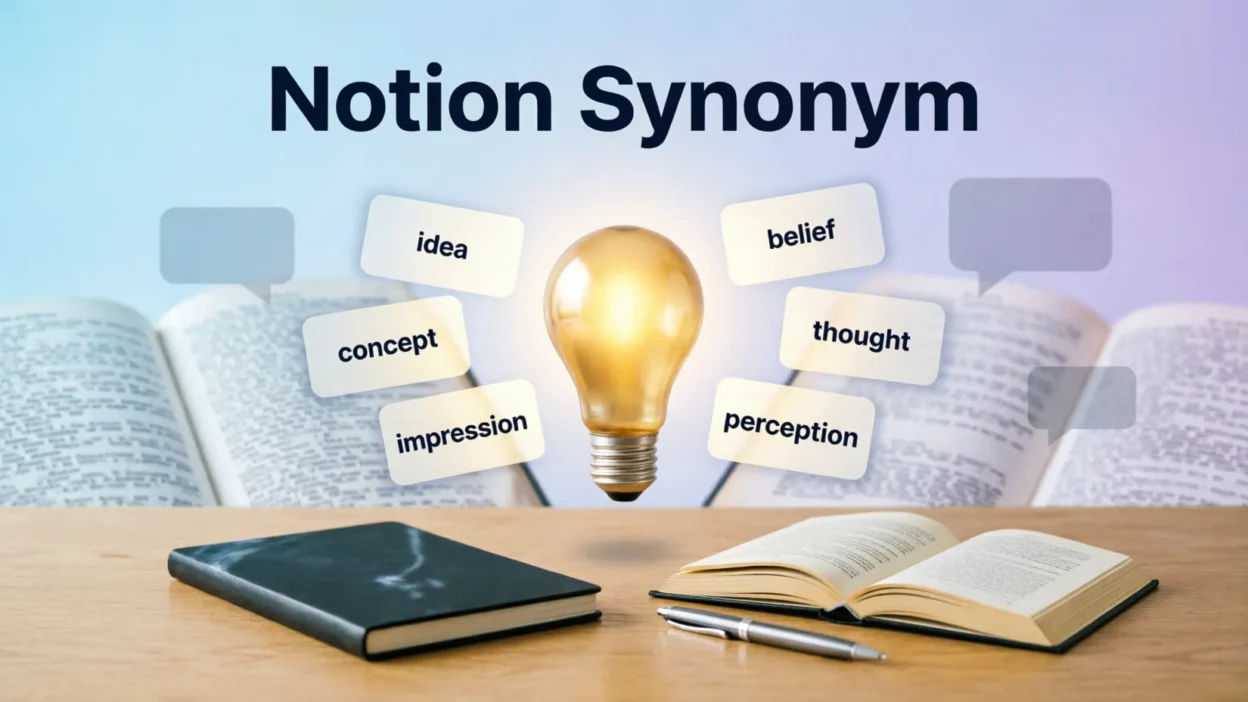
When you need a notion synonym, the best choice depends on what you mean by “notion.” The word can describe an idea, belief, opinion, concept, impression, thought, or understanding. For example, “the notion that success comes easily” could become “the belief that success comes easily,” while “a notion about physics” could become “a concept about physics.”
Quick Answer
The most useful synonyms for notion include idea, concept, thought, belief, opinion, impression, view, understanding, perception, assumption, theory, conception, conviction, judgment, principle, sentiment, suspicion, hypothesis, interpretation, perspective, insight, impression, fancy, notion, and consideration. The right alternative depends on whether you are describing an idea, belief, opinion, or general understanding.
What Does “Notion” Mean?
The noun notion generally means an idea, belief, or understanding about something.
It can be used in several ways:
- Idea: She had a notion for a new business.
- Belief: He rejected the notion that money guarantees happiness.
- Understanding: I had only a vague notion of how the machine worked.
- Opinion: Her notion about the issue was different from mine.
“Notion” can sometimes sound slightly formal or suggest that an idea is uncertain, simplified, or not necessarily correct.
For example:
Here, “notion” suggests a personal belief or idea that the speaker may question.
30 Synonyms for Notion
Below are 30 useful alternatives, with examples and guidance on when each word works best.
1. Idea
Simple meaning: A thought, plan, or mental suggestion.
Example: She had an interesting idea for the project.
Best usage/context: General writing, conversation, plans, and creative thinking.
2. Concept
Simple meaning: A general idea about something.
Example: The concept of equality is important in modern society.
Best usage/context: Academic, professional, technical, and educational writing.
3. Thought
Simple meaning: Something that comes into your mind.
Example: I had a thought about how we could solve the problem.
Best usage/context: Everyday conversations and personal reflections.
4. Belief
Simple meaning: Something you accept as true.
Example: Her belief in hard work helped her succeed.
Best usage/context: Personal convictions, values, religion, philosophy, and opinions about truth.
5. Opinion
Simple meaning: What someone thinks about a subject.
Example: Everyone has an opinion about the new policy.
Best usage/context: Discussions, debates, reviews, and personal viewpoints.
6. View
Simple meaning: A person’s opinion or way of seeing something.
Example: His view of education has changed over time.
Best usage/context: Formal and informal discussions about opinions.
7. Impression
Simple meaning: An idea or feeling you get about something.
Example: My first impression of the city was very positive.
Best usage/context: First reactions, personal experiences, and perceptions.
8. Perception
Simple meaning: The way someone understands or sees something.
Example: Public perception of the company changed quickly.
Best usage/context: Formal, academic, business, and social discussions.
9. Understanding
Simple meaning: Knowledge or awareness of something.
Example: She has a strong understanding of basic economics.
Best usage/context: Education, explanations, skills, and knowledge.
10. Assumption
Simple meaning: Something believed to be true without complete proof.
Example: The decision was based on the assumption that demand would increase.
Best usage/context: Arguments, analysis, research, and situations involving uncertainty.
11. Conception
Simple meaning: A person’s idea or understanding of something.
Example: His conception of leadership differs from mine.
Best usage/context: Formal, academic, philosophical, and intellectual writing.
12. Theory
Simple meaning: An explanation or set of ideas about how something works.
Example: Scientists developed a theory to explain the results.
Best usage/context: Science, research, academic writing, and structured explanations.
13. Belief system
Simple meaning: A connected set of beliefs about life or the world.
Example: Different cultures may have very different belief systems.
Best usage/context: Culture, philosophy, religion, sociology, and anthropology.
14. Conviction
Simple meaning: A strong belief that something is true or right.
Example: She spoke with conviction about the importance of education.
Best usage/context: Strong personal beliefs, principles, speeches, and persuasive writing.
15. Judgment
Simple meaning: An opinion formed after thinking about something.
Example: His judgment of the situation was reasonable.
Best usage/context: Decisions, assessments, professional contexts, and opinions.
16. Interpretation
Simple meaning: The meaning someone gives to something.
Example: Her interpretation of the poem was very different from mine.
Best usage/context: Literature, art, language, events, and ambiguous information.
17. Perspective
Simple meaning: A particular way of looking at something.
Example: Traveling gave him a new perspective on life.
Best usage/context: Personal viewpoints, discussions, essays, and analytical writing.
18. Hypothesis
Simple meaning: An idea that can be tested to determine whether it is correct.
Example: The researchers developed a hypothesis before beginning the experiment.
Best usage/context: Science, research, experiments, and academic writing.
19. Proposition
Simple meaning: An idea or statement presented for consideration.
Example: The author challenges the proposition that technology always improves education.
Best usage/context: Formal arguments, academic writing, philosophy, and logic.
20. Premise
Simple meaning: An idea or statement used as the basis for an argument.
Example: The argument depends on the premise that people act rationally.
Best usage/context: Logic, philosophy, essays, debates, and analytical writing.
21. Principle
Simple meaning: A basic belief or rule that guides behavior or thinking.
Example: Honesty is an important principle in her life.
Best usage/context: Ethics, values, rules, professional writing, and personal beliefs.
22. Sentiment
Simple meaning: A feeling, attitude, or opinion about something.
Example: There was widespread public sentiment against the proposal.
Best usage/context: Social issues, public opinion, politics, literature, and formal writing.
23. Fancy
Simple meaning: A personal idea, desire, or imagination.
Example: He had a fancy that he could become a famous musician.
Best usage/context: Literary or expressive writing; usually less suitable for formal academic contexts.
24. Suspicion
Simple meaning: A feeling that something may be true without proof.
Example: She had a suspicion that something was wrong.
Best usage/context: Uncertainty, investigation, mystery, and personal impressions.
25. Intuition
Simple meaning: An understanding that comes without conscious reasoning.
Example: Her intuition told her to wait before making a decision.
Best usage/context: Personal judgment, instincts, decision-making, and reflective writing.
26. Insight
Simple meaning: A clear and useful understanding of something.
Example: The interview provided valuable insight into consumer behavior.
Best usage/context: Analysis, education, research, business, and thoughtful discussion.
27. Notion of
Simple meaning: An idea or belief concerning something.
Example: He questioned the notion of absolute freedom.
Best usage/context: Formal discussions where you want to examine or challenge an idea.
28. Thought process
Simple meaning: The way someone thinks through an issue.
Example: The teacher explained her thought process step by step.
Best usage/context: Problem-solving, education, explanations, and professional communication.
29. Ideology
Simple meaning: A connected set of ideas or beliefs, especially about society and politics.
Example: The movement was influenced by a particular ideology.
Best usage/context: Politics, history, sociology, philosophy, and social analysis.
30. Outlook
Simple meaning: A person’s general attitude or way of viewing life or a situation.
Example: Her positive outlook helped her handle difficult situations.
Best usage/context: Personal attitudes, future expectations, careers, and life perspectives.
Notion Synonyms Comparison Table
| Synonym | Main meaning | Formality | Best context |
|---|---|---|---|
| Idea | General thought or plan | Neutral | Everyday writing |
| Concept | General or abstract idea | Formal | Academic writing |
| Thought | Mental idea | Neutral | Conversation |
| Belief | Something accepted as true | Neutral | Values and convictions |
| Opinion | Personal judgment | Neutral | Discussions |
| View | Way of seeing something | Neutral | Opinions |
| Impression | Feeling or initial idea | Neutral | Experiences |
| Perception | Way something is understood | Formal | Academic/social topics |
| Understanding | Knowledge or awareness | Neutral | Education |
| Assumption | Unproven belief | Formal | Analysis |
| Conception | Mental understanding | Formal | Academic writing |
| Theory | Explanation based on ideas | Formal | Science/research |
| Conviction | Strong belief | Formal | Values and arguments |
| Perspective | Particular viewpoint | Neutral/Formal | Analysis |
| Hypothesis | Testable proposed explanation | Formal | Research |
| Interpretation | Meaning assigned to something | Formal | Literature/analysis |
| Principle | Basic rule or belief | Formal | Ethics/values |
| Sentiment | Feeling or public attitude | Formal | Social issues |
| Intuition | Instinctive understanding | Neutral | Decisions |
| Insight | Deep understanding | Neutral/Formal | Analysis |
How to Choose the Right Synonym for Notion
Not every synonym for notion can replace it in every sentence. Choose your word according to the exact meaning you want.
For a General Idea
Use:
- idea
- thought
- concept
- notion
Example:
“Concept” would sound more formal, while “thought” would sound more conversational.
For a Personal Belief
Use:
- belief
- conviction
- view
- opinion
Example:
“Conviction” works when the belief is especially strong.
For an Opinion
Use:
- opinion
- view
- perspective
- judgment
Example:
“Perspective” emphasizes the way someone looks at an issue rather than simply what they think.
For an Academic Idea
Use:
- concept
- theory
- hypothesis
- proposition
- conception
Example:
Here, “idea” would be too general because hypothesis has a specific research meaning.
For an Unproven Belief
Use:
- assumption
- suspicion
- notion
- hypothesis
Example:
“Assumption” clearly indicates that the idea was accepted without sufficient evidence.
For a Deep Understanding
Use:
- insight
- understanding
- perception
Example:
“Insight” suggests useful or deeper understanding, rather than simply having an idea.
Common Usage Mistakes With Notion Synonyms
Using “Theory” for Every Idea
A theory is not simply any random idea. In academic and scientific contexts, theory has a more specific meaning.
Instead of
You can use it when you genuinely mean an explanation, but use idea if you simply mean a possible thought.
Confusing “Belief” With “Opinion”
A belief is generally something a person accepts as true, while an opinion is a personal judgment or view.
For example:
The two words overlap, but they are not always interchangeable.
Using “Hypothesis” as a General Synonym
A hypothesis is normally an idea or explanation that can be tested.
For casual writing, idea is usually more natural.
Replacing “Notion” Without Checking the Tone
“Notion” can sound more formal or abstract than “idea.”
Compare:
The first sentence sounds more natural in everyday conversation.
Confusing “Perception” With Reality
A perception is how something is understood or experienced. It does not necessarily mean that the perception is objectively true.
For example:
This describes how people viewed the company, not necessarily how the company itself changed.
FAQs:
What is the closest synonym for notion?
Idea is usually the closest general synonym for “notion.” However, concept, belief, opinion, thought, or perception may be more accurate depending on the sentence.
Is “idea” and “notion” the same?
They can have similar meanings, but they are not always identical. “Idea” is broader and more common, while “notion” can suggest a particular belief, impression, or somewhat uncertain idea.
What is a formal synonym for notion?
Depending on the context, formal alternatives include concept, conception, proposition, perception, hypothesis, assumption, and perspective.
What is a synonym for notion in academic writing?
Concept is often a strong choice for academic writing. Other possibilities include conception, hypothesis, proposition, assumption, and theory, depending on the intended meaning.
What is a synonym for “notion” meaning belief?
When “notion” means a belief, useful alternatives include belief, conviction, assumption, view, opinion, and conception.
What is the opposite of notion?
There is no single opposite in every context. Depending on the sentence, possible contrasts include fact, certainty, reality, evidence, or knowledge.
Can “concept” replace “notion”?
Often, yes. However, “concept” usually refers to a more clearly defined or abstract idea, while “notion” can refer to a personal, vague, or questionable idea.
What is the difference between notion and perception?
A notion is generally an idea or belief, while a perception is the way someone interprets or experiences something. For example, you can have a notion about success, but your perception of success describes how you see or understand it.
Conclusion
The best notion synonym depends on the meaning, tone, and context of your sentence. Idea is the simplest everyday alternative, while concept works well for formal or academic writing. Belief emphasizes something accepted as true, opinion focuses on personal judgment, perspective highlights a particular viewpoint, and assumption suggests an idea accepted without complete evidence.
Choosing the right synonym is not simply about finding a word with a similar dictionary definition. Consider what you actually want to communicate. A precise word makes your writing clearer, more natural, and more effective.

I am Andrew Foster, a passionate language writer who enjoys helping readers discover the right synonyms and improve their vocabulary. I create clear, accurate, and engaging content that makes learning English simple, practical, and enjoyable.