When looking for a context synonym, the best word depends on what you mean by “context.” It can refer to the situation surrounding an event, the background of an idea, the conditions in which something happens, or the words surrounding a particular statement.
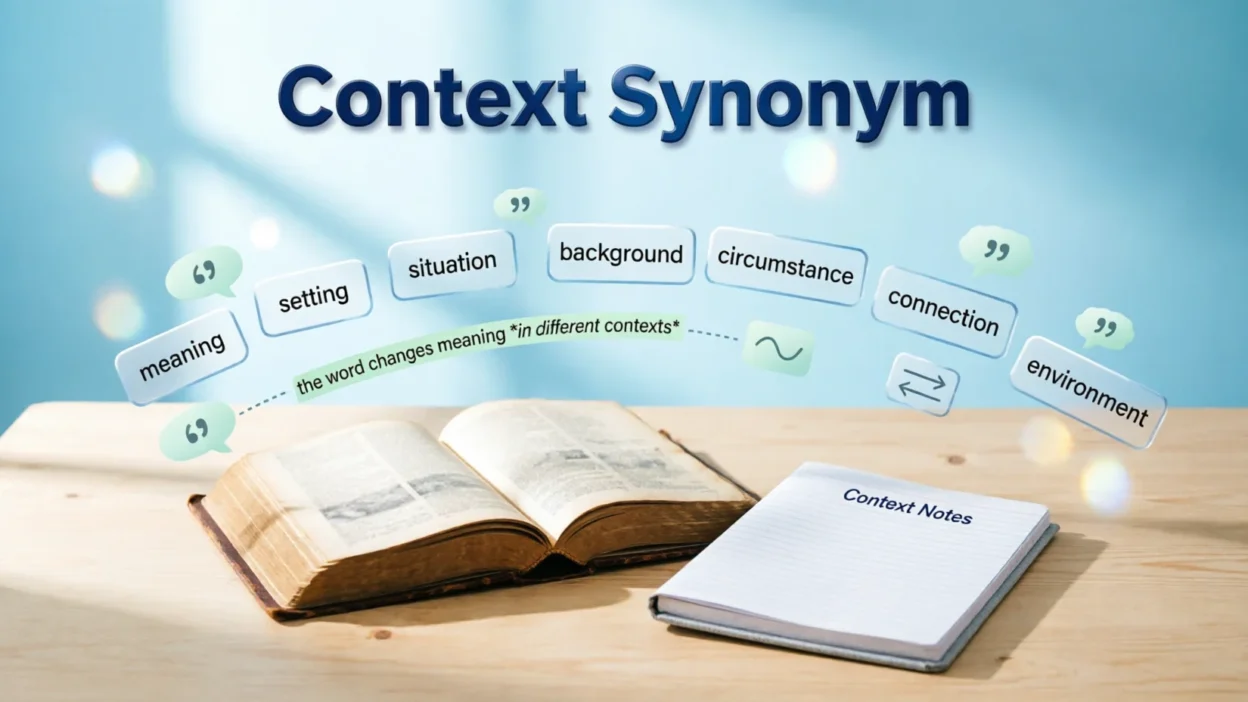
Common synonyms include setting, situation, background, circumstances, environment, framework, surroundings, and conditions.
Choosing the right synonym can make your writing more precise and natural. The words may be similar, but they are not always interchangeable.
Quick Answer: What Is a Synonym for Context?
Some common synonyms for context are:
- Setting – the place or situation where something happens
- Situation – the circumstances surrounding an event
- Background – information that helps explain something
- Circumstances – conditions affecting an event or person
- Environment – surrounding conditions or influences
- Surroundings – things and conditions around someone or something
- Framework – a structure used to understand or organize an idea
- Conditions – particular circumstances affecting a situation
- Backdrop – the circumstances or setting behind an event
- Perspective – a particular way of viewing something
The most suitable word depends on whether you are discussing a place, situation, background information, surrounding conditions, or way of understanding an idea.
What Does Context Mean?
Context means the information, situation, or circumstances that surround something and help you understand its meaning.
For example:
Here, context means the additional information or circumstances that explain why she made the comment.
Context is important in everyday conversation, literature, education, journalism, history, and professional writing. A sentence can sometimes have different meanings when it is removed from the situation in which it was originally spoken or written.
Context in a Sentence
Here are a few examples:
- The historical context helps us understand the novel.
- You need to consider the context before judging his statement.
- The teacher explained the context of the poem.
- The meaning of the word changes depending on its context.
30 Context Synonyms
Not every synonym below has exactly the same meaning as context. Some are closer alternatives, while others work better in particular situations.
1. Setting
Simple meaning: The place, time, or situation in which something happens.
Example:
The setting of the novel is a small coastal village.
Best usage/context:
Use setting when talking about the location, time, or circumstances surrounding an event, story, or scene.
2. Situation
Simple meaning: The circumstances that someone or something is experiencing.
Example:
We need to understand the situation before making a decision.
Best usage/context:
Use situation when context refers to the circumstances surrounding a particular event or problem.
3. Background
Simple meaning: Information that explains or gives additional understanding.
Example:
The article provides useful background about the historical event.
Best usage/context:
Use background when you mean previous information, history, or facts needed to understand something.
4. Circumstances
Simple meaning: The conditions surrounding an event or person.
Example:
Under these circumstances, delaying the meeting was reasonable.
Best usage/context:
Use circumstances when several conditions influence what happens.
5. Environment
Simple meaning: The conditions and surroundings in which something exists or develops.
Example:
Children learn differently depending on their educational environment.
Best usage/context:
Use environment for physical, social, cultural, educational, or professional surroundings.
6. Surroundings
Simple meaning: Everything around a person or thing.
Example:
The meaning of the artwork becomes clearer when you consider its surroundings.
Best usage/context:
Use surroundings when focusing on nearby physical or social elements.
7. Framework
Simple meaning: A structure that helps organize or understand something.
Example:
The theory provides a useful framework for understanding human behavior.
Best usage/context:
Use framework in academic, professional, analytical, and theoretical writing.
8. Conditions
Simple meaning: Particular factors or circumstances affecting something.
Example:
The experiment was repeated under controlled conditions.
Best usage/context:
Use conditions when specific factors influence an event, process, or result.
9. Backdrop
Simple meaning: The situation or setting behind an event.
Example:
The economic crisis served as a backdrop to the political debate.
Best usage/context:
Use backdrop when describing broader circumstances surrounding an event.
10. Perspective
Simple meaning: A particular way of looking at or understanding something.
Example:
From a historical perspective, the decision makes more sense.
Best usage/context:
Use perspective when context involves a viewpoint or way of interpreting an issue.
11. Circumstance
Simple meaning: A condition or fact connected with an event.
Example:
The unusual circumstance changed the outcome.
Best usage/context:
Use the singular circumstance when referring to one particular condition or fact.
12. Situation
Simple meaning: The set of conditions existing at a particular time.
Example:
The manager carefully assessed the situation before responding.
Best usage/context:
Useful when context refers to a current event, problem, or set of circumstances.
13. Locale
Simple meaning: A particular place or location.
Example:
The film uses a rural locale to create a peaceful atmosphere.
Best usage/context:
Use locale when the physical place is the most important part of the context.
14. Environment
Simple meaning: The surroundings and conditions affecting something.
Example:
A supportive work environment can encourage creativity.
Best usage/context:
Especially useful for workplaces, schools, communities, nature, and social settings.
15. Climate
Simple meaning: The general atmosphere or conditions surrounding a situation.
Example:
The political climate had changed considerably.
Best usage/context:
Use climate figuratively for social, political, economic, or cultural conditions.
16. Atmosphere
Simple meaning: The general feeling or mood of a place or situation.
Example:
The quiet atmosphere helped everyone concentrate.
Best usage/context:
Use atmosphere when emotional tone or mood is more important than factual background.
17. Surroundings
Simple meaning: The things and conditions around something.
Example:
The meaning of the sculpture is influenced by its surroundings.
Best usage/context:
Best when physical or immediate surroundings contribute to understanding.
18. Foundation
Simple meaning: The basic ideas or information on which something is built.
Example:
Understanding grammar provides a foundation for learning another language.
Best usage/context:
Use foundation when referring to basic knowledge or principles rather than immediate circumstances.
19. Structure
Simple meaning: The way parts are organized or connected.
Example:
The structure of the argument provides important context for the conclusion.
Best usage/context:
Useful when discussing how information, ideas, or arguments are organized.
20. Reference
Simple meaning: Information that helps explain or identify something.
Example:
The author included several references to earlier events.
Best usage/context:
Use reference when context comes from another person, event, text, or source.
21. Perspective
Simple meaning: A particular viewpoint or approach to an issue.
Example:
The historical perspective gives readers a deeper understanding of the conflict.
Best usage/context:
Use it when the context changes how someone interprets an idea or event.
22. Scope
Simple meaning: The range or limits of something.
Example:
The report needs to explain the scope of the investigation.
Best usage/context:
Use scope when context involves the boundaries or range of a topic.
23. Domain
Simple meaning: A particular area of knowledge, activity, or expertise.
Example:
The word has a different meaning in the medical domain.
Best usage/context:
Useful in academic, technical, professional, and specialized discussions.
24. Frame
Simple meaning: A way of presenting or viewing something.
Example:
The journalist framed the issue within a broader social context.
Best usage/context:
Use frame when discussing how information or an issue is presented.
25. Lens
Simple meaning: A particular way of examining or understanding something.
Example:
The issue can be examined through a cultural lens.
Best usage/context:
Common in academic and analytical writing when discussing interpretation.
26. Scenario
Simple meaning: A possible situation or set of circumstances.
Example:
In this scenario, the company would need additional resources.
Best usage/context:
Use scenario when describing a possible or imagined situation.
27. Circumstantial Background
Simple meaning: The conditions and information surrounding an event.
Example:
The circumstantial background helps explain why the decision was made.
Best usage/context:
Useful when detailed surrounding conditions are especially important.
28. History
Simple meaning: Previous events and developments connected to something.
Example:
Knowing the history of the region helps explain the current situation.
Best usage/context:
Use history when context comes primarily from past events.
29. Setting
Simple meaning: The time, place, and circumstances surrounding an event.
Example:
The historical setting is essential to understanding the story.
Best usage/context:
Especially useful for novels, films, plays, historical events, and narratives.
30. Contextual Background
Simple meaning: Supporting information that makes an idea or event easier to understand.
Example:
The teacher provided contextual background before discussing the poem.
Best usage/context:
Use this phrase in educational, academic, and explanatory writing when additional background information is needed.
Context Synonyms Comparison Table
| Synonym | Main Meaning | Best Used For | Example |
|---|---|---|---|
| Context | Surrounding information or circumstances | General explanation | Consider the context. |
| Setting | Place, time, or situation | Stories and events | The setting is London. |
| Situation | Current circumstances | Problems and events | The situation is complicated. |
| Background | Supporting information | History and explanations | Read the background first. |
| Circumstances | Conditions surrounding something | Events and decisions | Under these circumstances… |
| Environment | Surrounding conditions | Work, school, society | A positive environment helps. |
| Surroundings | Things around something | Physical settings | Look at your surroundings. |
| Framework | Organized structure | Academic analysis | Use this framework. |
| Conditions | Factors affecting something | Experiments and events | The conditions changed. |
| Backdrop | Broader surrounding situation | Events and stories | The crisis formed the backdrop. |
| Perspective | Way of viewing something | Interpretation | From this perspective… |
| Atmosphere | Mood or feeling | Places and situations | The atmosphere was tense. |
| Climate | General social conditions | Politics, society, economics | The economic climate changed. |
| Locale | Specific place | Geography and stories | The rural locale was ideal. |
| Lens | Interpretive viewpoint | Analysis | Through a cultural lens… |
How to Choose the Right Context Synonym
The best synonym depends on what kind of context you mean.
For Place and Location
Choose:
- Setting
- Locale
- Surroundings
- Environment
Example:
“The story takes place in a historical setting.”
These words work well when the physical location or surrounding place matters.
For a Situation or Event
Choose:
- Situation
- Circumstances
- Conditions
- Scenario
- Backdrop
Example:
“We need to understand the circumstances before reaching a conclusion.”
These words emphasize what is happening and the factors influencing it.
For Historical Information
Choose:
- Background
- History
- Setting
- Backdrop
Example:
“Understanding the historical background makes the speech easier to understand.”
For Academic Writing
Choose:
- Framework
- Perspective
- Lens
- Scope
- Domain
- Structure
Example:
“The theory provides a useful framework for analyzing the results.”
These words can be more precise than simply repeating context.
For Mood or Feeling
Choose:
- Atmosphere
- Environment
- Climate
Example:
“The tense atmosphere made communication difficult.”
For Interpretation
Choose:
- Perspective
- Lens
- Frame
- Framework
Example:
“The issue looks different when examined through a cultural lens.”
Context vs. Background
Context and background are closely related, but they are not identical.
Context includes the surrounding information or circumstances that help explain something.
Background usually refers to previous information, history, or supporting details.
For example:
But:
In simple terms, background tells you what came before, while context helps you understand the surrounding meaning or circumstances.
Context vs. Situation
Situation usually refers to what is happening at a particular moment.
Context is broader and can include information that helps explain why the situation exists.
For example:
This tells us what is happening.
This tells us what surrounds and explains the situation.
Context vs. Setting
Setting usually focuses on the place, time, and circumstances of an event, particularly in stories.
Context can be much broader.
For example:
But:
The setting tells you where and when. Context can explain why things have meaning in that setting.
Common Mistakes When Using Context Synonyms
1. Treating Every Synonym as Exactly the Same
Words that are similar do not always have identical meanings.
For example, atmosphere focuses on mood, while background focuses more on supporting information.
2. Using “Setting” for Every Type of Context
Setting is excellent for stories and locations, but it may sound unnatural when discussing an abstract argument.
Instead of:
you may need:
3. Confusing Background With Context
Background usually refers to information from earlier events or history. Context can include current circumstances, surrounding words, social factors, and other information.
4. Using “Environment” Only for Physical Places
Environment can also describe social, professional, educational, cultural, or digital conditions.
For example:
5. Choosing Formal Words When Simple Ones Work Better
Words such as framework, lens, and domain can be useful in academic writing, but they may sound unnecessarily complicated in casual conversation.
Sometimes situation or background is clearer.
FAQs:
What is the closest synonym for context?
Situation, background, and circumstances are among the closest alternatives, depending on the intended meaning. Setting is also close when referring to a place, time, or story.
What is another word for context in writing?
Useful alternatives include background, setting, circumstances, framework, perspective, situation, environment, and surroundings.
What is a synonym for context in an essay?
For an essay, suitable choices include background, framework, perspective, circumstances, setting, and historical background. The best choice depends on what the paragraph is explaining.
What is a synonym for context in academic writing?
Common academic alternatives include framework, perspective, background, circumstances, scope, lens, and domain.
What is the difference between context and background?
Background generally means previous information or history that helps explain something. Context includes the broader surrounding information, circumstances, and conditions that help someone understand meaning.
Can “situation” replace “context”?
Sometimes. Situation works when context refers to the circumstances surrounding an event. However, it may not work when context means background information, historical details, or the surrounding words in a sentence.
What is a synonym for context in literature?
Setting, background, atmosphere, backdrop, and circumstances can all work in literary discussions. Setting is especially useful for the time and place of a story, while historical context describes the broader period and circumstances surrounding it.
Why is context important?
Context helps people understand the intended meaning of words, statements, events, and ideas. Without enough context, information can sometimes be misunderstood or interpreted differently.
Conclusion
A context synonym can be useful when you want to make your writing more precise and avoid repeating the same word. However, the best alternative depends on the meaning you want to express.
Use setting for place and time, background for supporting or historical information, situation for current circumstances, circumstances for influencing conditions, and environment for surrounding conditions. In academic writing, words such as framework, perspective, lens, scope, and domain can provide more specific meanings.
Understanding these subtle differences helps students, writers, ESL learners, and content creators communicate ideas more clearly. Instead of choosing a synonym simply because it looks similar to “context,” choose the word that accurately describes the relationship between the information and the idea being discussed.

I’m James Parker, Administrator at SynonymsHive. I oversee content quality, improve user experience, and ensure reliable synonym resources. My passion is making language learning simple, accurate, and accessible for everyone.