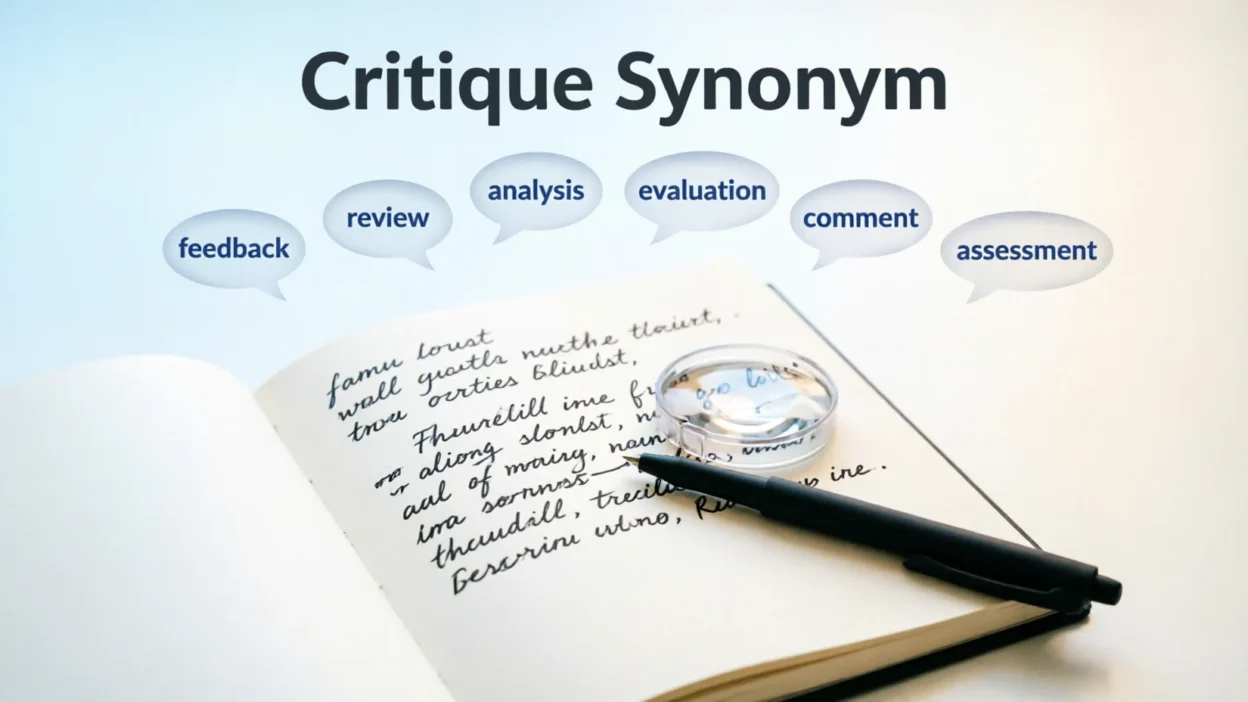
When you need a critique synonym, the best choice depends on what you mean. Common alternatives include review, analysis, evaluation, assessment, feedback, commentary, appraisal, criticism, and examination. Some words sound neutral and constructive, while others can suggest disapproval or fault-finding.
Quick Answer
A critique is a careful evaluation of something, especially its strengths, weaknesses, quality, or effectiveness. Depending on context, useful synonyms include review, evaluation, assessment, analysis, feedback, appraisal, commentary, criticism, examination, and judgment.
For example:
- Critique of an essay → evaluation or review
- Critique of a painting → analysis or commentary
- Negative critique of a decision → criticism
- Helpful critique from a teacher → feedback
- Detailed critique of a study → examination or analysis
What Does “Critique” Mean?
The word critique means a detailed examination and evaluation of something. It is often used when discussing writing, art, research, performances, products, ideas, or other forms of work.
A critique can identify both strengths and weaknesses. It does not always mean saying that something is bad.
For example:
This means the teacher examined the essay carefully and discussed what worked well and what could be improved.
Critique as a Noun
As a noun, critique refers to an evaluation or detailed discussion.
Critique as a Verb
As a verb, critique means to evaluate or analyze something carefully.
30 Synonyms for Critique
1. Review
Simple meaning: A careful look at something to judge or discuss its quality.
Example:
The editor wrote a detailed review of the manuscript.
Best usage/context: Books, movies, products, documents, performances, and general evaluations.
2. Evaluation
Simple meaning: A judgment about the quality, value, or effectiveness of something.
Example:
The teacher completed an evaluation of the student’s presentation.
Best usage/context: Academic, professional, educational, and formal situations.
3. Assessment
Simple meaning: An examination used to understand the quality, ability, or effectiveness of something.
Example:
The assessment identified several weaknesses in the project.
Best usage/context: Education, workplaces, research, performance, and formal analysis.
4. Analysis
Simple meaning: A detailed examination of something to understand it better.
Example:
Her analysis of the poem revealed several important themes.
Best usage/context: Academic writing, literature, research, data, arguments, and complex subjects.
5. Feedback
Simple meaning: Comments that explain what is good and what could be improved.
Example:
The writer received useful feedback from her editor.
Best usage/context: Writing, education, workplaces, creative projects, and coaching.
6. Appraisal
Simple meaning: An assessment of the quality, value, or performance of something.
Example:
The manager gave an honest appraisal of the employee’s performance.
Best usage/context: Professional, financial, workplace, and formal contexts.
7. Commentary
Simple meaning: Written or spoken observations and opinions about something.
Example:
The article provides interesting commentary on modern literature.
Best usage/context: Media, literature, politics, culture, sports, and public discussion.
8. Criticism
Simple meaning: Comments that identify faults, weaknesses, or problems.
Example:
The proposal received criticism for its lack of detail.
Best usage/context: When focusing particularly on shortcomings or negative judgments.
9. Examination
Simple meaning: A detailed investigation or study of something.
Example:
The report offers an examination of the company’s policies.
Best usage/context: Formal, academic, research, and investigative writing.
10. Inspection
Simple meaning: A careful check of something.
Example:
The engineer conducted an inspection of the building.
Best usage/context: Physical objects, buildings, equipment, procedures, and quality control.
11. Scrutiny
Simple meaning: Very close and careful examination.
Example:
The proposal came under intense scrutiny from researchers.
Best usage/context: Formal writing when emphasizing detailed or critical examination.
12. Judgment
Simple meaning: An opinion or decision about the quality or value of something.
Example:
Her judgment of the performance was fair and balanced.
Best usage/context: Decisions, opinions, quality assessments, and formal discussions.
13. Commentary
Simple meaning: Discussion or observations about a particular subject.
Example:
His commentary on the painting focused on its use of color.
Best usage/context: Art, literature, media, public discussion, and cultural subjects.
14. Appraisal
Simple meaning: A considered opinion about the quality or value of something.
Example:
The expert gave an independent appraisal of the artwork.
Best usage/context: Formal evaluations, property, performance, art, and professional settings.
15. Assessment
Simple meaning: The process of judging something after examining it.
Example:
The assessment of the project took several weeks.
Best usage/context: Academic, professional, technical, and organizational contexts.
16. Interpretation
Simple meaning: An explanation of what something means or represents.
Example:
Her interpretation of the poem differed from mine.
Best usage/context: Literature, art, music, historical events, and ideas.
17. Investigation
Simple meaning: A systematic effort to discover facts or understand a problem.
Example:
The investigation revealed several problems with the procedure.
Best usage/context: Problems, incidents, research, organizations, and factual inquiries.
18. Audit
Simple meaning: A formal examination of records, systems, or activities.
Example:
The company conducted an audit of its financial records.
Best usage/context: Finance, accounting, business systems, and compliance.
19. Commentary
Simple meaning: Expressed thoughts or observations about a subject.
Example:
The professor’s commentary helped students understand the argument.
Best usage/context: Academic discussion, literature, media, and public analysis.
20. Report
Simple meaning: A written or spoken account that presents information and findings.
Example:
The consultant prepared a report on the project’s progress.
Best usage/context: Business, research, education, journalism, and professional communication.
21. Opinion
Simple meaning: A person’s view or belief about something.
Example:
In my opinion, the article needs stronger evidence.
Best usage/context: Personal viewpoints and less formal discussions.
22. Observation
Simple meaning: A comment based on noticing something.
Example:
The reviewer made an important observation about the author’s argument.
Best usage/context: Academic writing, research, reviews, and thoughtful discussion.
23. Comment
Simple meaning: Something said or written about a subject.
Example:
The editor left several helpful comments on the draft.
Best usage/context: General, informal, professional, and educational communication.
24. Dissection
Simple meaning: A very detailed examination of something, often by breaking it into parts.
Example:
The article provides a detailed dissection of the author’s argument.
Best usage/context: Detailed analysis of arguments, texts, strategies, or complex ideas.
25. Examination
Simple meaning: A close study of something.
Example:
The paper includes an examination of the evidence.
Best usage/context: Academic, formal, research, and analytical writing.
26. Reviewal
Simple meaning: The act of reviewing something.
Example:
The documents are currently under review.
Best usage/context: Although review is much more natural and common, this term may occasionally appear in formal contexts.
27. Reflection
Simple meaning: Careful thought about something that happened or was created.
Example:
Her reflection on the project identified several lessons.
Best usage/context: Personal writing, education, professional development, and thoughtful analysis.
28. Consideration
Simple meaning: Careful thought about something before reaching a conclusion.
Example:
The proposal deserves careful consideration.
Best usage/context: Formal writing, decisions, proposals, and professional discussions.
29. Analysis and Evaluation
Simple meaning: A combination of examining something closely and judging its quality or effectiveness.
Example:
The assignment requires an analysis and evaluation of the argument.
Best usage/context: Academic essays, research papers, reports, and formal assessments.
30. Peer Review
Simple meaning: Evaluation of someone’s work by people with relevant knowledge or expertise.
Example:
The research paper went through peer review before publication.
Best usage/context: Academic research, scientific writing, journals, and scholarly work.
Critique Synonyms Comparison Table
| Synonym | Main Meaning | Tone | Common Context |
|---|---|---|---|
| Review | General examination | Neutral | Books, products, work |
| Evaluation | Judging quality or effectiveness | Formal | Academic, professional |
| Assessment | Measuring or judging | Formal | Education, work |
| Analysis | Detailed examination | Neutral/Formal | Research, writing |
| Feedback | Helpful comments | Constructive | Education, work |
| Appraisal | Judging value or performance | Formal | Business, performance |
| Commentary | Discussion or observations | Neutral | Media, literature |
| Criticism | Pointing out faults | Can be negative | Arguments, work |
| Examination | Detailed study | Formal | Research, academic |
| Scrutiny | Very close examination | Serious | Public, professional |
| Interpretation | Explaining meaning | Neutral | Art, literature |
| Inspection | Careful checking | Formal | Buildings, equipment |
| Judgment | Opinion about quality | Neutral/Formal | Decisions, reviews |
| Peer review | Expert evaluation | Formal | Academic research |
How to Choose the Right Synonym for Critique
The best synonym depends on your tone, purpose, and subject.
For a Neutral Tone
Use:
- Review
- Analysis
- Examination
- Commentary
- Assessment
These words work well when you want to discuss something without suggesting that it is necessarily good or bad.
Example:
For a Constructive Tone
Use:
- Feedback
- Review
- Assessment
- Observation
- Reflection
These choices are useful when your goal is to help someone improve.
Example:
For a Formal or Academic Tone
Use:
- Evaluation
- Assessment
- Analysis
- Examination
- Peer review
- Appraisal
These words fit academic papers, research, professional reports, and formal communication.
Example:
When You Mean Negative Comments
Use:
- Criticism
- Objection
- Disapproval
- Scrutiny
These words can emphasize problems, weaknesses, or disagreement.
Example:
When Discussing Art or Literature
Use:
- Analysis
- Interpretation
- Commentary
- Review
- Examination
Example:
When Discussing Academic Research
Use:
- Analysis
- Evaluation
- Assessment
- Examination
- Peer review
- Appraisal
Example:
Critique vs. Criticism
These words are related, but they are not always interchangeable.
A critique usually suggests a structured and thoughtful examination of something. It can identify both strengths and weaknesses.
Criticism more often focuses on faults, problems, or negative aspects.
Compare:
This suggests a detailed evaluation.
This places more emphasis on what was wrong with it.
Critique vs. Review
A review is often broader and can include an overall opinion or recommendation.
A critique usually involves deeper examination and discussion.
For example:
This could describe the movie and give an overall opinion.
This suggests a more detailed examination of how the movie was constructed.
Critique vs. Feedback
Feedback is generally intended to help someone understand what they did well and what they can improve.
A critique can be more analytical and may be written for academic or professional purposes.
The first focuses on improvement; the second focuses on analysis and evaluation.
Common Mistakes When Using “Critique”
Mistake 1: Assuming a critique must be negative
A critique does not necessarily mean an attack or negative review.
A balanced critique can recognize both strengths and weaknesses.
Mistake 2: Using “criticism” for every situation
Although criticism is related to critique, it can sound more negative.
If you want a neutral or constructive tone, evaluation, analysis, or feedback may be more appropriate.
Mistake 3: Confusing analysis with evaluation
Analysis focuses on understanding something by examining its parts.
Evaluation focuses on judging its quality, effectiveness, or value.
For example:
Mistake 4: Using “inspection” for abstract ideas
Inspection is usually associated with checking something carefully, especially a physical object, system, or process.
For an essay or argument, analysis or examination usually sounds more natural.
Mistake 5: Choosing a synonym without considering tone
The words feedback, criticism, scrutiny, and evaluation can communicate different attitudes.
Always consider whether you want to sound neutral, constructive, formal, analytical, or negative.
FAQs:
What is the best synonym for critique?
There is no single synonym that works in every situation. Review, evaluation, assessment, analysis, feedback, and criticism are common alternatives, but the right choice depends on your meaning and context.
What is a simple synonym for critique?
Review is one of the simplest and most widely understood synonyms. Feedback is also useful when you mean comments intended to help someone improve.
Is “criticism” the same as “critique”?
They are closely related, but they can differ in tone. Critique often suggests a careful, structured evaluation, while criticism can place greater emphasis on faults or negative judgments.
What is a positive synonym for critique?
Feedback, review, assessment, and evaluation can work when the purpose is constructive. The word feedback is especially common when comments are intended to help someone improve.
What is a formal synonym for critique?
Evaluation, assessment, examination, appraisal, analysis, and peer review can all work in formal contexts, depending on what is being discussed.
What is a synonym for critique in academic writing?
Common choices include analysis, evaluation, assessment, examination, appraisal, and peer review. The best choice depends on whether you are examining, judging, or reviewing the subject.
What is the difference between critique and evaluation?
A critique usually involves detailed discussion of a subject’s qualities, strengths, and weaknesses. Evaluation focuses more directly on judging its quality, value, or effectiveness.
What is the opposite of critique?
There is no perfect single opposite. Depending on the context, possible contrasts include praise, approval, endorsement, commendation, or acceptance.
Conclusion
A critique is a careful examination and evaluation of something. Its best synonym depends on what you want to communicate. Use review for a general evaluation, analysis for detailed examination, evaluation or assessment for formal judgment, feedback for constructive suggestions, and criticism when emphasizing faults or weaknesses.
Understanding these differences can make your writing more precise. Instead of using critique repeatedly, choose a related word that accurately reflects your purpose, tone, and audience.

I am Olivia Brooks, a language enthusiast and writer at SynonymsHive. I enjoy creating clear, engaging content about synonyms, vocabulary, and word meanings, helping readers improve their writing and communicate with confidence every day.