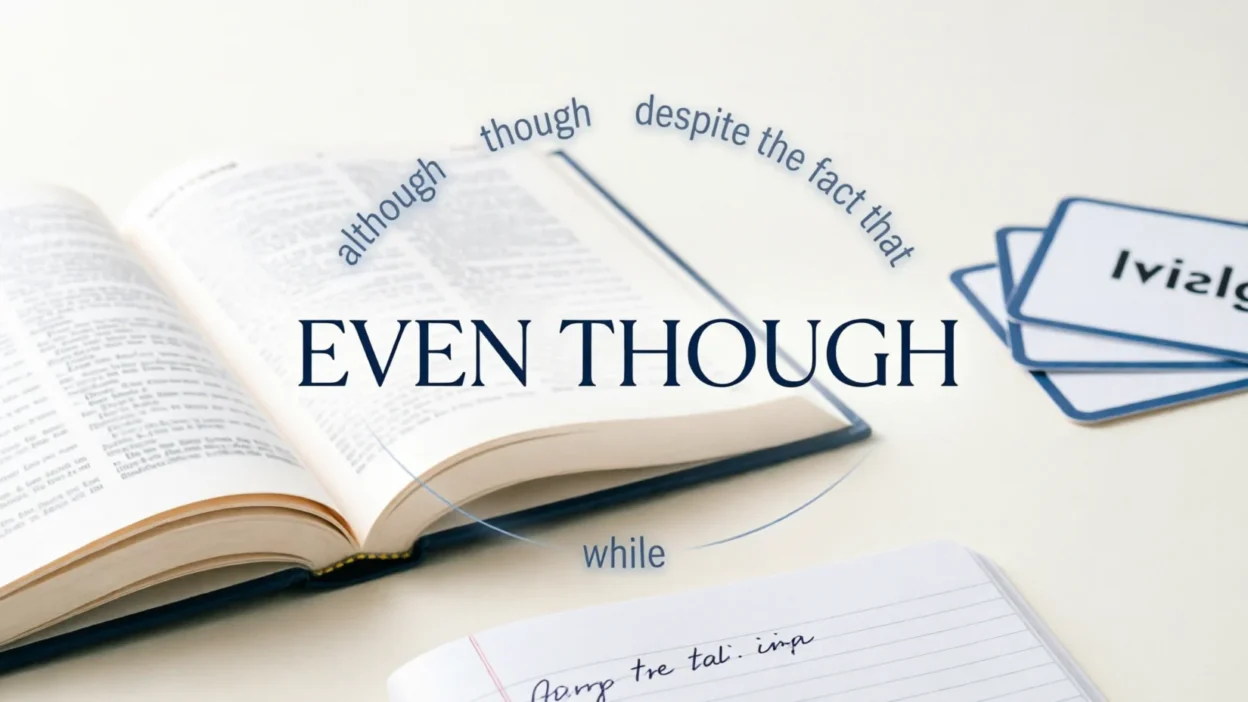
If you are looking for an even though synonym, useful alternatives include although, though, despite the fact that, while, whereas, notwithstanding the fact that, even if, despite, in spite of the fact that, and regardless of the fact that. However, these expressions are not always interchangeable because some introduce a clause, while others work with nouns or different sentence structures.
Quick Answer
The most common synonym for even though is although. Both introduce a contrast between two ideas.
Example:
- Even though it was raining, we went outside.
- Although it was raining, we went outside.
Other useful alternatives include though, despite the fact that, in spite of the fact that, and while. The best choice depends on the sentence, tone, and exact meaning you want to express.
What Does “Even Though” Mean?
Even though is a conjunction used to show a strong contrast between two facts or situations.
It means that something happened despite a fact that might have prevented it or made it surprising.
Example:
Even though she was tired, she continued working.
The sentence tells us that she was tired, but she continued working anyway.
The basic pattern is:
Even though + subject + verb, main clause
Example:
- Even though he was nervous, he gave the presentation.
- Even though the task was difficult, they finished it.
Even Though vs. Although
Even though and although are very similar.
- Even though often emphasizes the contrast more strongly.
- Although is slightly more neutral and is very common in formal writing.
Example:
- Even though the exam was difficult, Maya passed.
- Although the exam was difficult, Maya passed.
Both are correct.
30 Synonyms and Alternatives for “Even Though”
Not every alternative below is a perfect grammatical replacement in every sentence. Some express a closely related contrast using a different structure.
1. Although
Simple meaning: Despite the fact that something is true.
Example: Although it was late, we continued the discussion.
Best usage/context: General writing, academic writing, formal and everyday English.
2. Though
Simple meaning: Despite the fact that.
Example: Though he was tired, he finished the assignment.
Best usage/context: Everyday English and conversational writing.
3. Despite the fact that
Simple meaning: Even with the fact that something is true.
Example: Despite the fact that she was busy, she helped me.
Best usage/context: Formal and explanatory writing.
4. In spite of the fact that
Simple meaning: Although something is true.
Example: In spite of the fact that it was cold, they went swimming.
Best usage/context: Formal writing and careful explanations.
5. Despite
Simple meaning: Without being prevented by something.
Example: Despite the rain, we went for a walk.
Best usage/context: When followed by a noun, pronoun, or gerund rather than a complete clause.
6. In spite of
Simple meaning: Even with a difficult or opposing condition.
Example: In spite of the traffic, we arrived on time.
Best usage/context: Everyday and formal writing when followed by a noun or gerund.
7. While
Simple meaning: Although; despite a contrasting fact.
Example: While the project was difficult, the team completed it successfully.
Best usage/context: Showing contrast between two situations.
8. Whereas
Simple meaning: In contrast to the fact that.
Example: Whereas John prefers working alone, Maria enjoys teamwork.
Best usage/context: Comparisons and clear contrasts, especially in formal writing.
9. Whilst
Simple meaning: Although or while.
Example: Whilst the plan was expensive, it produced excellent results.
Best usage/context: Formal or British English.
10. Even if
Simple meaning: Whether or not a possible condition happens.
Example: Even if it rains, we will play the match.
Best usage/context: Hypothetical or future situations.
Important: “Even if” is not always interchangeable with “even though.” It usually describes a possibility rather than an established fact.
11. Regardless of the fact that
Simple meaning: Without being affected by a particular fact.
Example: Regardless of the fact that he was inexperienced, he performed well.
Best usage/context: Formal or highly explicit writing.
12. Notwithstanding the fact that
Simple meaning: Despite the fact that.
Example: Notwithstanding the fact that the evidence was limited, the researchers continued.
Best usage/context: Very formal writing.
13. Notwithstanding
Simple meaning: Despite something.
Example: Notwithstanding the difficulties, the project succeeded.
Best usage/context: Formal writing, reports, and legal or professional contexts.
14. Albeit
Simple meaning: Although; even though.
Example: The solution was effective, albeit expensive.
Best usage/context: Formal writing. Usually followed by an adjective, adverb, or phrase rather than a complete clause.
15. For all
Simple meaning: Despite everything about a particular situation.
Example: For all his experience, he still made a basic mistake.
Best usage/context: Literary, conversational, or expressive writing.
16. Despite the circumstance that
Simple meaning: Even though a particular situation exists.
Example: Despite the circumstance that resources were limited, the team succeeded.
Best usage/context: Formal explanatory writing, although it can sound less natural than “despite the fact that.”
17. In the face of
Simple meaning: Despite encountering something difficult.
Example: In the face of serious challenges, they remained determined.
Best usage/context: Strong challenges, adversity, professional writing, and speeches.
18. In the presence of
Simple meaning: Despite something being present.
Example: In the presence of considerable uncertainty, the company moved forward.
Best usage/context: Formal and analytical writing.
19. Against the background of
Simple meaning: Despite or while dealing with a particular surrounding situation.
Example: Against the background of economic uncertainty, the company expanded.
Best usage/context: Reports, journalism, academic writing, and analysis.
20. In defiance of
Simple meaning: Despite something, especially by deliberately opposing it.
Example: In defiance of the warnings, they entered the area.
Best usage/context: Situations involving deliberate resistance or opposition.
21. Regardless of
Simple meaning: Without being affected by something.
Example: Regardless of the weather, the event will continue.
Best usage/context: General writing and instructions.
22. Irrespective of
Simple meaning: Without considering or being affected by something.
Example: Irrespective of the outcome, we learned something valuable.
Best usage/context: Formal and professional writing.
23. No matter that
Simple meaning: Regardless of the fact that.
Example: No matter that the journey was long, they remained cheerful.
Best usage/context: Literary or less common English.
24. Despite being
Simple meaning: Although someone or something has a particular quality or condition.
Example: Despite being young, she showed remarkable maturity.
Best usage/context: Concise writing when the subject is the same in both parts.
25. In spite of being
Simple meaning: Although someone or something is.
Example: In spite of being nervous, he spoke confidently.
Best usage/context: Everyday and formal writing.
26. Despite having
Simple meaning: Although someone or something possesses or experienced something.
Example: Despite having little experience, she performed exceptionally well.
Best usage/context: Concise descriptions of contrasting circumstances.
27. In spite of having
Simple meaning: Although someone or something has something.
Example: In spite of having limited resources, the team completed the project.
Best usage/context: Formal and everyday writing.
28. Even with
Simple meaning: Despite having or receiving something.
Example: Even with extra time, he could not finish the task.
Best usage/context: Short, natural sentences involving circumstances or resources.
29. For all that
Simple meaning: Despite that fact or situation.
Example: The plan had several weaknesses. For all that, it was successful.
Best usage/context: Formal, literary, or expressive writing.
30. All the same
Simple meaning: Despite that; nevertheless.
Example: The weather was terrible. All the same, they enjoyed the trip.
Best usage/context: When expressing a contrasting result across two sentences.
Comparison Table: “Even Though” Alternatives
| Alternative | Main meaning | Formality | Can introduce a full clause? |
| Although | Despite the fact that | Neutral/Formal | Yes |
| Though | Despite the fact that | Neutral | Yes |
| Despite the fact that | Despite a known fact | Formal | Yes |
| In spite of the fact that | Despite a known fact | Formal | Yes |
| While | Although / in contrast | Neutral/Formal | Yes |
| Whereas | In contrast | Formal | Yes |
| Even if | Despite a possible condition | Neutral | Yes |
| Despite | Without being prevented by | Neutral/Formal | No |
| In spite of | Without being prevented by | Neutral/Formal | No |
| Albeit | Although | Formal | Usually no |
| Notwithstanding | Despite | Formal | Usually no |
| Regardless of | Without being affected by | Neutral/Formal | Usually no |
| Irrespective of | Without considering | Formal | Usually no |
| Even with | Despite having | Neutral | No |
| All the same | Nevertheless | Neutral | No |
How to Choose the Right “Even Though” Synonym
Choosing the right alternative depends on meaning, tone, sentence structure, and emphasis.
For Everyday English
Choose:
- Although
- Though
- Even though
- While
Example:
Although I was tired, I went to the gym.
These sound natural and clear.
For Formal Writing
Choose:
- Although
- Despite the fact that
- In spite of the fact that
- Notwithstanding
- Irrespective of
Example:
Despite the fact that the sample was small, the findings were useful.
These forms work well in reports, essays, and professional writing.
For Shorter Sentences
Use despite, in spite of, or even with.
Instead of:
Even though she had limited experience, she completed the project.
You can write:
Despite her limited experience, she completed the project.
This version is shorter and more concise.
For Strong Contrast
Use:
- Even though
- Although
- Despite
- In the face of
Example:
Even though the conditions were difficult, the team continued.
The phrase “even though” makes the contrast especially clear.
For Hypothetical Situations
Use even if.
Even if we lose, we will learn from the experience.
This differs from:
Even though we lost, we learned from the experience.
The first sentence describes a possibility. The second describes a known fact.
For Direct Comparison
Use whereas or while.
Whereas Sarah enjoys working alone, Tom prefers teamwork.
These are useful when contrasting two people, ideas, situations, or preferences.
Common Mistakes With “Even Though”
Mistake 1: Using “despite” before a complete clause
Incorrect:
Despite she was tired, she continued working.
Correct:
Despite being tired, she continued working.
Or:
Despite the fact that she was tired, she continued working.
“Despite” normally needs a noun, pronoun, or -ing form, unless it is followed by “the fact that.”
Mistake 2: Confusing “even though” and “even if”
These expressions have different meanings.
Even though usually introduces a real or known fact:
Even though he was sick, he went to work.
Even if introduces a possible or hypothetical condition:
Even if he is sick tomorrow, he will attend the meeting.
Mistake 3: Using “although” and “but” together
Incorrect:
Although it was raining, but we went outside.
Correct:
Although it was raining, we went outside.
Or:
It was raining, but we went outside.
You normally do not need both although and but in the same construction.
Mistake 4: Using “despite of”
Incorrect:
Despite of the rain, we continued.
Correct:
Despite the rain, we continued.
Or:
In spite of the rain, we continued.
The standard expression is despite, not “despite of.”
Mistake 5: Assuming every alternative has exactly the same meaning
Some alternatives change the emphasis.
For example:
Even though he was warned, he continued.
suggests a surprising action despite a known fact.
But:
Whereas he prefers tea, I prefer coffee.
is primarily a comparison.
Understanding this difference helps you choose more precise language.
Examples of “Even Though” in Different Contexts
Academic Writing
Even though the study had limitations, its findings were useful.
Alternative:
Although the study had limitations, its findings were useful.
Professional Writing
Even though the deadline was approaching, the team carefully reviewed the report.
Alternative:
Despite the approaching deadline, the team carefully reviewed the report.
Casual Conversation
Even though I was tired, I watched the movie.
Alternative:
Though I was tired, I watched the movie.
Creative Writing
Even though the night was cold and dark, she continued walking.
Alternative:
Despite the cold and darkness, she continued walking.
FAQs:
What is the best synonym for “even though”?
Although is usually the best direct synonym. Though is also very common. The best choice depends on the sentence and desired tone.
Is “although” the same as “even though”?
They are very similar and often interchangeable. However, even though can place slightly stronger emphasis on the contrast.
What is a short synonym for “even though”?
Though and although are short, natural alternatives. Despite can also create a shorter sentence but usually requires a different grammatical structure.
Can I use “despite” instead of “even though”?
Yes, but you often need to change the sentence structure.
Even though it was raining, we went out.
becomes:
Despite the rain, we went out.
What is the difference between “even though” and “even if”?
Even though refers to a real or known situation, while even if usually refers to a possible or hypothetical situation.
Is “though” formal or informal?
“Though” is common in both everyday and written English. It can sound slightly more conversational than “although,” depending on the sentence.
What can I use instead of “even though” in academic writing?
Good choices include although, despite the fact that, in spite of the fact that, and sometimes while. Choose the expression that best matches your sentence structure.
Can “while” replace “even though”?
Sometimes. While can mean “although” when it introduces a contrast. However, it can also refer to time, so context matters.
Conclusion
The best even though synonym depends on what you want your sentence to communicate. Although is the closest general alternative, while though offers a natural conversational option. For concise writing, despite and in spite of are useful when you adjust the sentence structure. For formal writing, expressions such as despite the fact that and notwithstanding can work well.
Remember that not every alternative has exactly the same grammatical function. Choosing between even though, although, despite, while, whereas, and even if requires attention to both meaning and sentence structure. With practice, you can use these contrast expressions naturally and make your writing clearer and more varied.

I’m James Parker, Administrator at SynonymsHive. I oversee content quality, improve user experience, and ensure reliable synonym resources. My passion is making language learning simple, accurate, and accessible for everyone.