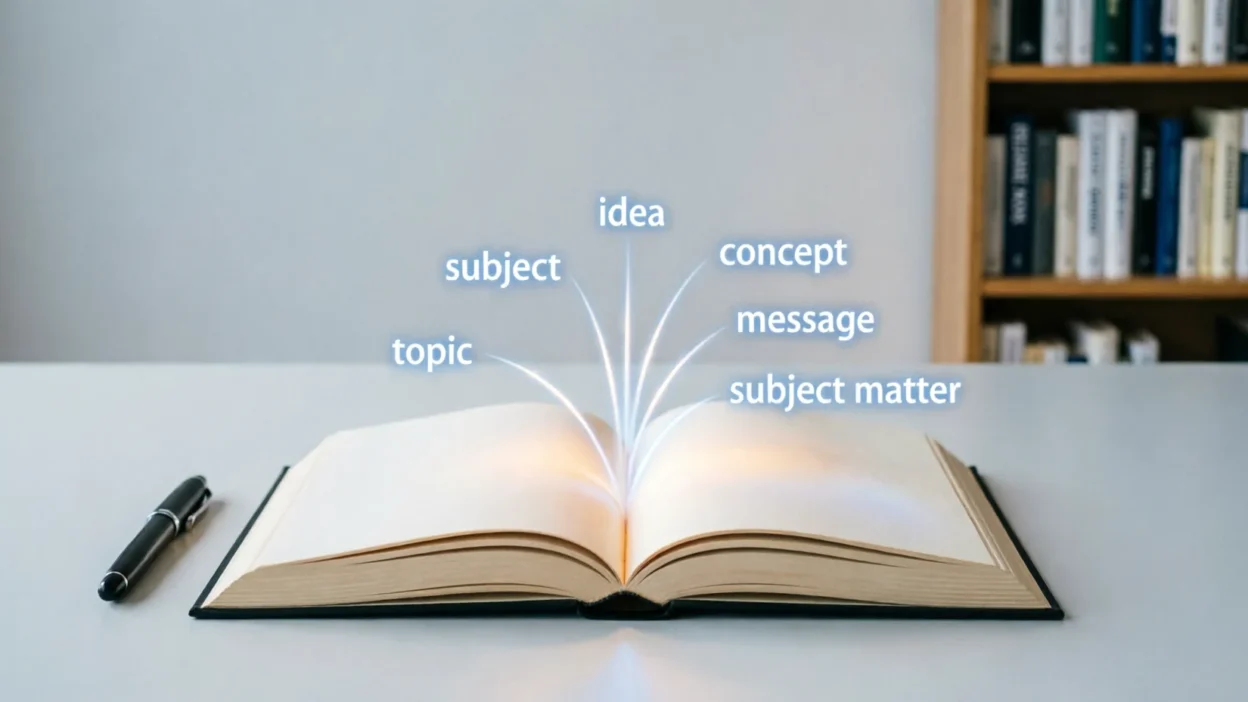
If you are looking for a theme synonym, the best choice depends on what you mean by “theme.” Common alternatives include subject, topic, idea, message, concept, motif, subject matter, central idea, focus, and thesis. However, these words are not always interchangeable. Some describe the main topic, while others describe a deeper message or repeated idea.
Understanding these differences can help students, writers, ESL learners, and content creators choose words that fit their exact meaning and context.
Quick Answer: What Is a Theme Synonym?
A theme synonym is a word or phrase that can replace “theme” when it expresses a similar idea. Depending on the context, useful synonyms include topic, subject, message, idea, concept, motif, focus, central idea, subject matter, and underlying message.
For example:
- Theme: The theme of the novel is friendship.
- Subject: The subject of the novel is friendship.
- Central idea: The central idea of the novel is the importance of friendship.
- Message: The message of the novel is that true friendship requires trust.
The right synonym depends on whether you are talking about a topic, idea, message, pattern, or deeper meaning.
What Does “Theme” Mean?
The word theme usually refers to the main idea, subject, or underlying message of something.
In literature, a theme is often a deeper idea that a story explores. Common literary themes include love, friendship, courage, identity, freedom, betrayal, ambition, family, and justice.
For example:
The theme of the story is the importance of forgiveness.
Here, “theme” refers to the broader idea explored throughout the story.
However, “theme” can have other meanings. In a discussion, it may mean the main subject being discussed. In design, it can refer to a particular visual style.
Theme in Literature
In literature, a theme is usually an underlying idea rather than a simple one-word subject.
For example:
- Topic: War
- Theme: The devastating human cost of war
“War” is the subject, while the statement about its human cost expresses a deeper theme.
Theme in Everyday Writing
In general writing, “theme” can refer to the central subject or recurring idea.
For example:
The conference had a theme of innovation and collaboration.
Here, “theme” means the main idea around which the event was organized.
30 Useful Theme Synonyms
Below are 30 alternatives to “theme,” along with their meanings, examples, and best contexts.
1. Topic
Simple meaning: The subject being discussed or written about.
Example:
Climate change was the main topic of the discussion.
Best usage/context: Use “topic” for general discussions, essays, conversations, presentations, and articles.
2. Subject
Simple meaning: The person, thing, or idea being discussed or studied.
Example:
The subject of the documentary is environmental conservation.
Best usage/context: “Subject” works well in academic, literary, educational, and general contexts.
3. Idea
Simple meaning: A thought, concept, or belief.
Example:
The story explores the idea of personal freedom.
Best usage/context: Use “idea” when the theme is a thought or principle rather than simply a topic.
4. Message
Simple meaning: The main lesson or meaning communicated by something.
Example:
The message of the story is that kindness can change people’s lives.
Best usage/context: Particularly useful for stories, films, speeches, advertisements, and creative works.
5. Concept
Simple meaning: A general idea or principle.
Example:
The exhibition explores the concept of human connection.
Best usage/context: Suitable for academic writing, art, design, research, and abstract discussions.
6. Motif
Simple meaning: A repeated idea, image, symbol, or element in a creative work.
Example:
Water is a recurring motif throughout the novel.
Best usage/context: Especially useful in literary and artistic analysis.
7. Subject Matter
Simple meaning: The particular subject that something discusses or presents.
Example:
The film deals with difficult subject matter.
Best usage/context: Useful for books, films, paintings, research, journalism, and academic discussions.
8. Central Idea
Simple meaning: The main idea around which something is organized.
Example:
The central idea of the article is the value of lifelong learning.
Best usage/context: Excellent for essays, articles, stories, presentations, and academic writing.
9. Main Idea
Simple meaning: The most important idea in a piece of writing or speech.
Example:
The main idea of the passage is the importance of teamwork.
Best usage/context: Common in education, reading comprehension, essays, and explanations.
10. Focus
Simple meaning: The main thing receiving attention.
Example:
The focus of the discussion was workplace communication.
Best usage/context: Use “focus” when describing what a conversation, article, project, or event concentrates on.
11. Message
Simple meaning: An idea or lesson that someone wants to communicate.
Example:
The film delivers a powerful message about equality.
Best usage/context: Best when “theme” means an intended lesson or takeaway.
12. Motif
Simple meaning: An element that appears repeatedly and supports a larger idea.
Example:
Birds serve as a motif representing freedom.
Best usage/context: Best for detailed literary, artistic, or film analysis.
13. Thesis
Simple meaning: A central claim or argument.
Example:
The essay’s thesis is that education should encourage independent thinking.
Best usage/context: Use “thesis” mainly in academic and argumentative writing. It is not a synonym for every meaning of “theme.”
14. Principle
Simple meaning: A basic belief, rule, or idea.
Example:
Respect is a central principle of the organization.
Best usage/context: Useful when the theme expresses a belief, value, or guiding rule.
15. Conceptual Focus
Simple meaning: The main abstract idea receiving attention.
Example:
Identity is the conceptual focus of the exhibition.
Best usage/context: Suitable for academic, artistic, and analytical writing.
16. Concern
Simple meaning: An issue or matter that receives attention.
Example:
Social inequality is a major concern in the novel.
Best usage/context: Useful when a theme involves a serious issue or problem.
17. Issue
Simple meaning: An important problem or subject for discussion.
Example:
The book addresses the issue of discrimination.
Best usage/context: Appropriate for social, political, academic, and journalistic contexts.
18. Matter
Simple meaning: A subject or situation being considered.
Example:
The story deals with matters of trust and loyalty.
Best usage/context: Useful in formal writing and expressions such as “a matter of…”
19. Narrative Focus
Simple meaning: The main subject or idea emphasized by a story.
Example:
The novel’s narrative focus is the struggle for independence.
Best usage/context: Best for literary analysis and discussions of storytelling.
20. Underlying Idea
Simple meaning: An important idea that may not be directly stated.
Example:
The underlying idea of the poem is that time changes everyone.
Best usage/context: Excellent when discussing deeper meanings in literature and creative writing.
21. Underlying Message
Simple meaning: A deeper lesson or meaning beneath the surface.
Example:
The underlying message is that success requires patience.
Best usage/context: Use this when the theme is a deeper lesson rather than the obvious subject.
22. Core Idea
Simple meaning: The most important idea.
Example:
The core idea of the campaign is responsible consumption.
Best usage/context: Useful in business, education, presentations, articles, and general communication.
23. Central Concept
Simple meaning: The main concept that connects different parts of something.
Example:
Community is the central concept of the project.
Best usage/context: Suitable for academic, professional, creative, and research contexts.
24. Motive
Simple meaning: A reason for doing something.
Example:
The character’s motive is revealed near the end of the story.
Best usage/context: Use carefully. “Motive” means a reason for an action and is not a direct synonym for “theme” in most literary contexts.
25. Thread
Simple meaning: An idea or subject that continues through something.
Example:
A strong thread of hope runs throughout the novel.
Best usage/context: Useful in literary criticism and descriptive writing.
26. Strand
Simple meaning: One particular idea or element that develops within a larger work.
Example:
The story contains a strong strand of political criticism.
Best usage/context: Useful for complex books, essays, films, and discussions containing multiple themes.
27. Line of Thought
Simple meaning: A connected series of ideas.
Example:
The author’s line of thought centers on human responsibility.
Best usage/context: Best for essays, arguments, academic discussions, and explanations.
28. Emphasis
Simple meaning: Special attention given to something.
Example:
The novel places strong emphasis on family relationships.
Best usage/context: Useful when “theme” refers to what a writer particularly highlights.
29. Perspective
Simple meaning: A particular way of viewing or understanding something.
Example:
The story presents a different perspective on childhood.
Best usage/context: Useful when the theme involves a viewpoint or way of understanding an issue.
30. Recurring Idea
Simple meaning: An idea that appears repeatedly.
Example:
Freedom is a recurring idea throughout the novel.
Best usage/context: Particularly useful when explaining repeated themes in books, films, poems, or other creative works.
Theme Synonyms Comparison Table
| Synonym | Main Meaning | Best Context | Formality |
| Topic | Subject being discussed | General writing | Neutral |
| Subject | Matter being studied | Academic/general | Neutral |
| Idea | Thought or concept | General/creative | Neutral |
| Message | Lesson or meaning | Stories/speeches | Neutral |
| Concept | Abstract idea | Academic/artistic | Formal |
| Motif | Repeated element | Literature/art | Formal |
| Subject matter | Content being discussed | Academic/creative | Formal |
| Central idea | Main idea | Education/writing | Neutral |
| Focus | Main area of attention | General/professional | Neutral |
| Thesis | Central argument | Academic writing | Formal |
| Principle | Guiding belief | Formal/general | Formal |
| Issue | Problem or matter | Social/academic | Neutral |
| Core idea | Most important idea | General/professional | Neutral |
| Underlying message | Deeper lesson | Literature/film | Neutral |
| Perspective | Way of viewing something | Analytical writing | Neutral |
Theme vs. Topic: What Is the Difference?
“Theme” and “topic” are closely related, but they are not always the same.
A topic is usually what something is about.
A theme is often the deeper idea explored through that topic.
For example:
- Topic: Friendship
- Theme: True friendship requires trust and honesty.
Another example:
- Topic: Poverty
- Theme: Poverty can limit people’s opportunities and choices.
This distinction is especially important in literary analysis.
Theme vs. Message
A theme is a broad idea explored by a work, while a message is often the lesson or meaning the audience takes from it.
For example:
Theme: Courage in difficult situations.
Message: People can overcome fear by facing challenges.
The two concepts can overlap, but “message” often sounds more direct and lesson-oriented.
Theme vs. Motif
A motif is usually something that repeatedly appears in a work and helps develop a theme.
For example, a novel may repeatedly mention rain.
Rain is the motif.
If the repeated references to rain represent sadness and emotional renewal, those ideas contribute to the work’s themes.
Therefore:
Motif = repeated element
Theme = broader idea or meaning
Theme vs. Subject
The words “theme” and “subject” can sometimes be used similarly, but “subject” usually refers more directly to what something is about.
For example:
The subject of the novel is migration.
This tells us what the novel discusses.
One theme of the novel is the emotional cost of leaving home.
This tells us about a deeper idea explored through that subject.
How to Choose the Right Theme Synonym
Choosing the right synonym depends on your meaning, tone, and purpose.
For General Writing
Use:
- Topic
- Subject
- Focus
- Main idea
- Core idea
Example:
The main topic of the meeting was customer service.
These words are simple and easy to understand.
For Academic Writing
Use:
- Concept
- Central idea
- Thesis
- Subject matter
- Principle
- Issue
Example:
The central concept of the study is social responsibility.
These choices can sound more precise in formal writing.
For Literature and Story Analysis
Use:
- Motif
- Underlying idea
- Underlying message
- Recurring idea
- Narrative focus
- Message
Example:
Freedom is an important recurring idea throughout the novel.
For Creative Writing
Use:
- Idea
- Message
- Concept
- Motif
- Thread
- Perspective
Example:
The story develops the idea of forgiveness through several characters.
For Events and Campaigns
Use:
- Topic
- Focus
- Central idea
- Concept
- Message
Example:
The central theme of this year’s event is community development.
For a Deeper Meaning
Use:
- Underlying idea
- Underlying message
- Core idea
- Central concept
- Message
Example:
The underlying message of the story is that appearances can be misleading.
Common Mistakes When Using Theme Synonyms
Mistake 1: Treating “Topic” and “Theme” as Exactly the Same
They can overlap, but they often serve different purposes.
“Topic” usually identifies the subject.
“Theme” often expresses a broader or deeper idea.
Mistake 2: Using “Motif” for Every Theme
A motif is a repeated element that can help develop a theme.
Not every theme is a motif.
Mistake 3: Using “Thesis” in Creative Writing
A thesis is generally a central argument or claim.
It is appropriate for essays and academic arguments but may sound unnatural when describing the central idea of a novel or poem.
Mistake 4: Assuming “Message” Always Means “Theme”
A message often expresses a lesson or intended takeaway.
A theme can be broader and more interpretive.
Mistake 5: Choosing a More Complicated Word Just to Sound Formal
Simple words such as topic, idea, subject, and focus are often clearer than unnecessarily complex alternatives.
Choose the word that communicates your meaning most accurately.
Examples of Theme Synonyms in Sentences
Here are some quick examples showing how different alternatives work:
- Topic: Education was the main topic of the meeting.
- Subject: The subject of the painting is nature.
- Idea: The story explores the idea of belonging.
- Message: The film has a powerful message about kindness.
- Concept: The artist explores the concept of identity.
- Motif: Mirrors are a recurring motif in the novel.
- Focus: The article focuses on workplace equality.
- Central idea: The central idea is that cooperation creates stronger communities.
- Issue: The story addresses the issue of social isolation.
- Perspective: The author offers a new perspective on family life.
FAQs:
What is the best synonym for theme?
There is no single synonym that works in every situation. Topic, subject, idea, message, concept, focus, motif, and central idea are among the most useful choices, depending on the intended meaning.
What is a simple synonym for theme?
Topic and subject are two simple alternatives. If you mean a deeper idea in a story, main idea or underlying message may be more appropriate.
Is “topic” a synonym for “theme”?
Sometimes, but they are not always identical. A topic is usually the subject being discussed, while a theme often describes a broader or deeper idea explored through that subject.
What is a literary synonym for theme?
In literary analysis, useful alternatives include central idea, underlying idea, message, motif, recurring idea, narrative focus, and underlying message. Each has a slightly different meaning.
Is “message” the same as “theme”?
Not exactly. A message often refers to the lesson or takeaway of a work, while a theme is usually a broader idea explored throughout it.
What is the difference between a theme and a motif?
A theme is a broader idea or meaning. A motif is a repeated image, symbol, phrase, event, or element that helps develop that broader idea.
Can “concept” replace “theme”?
Yes, in some contexts. “Concept” works especially well when referring to an abstract idea in art, design, academic writing, or creative projects. It does not replace every meaning of “theme.”
What is the opposite of a theme?
There is no exact universal opposite of “theme.” Depending on context, you might contrast a central theme with a minor detail, secondary element, background detail, or incidental point.
Final Thoughts
The best theme synonym depends on what you want to communicate. If you mean a general subject, choose topic or subject. If you mean a central thought, use idea, central idea, or core idea. For a deeper lesson, message or underlying message may work better. In literary analysis, motif and recurring idea can describe repeated elements that contribute to a larger theme.
The key is not simply to find a replacement word. Instead, consider the exact meaning, tone, audience, and context of your sentence. Choosing the most precise synonym will make your writing clearer, more natural, and more effective.

I am Andrew Foster, a passionate language writer who enjoys helping readers discover the right synonyms and improve their vocabulary. I create clear, accurate, and engaging content that makes learning English simple, practical, and enjoyable.