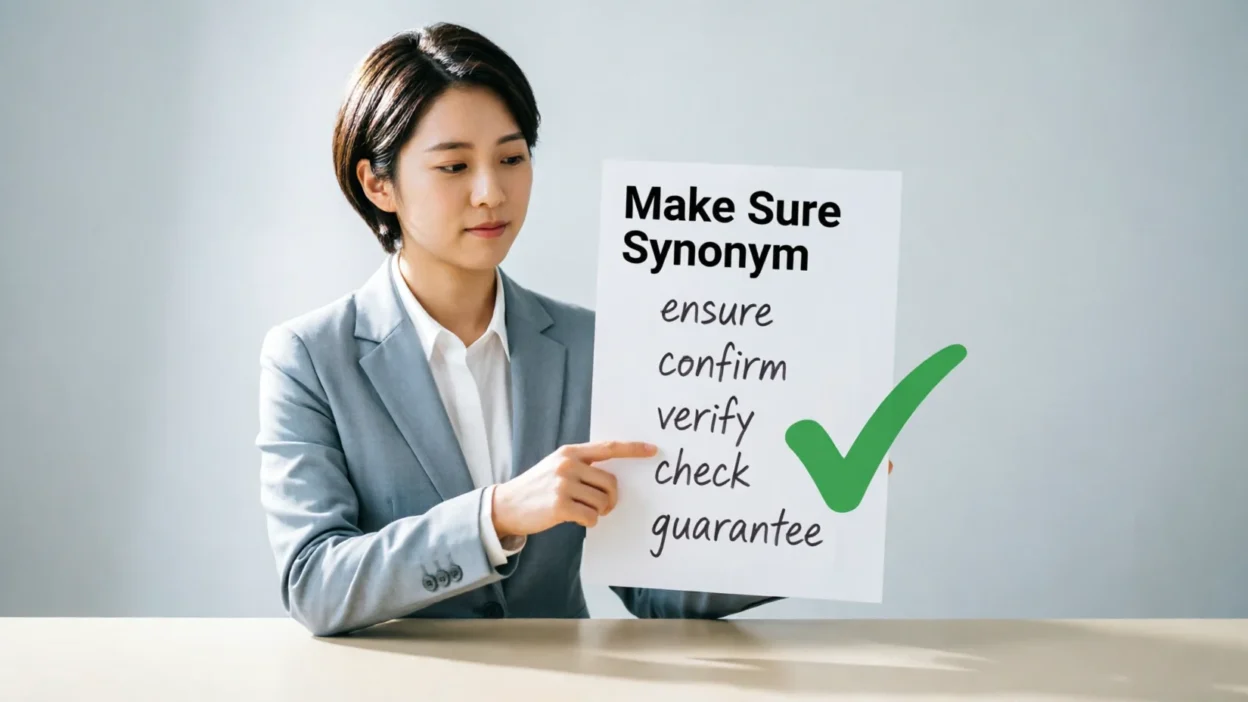
Finding the right make sure synonym can make your writing clearer, more precise, and less repetitive. Depending on the situation, you can use words such as ensure, verify, confirm, check, guarantee, establish, secure, or assure. The best choice depends on whether you are checking information, preventing a problem, confirming something, or promising an outcome.
This guide explains 30 useful alternatives to “make sure” with simple meanings, examples, and the best contexts for using each one.
Quick Answer: What Is a Synonym for “Make Sure”?
The most common synonym for make sure is ensure. Other useful alternatives include verify, confirm, check, guarantee, assure, establish, secure, ascertain, validate, and double-check.
- Make sure → general and conversational
- Ensure → formal and professional
- Verify → check that something is accurate or true
- Confirm → establish that something is correct or definite
- Check → examine something for mistakes or problems
- Guarantee → promise that something will happen or be true
What Does “Make Sure” Mean?
Make sure means to take action so that something is certain, correct, safe, or completed as expected.
For example:
Please make sure the door is locked.
Here, the speaker wants someone to check the door and confirm that it is locked.
“Make sure” can have slightly different meanings depending on context. It may mean check, confirm, ensure, verify, or take action to prevent a problem.
Make Sure in Everyday English
“Make sure” is very common in casual conversations.
Example:
“Make sure you bring your passport.”
It means: Remember to bring your passport and check that you have it before leaving.
Make Sure in Professional Writing
In formal writing, ensure is often a smoother alternative.
Example:
“Please ensure that all documents are complete before submission.”
Both expressions are correct, but “ensure” sounds more formal.
30 Synonyms for Make Sure
1. Ensure
Simple meaning: Make certain that something happens or is correct.
Example:
“Please ensure that all the lights are switched off.”
Best usage/context: Formal writing, workplace communication, instructions, and academic writing.
2. Verify
Simple meaning: Check that something is true, accurate, or correct.
Example:
“Please verify your email address before submitting the form.”
Best usage/context: Facts, information, documents, identities, data, and records.
3. Confirm
Simple meaning: Establish that something is true or definite.
Example:
“Please confirm your appointment by Friday.”
Best usage/context: Appointments, plans, reservations, information, decisions, and arrangements.
4. Check
Simple meaning: Look at something carefully to see whether it is correct or safe.
Example:
“Check the address before sending the package.”
Best usage/context: Everyday speech, instructions, proofreading, safety, and routine tasks.
5. Guarantee
Simple meaning: Promise that something will happen or be true.
Example:
“This warranty guarantees that the product will be repaired if it develops a manufacturing defect.”
Best usage/context: Promises, products, services, contracts, and situations involving certainty.
6. Assure
Simple meaning: Tell someone confidently that something is true or will happen.
Example:
“She assured me that everything was ready.”
Best usage/context: Reassuring people, personal communication, customer service, and formal statements.
7. Establish
Simple meaning: Determine or prove something clearly.
Example:
“The investigation established the cause of the problem.”
Best usage/context: Research, investigations, reports, academic writing, and formal discussions.
8. Ascertain
Simple meaning: Find out something with certainty.
Example:
“The manager contacted the supplier to ascertain the delivery date.”
Best usage/context: Formal writing, research, investigations, and professional communication.
9. Validate
Simple meaning: Check that something is valid, acceptable, or accurate.
Example:
“The system validates the information before processing the application.”
Best usage/context: Data, research, software, processes, documents, and technical contexts.
10. Double-Check
Simple meaning: Check something again to avoid an error.
Example:
“Double-check the figures before publishing the report.”
Best usage/context: Everyday and professional situations where accuracy is important.
11. Make Certain
Simple meaning: Take action to remove doubt.
Example:
“Make certain that everyone has received the instructions.”
Best usage/context: Formal or emphatic writing and careful instructions.
12. Be Certain
Simple meaning: Have confidence that something is true or correct.
Example:
“Be certain that you understand the instructions before starting.”
Best usage/context: Advice, instructions, warnings, and situations requiring confidence.
13. See to It
Simple meaning: Take responsibility for making something happen.
Example:
“I’ll see to it that the documents are delivered today.”
Best usage/context: Conversational and professional English when talking about responsibility.
14. Take Care
Simple meaning: Act carefully to prevent problems.
Example:
“Take care to save your work before closing the program.”
Best usage/context: Instructions, warnings, safety advice, and everyday communication.
15. Take Steps
Simple meaning: Do something deliberately to achieve or prevent a result.
Example:
“The company took steps to protect customer information.”
Best usage/context: Formal writing, business, policy, safety, and problem prevention.
16. Safeguard
Simple meaning: Protect something from harm, loss, or damage.
Example:
“Strong passwords help safeguard personal information.”
Best usage/context: Security, safety, finances, personal information, and risk prevention.
17. Secure
Simple meaning: Obtain or protect something successfully.
Example:
“Please secure all equipment before leaving the room.”
Best usage/context: Safety, security, resources, agreements, and professional contexts.
18. Protect
Simple meaning: Keep someone or something safe from harm.
Example:
“Always protect your files with a secure backup.”
Best usage/context: Safety, cybersecurity, people, property, information, and risk management.
19. Prevent
Simple meaning: Stop something bad or unwanted from happening.
Example:
“Regular maintenance can prevent serious problems.”
Best usage/context: Health, safety, maintenance, risk management, and problem-solving.
20. Guard Against
Simple meaning: Take action to protect against a possible problem.
Example:
“Back up your files to guard against data loss.”
Best usage/context: Risks, dangers, mistakes, losses, and preventative measures.
21. Assure Yourself
Simple meaning: Check something personally so that you feel certain about it.
Example:
“She checked the schedule to assure herself that the train was still running.”
Best usage/context: Personal verification and situations where someone wants confidence.
22. Satisfy Yourself
Simple meaning: Check something until you are personally convinced.
Example:
“He reviewed the evidence to satisfy himself that the decision was justified.”
Best usage/context: Formal writing, investigations, decisions, and careful evaluation.
23. Make Certain Of
Simple meaning: Check or establish something so there is no doubt about it.
Example:
“Make certain of the meeting time before you leave.”
Best usage/context: Careful instructions and situations involving uncertainty.
24. Determine
Simple meaning: Find out or establish something after examination.
Example:
“The technician determined that the machine needed a replacement part.”
Best usage/context: Technical, professional, academic, and investigative writing.
25. Check On
Simple meaning: Look at something to see how it is progressing or whether it is okay.
Example:
“I’ll check on the children before going to bed.”
Best usage/context: People, tasks, projects, situations, and routine follow-up.
26. Inspect
Simple meaning: Examine something carefully.
Example:
“The engineer inspected the equipment before the test.”
Best usage/context: Buildings, machinery, products, safety checks, and professional inspections.
27. Review
Simple meaning: Examine something carefully, often to identify errors or improvements.
Example:
“Please review the contract before signing it.”
Best usage/context: Documents, assignments, reports, contracts, plans, and professional work.
28. Validate the Accuracy Of
Simple meaning: Check whether information is accurate.
Example:
“The researcher validated the accuracy of the survey results.”
Best usage/context: Academic, scientific, technical, and data-related writing.
29. Reassure
Simple meaning: Give someone confidence that something is safe, true, or okay.
Example:
“The doctor reassured the patient that the procedure was routine.”
Best usage/context: Emotional support, customer service, healthcare communication, and personal conversations.
30. Take Precautions
Simple meaning: Do something in advance to avoid possible trouble.
Example:
“Travelers should take precautions before visiting unfamiliar areas.”
Best usage/context: Safety, travel, health, security, emergencies, and risk prevention.
Comparison Table: Make Sure vs. Its Synonyms
| Synonym | Main idea | Tone | Best context |
| Make sure | Check or ensure something | Neutral | Everyday English |
| Ensure | Make something certain | Formal | Work and academic writing |
| Verify | Check accuracy or truth | Formal | Facts and information |
| Confirm | Establish that something is definite | Neutral/Formal | Plans and information |
| Check | Examine something | Neutral | Everyday situations |
| Guarantee | Promise an outcome | Strong/Formal | Products and promises |
| Assure | Give someone confidence | Neutral/Formal | People and reassurance |
| Establish | Prove or determine | Formal | Research and investigations |
| Ascertain | Find out with certainty | Formal | Research and professional writing |
| Validate | Confirm validity or accuracy | Formal | Data and technical contexts |
| Double-check | Check again | Neutral | Accuracy and proofreading |
| Safeguard | Protect from harm | Formal | Security and risk |
| Prevent | Stop something from happening | Neutral | Problems and risks |
| Inspect | Examine carefully | Formal | Equipment and safety |
| Review | Examine carefully | Neutral/Formal | Documents and work |
How to Choose the Right Synonym for Make Sure
The best synonym depends on what you want to communicate. Not every alternative can replace “make sure” in every sentence.
For Casual or Everyday English
Choose:
- Check
- Double-check
- Make certain
- See to it
- Take care
Example:
“Make sure you lock the door.”
Natural alternatives include:
- “Check that you locked the door.”
- “Double-check the door.”
- “Make certain the door is locked.”
For Formal or Professional Writing
Choose:
- Ensure
- Verify
- Confirm
- Establish
- Ascertain
- Validate
Example:
“Please ensure that all required fields are completed.”
“Ensure” is especially useful when writing instructions or describing procedures.
When You Mean “Check Information”
Choose:
- Verify
- Confirm
- Validate
- Check
- Review
- Inspect
Example:
“Please verify the information before submitting the application.”
Here, verify is more precise than “guarantee” because you are checking existing information rather than promising an outcome.
When You Mean “Promise”
Choose:
- Guarantee
- Assure
Example:
“The company guarantees a full refund.”
This is different from:
“The company ensures a full refund.”
“Guarantee” emphasizes a promise or commitment, while “ensure” focuses on taking action to make the result happen.
When You Mean “Prevent a Problem”
Choose:
- Prevent
- Safeguard
- Protect
- Guard against
- Take precautions
- Take steps
Example:
“Back up your files to prevent data loss.”
These words are better when the goal is to avoid an unwanted result.
When You Mean “Give Someone Confidence”
Choose:
- Assure
- Reassure
Example:
“The manager reassured the customer that the issue would be resolved.”
These words focus on a person’s confidence rather than simply checking a fact.
Common Mistakes When Using Make Sure Synonyms
1. Using “Guarantee” When You Only Mean “Check”
Incorrect or awkward:
“Guarantee the spelling before submitting the essay.”
Better:
“Check the spelling before submitting the essay.”
Guarantee suggests a promise, while check means examine something.
2. Confusing “Assure” and “Ensure”
These words are related but not identical.
- Assure → give a person confidence
- Ensure → make something certain
Example:
“She assured me that everything was ready.”
“She ensured that everything was ready.”
The first focuses on what she told someone. The second focuses on the action she took.
3. Using Very Formal Words in Casual Conversation
Words such as ascertain, establish, and validate can sound unnecessarily formal in everyday speech.
Instead of:
“Please ascertain whether the store is open.”
A natural conversation might use:
“Please check if the store is open.”
4. Assuming Every Synonym Has Exactly the Same Meaning
Synonyms often overlap, but they can carry different meanings and levels of formality.
For example:
- Check = examine
- Verify = establish accuracy or truth
- Confirm = establish that something is definite
- Guarantee = promise an outcome
- Prevent = stop something from happening
Choosing the most precise word makes your writing stronger.
FAQs:
What is the best synonym for “make sure”?
Ensure is usually the best synonym for formal writing. In everyday conversation, check or double-check may sound more natural.
Is “ensure” the same as “make sure”?
They are very similar. Both can mean taking action to make something certain. However, ensure is generally more formal than make sure.
What is a formal synonym for “make sure”?
Common formal alternatives include ensure, verify, confirm, establish, ascertain, validate, and make certain.
What is another word for “make sure” in an email?
Depending on the meaning, you can use ensure, confirm, verify, check, or please make certain.
For example:
“Please ensure that the attached document is complete.”
What is a synonym for “make sure” when checking information?
Verify is often the most precise choice. You can also use check, confirm, validate, or review, depending on the situation.
What is the difference between “make sure” and “guarantee”?
“Make sure” means taking action to make something certain. Guarantee means making a promise that something will happen or be true.
What is a synonym for “make sure” in academic writing?
Ensure, verify, establish, and confirm are useful academic alternatives. The right word depends on the exact meaning of the sentence.
Can “assure” replace “make sure”?
Sometimes, but not always. Assure normally means giving a person confidence, while ensure means making something certain.
Conclusion
The best make sure synonym depends on your exact meaning and the tone of your writing. Ensure is a strong choice for formal and professional contexts, while check and double-check work naturally in everyday English.
If you are checking if information is accurate, choose verify. If you are confirming plans or details, use confirm. If you are promising an outcome, guarantee may be better. When the goal is to protect against a problem, words such as prevent, safeguard, protect, and take precautions are more precise.
Understanding these differences will help you choose words that sound natural, accurate, and appropriate for your audience.

I am Olivia Brooks, a language enthusiast and writer at SynonymsHive. I enjoy creating clear, engaging content about synonyms, vocabulary, and word meanings, helping readers improve their writing and communicate with confidence every day.