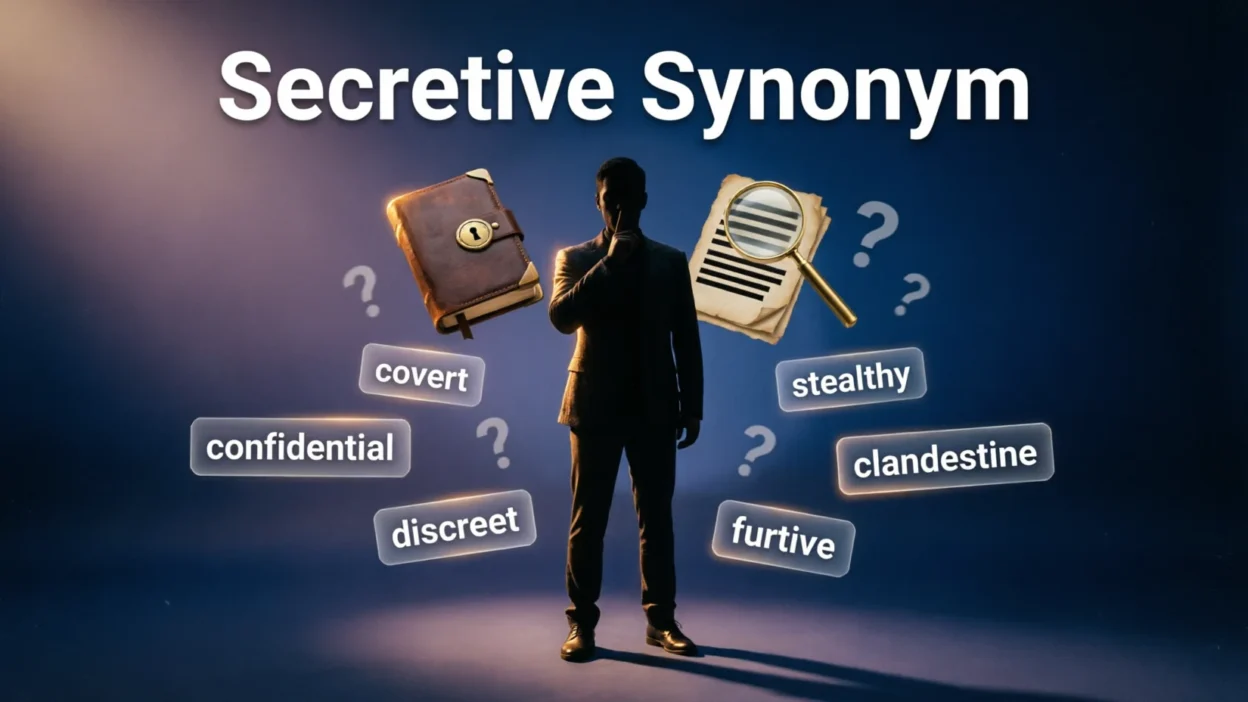
Finding the right secretive synonym depends on what you mean. Words such as private, discreet, guarded, covert, concealed, mysterious, and furtive can describe someone or something that is not openly revealed. However, each word has a slightly different meaning and tone.
If you want to describe a person who avoids sharing personal information, private or reserved may be appropriate. If something is deliberately hidden, covert, concealed, or hidden may work better. Choosing the right synonym helps make your writing more precise and natural.
Quick Answer: What Is a Synonym for Secretive?
Common synonyms for secretive include private, discreet, guarded, reserved, mysterious, covert, concealed, hidden, confidential, and furtive. The best choice depends on the situation. For a person, “private” can sound neutral, while “furtive” often suggests suspicious or dishonest behavior.
What Does Secretive Mean?
Secretive describes someone or something that keeps information, feelings, plans, or activities hidden from other people.
For example:
This means Maria does not openly discuss her personal life.
The word can describe a person’s behavior, communication style, plans, activities, or information.
Secretive as a Personality Trait
When describing a person, secretive often means they do not easily reveal their thoughts, feelings, plans, or personal information.
Example:
“Daniel is secretive about his future plans.”
Secretive as Hidden Behavior
The word can also describe actions that are intentionally kept from others.
Example:
“The company held a secretive meeting.”
Here, the meeting was not openly discussed or made public.
Is Secretive Always Negative?
No. The meaning depends on context.
Sometimes secretive simply means someone values privacy. In other situations, it can suggest that a person is deliberately hiding something suspicious.
Compare:
- She is private about her family life. — Usually neutral.
- She is secretive about her family life. — May suggest that she is deliberately withholding information.
- He was furtive about his actions. — Stronger suggestion that he was trying to avoid attention.
30 Synonyms for Secretive
1. Private
Simple meaning: Not willing to share personal information.
Example:
“James is a very private person.”
Best usage/context: Use this for people who prefer to keep personal matters to themselves. It is generally neutral and polite.
2. Discreet
Simple meaning: Careful about keeping information confidential.
Example:
“She was discreet about the details of the agreement.”
Best usage/context: Suitable for professional, social, or sensitive situations where information should not be revealed.
3. Guarded
Simple meaning: Careful about what you say or reveal.
Example:
“He was guarded when asked about his plans.”
Best usage/context: Useful when someone deliberately avoids giving much information.
4. Reserved
Simple meaning: Quiet and unwilling to openly express thoughts or feelings.
Example:
“She is reserved when discussing her personal life.”
Best usage/context: Best for personality and communication style rather than deliberately hidden activities.
5. Confidential
Simple meaning: Intended to be kept private.
Example:
“The information in the report is confidential.”
Best usage/context: Common in workplaces, legal matters, business, healthcare, and other sensitive situations.
6. Covert
Simple meaning: Hidden or not openly shown.
Example:
“The group carried out a covert operation.”
Best usage/context: Appropriate for deliberately concealed actions, operations, or activities.
7. Hidden
Simple meaning: Kept out of sight or not revealed.
Example:
“The documents were hidden in a locked drawer.”
Best usage/context: A broad and simple choice for information, objects, intentions, or activities that are not visible or known.
8. Concealed
Simple meaning: Deliberately kept from being seen or discovered.
Example:
“He concealed the letter inside a book.”
Best usage/context: Strong choice when something has been intentionally hidden.
9. Mysterious
Simple meaning: Difficult to understand, explain, or know.
Example:
“She received a mysterious message.”
Best usage/context: Use when something creates uncertainty or curiosity rather than simply being private.
10. Furtive
Simple meaning: Trying to avoid being noticed.
Example:
“He gave a furtive glance toward the door.”
Best usage/context: Often used when behavior appears suspicious, secretive, or evasive.
11. Evasive
Simple meaning: Avoiding a direct answer or response.
Example:
“The politician gave an evasive answer to the question.”
Best usage/context: Particularly useful when someone avoids answering questions directly.
12. Reticent
Simple meaning: Unwilling to speak freely about something.
Example:
“She was reticent about her childhood.”
Best usage/context: Good for formal writing when describing someone who is reluctant to discuss personal matters.
13. Uncommunicative
Simple meaning: Not willing or likely to talk or share information.
Example:
“The witness became unusually uncommunicative.”
Best usage/context: Useful when someone gives little information during communication.
14. Tight-lipped
Simple meaning: Refusing to discuss something.
Example:
“The manager was tight-lipped about the upcoming changes.”
Best usage/context: Common in journalism and everyday English when someone deliberately refuses to reveal information.
15. Cloaked
Simple meaning: Covered or hidden from view or knowledge.
Example:
“The project was cloaked in secrecy.”
Best usage/context: Often used figuratively with plans, projects, motives, or events.
16. Stealthy
Simple meaning: Done quietly and carefully so that others do not notice.
Example:
“The team made a stealthy exit.”
Best usage/context: Useful for actions performed without attracting attention.
17. Surreptitious
Simple meaning: Done secretly, often to avoid being noticed.
Example:
“He took a surreptitious look at the document.”
Best usage/context: More formal than “secretive” and often implies that someone is trying to avoid detection.
18. Undercover
Simple meaning: Hidden under a false identity or purpose.
Example:
“The detective worked undercover for several months.”
Best usage/context: Common for investigations, law enforcement, journalism, and deliberately concealed identities.
19. Incognito
Simple meaning: With one’s identity hidden.
Example:
“The celebrity traveled incognito.”
Best usage/context: Best when someone hides their identity rather than simply withholding information.
20. Unrevealing
Simple meaning: Giving little useful information.
Example:
“His response was brief and unrevealing.”
Best usage/context: Useful when describing statements, answers, interviews, or information that reveals very little.
21. Obscure
Simple meaning: Difficult to understand, see, or discover.
Example:
“The document contains several obscure references.”
Best usage/context: Best when something is unclear or difficult to identify, rather than intentionally private.
22. Enigmatic
Simple meaning: Mysterious and difficult to understand.
Example:
“Her enigmatic smile made everyone curious.”
Best usage/context: Useful in literary, descriptive, and creative writing.
23. Cryptic
Simple meaning: Mysterious or difficult to understand.
Example:
“He left a cryptic note on the table.”
Best usage/context: Ideal for messages, statements, clues, or remarks that are deliberately unclear.
24. Confidentialized
Simple meaning: Made private or restricted from general access.
Example:
“The sensitive records were confidentialized before publication.”
Best usage/context: Rare and specialized. In ordinary writing, “confidential” or “restricted” is usually more natural.
25. Restricted
Simple meaning: Limited so that only certain people can access it.
Example:
“The files are restricted to authorized employees.”
Best usage/context: Appropriate for documents, information, locations, systems, and access permissions.
26. Suppressed
Simple meaning: Prevented from being expressed, published, or revealed.
Example:
“Several details were suppressed from the public report.”
Best usage/context: Useful when information is deliberately prevented from becoming known or public.
27. Withheld
Simple meaning: Kept back instead of being given or revealed.
Example:
“The witness withheld important information.”
Best usage/context: Best for information, details, evidence, opinions, or facts that someone chooses not to provide.
28. Secret
Simple meaning: Known by only a limited number of people.
Example:
“They made a secret agreement.”
Best usage/context: A simple, direct choice for information, plans, arrangements, or activities intentionally kept from others.
29. Stealthy
Simple meaning: Quiet and difficult to notice.
Example:
“The cat made a stealthy approach toward the bird.”
Best usage/context: Useful for movements or actions designed to avoid attention.
30. Cloistered
Simple meaning: Kept away from other people or ordinary public life.
Example:
“She lived a quiet, cloistered life away from the media.”
Best usage/context: Best for people or lifestyles that are isolated, sheltered, or separated from public attention.
Secretive Synonyms Comparison Table
| Synonym | Main Meaning | Tone | Best Used For |
|---|---|---|---|
| Private | Keeps personal matters to oneself | Neutral | People |
| Discreet | Careful with sensitive information | Positive/Neutral | People, information |
| Guarded | Reveals little | Neutral | People, answers |
| Reserved | Quiet and restrained | Neutral | Personality |
| Confidential | Intended to remain private | Neutral/Formal | Information |
| Covert | Deliberately hidden | Formal | Actions, operations |
| Hidden | Not visible or known | Neutral | Objects, facts, plans |
| Concealed | Intentionally hidden | Neutral | Objects, information |
| Mysterious | Difficult to understand | Neutral/Intriguing | People, events |
| Furtive | Secretive and avoiding notice | Negative | Actions, looks |
| Evasive | Avoiding direct answers | Negative/Neutral | Responses |
| Reticent | Unwilling to speak | Formal | People |
| Tight-lipped | Refusing to reveal information | Informal | People, situations |
| Stealthy | Avoiding detection | Neutral/Negative | Actions |
| Surreptitious | Secret and unnoticed | Formal | Actions |
| Undercover | Hidden identity or purpose | Neutral | Investigations |
| Incognito | Identity is concealed | Neutral | People |
| Enigmatic | Mysterious and hard to understand | Literary | People, behavior |
| Cryptic | Difficult to understand | Neutral | Messages, clues |
| Withheld | Kept back | Neutral | Information |
How to Choose the Right Secretive Synonym
The best synonym depends on tone, meaning, and intent.
For a Neutral or Positive Tone
Choose:
- Private
- Discreet
- Reserved
- Guarded
These words are useful when you do not want to suggest dishonesty.
Example:
“She is private about her relationships.”
This sounds more respectful than:
“She is secretive about her relationships.”
For Formal Writing
Choose:
- Confidential
- Covert
- Reticent
- Surreptitious
- Restricted
- Withheld
These words work well in academic, professional, legal, or formal contexts.
Example:
“The documents contain confidential information.”
For Suspicious Behavior
Choose:
- Furtive
- Evasive
- Surreptitious
- Stealthy
- Covert
These words can suggest that someone is intentionally avoiding attention.
Example:
“He gave a furtive glance at the security guard.”
For Mystery or Curiosity
Choose:
- Mysterious
- Enigmatic
- Cryptic
- Obscure
- Unrevealing
These words are particularly useful in creative writing.
Example:
“The stranger gave an enigmatic smile.”
For Hidden Information
Choose:
- Concealed
- Hidden
- Withheld
- Suppressed
- Restricted
- Confidential
These words are better when the subject is information rather than a person’s personality.
Secretive vs. Private
Secretive and private are closely related, but they are not always interchangeable.
Private usually suggests that someone has chosen not to share personal information.
Secretive can suggest a stronger intention to keep something hidden.
Compare:
- “She is private about her finances.”
- “She is secretive about her finances.”
The first sentence sounds neutral. The second may make the reader wonder whether she is deliberately hiding something.
Secretive vs. Mysterious
A secretive person intentionally keeps information from others.
A mysterious person or thing is difficult to understand or explain.
Example:
“His secretive behavior made people suspicious.”
“His mysterious behavior made people curious.”
The first focuses on hiding information. The second focuses on uncertainty.
Secretive vs. Covert
Secretive commonly describes people or behavior.
Covert usually describes actions, operations, activities, or methods that are intentionally hidden.
Example:
“She is secretive about her plans.”
“The organization conducted a covert operation.”
Secretive vs. Furtive
Furtive is stronger and usually carries a suspicious meaning.
Secretive can be neutral depending on context.
Example:
“Tom is secretive about his personal life.”
“Tom gave a furtive glance around the room.”
The second example suggests an attempt to avoid being noticed.
Common Mistakes When Using Secretive Synonyms
Using “private” and “secretive” as Exact Equivalents
They overlap, but their tones differ. Private is often respectful, while secretive may imply deliberate concealment.
Using “mysterious” for Every Hidden Situation
Something hidden is not automatically mysterious.
A locked document may be confidential, but it is not necessarily mysterious.
Using “covert” to Describe Someone’s Personality
“Covert” usually describes hidden activities or operations.
Instead of:
“He is a covert person.”
Say:
“He is a secretive person.”
Or:
“He works on covert operations.”
Confusing “reserved” With “dishonest”
A reserved person may simply be quiet or emotionally restrained. The word does not necessarily imply that the person is hiding something wrong.
Overusing Strong Words
Words such as furtive, surreptitious, and covert can suggest deliberate concealment or suspicious behavior. Use them only when the context supports that meaning.
FAQs:
What is the best synonym for secretive?
There is no single best synonym for every situation. Private works well for personal matters, guarded for limited communication, confidential for sensitive information, and covert for deliberately hidden activities.
What is a positive synonym for secretive?
Private, discreet, and sometimes reserved can provide a more neutral or positive alternative. They can describe someone who respects personal boundaries without suggesting dishonesty.
What is a negative synonym for secretive?
Furtive, evasive, and surreptitious can carry more negative or suspicious meanings. The exact tone depends on the sentence.
What is a synonym for a secretive person?
Useful choices include private person, reserved person, guarded person, reticent person, and tight-lipped person. “Furtive” is generally better for behavior than for describing someone’s entire personality.
What is a formal synonym for secretive?
Depending on context, confidential, reticent, covert, surreptitious, or discreet can work in formal writing.
What is the difference between secretive and discreet?
Someone who is secretive tends to keep information hidden, while someone who is discreet is careful not to reveal sensitive information. “Discreet” often has a more positive or professional tone.
What is the difference between secretive and reserved?
Secretive focuses on withholding information. Reserved focuses more on a person’s quiet, restrained, or less expressive personality.
Can “mysterious” mean secretive?
Sometimes. Both words can involve information that is not easily known. However, secretive emphasizes intentional hiding, while mysterious emphasizes uncertainty or difficulty in understanding something.
Conclusion
The best secretive synonym depends on exactly what you want to communicate. Use private when someone protects personal information, discreet when someone carefully handles sensitive matters, and guarded when someone reveals very little.
For hidden actions, covert, surreptitious, or stealthy may be more precise. For mysterious people or situations, enigmatic, cryptic, or mysterious can create the right effect. If someone avoids answering questions, evasive or tight-lipped may be more accurate.
Understanding these differences allows you to choose words that communicate not only the basic idea of secrecy but also the exact tone and intention behind it.

I’m Nathan Collins, a language enthusiast passionate about exploring synonyms and improving everyday writing. I create clear, accurate, and helpful content that helps readers expand vocabulary and communicate with confidence.