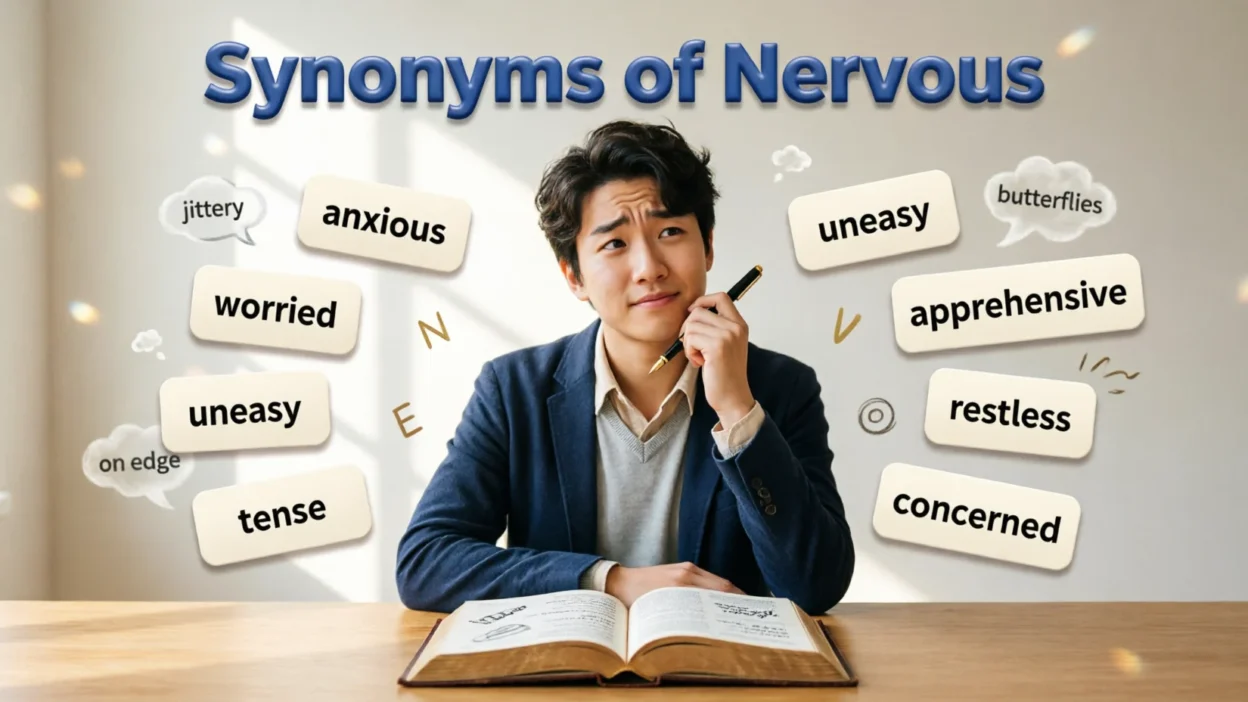
Feeling nervous is common when you are worried, uncertain, excited, or afraid about what might happen. Useful nervous synonyms include anxious, uneasy, worried, apprehensive, tense, restless, concerned, fearful, and jittery. The best synonym depends on the exact feeling and situation. For example, “anxious” often describes worry, while “tense” focuses more on physical or emotional strain.
Quick Answer
The most useful synonyms for nervous are:
Anxious, uneasy, worried, apprehensive, tense, restless, concerned, fearful, jittery, uneasy, agitated, apprehensive, insecure, troubled, uncomfortable, frightened, panicky, jumpy, edgy, hesitant, timid, shy, alarmed, disturbed, unsettled, apprehensive, stressed, fearful, doubtful, and self-conscious.
Not every synonym has exactly the same meaning. Choose a word according to whether you want to emphasize worry, fear, tension, uncertainty, shyness, or physical agitation.
What Does “Nervous” Mean?
Nervous usually means feeling worried, uncomfortable, frightened, or uncertain about something that may happen.
For example:
Here, “nervous” describes a mixture of worry and uncertainty.
The word can also describe someone who is easily worried or anxious:
“Nervous” can sometimes refer to physical effects of anxiety, such as shaking, sweating, fidgeting, or having a racing heartbeat.
Nervous Synonyms and Their Meanings
Below are 30 useful alternatives, with examples and guidance on when each word works best.
1. Anxious
Simple meaning: Worried or uneasy about something that may happen.
Example: She felt anxious before receiving her exam results.
Best usage/context: Use it for strong worry about a future event or uncertain situation.
2. Uneasy
Simple meaning: Uncomfortable or worried without knowing exactly why.
Example: I felt uneasy when I noticed that the door was unlocked.
Best usage/context: Good when something creates a vague sense of discomfort or concern.
3. Worried
Simple meaning: Thinking about a problem with fear or concern.
Example: His parents were worried about his late arrival.
Best usage/context: One of the simplest and most common alternatives to “nervous.”
4. Apprehensive
Simple meaning: Worried that something unpleasant may happen.
Example: She was apprehensive about starting at a new school.
Best usage/context: Useful in formal or thoughtful writing when someone anticipates a negative outcome.
5. Tense
Simple meaning: Unable to relax because of stress or worry.
Example: Everyone became tense as they waited for the announcement.
Best usage/context: Best when nervousness creates emotional or physical strain.
6. Restless
Simple meaning: Unable to stay calm or still.
Example: He became restless while waiting for the interview to begin.
Best usage/context: Use it when nervousness is shown through movement or difficulty relaxing.
7. Concerned
Simple meaning: Worried about a person, situation, or possible problem.
Example: The teacher was concerned about the student’s sudden absence.
Best usage/context: Suitable for polite, neutral, and professional communication.
8. Fearful
Simple meaning: Feeling afraid or expecting danger.
Example: The hikers became fearful when the weather suddenly changed.
Best usage/context: Stronger than ordinary nervousness because it emphasizes fear.
9. Jittery
Simple meaning: Extremely nervous and unable to relax.
Example: I felt jittery before going on stage.
Best usage/context: Informal conversations, especially when nervousness produces physical agitation.
10. Edgy
Simple meaning: Nervous, tense, or easily irritated.
Example: He seemed edgy while waiting for the final decision.
Best usage/context: Informal English for someone who is tense or unusually irritable.
11. Jumpy
Simple meaning: Easily startled or frightened.
Example: She was jumpy after hearing strange noises outside.
Best usage/context: Best when nervousness makes someone react strongly to sudden sounds or movements.
12. Agitated
Simple meaning: Very upset, restless, or emotionally disturbed.
Example: The customer became agitated after waiting for an hour.
Best usage/context: Useful when nervousness is accompanied by visible emotional disturbance or frustration.
13. Insecure
Simple meaning: Lacking confidence or feeling uncertain about yourself.
Example: He felt insecure about speaking English in front of the class.
Best usage/context: Use it when nervousness comes from low confidence or self-doubt.
14. Troubled
Simple meaning: Worried or emotionally disturbed by a problem.
Example: She looked troubled after hearing the news.
Best usage/context: Good for describing deeper or ongoing emotional concern.
15. Uncomfortable
Simple meaning: Not feeling relaxed, safe, or at ease.
Example: I felt uncomfortable answering such a personal question.
Best usage/context: Appropriate when nervousness comes from an awkward or unpleasant situation.
16. Frightened
Simple meaning: Afraid of something.
Example: The child was frightened by the loud thunder.
Best usage/context: Use this when fear is the main emotion rather than ordinary nervousness.
17. Panicky
Simple meaning: Feeling sudden and intense fear or anxiety.
Example: She became panicky when she realized she had lost her passport.
Best usage/context: Appropriate for intense nervousness that feels difficult to control.
18. Hesitant
Simple meaning: Unsure about whether to act or make a decision.
Example: He was hesitant to ask for help.
Best usage/context: Best when nervousness causes someone to pause or hold back.
19. Timid
Simple meaning: Lacking confidence and easily frightened.
Example: The timid student rarely volunteered to speak.
Best usage/context: Usually describes a person’s behavior or personality rather than a temporary feeling.
20. Shy
Simple meaning: Uncomfortable or nervous around other people.
Example: She was shy when meeting new classmates.
Best usage/context: Particularly useful for social situations and interactions with unfamiliar people.
21. Alarmed
Simple meaning: Suddenly worried or frightened because something seems dangerous.
Example: The passengers became alarmed when the lights went out.
Best usage/context: Use it when nervousness is caused by a sudden warning or perceived danger.
22. Disturbed
Simple meaning: Emotionally upset or unsettled.
Example: He was disturbed by the unexpected message.
Best usage/context: Suitable when something causes significant emotional discomfort.
23. Unsettled
Simple meaning: Worried or uncomfortable because you do not feel calm or secure.
Example: The strange conversation left her feeling unsettled.
Best usage/context: Excellent for describing an uneasy feeling that is difficult to define.
24. Stressed
Simple meaning: Feeling pressure or emotional strain.
Example: She felt stressed about completing the project on time.
Best usage/context: Common in everyday English when nervousness comes from workload, deadlines, or pressure.
25. Self-conscious
Simple meaning: Worried about how other people see or judge you.
Example: He felt self-conscious about making a mistake during his presentation.
Best usage/context: Best when nervousness is connected to embarrassment or concern about appearance or performance.
26. Doubtful
Simple meaning: Unsure about something or lacking confidence that it will happen successfully.
Example: She was doubtful about whether she could finish the assignment.
Best usage/context: Useful when uncertainty is the main reason for nervousness.
27. Agitated
Simple meaning: Very restless or upset.
Example: The patient appeared agitated while waiting for the results.
Best usage/context: More intense and formal than “nervous.” Avoid using it for mild everyday nervousness.
28. Fear-stricken
Simple meaning: Overwhelmed by fear.
Example: The fear-stricken traveler froze when he heard the alarm.
Best usage/context: Literary or dramatic writing where the fear is particularly strong.
29. Fidgety
Simple meaning: Unable to sit still because of nervousness or impatience.
Example: The children became fidgety during the long meeting.
Best usage/context: Great for describing visible physical signs of nervousness.
30. Uncertain
Simple meaning: Not confident about what will happen or what to do.
Example: She felt uncertain about accepting the new position.
Best usage/context: Use it when nervousness comes primarily from doubt or lack of information.
Comparison Table: Nervous Synonyms at a Glance
| Synonym | Main feeling | Strength | Common context |
|---|---|---|---|
| Anxious | Worry | Medium | Future events |
| Uneasy | Discomfort | Mild–Medium | Unclear situations |
| Worried | Concern | Medium | Everyday situations |
| Apprehensive | Fear of what may happen | Medium | Formal writing |
| Tense | Emotional strain | Medium | Stressful situations |
| Restless | Inability to relax | Mild–Medium | Waiting |
| Concerned | Care or worry | Mild–Medium | Professional settings |
| Fearful | Fear | Strong | Danger |
| Jittery | Physical nervousness | Medium | Informal speech |
| Edgy | Tension/irritability | Medium | Informal situations |
| Jumpy | Easily startled | Medium | Fear or anxiety |
| Agitated | Emotional disturbance | Strong | Upsetting situations |
| Insecure | Lack of confidence | Medium | Social/performance situations |
| Frightened | Fear | Strong | Immediate danger |
| Panicky | Intense fear | Very strong | Emergencies |
| Shy | Social discomfort | Mild–Medium | Meeting people |
| Hesitant | Uncertainty about acting | Mild–Medium | Decisions |
| Stressed | Pressure | Medium | Work/school |
| Self-conscious | Fear of judgment | Medium | Social situations |
| Fidgety | Physical restlessness | Mild–Medium | Waiting |
How to Choose the Right Synonym for “Nervous”
The right word depends on what kind of nervousness you want to describe.
For General Worry
Choose:
- Anxious
- Worried
- Concerned
- Uneasy
Example:
You could say:
For Fear
Choose:
- Fearful
- Frightened
- Alarmed
- Panicky
Example:
A stronger version could be:
For Physical Nervousness
Choose:
- Jittery
- Fidgety
- Jumpy
- Restless
Example:
More specifically:
This emphasizes the physical signs of nervousness.
For Social Nervousness
Choose:
- Shy
- Self-conscious
- Insecure
- Timid
Example:
A more precise description might be:
For Stress and Pressure
Choose:
- Tense
- Stressed
- Agitated
- Restless
Example:
You could write:
Nervous vs. Anxious
Nervous and anxious are closely related, but they are not always interchangeable.
Nervous often describes temporary worry before a particular event:
Anxious can also describe this feeling, but it often emphasizes stronger or continuing worry:
In everyday English, both words are commonly used for feelings of worry or uneasiness.
Nervous vs. Scared
These words differ mainly in intensity.
Nervous usually describes worry or uncertainty:
Scared describes fear:
Therefore, “scared” is usually a better choice when actual fear or danger is the central emotion.
Nervous vs. Shy
Nervous can happen in many situations, including exams, interviews, travel, performances, and difficult conversations.
Shy is mainly connected with social interaction and a lack of confidence around other people
Someone can be nervous without being shy.
Common Mistakes When Using Nervous Synonyms
Using Every Synonym as an Exact Replacement
Synonyms often have related meanings rather than identical meanings.
For example, panicky is much stronger than uneasy. Saying someone is “panicky” suggests intense fear, while “uneasy” may describe only mild discomfort.
Using “Timid” for Every Temporary Feeling
“Timid” commonly describes someone’s character or behavior.
For a temporary situation, nervous or hesitant may be more natural.
Confusing “Concerned” With “Frightened”
“Concerned” usually indicates worry or care.
“Frightened” indicates fear.
The emotional intensity and meaning are different.
Choosing Formal Words in Casual Conversations
Words such as apprehensive, agitated, and unsettled can work well in formal or descriptive writing. In everyday conversation, simpler words such as nervous, worried, or anxious may sound more natural.
FAQs:
What is the best synonym for nervous?
Anxious is one of the closest general synonyms for “nervous,” especially when someone is worried about something that may happen. However, the best choice depends on the exact context.
What is a stronger word for nervous?
Words such as panicky, frightened, fearful, alarmed, and agitated can express stronger feelings than ordinary nervousness. The appropriate choice depends on whether the emotion is mainly fear, worry, or agitation.
What is a simple synonym for nervous?
Simple alternatives include worried, uneasy, anxious, tense, and concerned.
What is a synonym for nervous before an event?
Anxious, apprehensive, worried, tense, and jittery can describe nervousness before an event such as an exam, interview, speech, or competition.
What is a synonym for nervous in a social situation?
Depending on the meaning, use shy, self-conscious, insecure, hesitant, or uneasy. These words can describe different forms of social nervousness.
Is “anxious” the same as “nervous”?
They are very similar, but not always identical. “Nervous” often describes temporary uneasiness about a particular situation, while “anxious” can emphasize stronger or more persistent worry.
What is the opposite of nervous?
Possible opposites include calm, relaxed, confident, comfortable, composed, and assured.
Can “excited” be a synonym for nervous?
Sometimes nervousness and excitement occur together, especially before an important event. However, excited normally expresses positive anticipation, while nervous emphasizes worry or uncertainty.
Conclusion
There are many useful alternatives to nervous, but each one communicates a slightly different shade of meaning. Anxious and worried are useful for general concern, apprehensive emphasizes fear about what may happen, tense highlights stress, and jittery or fidgety describe physical signs of nervousness.
For stronger emotions, words such as frightened, fearful, alarmed, and panicky may be more appropriate. For social situations, shy, insecure, and self-conscious can provide greater precision.
Choosing the right synonym makes your writing more natural and expressive. Instead of repeatedly using “nervous,” consider the exact emotion, intensity, situation, and tone you want your reader to understand.

I’m James Parker, Administrator at SynonymsHive. I oversee content quality, improve user experience, and ensure reliable synonym resources. My passion is making language learning simple, accurate, and accessible for everyone.