Finding the right words to use instead of “also” can make your writing clearer, smoother, and more engaging. If you are writing an essay, preparing an assignment, creating content, or speaking English, learning other words for also helps you express additional ideas without repeating the same word.
Common alternatives include too, as well, additionally, furthermore, moreover, in addition, and besides. However, each word has a slightly different meaning, tone, or purpose. Some are best for formal writing, while others sound more natural in everyday conversations.
In this guide, you will discover 30 useful synonyms for also, along with simple meanings, practical example sentences, and advice on when to use each word.
Quick Answer: What Are Other Words for Also?
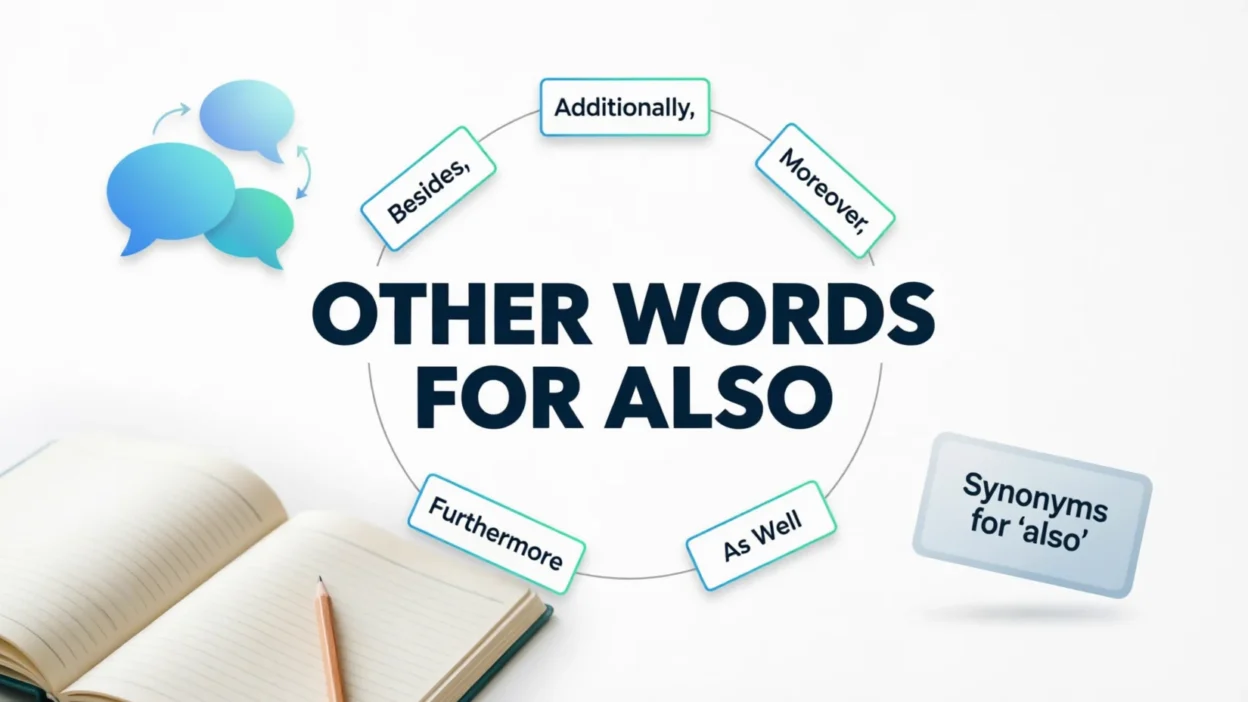
Other words for also include too, as well, additionally, furthermore, moreover, in addition, besides, likewise, equally, plus, and along with.
Use “too” or “as well” in casual conversations, “additionally” or “in addition” in formal writing, and “furthermore” or “moreover” when introducing another supporting point. The best alternative depends on your sentence and the relationship between your ideas.
What Does Also Mean?
The word “also” is an adverb that means in addition, too, or as well. It introduces another fact, action, quality, or idea related to something already mentioned.
For example:
- Original: She enjoys reading. She also enjoys writing.
- Alternative: She enjoys reading. She enjoys writing too.
In both sentences, “also” and “too” communicate that the person enjoys two activities.
“Also” can appear in different positions in a sentence. It commonly comes before the main verb, after the verb “be,” or before another element that needs emphasis.
Examples:
- They also play football.
- She is also a talented artist.
- I invited my friends and also my cousins.
Choosing an appropriate alternative helps you avoid repetition and communicate your ideas more naturally.
30 Other Words for Also With Meanings and Examples
Below are 30 alternatives to “also,” including conversational expressions, formal transitions, and phrases that express related ideas.
1. Too
Meaning: In addition; as well.
Example: I enjoy reading novels, and my sister enjoys them too.
Best usage/context: Use “too” in everyday conversations, informal writing, and friendly messages. It often appears at the end of a sentence.
2. As Well
Meaning: In addition to something already mentioned.
Example: She speaks English and understands French as well.
Best usage/context: Use “as well” in conversations, emails, and general writing. It is a natural alternative to “also,” especially near the end of a sentence.
3. Additionally
Meaning: Used to introduce another fact, point, or piece of information.
Example: The course teaches grammar. Additionally, it helps students improve their speaking skills.
Best usage/context: Use “additionally” in reports, academic assignments, business documents, and formal explanations.
4. Furthermore
Meaning: In addition to what has already been said, often to strengthen an argument.
Example: The proposal is affordable. Furthermore, it can be implemented quickly.
Best usage/context: Use “furthermore” in formal writing when you want to add another important supporting point.
5. Moreover
Meaning: In addition to what has already been mentioned, often with emphasis.
Example: The library is well organized. Moreover, it provides free access to digital resources.
Best usage/context: Use “moreover” in essays, research discussions, reports, and persuasive writing when the next point strengthens the previous one.
6. In Addition
Meaning: Along with something else; as an extra point.
Example: In addition to teaching mathematics, the school offers science workshops.
Best usage/context: Use “in addition” when introducing extra information or describing an additional feature, service, or responsibility.
7. Besides
Meaning: In addition to something; sometimes used to give another reason.
Example: Besides learning new vocabulary, students can improve their pronunciation through practice.
Best usage/context: Use “besides” in conversations and general writing. It can sound more conversational than “furthermore” or “moreover.”
8. Plus
Meaning: With something extra; also.
Example: The apartment is spacious, plus it is close to public transportation.
Best usage/context: Use “plus” in informal writing, advertisements, product descriptions, and conversations. It can introduce an extra benefit or advantage.
9. Likewise
Meaning: In the same way; similarly.
Example: Maria enjoys painting. Likewise, her brother loves creating art.
Best usage/context: Use “likewise” when adding a related example or showing that something is true in a similar way. It does not fit every sentence where “also” appears.
10. Similarly
Meaning: In a similar way or manner.
Example: The first student improved her writing. Similarly, the second student made progress through regular practice.
Best usage/context: Use “similarly” in academic writing, comparisons, reports, and explanations involving related situations.
11. Equally
Meaning: To the same degree or extent.
Example: Good communication and careful planning are equally important for a successful project.
Best usage/context: Use “equally” when expressing equal importance, value, or degree rather than simply adding another item.
12. As Well As
Meaning: In addition to; together with.
Example: She teaches mathematics as well as science.
Best usage/context: Use “as well as” to connect related people, things, activities, or responsibilities within a sentence.
13. Along With
Meaning: Together with or in addition to.
Example: The manager, along with her team, attended the conference.
Best usage/context: Use “along with” when mentioning another person, object, or activity connected to the main subject.
14. Coupled With
Meaning: Combined with or accompanied by something else.
Example: Her experience, coupled with her creativity, makes her a strong candidate.
Best usage/context: Use “coupled with” in formal writing when two qualities, conditions, or factors work together.
15. Not to Mention
Meaning: Used to introduce an additional fact that deserves attention.
Example: The hotel offers comfortable rooms, excellent service, and a beautiful garden, not to mention a swimming pool.
Best usage/context: Use this expression in conversational writing, reviews, and descriptions when you want to emphasize an extra advantage or detail.
16. On Top of That
Meaning: In addition to everything already mentioned.
Example: The train was delayed, and on top of that, it started raining.
Best usage/context: Use “on top of that” in informal conversations and storytelling, especially when adding another event or problem.
17. What Is More
Meaning: Furthermore; used to introduce another important point.
Example: The program is easy to use. What is more, it is available at no cost.
Best usage/context: Use “what is more” in general or moderately formal writing when highlighting an additional benefit or argument.
18. Over and Above
Meaning: In addition to something already included or expected.
Example: The employee received a bonus over and above her regular salary.
Best usage/context: Use “over and above” when referring to something extra beyond a basic amount, requirement, or expectation.
19. Not Only That
Meaning: Used to introduce another point, often one that makes the situation more impressive.
Example: The book is informative. Not only that, it is also enjoyable to read.
Best usage/context: Use “not only that” in conversations, presentations, and accessible writing to emphasize an additional fact.
20. In the Same Way
Meaning: In a similar manner.
Example: Regular reading improves vocabulary. In the same way, listening to podcasts can help learners discover new expressions.
Best usage/context: Use this phrase when explaining a similarity between methods, actions, or situations.
21. By the Same Token
Meaning: For a similar reason or according to the same principle.
Example: A good leader should listen to employees. By the same token, employees should communicate their concerns respectfully.
Best usage/context: Use “by the same token” in discussions, essays, and arguments when extending the same reasoning to another situation.
22. Correspondingly
Meaning: In a way that matches or relates to something else.
Example: The company expanded its services. Correspondingly, its customer support team grew.
Best usage/context: Use “correspondingly” in formal reports and analytical writing when one change or situation relates to another.
23. Further
Meaning: Additional or more, depending on how it is used.
Example: For further information, please contact the admissions office.
Best usage/context: Use “further” in phrases such as “further details,” “further assistance,” and “further discussion.” It is not a direct replacement for “also” in every sentence.
24. Another
Meaning: One more or an additional person or thing.
Example: She completed one assignment and started another.
Best usage/context: Use “another” when referring to an extra item, person, or opportunity. It usually modifies a noun rather than connecting two complete ideas.
25. Extra
Meaning: Additional or more than what is usual or expected.
Example: The teacher provided extra examples to help the students understand the lesson.
Best usage/context: Use “extra” when emphasizing an additional amount, resource, service, or effort.
26. Including
Meaning: Containing something as part of a larger group.
Example: The workshop covers several skills, including writing, editing, and proofreading.
Best usage/context: Use “including” when adding examples or identifying members of a larger category. It is not interchangeable with “also” in every grammatical structure.
27. Together With
Meaning: Alongside or in combination with another person or thing.
Example: The report, together with the supporting documents, was submitted yesterday.
Best usage/context: Use “together with” in formal communication when identifying accompanying people, materials, or items.
28. Added to That
Meaning: In addition to the information already given.
Example: The restaurant serves delicious food. Added to that, its staff are friendly and helpful.
Best usage/context: Use “added to that” in conversational explanations and informal writing when introducing another observation.
29. Also Worth Mentioning
Meaning: Something else that deserves attention.
Example: The museum has an impressive collection. Also worth mentioning is its free educational program for children.
Best usage/context: Use this phrase in reviews, articles, reports, and presentations when introducing a relevant detail that might otherwise be overlooked.
30. Additionally to This
Meaning: Intended to mean “in addition to this.”
Example: In addition to this, students receive access to online learning materials.
Best usage/context: The phrase “additionally to this” is generally awkward in standard English. Prefer “in addition to this” or simply “additionally.” These are more natural choices for formal and everyday writing.
Comparison Table: Which Synonym for Also Should You Use?
The following table compares common alternatives according to tone, purpose, and typical usage.
| Alternative | Tone | Best use |
| Too | Casual | Everyday conversations |
| As well | Neutral | General writing and speech |
| Additionally | Formal | Reports and explanations |
| Furthermore | Formal | Supporting an argument |
| Moreover | Formal | Emphasizing another point |
| In addition | Neutral to formal | Adding information |
| Besides | Conversational | Extra details or reasons |
| Plus | Informal | Benefits and advantages |
| Likewise | Neutral to formal | Similar situations |
| Similarly | Neutral to formal | Comparisons |
| Equally | Neutral | Equal importance or degree |
| As well as | Neutral | Connecting related items |
| Along with | Neutral | Accompanying people or things |
| Coupled with | Formal | Combined factors |
| Not to mention | Conversational | Highlighting an extra detail |
| On top of that | Informal | Adding another event or fact |
| What is more | Neutral to formal | Introducing a stronger point |
| Over and above | Formal | Something beyond an expected amount |
| Not only that | Conversational | Emphasizing an additional point |
| In the same way | Neutral | Explaining a similarity |
| By the same token | Formal | Extending an argument |
| Correspondingly | Formal | Related changes or results |
| Further | Formal in common phrases | Additional information |
| Another | Neutral | One more item |
| Extra | Neutral | Additional resources or amounts |
| Including | Neutral | Giving examples |
| Together with | Neutral to formal | Accompanying items or people |
| Added to that | Conversational | Adding an observation |
| Also worth mentioning | Neutral | Introducing a noteworthy detail |
| In addition to this | Neutral to formal | Adding a related fact |
How to Choose the Right Synonym for Also
Not every alternative to “also” works in every situation. Choose your replacement according to the meaning you want to communicate and the tone of your writing.
1. For Formal and Academic Writing
Choose additionally, furthermore, moreover, or in addition.
These expressions work well in essays, reports, research discussions, and professional documents.
Example:
Original: The study examines reading habits. It also explores the effects of digital media.
Revised: The study examines reading habits. Furthermore, it explores the effects of digital media.
Use “furthermore” when the second point strengthens or extends the first.
2. For Everyday Conversations
Choose too, as well, besides, or plus.
These alternatives sound natural in informal communication.
Example:
Original: I want to visit the museum. I also want to see the art gallery.
Revised: I want to visit the museum, and I want to see the art gallery too.
3. For Adding Supporting Arguments
Choose moreover, furthermore, or what is more.
These expressions help connect ideas when explaining why something is useful, important, or convincing.
Example:
The new system saves time. Moreover, it reduces unnecessary paperwork.
4. For Showing Similarity
Choose likewise, similarly, or in the same way.
These words are most appropriate when the second statement resembles the first.
Example:
Reading helps learners expand their vocabulary. Similarly, listening to English conversations exposes them to new expressions.
Remember that these expressions emphasize similarity rather than simply adding unrelated information.
5. For Adding People or Things
Choose along with, as well as, together with, or in addition to.
Example:
Original: The teacher organized the event. The students helped.
Revised: The teacher, along with the students, organized the event.
Be careful with subject-verb agreement. In this sentence, “the teacher” is the main subject, so the verb remains singular.
6. For Emphasizing Extra Benefits
Choose plus, not to mention, on top of that, or over and above, depending on the context.
Example:
The phone has a long battery life. On top of that, it charges quickly.
For professional product descriptions, “in addition” may sound more appropriate than “on top of that.”
7. For Simple and Clear Writing
Choose too or as well when a short, natural expression is enough.
Example:
Original: He also wants to participate.
Revised: He wants to participate too.
Simple alternatives often make sentences easier to understand without changing their meaning.
Common Mistakes When Using Synonyms for Also
Although many words can express addition, they are not always interchangeable.
Mistake 1: Using Moreover When You Mean Similarly
“Moreover” adds another supporting point, while “similarly” highlights a resemblance.
Incorrect choice: She enjoys painting. Similarly, she also enjoys mathematics.
This may be grammatically possible in some contexts, but “similarly” is unsuitable if no meaningful similarity is being established.
Better: She enjoys painting. Moreover, she enjoys mathematics.
Mistake 2: Confusing Also With As Well As
“Also” usually functions as an adverb, whereas “as well as” connects elements in a sentence.
Example:
- Correct: She also teaches English.
- Correct: She teaches English as well as history.
The two structures are related but not identical.
Mistake 3: Using Too Many Transition Words
Adding several alternatives to the same sentence can make writing repetitive.
Awkward: Additionally, the course is affordable. Furthermore, it is flexible. Moreover, it is convenient. In addition, it is practical.
Better: The course is affordable, flexible, and convenient. It also offers practical learning activities.
Use transition words when they help readers follow your ideas, not simply to make sentences longer.
Mistake 4: Forgetting the Position of Too
“Too” often appears at the end of a sentence or clause.
Natural: I would like to attend the meeting too.
Natural: I, too, would like to attend the meeting.
Both structures are correct, but the second is more emphatic.
Mistake 5: Treating Every Alternative as a Direct Replacement
Words such as “equally,” “including,” “another,” and “similarly” have specific functions.
For example:
- “Equally” expresses the same degree or importance.
- “Including” introduces examples or members of a group.
- “Another” identifies one more item.
- “Similarly” highlights resemblance.
Choose a word that matches the intended meaning rather than replacing “also” mechanically.
Mistake 6: Writing “Additionally to This”
Although readers may understand this phrase, it sounds unnatural in standard English.
Instead of “Additionally to this, the company offers free support,” write:
“In addition to this, the company offers free support.”
You can also simplify the sentence to:
“Additionally, the company offers free support.”
FAQs:
1. What is the most common synonym for also?
“Too” and “as well” are two of the most common alternatives in everyday English. “Additionally,” “furthermore,” and “moreover” are useful in more formal writing.
2. What is a formal word for also?
“Additionally” is a strong general choice for formal writing. “Furthermore” and “moreover” are useful when introducing another point that supports or strengthens an argument.
3. What is an informal word for also?
“Too,” “as well,” and “plus” are common informal alternatives. For example, “I want to come too” sounds natural in everyday conversation.
4. Can I use furthermore instead of also?
Yes, in some contexts. “Furthermore” is particularly useful when adding another supporting point in a discussion or argument. However, “also” is more neutral and works in a wider range of sentences.
5. What is the difference between also and too?
Both words express addition. “Also” commonly appears before the main verb or after a form of “be,” while “too” often appears at the end of a sentence or clause.
Examples:
- She also likes coffee.
- She likes coffee too.
Both sentences are correct.
6. What is the difference between also and moreover?
“Also” adds information neutrally, while “moreover” often introduces an additional point that strengthens the previous statement.
Example:
- Also: The office provides training. It also offers mentoring.
- Moreover: The office provides excellent training. Moreover, its mentoring program supports new employees.
7. How can I avoid repeating also in an essay?
Use alternatives such as “in addition,” “furthermore,” “moreover,” and “additionally” where they fit the meaning. You can also combine related sentences or use expressions such as “as well as.” Avoid replacing every occurrence with a different transition word if doing so makes the essay sound unnatural.
8. Is besides a synonym for also?
Yes, “besides” can mean “in addition to” or introduce an extra reason. However, it can also mean “apart from,” depending on the context.
Example: Besides English, she speaks Arabic.
Here, “besides” means that Arabic is another language she speaks in addition to English.
Conclusion
Learning other words for also helps you express additional ideas without relying on the same word in every sentence. Alternatives such as “too,” “as well,” “additionally,” “furthermore,” “moreover,” and “in addition” can make your writing more natural, precise, and engaging.
The key is to choose a synonym that fits your purpose. Use casual expressions in conversations, formal transitions in academic writing, and similarity words when comparing related ideas. Remember that not every synonym can replace “also” in every sentence.
With regular practice, you can build a stronger vocabulary, improve sentence flow, and communicate your ideas more confidently in both spoken and written English.

I am Andrew Foster, a passionate language writer who enjoys helping readers discover the right synonyms and improve their vocabulary. I create clear, accurate, and engaging content that makes learning English simple, practical, and enjoyable.