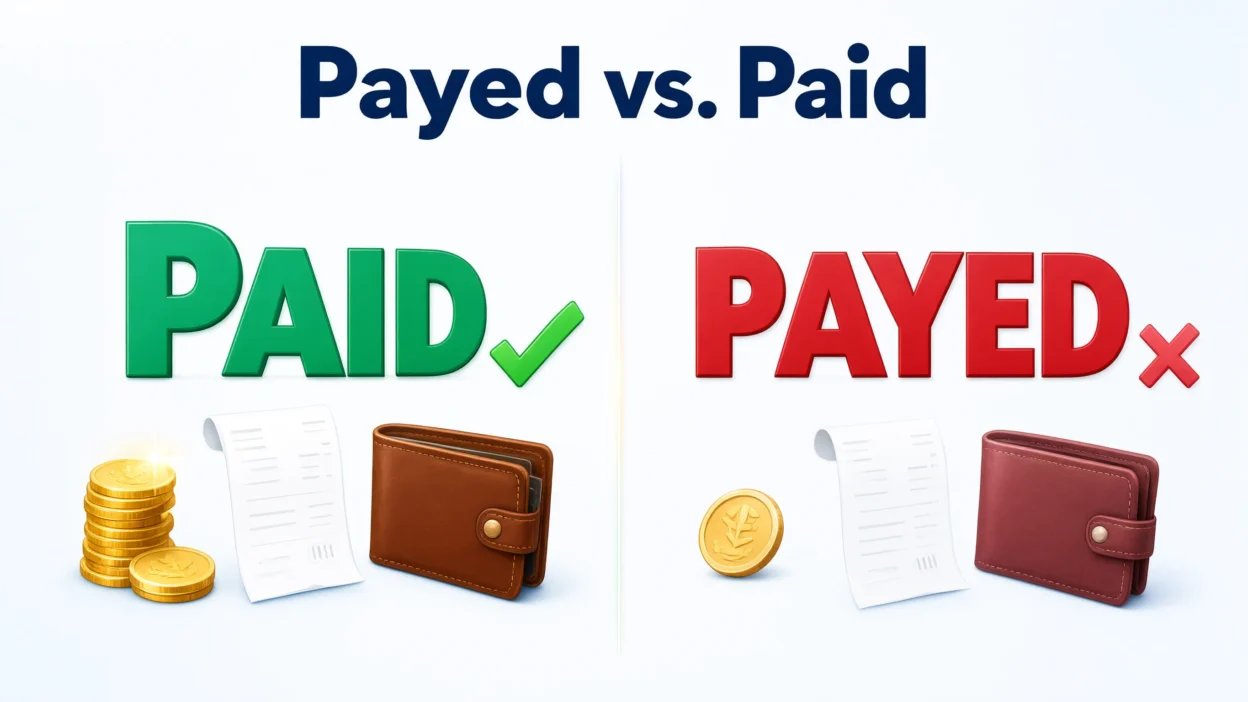
When deciding between payed vs paid, the correct word in most everyday situations is paid. It is the past tense and past participle of the verb pay, which means to give money for something or to settle a debt. For example, “I paid the bill yesterday” is correct.
Although payed is a real English word, it has a much narrower use related mainly to nautical language, such as letting out a rope or sealing a surface with tar. This difference can confuse students, English learners, and even experienced writers. Understanding when to use each spelling will help you write clearer emails, assignments, messages, and professional documents.
Both words come from the verb pay, but they are not interchangeable in ordinary writing. If you are talking about salaries, bills, purchases, fees, or debts, choose paid. If you are describing a specialized action involving ropes, cables, or similar nautical tasks, payed may be appropriate.
The easiest way to avoid mistakes is to remember that financial transactions almost always require paid. In this guide, you will learn the meanings of both words, their grammatical differences, practical examples, common errors, and the simple trick that makes the correct spelling easy to remember.
Quick Answer: Payed vs Paid
Paid is the correct spelling in almost every everyday situation. It is the past tense and past participle of pay, as in “She paid for lunch.” Payed is a specialized nautical term used when letting out rope or cable or, in some technical contexts, applying protective material to a surface. For bills, wages, purchases, and debts, always use paid.
Why Do People Confuse Payed and Paid?
People confuse payed and paid because both spellings are associated with the verb pay. English has many irregular verbs that do not follow the usual rule of adding -ed to form the past tense.
For example:
- Walk → walked
- Talk → talked
- Play → played
- Pay → paid
Because many English verbs form their past tense with -ed, some writers assume that payed must also be correct for everyday situations.
Another reason is that payed does exist as a legitimate word. However, its specialized meaning is uncommon in daily conversations. Spell-checking tools and unfamiliar technical vocabulary can also contribute to the confusion.
The key is to focus on the meaning of the sentence rather than simply how the word looks.
First Word: What Does Paid Mean?
Paid is the simple past tense and past participle of pay. It describes giving money, settling a bill, compensating someone, or fulfilling a financial obligation.
It is the standard spelling used in everyday English, business writing, academic assignments, and casual conversations.
Meaning of Paid
The word paid can have several related meanings:
- Gave money: “I paid $20 for the book.”
- Settled a debt: “She paid her outstanding balance.”
- Provided compensation: “The company paid its employees.”
- Covered a cost: “They paid for the hotel room.”
- Received compensation: “He was paid for his work.”
Paid can also appear in expressions that do not refer directly to money, such as “paid attention” and “paid a visit.”
Example Sentences With Paid
- I paid the electricity bill this morning.
- She paid for our dinner.
- The company paid its workers on Friday.
- Have you paid your registration fee?
- He paid attention to the teacher.
- We paid off our loan last year.
In each example, paid is the appropriate spelling.
Second Word: What Does Payed Mean?
Payed is a specialized form of pay used mainly in nautical contexts. It can describe letting out rope or cable, especially by slackening it gradually. In some technical uses, it also refers to applying a protective coating or sealing material to a surface.
Although payed is a legitimate word, it is not the normal past tense spelling when talking about money.
Meaning of Payed
The word payed is most commonly associated with specialized activities involving ropes, cables, ships, or protective materials.
Examples include:
- Letting out a rope: The sailor payed out the rope slowly.
- Releasing a cable: The crew payed out the cable as the vessel moved.
- Applying protective material: The workers payed the seams with a sealing compound.
The exact technical meaning depends on the context. These uses are uncommon outside specialist writing, so most readers will rarely need the word.
Example Sentences With Payed
- The sailor payed out the rope carefully.
- The crew payed out the cable from the ship.
- The deckhand payed out more line as the boat moved.
- The workers payed the seams with protective material.
These examples use payed in specialized senses rather than in connection with ordinary financial payments.
Payed vs Paid: Comparison Table
| Feature | Paid | Payed |
| Main meaning | Gave money or settled a debt | Let out rope or cable; certain technical coating uses |
| Everyday usage | Very common | Rare |
| Grammar | Past tense and past participle of pay | Specialized past-tense form |
| Bills and purchases | Correct | Incorrect |
| Salaries and wages | Correct | Incorrect |
| Nautical rope or cable | Usually not the intended term | Can be correct |
| Example | I paid the bill. | The sailor payed out the rope. |
The most important difference is their meaning. Paid is the normal choice for financial transactions, while payed is reserved for specific technical contexts.
When Should You Use Paid or Payed?
Choosing between the two words becomes easy when you identify what the sentence describes.
When to Use Paid
Use paid when discussing money, compensation, costs, debts, or common expressions involving the verb pay.
Examples:
- “I paid for my groceries.”
- “She paid her employees.”
- “We have paid the school fees.”
- “He paid attention during the lesson.”
- “They paid a visit to their grandparents.”
If the sentence is about money or a familiar expression, paid is almost certainly correct.
When to Use Payed
Use payed when the sentence describes a specialized action, such as letting out a rope or cable, or applying protective material in certain technical contexts.
Examples:
- “The sailor payed out the line.”
- “The crew payed out the cable.”
- “The workers payed the seams with sealant.”
These examples are most likely to appear in nautical, historical, or technical writing.
A Simple Decision Rule
Ask yourself one question: Am I talking about money?
- If yes, use paid.
- If you are describing a specialized nautical or technical action, check whether payed is the appropriate term.
- If you are unsure and the sentence concerns an ordinary payment, choose paid.
12 Examples of Payed vs Paid in Sentences
The following examples show how the correct spelling depends on the intended meaning.
Everyday Examples Using Paid
1. Paying a bill
Correct: I paid the water bill yesterday.
Incorrect: I payed the water bill yesterday.
Why: A bill is a financial obligation, so paid is correct.
2. Buying something
Correct: She paid $50 for her new shoes.
Incorrect: She payed $50 for her new shoes.
Why: The sentence describes a purchase.
3. Receiving a salary
Correct: The employees were paid at the end of the month.
Incorrect: The employees were payed at the end of the month.
Why: Compensation requires paid.
4. Paying school fees
Correct: My parents paid my school fees.
Incorrect: My parents payed my school fees.
Why: School fees are payments.
5. Settling a debt
Correct: He paid off his loan early.
Incorrect: He payed off his loan early.
Why: The verb describes settling a debt.
6. Paying attention
Correct: Please pay attention to the instructions.
Correct past tense: She paid attention to the instructions.
Incorrect: She payed attention to the instructions.
Why: The common expression uses paid in the past tense.
7. Paying for a service
Correct: We paid a professional to repair the computer.
Incorrect: We payed a professional to repair the computer.
Why: The sentence describes compensation.
8. Paying online
Correct: I paid for the order through the website.
Incorrect: I payed for the order through the website.
Why: Online purchases still require paid.
Specialized Examples Using Payed
9. Letting out a rope
Correct: The sailor payed out the rope slowly.
Why: The sentence describes a nautical action.
10. Releasing a cable
Correct: The crew payed out the cable from the vessel.
Why: Payed out can describe gradually releasing a cable.
11. Giving a boat more line
Correct: The deckhand payed out additional line as the boat moved.
Why: The specialized expression refers to releasing more rope.
12. Applying a protective coating
Correct in the relevant technical sense: The workers payed the seams with protective material.
Why: Some specialized uses of pay refer to coating or sealing a surface.
Common Mistakes With Payed and Paid
Even when you understand the difference, a few common mistakes are worth avoiding.
Mistake 1: Adding -ed to Pay
Incorrect: “I payed for the tickets.”
Correct: “I paid for the tickets.”
Although adding -ed works for many regular verbs, pay normally changes to paid in the past tense.
Mistake 2: Using Payed for Salaries
Incorrect: “The manager payed all the staff.”
Correct: “The manager paid all the staff.”
Wages, salaries, bonuses, and other forms of compensation use paid.
Mistake 3: Thinking Payed Is Never a Word
It is incorrect to claim that payed does not exist. It is a valid but uncommon word in specialized contexts.
For example, “The sailor payed out the line” uses the word in its nautical sense.
Mistake 4: Confusing Paid With Payed Out
The phrase paid out can refer to money distributed to someone. The phrase payed out can refer to letting out rope or cable.
Compare:
- The insurance company paid out the claim.
- The sailor payed out the rope.
The words look similar, but their meanings are different.
Memory Trick: How to Remember Paid vs Payed
Use this simple memory trick:
Paid = Payment.
Both words begin with the same sound, and the spelling paid is the one to remember whenever money is involved.
Think of these familiar examples:
- Paid a bill
- Paid for lunch
- Paid a salary
- Paid attention
- Paid off a debt
For payed, remember the phrase “payed out a rope.” This unusual association helps you connect the word with its specialized nautical meaning.
If you are writing a school assignment, work email, social media post, or everyday message, paid will almost always be the right choice.
American vs British English: Is There a Difference?
There is no meaningful American-versus-British spelling difference between paid and payed in ordinary financial contexts.
Both American and British English use paid as the standard past tense and past participle of pay.
| Context | American English | British English |
| Paying a bill | I paid the bill. | I paid the bill. |
| Paying wages | They paid the workers. | They paid the workers. |
| Paying attention | She paid attention. | She paid attention. |
| Nautical use | Payed out the rope | Payed out the rope |
Regional vocabulary and technical conventions can vary, but the basic spelling rule remains the same.
Similar Words: Paid, Pay, Payable, and Payment
Understanding related words can help you use paid correctly in different sentences.
Pay
Pay is the base form of the verb. It is used in the present tense and after modal verbs.
Example: “I pay my bills online.”
Paid
Paid is the usual past tense and past participle of pay.
Example: “I paid my bills yesterday.”
Paying
Paying is the present participle or gerund form of pay.
Example: “She is paying for the groceries.”
Payable
Payable describes money that must be paid or is due.
Example: “The invoice is payable within 30 days.”
Payment
Payment is a noun referring to money given in exchange for something or to settle an obligation.
Example: “Your payment has been received.”
Payed Out
Payed out is a specialized expression associated with releasing rope or cable. By contrast, paid out is used when money is distributed.
Example: “The company paid out the refund.”
These related forms make it easier to choose the correct word based on grammar and meaning.
Final Verdict: Payed or Paid?
Paid is the correct word for almost all everyday uses of the verb pay. Use it when discussing bills, purchases, wages, fees, debts, or expressions such as paid attention.
Payed is a valid but uncommon spelling used in specialized nautical contexts and certain technical applications, such as letting out rope or cable.
If you are unsure which word to choose, consider the meaning of your sentence. When money or a financial obligation is involved, write paid. Save payed for the specific technical contexts where it is appropriate.
FAQs:
1. Is it paid or payed?
Paid is correct in almost every everyday situation. Use it for bills, purchases, wages, and debts. Payed is used mainly in specialized nautical or technical contexts.
2. Is payed ever a real word?
Yes. Payed is a real English word. It can refer to letting out a rope or cable and, in certain technical contexts, applying protective material to a surface.
3. Is “I payed the bill” grammatically correct?
No, not in standard everyday English. The correct sentence is “I paid the bill.” The verb pay normally takes the irregular past-tense form paid when referring to a financial transaction.
4. Why is paid spelled without -ed?
Pay is an irregular verb in this use. Its past tense and past participle are paid, rather than the regular form payed. Similar irregular verbs include say → said and lay → laid.
5. Is it paid off or payed off?
Use paid off when talking about a debt or loan that has been settled. For example, “She paid off her student loan.” The expression payed off is not correct for this financial meaning.
6. Is it paid attention or payed attention?
The correct expression is paid attention. For example, “The students paid attention to the lesson.” This is a standard expression even though it does not involve a direct financial payment.
7. Is “paid out” or “payed out” correct?
Both can be correct, depending on the meaning. Use paid out for money distributed, such as an insurance claim. Use payed out when describing the specialized action of letting out a rope or cable.
Remember This
- Paid is the standard past tense and past participle of pay.
- Use paid for bills, salaries, purchases, debts, and paid attention.
- Payed is a specialized word associated mainly with ropes, cables, and certain technical coating tasks.
- American and British English follow the same basic rule.
- When in doubt about an ordinary payment, choose paid.
Conclusion
The difference between payed and paid is simple once you understand their meanings. Paid is the correct choice for everyday situations involving money, purchases, bills, salaries, and debts. It is also used in common expressions such as paid attention and paid a visit. Because pay is an irregular verb, its standard past tense does not follow the usual pattern of adding -ed.
Although payed is a legitimate English word, it belongs mainly to specialized nautical and technical contexts. Remember the connection between paid and payment, and you will avoid the most common spelling mistake.
Whenever you write about a financial transaction, use paid unless you are describing a specific technical action that calls for payed. This small distinction will make your English clearer, more accurate, and more natural.

I am Olivia Brooks, a language enthusiast and writer at SynonymsHive. I enjoy creating clear, engaging content about synonyms, vocabulary, and word meanings, helping readers improve their writing and communicate with confidence every day.