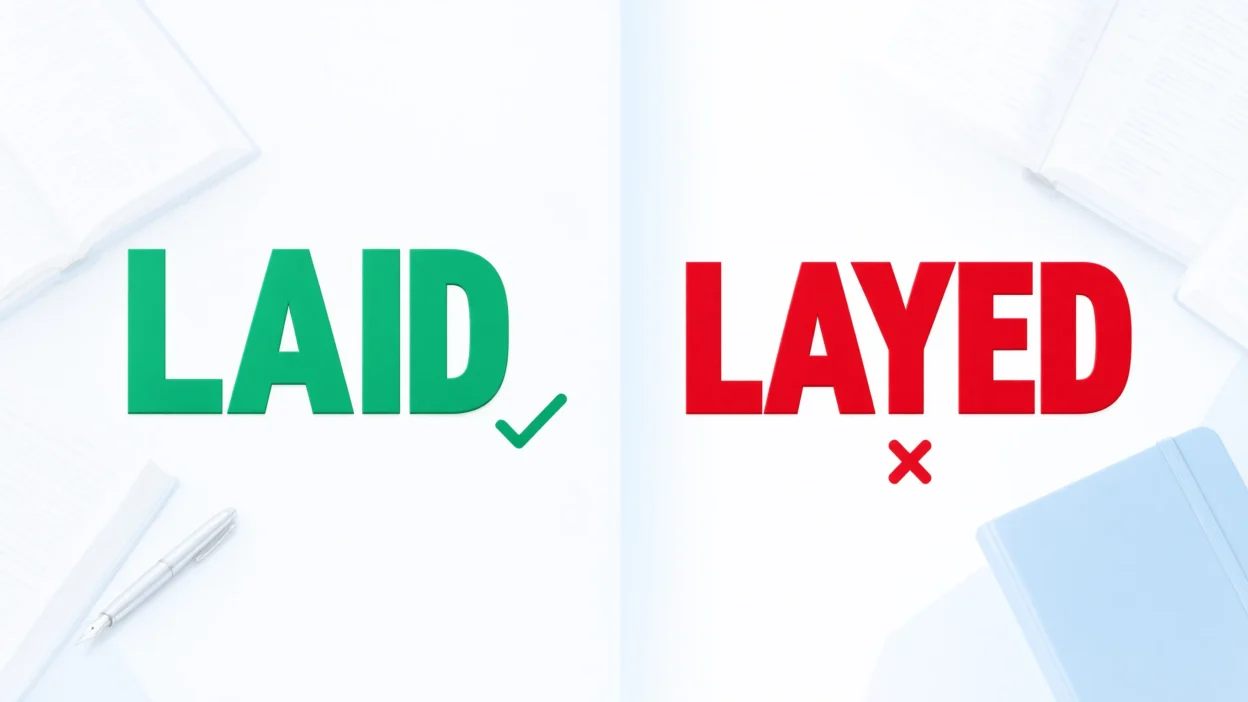
When deciding between laid vs. layed, the correct spelling in standard English is almost always laid. It is the past tense and past participle of the verb lay, which means to put or place something down.
For example, “She laid the book on the table” is correct. The spelling layed is generally considered incorrect in modern standard English when used as the past tense of lay. This spelling confusion happens because many English verbs form their past tense by adding -ed, such as played, walked, and cleaned. However, lay is an irregular verb, so its past form does not follow that pattern.
Understanding the difference between lay, laid, and lie can help you avoid common grammar mistakes in school assignments, professional emails, creative writing, and everyday conversations. Although laid and layed may sound similar, only one is the standard spelling for the past tense of lay.
In this guide, you will learn what each word means, when to use laid, why layed is usually incorrect, and how to recognize the difference through simple examples. You will also discover an easy memory trick to help you choose the right spelling whenever you write in English.
Quick Answer: Laid vs. Layed
Laid is the correct spelling of the past tense and past participle of lay. It means placed or put something down. Layed is not accepted in standard modern English for this meaning. For example, write “He laid the keys on the desk,” not “He layed the keys on the desk.”
Why Do People Confuse Laid and Layed?
People often confuse laid and layed because English has many regular verbs that form their past tense by adding -ed. For example, play becomes played, and stay becomes stayed. Following this pattern, some writers assume that lay should become layed.
However, lay is an irregular verb. Its past tense is laid, not layed. English contains many irregular verbs that change in unexpected ways, including go to went, take to took, and make to made.
Another reason for the confusion is pronunciation. In ordinary speech, laid and the incorrectly spelled layed may be pronounced the same way. Because their sounds do not clearly reveal the spelling difference, writers must remember the correct written form.
What Does Laid Mean?
Laid is the past tense and past participle of the verb lay. It means to put, place, or set something down. It can also describe arranging objects, placing something carefully, or producing eggs.
Examples:
- She laid her phone beside the computer.
- He laid the baby gently in the crib.
- The hen laid three eggs yesterday.
- They laid the foundation for the new building.
- I have laid all the documents on your desk.
In these sentences, laid describes an action involving something being placed, positioned, or produced.
How Is Laid Used in a Sentence?
Use laid when talking about an action that happened in the past or when forming a perfect tense with a helping verb such as has, have, or had.
- Simple past: She laid the blanket on the bed.
- Present perfect: She has laid the blanket on the bed.
- Past perfect: She had laid the blanket on the bed before the guests arrived.
Remember that lay generally takes a direct object. Someone lays something, such as a book, a blanket, or a foundation.
What Does Layed Mean?
Layed is generally an incorrect spelling of laid in standard modern English. It is not the accepted past tense or past participle of lay when the verb means to place something down.
For example:
- Incorrect: He layed his jacket on the chair.
- Correct: He laid his jacket on the chair.
The same rule applies to other sentences:
- Incorrect: The hen layed two eggs.
- Correct: The hen laid two eggs.
Although you may encounter layed in informal writing, online posts, or spelling mistakes, you should use laid in schoolwork, business communication, articles, and other standard English writing.
Laid vs. Layed: Comparison Table
| Feature | Laid | Layed |
| Standard spelling | Correct | Generally incorrect |
| Base verb | Lay | Lay |
| Past tense | Yes | No |
| Past participle | Yes | No |
| Meaning | Put or placed something down | No standard meaning for this use |
| Example | She laid the book down. | She layed the book down. |
| Suitable for formal writing | Yes | No |
The main distinction is simple: use laid whenever you need the standard past tense or past participle of lay.
When Should You Use Laid or Layed?
Use Laid for Past Actions
Choose laid when describing something that someone placed or put down in the past.
Examples:
- Maria laid her purse on the counter.
- The workers laid the bricks carefully.
- He laid his cards on the table.
Use Laid With Has, Have, or Had
Use laid after these helping verbs when the sentence requires the past participle.
Examples:
- I have laid the papers in the correct order.
- She has laid the groundwork for the project.
- They had laid the carpet before moving in.
Use Laid When Talking About Eggs
The verb lay is also used when birds and some other animals produce eggs. Its past tense is laid.
Examples:
- The chicken laid an egg this morning.
- The turtle laid its eggs in the sand.
Avoid Layed in Standard English
Do not use layed as the past tense of lay in standard writing. Replace it with laid.
Incorrect: The teacher layed the books on the desk.
Correct: The teacher laid the books on the desk.
12 Examples of Laid vs. Layed in Sentences
These examples show how to use laid correctly in everyday English.
1. Correct: She laid her keys on the kitchen counter.
Incorrect: She layed her keys on the kitchen counter.
2. Correct: He laid the baby in the crib.
Incorrect: He layed the baby in the crib.
3. Correct: The hen laid two eggs this morning.
Incorrect: The hen layed two eggs this morning.
4. Correct: I laid my clothes on the bed.
Incorrect: I layed my clothes on the bed.
5. Correct: They laid the foundation for the house.
Incorrect: They layed the foundation for the house.
6. Correct: She has laid the documents on your desk.
Incorrect: She has layed the documents on your desk.
7. Correct: He laid the cards face down.
Incorrect: He layed the cards face down.
8. Correct: The workers laid the new tiles yesterday.
Incorrect: The workers layed the new tiles yesterday.
9. Correct: I had laid the table before the guests arrived.
Incorrect: I had layed the table before the guests arrived.
10. Correct: The farmer laid the tools beside the barn.
Incorrect: The farmer layed the tools beside the barn.
11. Correct: She carefully laid the flowers on the grave.
Incorrect: She carefully layed the flowers on the grave.
12. Correct: The company has laid plans for future growth.
Incorrect: The company has layed plans for future growth.
In every example, laid is the correct form. The incorrect sentences demonstrate a common spelling error.
Common Mistakes With Laid and Layed
Even though the rule is straightforward, several related grammar mistakes can make the choice confusing.
Mistake 1: Writing Layed Instead of Laid
Incorrect: He layed the newspaper on the table.
Correct: He laid the newspaper on the table.
The past tense of lay is irregular, so you cannot form it by simply adding -ed.
Mistake 2: Confusing Lay With Lie
The verbs lay and lie have different meanings and different past-tense forms.
- Lay: To put something down.
- Lie: To recline or rest in a horizontal position.
Compare these examples:
- I lay the book on the shelf.
- Yesterday, I laid the book on the shelf.
- I lie on the sofa when I feel tired.
- Yesterday, I lay on the sofa.
Notice that lay is the past tense of lie. This is one reason English learners sometimes struggle with these words.
Mistake 3: Using Laid Without an Object
When lay means to put something down, it generally needs a direct object.
Incorrect: I laid on the bed.
Correct: I lay on the bed.
If you mean that you reclined on the bed, use lie in the present tense and lay in the past tense. If you mean that you placed something on the bed, use laid.
Mistake 4: Assuming Every Verb Takes -Ed
Many English verbs follow the regular -ed pattern, but irregular verbs do not always follow predictable spelling rules.
For example:
- Go → went
- Buy → bought
- Teach → taught
- Lay → laid
Learning common irregular verbs will improve your spelling and grammar.
What Is an Easy Memory Trick for Laid vs. Layed?
Use this simple trick: Lay, laid, laid — never layed.
Remember the three main forms:
- Present: lay
- Past: laid
- Past participle: laid
You can also remember the sentence, “Yesterday, I laid it down.”
For example:
- Today, I lay the book on the desk.
- Yesterday, I laid the book on the desk.
- I have laid the book on the desk.
Repeating these forms in short sentences can help you remember them naturally.
Laid vs. Layed in American and British English
There is no standard American-versus-British spelling difference between laid and layed. Both American and British English use laid as the standard past tense and past participle of lay.
For example:
- American English: She laid the bag on the floor.
- British English: She laid the bag on the floor.
The spelling remains the same in both varieties. You should not switch to layed when writing for a British or American audience.
Similar Words You Should Know
Understanding related words can make the difference between laid and layed easier to remember.
| Word | Meaning | Example |
| Lay | Put or place something down | I lay the book on the desk. |
| Laid | Past tense of lay | I laid the book on the desk yesterday. |
| Laying | Present participle of lay | She is laying the blanket on the bed. |
| Lie | Recline or rest | I lie down after work. |
| Lay (past of lie) | Reclined or rested | I lay down yesterday. |
| Lain | Past participle of lie | I have lain here for an hour. |
| Placed | Put something in a position | He placed the cup on the shelf. |
| Set | Put or position something | She set the bag on the chair. |
The most important distinction is between lay and lie. Lay involves putting something down, while lie describes a person or animal reclining. Their past forms are different: laid is the past tense of lay, and lay is the past tense of lie.
Final Verdict: Laid or Layed?
Laid is the correct spelling in standard English. Use it as the past tense and past participle of lay when you mean to put, place, or set something down.
Layed is generally a misspelling in this context and should be avoided in formal and everyday standard writing. Whether you are writing an essay, sending an email, or creating online content, choose laid.
FAQs:
1. Is laid or layed correct?
Laid is correct in standard English. It is the past tense and past participle of lay. Layed is generally an incorrect spelling when used with this meaning.
2. Is layed ever a real word?
You may encounter layed in historical texts, specialized contexts, or nonstandard writing, but it is not the accepted modern standard form for the past tense of lay. In ordinary writing, use laid.
3. Why is laid spelled without -ed?
Lay is an irregular verb. Instead of forming its past tense as layed, it changes to laid. English has many irregular verbs with unexpected past forms.
4. What is the past tense of lay?
The past tense of lay is laid. For example, “She laid the book on the table yesterday.”
5. What is the past participle of lay?
The past participle of lay is also laid. Use it with helping verbs such as has, have, and had. For example, “They have laid the carpet.”
6. Is it laid down or layed down?
The correct expression is laid down when describing a completed action. For example, “He laid down the rules.” The spelling layed down is not standard.
7. What is the difference between laid and lain?
Laid is the past tense and past participle of lay, meaning to put something down. Lain is the past participle of lie, meaning to recline. For example, “She laid the blanket down” and “She has lain in bed all morning.”
8. Is laid correct in both American and British English?
Yes. Both American and British English use laid as the standard past tense and past participle of lay. There is no regional spelling difference for this word.
Remember This
- Lay = put or place something down.
- Laid = the past tense and past participle of lay.
- Layed = generally incorrect for this meaning.
- Lie = recline or rest.
- Lay can also be the past tense of lie.
The easiest rule to remember is: When the past tense of lay means placed, write laid, never layed.
Conclusion
The difference between laid and layed is simple once you learn that lay is an irregular verb. Although adding -ed is a common way to form the past tense of English verbs, this rule does not apply to every word. The correct past tense and past participle of lay are both laid. Use it when describing placing objects, arranging items, laying foundations, or producing eggs.
To improve your writing, practice using lay, laid, and lie in complete sentences. Remember that laid means something was put down, while lie refers to reclining or resting. Both American and British English follow the same spelling rule. With a little practice, you will be able to choose laid confidently in school assignments, professional writing, and everyday communication.

I’m James Parker, Administrator at SynonymsHive. I oversee content quality, improve user experience, and ensure reliable synonym resources. My passion is making language learning simple, accurate, and accessible for everyone.