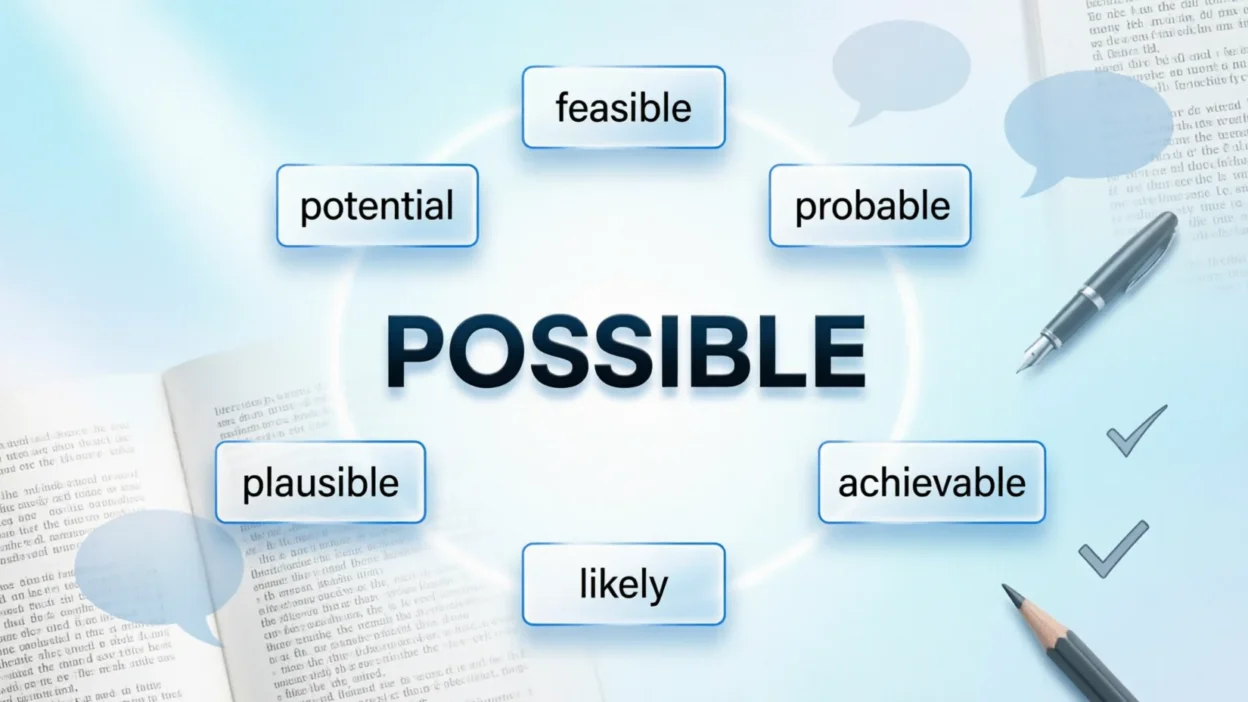
The word possible describes something that can happen, can exist, or can be done. Common synonyms include potential, feasible, achievable, plausible, conceivable, probable, likely, and attainable, but each has a slightly different meaning.
Choosing the right synonym depends on if you are talking about an opportunity, an uncertain event, something practical, or something that seems believable.
Understanding the differences between these words can make your English more precise and natural. This guide explains 30 synonyms for possible, with simple meanings, example sentences, and the best context for each word.
Quick Answer: What Is a Synonym for Possible?
Some of the most useful synonyms for possible are potential, feasible, achievable, attainable, plausible, conceivable, probable, likely, viable, and practicable.
However, these words are not always interchangeable. For example, feasible usually means something can realistically be done, while plausible means something seems reasonable or believable. Potential often refers to something that may develop or happen in the future.
What Does “Possible” Mean?
Possible means that something can happen, exist, or be done.
For example:
- It is possible to finish the project today.
- Is it possible to change the appointment?
- There are several possible explanations.
- We are considering every possible solution.
The word can describe an event, action, explanation, result, opportunity, or situation.
Different Meanings of Possible
Possible as “able to happen”
Possible as “able to be done”
Possible as “reasonable or believable”
Possible as “potential”
Because the meaning changes slightly according to context, the best synonym also changes.
30 Synonyms for Possible
1. Potential
Simple meaning: Something that may happen or develop in the future.
Example
Best usage/context: Use potential when discussing future opportunities, abilities, results, or developments.
2. Feasible
Simple meaning: Possible and practical to accomplish.
Example:
Best usage/context: Common in business, engineering, planning, and academic writing when something is realistically achievable.
3. Achievable
Simple meaning: Able to be successfully completed or reached.
Example:
Best usage/context: Best for goals, targets, results, and objectives.
4. Attainable
Simple meaning: Possible to achieve or obtain.
Example:
Best usage/context: Useful for goals, standards, ambitions, and desired results.
5. Plausible
Simple meaning: Reasonable enough to be believed.
Example:
Best usage/context: Use it when discussing explanations, theories, reasons, or claims that seem believable.
6. Conceivable
Simple meaning: Able to be imagined or considered as possible.
Example:
Best usage/context: Useful when discussing something imaginable, especially an uncertain future situation.
7. Probable
Simple meaning: Likely to happen.
Example:
Best usage/context: Use probable when something has a relatively strong chance of happening.
8. Likely
Simple meaning: Having a good chance of happening.
Example:
Best usage/context: Very common in everyday English when discussing expected events or outcomes.
9. Viable
Simple meaning: Capable of working or succeeding.
Example:
Best usage/context: Best for plans, businesses, solutions, strategies, and alternatives that could realistically work.
10. Practicable
Simple meaning: Able to be done successfully in real conditions.
Example:
Best usage/context: Formal situations involving plans, procedures, or solutions.
11. Realistic
Simple meaning: Reasonably possible in the real world.
Example:
Best usage/context: Useful when judging whether an expectation, goal, or plan matches real-world conditions.
12. Doable
Simple meaning: Possible to complete or accomplish.
Example:
Best usage/context: Informal English, especially when discussing tasks, jobs, or projects.
13. Attainable
Simple meaning: Possible to reach or obtain.
Exampl
Best usage/context: Particularly useful for goals and measurable achievements.
14. Potentially
Simple meaning: In a way that may happen or develop.
Example:
Best usage/context: Use as an adverb when describing something that may happen in the future.
15. Prospective
Simple meaning: Expected or considered as a future possibility.
Example:
Best usage/context: Common with people, customers, buyers, employees, students, and future opportunities.
16. Contemplable
Simple meaning: Able to be considered or thought about.
Example
Best usage/context: Formal and relatively uncommon; use it when emphasizing consideration rather than likelihood.
17. Permissible
Simple meaning: Allowed under a rule, law, or system.
Example:
Best usage/context: Use when possible means “allowed” rather than simply “able to happen.”
18. Allowable
Simple meaning: Permitted or accepted.
Exampl
Best usage/context: Common in rules, policies, finance, regulations, and technical instructions.
19. Available
Simple meaning: Ready or able to be used or obtained.
Example:
Best usage/context: Useful when possible refers to choices, resources, options, or opportunities that can be accessed.
20. Open
Simple meaning: Still available for consideration or development.
Exampl
Best usage/context: Useful when discussing options, decisions, opportunities, or unresolved situations.
21. Potential
Simple meaning: Having the ability or possibility to become something.
Example:
Best usage/context: Best for future possibilities, abilities, opportunities, and growth.
22. Credible
Simple meaning: Believable or worthy of trust.
Example
Best usage/context: Use when an idea or explanation is believable, although credible does not always mean that something is actually possible.
23. Reasonable
Simple meaning: Sensible and believable.
Exampl
Best usage/context: Useful when an option, explanation, assumption, or expectation makes sense.
24. Imagined
Simple meaning: Able to be formed as an idea in the mind.
Example:
Best usage/context: Use when discussing things that can be mentally considered rather than confirmed realities.
25. Hypothetical
Simple meaning: Based on an imagined situation or possibility.
Examp
Best usage/context: Common in academic discussions, problem-solving, law, science, and thought experiments.
26. Potentially achievable
Simple meaning: Possibly capable of being achieved.
Example:
Best usage/context: Useful when you want to emphasize both uncertainty and future achievement.
27. Obtainable
Simple meaning: Possible to get or acquire.
Example:
Best usage/context: Best when possible means something can be acquired, accessed, or obtained.
28. Reachable
Simple meaning: Possible to reach physically or figuratively.
Example:
Best usage/context: Useful for destinations, goals, deadlines, and targets.
29. Workable
Simple meaning: Capable of functioning successfully.
Example:
Best usage/context: Best for plans, systems, arrangements, and solutions that can function in practice.
30. Realizable
Simple meaning: Capable of being achieved or made real.
Example:
Best usage/context: More formal than achievable and useful for ambitions, plans, ideas, or objectives.
Comparison Table: Possible Synonyms at a Glance
| Synonym | Main Meaning | Best Context | Tone |
|---|---|---|---|
| Possible | Can happen or be done | General use | Neutral |
| Potential | May develop or happen | Future opportunities | Neutral |
| Feasible | Practical to accomplish | Plans and projects | Formal |
| Achievable | Can be successfully completed | Goals and targets | Neutral |
| Attainable | Can be reached or obtained | Goals and standards | Neutral/Formal |
| Plausible | Seems believable | Explanations and theories | Neutral/Formal |
| Conceivable | Can be imagined | Uncertain possibilities | Formal |
| Probable | Likely to happen | Predictions | Formal |
| Likely | Has a good chance of happening | Everyday predictions | Neutral |
| Viable | Can work successfully | Solutions and strategies | Formal |
| Practicable | Can be practically done | Procedures and plans | Formal |
| Realistic | Fits real-world conditions | Expectations and plans | Neutral |
| Doable | Can be done | Tasks and projects | Informal |
| Prospective | Expected or considered for the future | People and opportunities | Formal |
| Permissible | Allowed | Rules and laws | Formal |
| Allowable | Permitted | Policies and limits | Formal |
| Available | Can be accessed or used | Options and resources | Neutral |
| Reasonable | Sensible or believable | Explanations and choices | Neutral |
| Hypothetical | Imagined for discussion | Examples and scenarios | Formal |
| Workable | Can function successfully | Plans and solutions | Neutral |
How to Choose the Right Synonym for Possible
The best synonym depends on what kind of possibility you want to express.
When You Mean “May Happen”
Use:
- Possible
- Potential
- Conceivable
- Probable
- Likely
Example:
If you think the event has a stronger chance of happening, likely or probable may be more appropriate.
When You Mean “Can Be Done”
Use:
- Feasible
- Achievable
- Attainable
- Doable
- Practicable
- Workable
Example:
Here, feasible emphasizes practical possibility rather than simply saying that something can theoretically happen.
When You Mean “Seems Believable”
Use:
- Plausible
- Credible
- Reasonable
- Conceivable
Example:
These words are useful when evaluating ideas, explanations, arguments, or theories.
When You Mean “Likely”
Use:
- Likely
- Probable
- Prospective
Example:
Remember that possible is broader than likely. Something can be possible without being likely.
When You Mean “Allowed”
Use:
- Permissible
- Allowable
Example:
In this situation, replacing permissible with feasible would change the meaning.
When You Mean “Can Work”
Use:
- Viable
- Workable
- Feasible
- Practicable
Example:
These words are particularly useful when discussing solutions, strategies, plans, or systems.
Possible vs. Probable
Possible means something can happen.
Probable means something is more likely to happen.
Compare:
This means Sara can win, but it does not tell us that she is likely to win.
This expresses a stronger expectation.
Therefore, probable is not always a direct replacement for possible.
Possible vs. Likely
These two words are closely related but have different levels of certainty.
The event may happen.
The speaker expects the event to happen.
A useful way to remember the difference is:
Possible = can happen
Likely = has a good chance of happening
Possible vs. Feasible
Possible is broad, while feasible emphasizes practicality.
For example:
This simply says it can happen.
This suggests that the timeline is realistically manageable with the available conditions and resources.
Possible vs. Plausible
Possible means something can happen or exist.
Plausible means something seems believable or reasonable.
For example:
The first statement concerns possibility. The second focuses on whether the explanation makes sense.
Common Usage Mistakes
Mistake 1: Treating Every Synonym as Identical
Not every synonym for possible works in every sentence.
Incorrect or awkward:
Better:
Mistake 2: Using “Probable” When You Only Mean “Possible”
Probable suggests a stronger likelihood.
Instead of:
If you only mean that going is an option, say:
Mistake 3: Confusing “Feasible” With “Likely”
A plan can be feasible without being likely to happen.
For example:
The project can realistically be completed, but its actual occurrence remains uncertain.
Mistake 4: Using “Plausible” to Mean “Proven”
A plausible explanation is believable, but it is not necessarily true.
For example:
This does not mean:
Mistake 5: Using “Possible” When You Mean “Allowed”
If a rule determines whether something is permitted, use words such as permissible or allowable.
can mean “Can I park here?” or “Am I allowed to park here?”
If permission is the main issue, a clearer sentence is:
FAQs:
What is the best synonym for possible?
There is no single best synonym for every situation. Potential, feasible, likely, plausible, achievable, and conceivable are useful alternatives, but the right choice depends on the intended meaning.
What is a simple synonym for possible?
Potential, likely, doable, and achievable can be simple alternatives depending on the sentence. For everyday English, doable is especially useful when talking about tasks.
What is a formal synonym for possible?
Depending on the context, formal alternatives include feasible, plausible, conceivable, viable, practicable, and realizable.
What is the opposite of possible?
Common opposites include impossible, unachievable, infeasible, unattainable, and unlikely, depending on the intended meaning.
Is “likely” the same as “possible”?
No. Possible means something can happen, while likely suggests that something has a good chance of happening. Something can be possible without being likely.
Is “feasible” a synonym for possible?
Yes, in some contexts. However, feasible specifically emphasizes that something is practical or realistically achievable.
Is “plausible” the same as “possible”?
Not exactly. Possible means something can happen or be true. Plausible means it appears reasonable or believable.
What is the difference between possible and potential?
Possible generally describes something that can happen or be done. Potential often describes something that may develop, become useful, or happen in the future.
Conclusion
The word possible is useful because it covers many kinds of uncertainty and opportunity, but more precise synonyms can make your writing clearer. Use feasible for practical plans, achievable for goals, plausible for believable explanations, likely for events with a strong chance of happening, and potential for future opportunities or development.
Learning these distinctions helps students, ESL learners, writers, and content creators choose words that communicate exactly what they mean. Instead of replacing possible automatically, first consider the context, level of certainty, practicality, and tone of your sentence.

I’m James Parker, Administrator at SynonymsHive. I oversee content quality, improve user experience, and ensure reliable synonym resources. My passion is making language learning simple, accurate, and accessible for everyone.