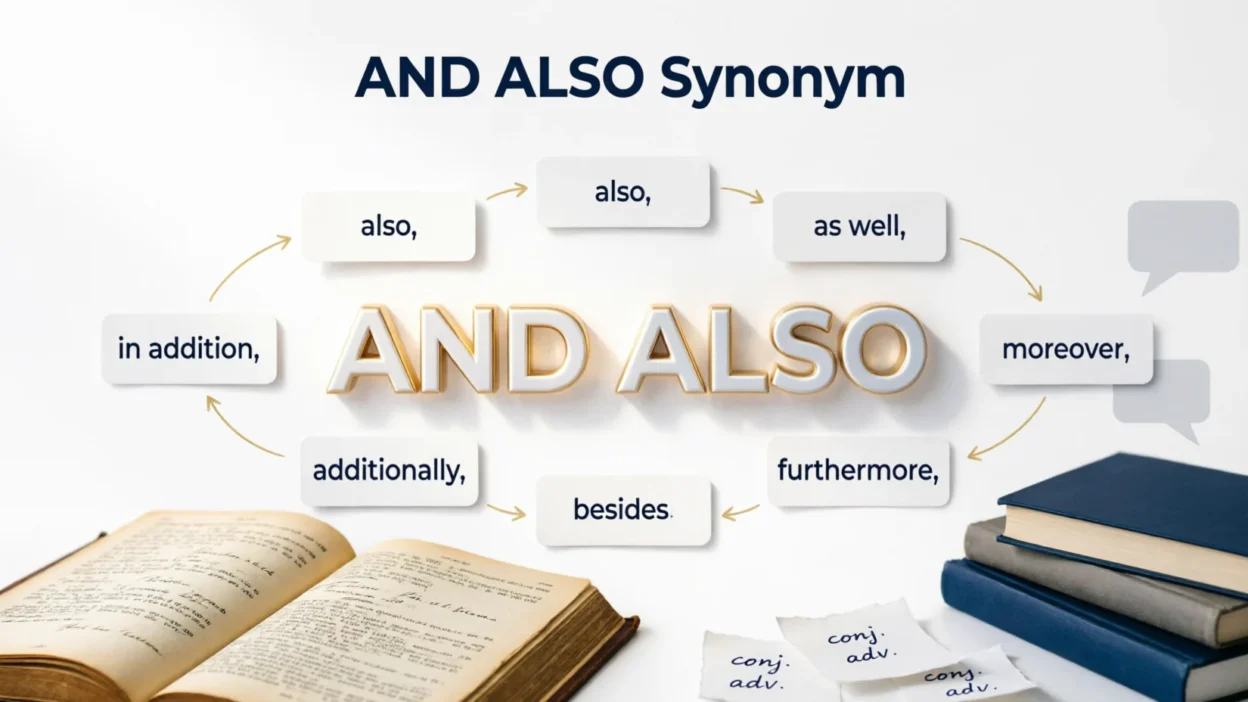
If you are looking for an “and also” synonym, useful alternatives include additionally, moreover, furthermore, as well as, besides, in addition, too, likewise, along with, and together with. The best choice depends on if you are adding information, emphasizing another point, or connecting two related ideas.
In everyday English, “and also” is common and correct, but using a suitable alternative can make your writing smoother and more precise. This guide explains 30 alternatives with simple meanings, examples, and usage contexts.
Quick Answer: What Is Another Word for “And Also”?
The most useful alternatives to “and also” are:
- Additionally — adds another fact or idea.
- Moreover — adds an important supporting point.
- Furthermore — adds another formal or supporting point.
- In addition — introduces extra information.
- As well as — connects two people, things, or actions.
- Besides — adds another reason or point.
- Too — adds something in a simple, informal way.
- Likewise — adds a similar point.
- Along with — indicates something accompanying another thing.
- Together with — emphasizes two things considered together.
What Does “And Also” Mean?
“And also” is used to add another person, thing, fact, action, or idea to something already mentioned.
For example:
Here, “also” adds Spanish to the information already given about English.
The phrase can be useful in conversation and writing, but it can sometimes sound repetitive because “and” and “also” both perform an additive function.
Simple Meaning
And also = in addition to something already mentioned.
Examples
- He is intelligent and also hardworking.
- We visited the museum and also explored the old town.
- She bought a notebook and also purchased some pens.
Depending on the sentence, you can replace “and also” with a more natural expression.
30 Synonyms and Alternatives for “And Also”
1. Additionally
Simple meaning: In addition; adding another point.
Example:
The course is affordable. Additionally, it offers flexible study hours.
Best usage/context: Formal writing, reports, essays, and informative content.
2. Moreover
Simple meaning: Also; more importantly, another supporting point.
Example:
The apartment is spacious. Moreover, it is close to public transportation.
Best usage/context: Formal writing when the additional point strengthens the previous statement.
3. Furthermore
Simple meaning: In addition to what has already been said.
Example:
The software is easy to use. Furthermore, it requires very little maintenance.
Best usage/context: Academic, professional, and formal writing.
4. In Addition
Simple meaning: Also; something extra.
Example:
In addition to English, she studies French.
Best usage/context: Essays, reports, explanations, and professional communication.
5. As Well As
Simple meaning: And; together with.
Example:
She teaches mathematics as well as science.
Best usage/context: Connecting two related people, things, subjects, or activities.
6. Besides
Simple meaning: In addition to; apart from that.
Example:
Besides working full-time, he studies at night.
Best usage/context: Everyday English and conversational writing; it can also introduce an additional reason.
7. Too
Simple meaning: Also.
Example:
I enjoyed the movie, too.
Best usage/context: Casual conversation and everyday writing.
8. As Well
Simple meaning: Also.
Example:
She wants to attend the workshop as well.
Best usage/context: Everyday English, especially at the end of a sentence.
9. Likewise
Simple meaning: In the same way; also.
Example:
The first team performed well, and the second team did likewise.
Best usage/context: Showing that another person or situation is similar.
10. Similarly
Simple meaning: In a similar way.
Example:
The first experiment produced useful results. Similarly, the second experiment provided valuable data.
Best usage/context: Comparisons and formal explanations.
11. Along With
Simple meaning: Together with; in addition to.
Example:
She brought her laptop along with several reference books.
Best usage/context: Describing something that accompanies another thing.
12. Together With
Simple meaning: With something or someone else.
Example:
The manager, together with her assistants, prepared the report.
Best usage/context: Formal and neutral writing.
13. Plus
Simple meaning: And; in addition.
Example:
The hotel has comfortable rooms, plus a large swimming pool.
Best usage/context: Informal and conversational English.
14. On Top Of That
Simple meaning: In addition to everything already mentioned.
Example:
The journey was long, and on top of that, our flight was delayed.
Best usage/context: Informal English, especially when adding an extra problem or benefit.
15. What’s More
Simple meaning: In addition; another important point is that.
Example:
The restaurant is affordable. What’s more, the food is excellent.
Best usage/context: Persuasive, conversational, and general writing.
16. Not to Mention
Simple meaning: Also considering another important thing.
Example:
The house is large and comfortable, not to mention the beautiful garden.
Best usage/context: Informal and persuasive writing when adding an especially noticeable point.
17. Apart From That
Simple meaning: Besides that; in addition to that.
Example:
The service was slow. Apart from that, everything was satisfactory.
Best usage/context: Conversations, reviews, and general explanations.
18. In Addition To
Simple meaning: Besides something already mentioned.
Example:
In addition to his regular job, he runs a small business.
Best usage/context: Formal and neutral writing.
19. Coupled With
Simple meaning: Combined with another thing.
Example:
Strong demand, coupled with limited supply, increased prices.
Best usage/context: Formal writing, analysis, business, and academic contexts.
20. Combined With
Simple meaning: Added together with something else.
Example:
Exercise, combined with a balanced diet, can support a healthy lifestyle.
Best usage/context: Formal, academic, scientific, and explanatory writing.
21. Accompanied By
Simple meaning: Happening or appearing together with something else.
Example:
The announcement was accompanied by several photographs.
Best usage/context: Formal descriptions and reports.
22. Not Only…But Also
Simple meaning: Emphasizes two things that are both true.
Example:
She is not only talented but also highly disciplined.
Best usage/context: Emphasis, persuasive writing, speeches, and polished English.
23. And
Simple meaning: Connects two or more related ideas.
Example:
He bought bread and milk.
Best usage/context: Almost every type of English; often the simplest replacement for unnecessary “and also.”
24. Also
Simple meaning: In addition; too.
Example:
She also enjoys reading.
Best usage/context: Everyday and formal English when the sentence does not need another connector.
25. Further
Simple meaning: Additional or extra.
Example:
Further information is available from the office.
Best usage/context: Formal writing, especially before nouns such as “information,” “details,” or “evidence.”
26. Beyond That
Simple meaning: In addition to what has already been mentioned.
Example:
The product is affordable. Beyond that, it is easy to maintain.
Best usage/context: Explanations and conversational writing.
27. Over And Above
Simple meaning: In addition to; besides.
Example:
Over and above his regular duties, he volunteers at the community center.
Best usage/context: Formal or somewhat emphatic English.
28. Together
Simple meaning: With another person or thing.
Example:
The two methods together provide a clearer understanding of the problem.
Best usage/context: When emphasizing combination rather than simply adding information.
29. Plus Also
Simple meaning: An informal way of emphasizing an additional point.
Example:
The phone is affordable, plus it has a long-lasting battery.
Best usage/context: Casual conversation. Usually, “plus” alone sounds more natural than “plus also.”
30. Alongside
Simple meaning: Together with or in addition to.
Example:
The company introduced new software alongside updated training materials.
Best usage/context: Professional, business, and formal writing.
Comparison Table: “And Also” Alternatives
| Alternative | Meaning | Formality | Best Context |
|---|---|---|---|
| Additionally | Adds information | Formal | Reports, essays |
| Moreover | Adds a strong supporting point | Formal | Academic writing |
| Furthermore | Adds another supporting idea | Formal | Essays, reports |
| In addition | Adds information | Neutral/Formal | General writing |
| As well as | Together with | Neutral | General English |
| Besides | In addition to | Neutral | Conversation, writing |
| Too | Also | Informal/Neutral | Everyday English |
| As well | Also | Neutral | Conversation |
| Likewise | In the same way | Neutral/Formal | Comparisons |
| Similarly | In a similar way | Formal | Analysis |
| Along with | Together with | Neutral | General writing |
| Together with | With another | Formal/Neutral | Professional writing |
| Plus | And additionally | Informal | Conversation |
| What’s more | Another important point | Neutral | Persuasive writing |
| Not to mention | Adds another notable point | Informal | Conversation |
| Not only…but also | Adds emphasis | Neutral/Formal | Speeches, essays |
| Alongside | Together with | Neutral/Formal | Business writing |
| Combined with | Added together | Formal | Academic writing |
| Coupled with | Joined with | Formal | Analysis |
| And | Simply connects ideas | Neutral | All contexts |
How to Choose the Right “And Also” Synonym
The right alternative depends on tone, meaning, and intent. Not every synonym can replace “and also” in every sentence.
For Formal or Academic Writing
Choose:
- Additionally
- Moreover
- Furthermore
- In addition
- Similarly
- Coupled with
- Combined with
Example:
Basic:
More formal:
For Everyday Conversation
Choose:
- Also
- Too
- As well
- Besides
- Plus
Example:
Or:
When You Want to Emphasize Two Qualities
Use not only…but also.
This structure gives both qualities equal attention.
When You Are Showing Similarity
Use:
- Likewise
- Similarly
Example:
These words are not simply replacements for “and also.” They specifically communicate a similar relationship.
When Something Comes With Something Else
Use:
- Along with
- Together with
- Alongside
- Accompanied by
Example:
Here, “along with” describes something accompanying another thing.
“And Also” vs. “Also”
Sometimes you do not need both and and also.
Compare:
This sentence is grammatically understandable.
You can make it simpler:
Or:
The best option depends on the sentence structure.
Common Mistakes When Using “And Also”
1. Using “And Also” Too Frequently
Repeating “and also” throughout an article can make writing sound repetitive.
Instead of:
Try:
2. Using “Moreover” in Casual Conversation
“Moreover” is grammatically correct, but it can sound formal in an ordinary conversation.
Instead of:
A natural conversational version is:
3. Confusing “Likewise” With “Additionally”
Likewise normally indicates similarity.
Additionally simply adds information.
The meanings are related but not identical.
4. Using “Besides” When You Mean “Similarly”
“Besides” means in addition to or can introduce an additional reason.
It does not normally mean “in the same way.”
5. Using “As Well As” Incorrectly
“As well as” usually connects items within the same sentence.
It is different from using “as well” at the end:
FAQs:
What is the best synonym for “and also”?
There is no single best synonym for every situation. Additionally, in addition, moreover, furthermore, as well as, too, and also are useful alternatives, depending on the sentence and level of formality.
Is “and also” grammatically correct?
Yes. “And also” can be grammatically correct when it appropriately connects or adds information. However, and or also alone may sometimes make the sentence more concise.
What is a formal word for “and also”?
Additionally, moreover, furthermore, and in addition are common formal alternatives.
What is a simple synonym for “and also”?
Also, too, and as well are simple and natural alternatives.
Can I use “moreover” instead of “and also”?
Often, yes, especially in formal writing. However, “moreover” usually introduces an additional point that supports or strengthens the previous idea.
What is the difference between “also” and “too”?
Both can mean “in addition.” Also commonly appears before the main verb or after the verb “be,” while too frequently appears at the end of a sentence.
Is “as well as” the same as “and also”?
They can have similar meanings, but their grammar and emphasis differ. As well as commonly connects two nouns, phrases, or activities, while “and also” can connect broader ideas or clauses.
Which “and also” synonym is best for essays?
Additionally, furthermore, moreover, and in addition are commonly suitable for essays. The choice should depend on the relationship between the ideas rather than simply replacing every “and also.”
Conclusion
“And also” is a simple way to add information, but English offers many alternatives with slightly different meanings and tones. Additionally and in addition work well for straightforward additions, while moreover and furthermore can introduce supporting points in formal writing.
For everyday conversation, also, too, as well, and besides are often more natural. When you want to show similarity, choose likewise or similarly. When you want emphasis, not only…but also can make your sentence more expressive.
The key is to choose a word that matches the relationship between your ideas, rather than replacing “and also” automatically.

I am Andrew Foster, a passionate language writer who enjoys helping readers discover the right synonyms and improve their vocabulary. I create clear, accurate, and engaging content that makes learning English simple, practical, and enjoyable.