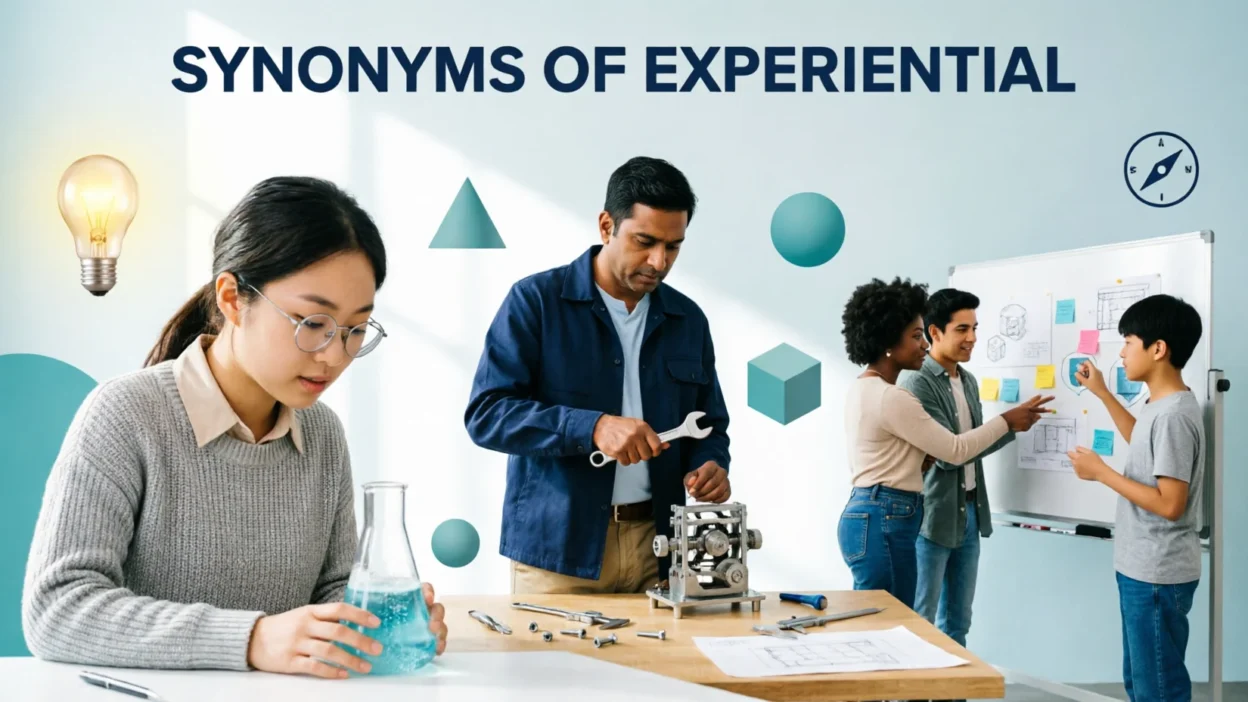
The word experiential describes something learned, understood, or gained through direct experience and practical involvement rather than theory alone. Common synonyms of experiential include hands-on, practical, experimental, experience-based, interactive, applied, immersive, and real-world. These words are useful when discussing education, training, personal development, research, and activities that help people learn by doing.
If you are writing an academic paper, describing a learning activity, or improving your everyday vocabulary, understanding the differences between these synonyms will help you choose the most accurate word.
Quick Answer: What Are the Best Synonyms of Experiential?
The best synonyms of experiential depend on the context. Use hands-on for practical activities, experience-based for knowledge gained through experience, interactive for activities involving participation, and immersive for experiences that deeply engage the senses or attention.
Other useful alternatives include practical, applied, experimental, participatory, real-world, engaging, observational, and activity-based.
What Does Experiential Mean?
Experiential is an adjective that describes something connected with personal experience, direct participation, or learning through doing.
It often refers to situations where people gain knowledge or skills by taking part in activities instead of simply reading about a subject or listening to an explanation.
For example:
- Experiential learning helps students understand scientific concepts through experiments.
- The company uses experiential training to develop employees’ communication skills.
- The museum offers an experiential exhibition that allows visitors to interact with historical objects.
The word is especially common in education, professional training, psychology, tourism, and personal development.
When Should You Use Experiential?
Use experiential when you want to emphasize learning, understanding, or engagement through actual experience.
For example, an experiential learning program might involve building a model, conducting a science experiment, participating in a workplace simulation, or completing a community project.
The term is more specific than practical because it highlights the role of experience in developing understanding.
30 Synonyms of Experiential With Meanings and Examples
The following words are useful alternatives to experiential, but they are not interchangeable in every sentence. Choose the word that best expresses the type of experience you want to describe.
1. Hands-on
Simple meaning: Involving direct physical participation or practical activity.
Example: The school introduced a hands-on science program for young learners.
Best usage/context: Practical education, workshops, skill development, and training.
2. Practical
Simple meaning: Focused on real activities and useful results rather than theory alone.
Example: The course provides practical experience in business management.
Best usage/context: Education, professional skills, everyday problem-solving, and training.
3. Experience-based
Simple meaning: Developed through actual experiences.
Example: The teacher uses an experience-based approach to explain difficult concepts.
Best usage/context: Learning methods, teaching strategies, professional development, and personal growth.
4. Experimental
Simple meaning: Involving tests, trials, or new methods to discover something.
Example: The researchers introduced an experimental approach to classroom learning.
Best usage/context: Scientific research, innovative teaching, trials, and exploratory activities.
Note: Experimental often emphasizes testing something new, rather than experience in general.
5. Interactive
Simple meaning: Involving active participation or communication.
Example: The museum created an interactive learning experience for children.
Best usage/context: Digital learning, presentations, educational games, exhibitions, and group activities.
6. Applied
Simple meaning: Used in practical situations rather than studied only in theory.
Example: Students develop applied skills through real business projects.
Best usage/context: Applied science, professional education, technical training, and research.
7. Immersive
Simple meaning: Creating an experience that deeply involves a person’s attention or senses.
Example: The immersive workshop allowed participants to experience a simulated workplace.
Best usage/context: Virtual reality, tourism, entertainment, simulations, and experiential education.
8. Real-world
Simple meaning: Connected with actual situations outside theory or simulation.
Example: The internship gives students real-world experience in marketing.
Best usage/context: Careers, internships, business education, and practical problem-solving.
9. Participatory
Simple meaning: Involving people actively in an activity or decision.
Example: The organization adopted a participatory approach to community education.
Best usage/context: Group learning, community projects, research, and collaborative decision-making.
10. Activity-based
Simple meaning: Organized around tasks or activities that help people learn.
Example: Activity-based teaching encourages students to solve problems independently.
Best usage/context: School education, workshops, children’s learning, and classroom instruction.
11. Observational
Simple meaning: Based on watching people, events, or processes carefully.
Example: The students gained observational experience by visiting a working laboratory.
Best usage/context: Research, field studies, science, and learning through observation.
12. Practice-oriented
Simple meaning: Focused on developing skills through practice.
Example: The college offers a practice-oriented course for aspiring nurses.
Best usage/context: Vocational education, professional training, healthcare, and technical subjects.
13. Field-based
Simple meaning: Conducted in a real environment outside a classroom or laboratory.
Example: The field-based program helped students understand local environmental problems.
Best usage/context: Environmental studies, geography, anthropology, and field research.
14. Embodied
Simple meaning: Involving bodily action, physical awareness, or movement in learning and understanding.
Example: The dance class uses embodied learning to teach rhythm and coordination.
Best usage/context: Dance, movement education, psychology, physical learning, and the arts.
15. Engaging
Simple meaning: Interesting and capable of holding someone’s attention.
Example: The teacher created an engaging learning experience through group challenges.
Best usage/context: Education, presentations, events, activities, and communication.
16. Involving
Simple meaning: Requiring someone to take part in an activity.
Example: The program offers an involving experience for new employees.
Best usage/context: General descriptions of activities, events, and group learning.
17. Direct
Simple meaning: Involving immediate contact with something rather than learning about it indirectly.
Example: Students gained direct experience by interviewing local business owners.
Best usage/context: Personal experience, observation, fieldwork, and professional learning.
18. Firsthand
Simple meaning: Obtained personally rather than through another person’s account.
Example: The students gained firsthand knowledge of farming practices during their visit.
Best usage/context: Personal accounts, travel, research, reporting, and learning from real situations.
19. Experiential-learning-based
Simple meaning: Designed around learning through experience and reflection.
Example: The school introduced an experiential-learning-based curriculum for science students.
Best usage/context: Educational programs, teaching frameworks, and curriculum design.
20. Skill-building
Simple meaning: Focused on developing abilities through learning and practice.
Example: The workshop provides a skill-building experience for young professionals.
Best usage/context: Career development, training, workshops, and personal improvement.
21. Real-life
Simple meaning: Connected with situations people encounter in everyday life.
Example: The teacher uses real-life examples to make mathematics easier to understand.
Best usage/context: Education, practical examples, life skills, and everyday problem-solving.
22. Action-oriented
Simple meaning: Focused on taking action and achieving practical results.
Example: The action-oriented program encourages students to solve local problems.
Best usage/context: Leadership, training, projects, and professional development.
23. Practice-based
Simple meaning: Built around repeated practice or practical work.
Example: The practice-based course helps students improve their clinical skills.
Best usage/context: Healthcare, teacher training, apprenticeships, and professional education.
24. Trial-based
Simple meaning: Involving trials or attempts to evaluate an idea or method.
Example: The team adopted a trial-based approach to test the new training method.
Best usage/context: Product testing, research, experimental learning, and evaluation.
25. Discovery-based
Simple meaning: Encouraging people to discover information or solutions themselves.
Example: The discovery-based activity helped students understand how plants grow.
Best usage/context: Science education, problem-solving, creative learning, and exploration.
26. Exploratory
Simple meaning: Focused on investigating, examining, or discovering something unfamiliar.
Example: The exploratory workshop introduced students to different career paths.
Best usage/context: Research, creative activities, early-stage learning, and new experiences.
27. Experiential in nature: Practical
Simple meaning: Involving experience or action in a way that helps people understand something.
Example: The project offered a practical introduction to sustainable agriculture.
Best usage/context: General descriptions of learning activities and experience-focused programs.
28. Demonstrative
Simple meaning: Showing how something works through an example or demonstration.
Example: The instructor used a demonstrative activity to explain the machine’s operation.
Best usage/context: Technical education, demonstrations, science lessons, and instructional training.
Note: Demonstrative is not a direct synonym in every context; it emphasizes showing rather than personally experiencing.
29. Sensory
Simple meaning: Connected with the senses, such as sight, hearing, touch, taste, or smell.
Example: The exhibition provides a sensory experience through sound, texture, and light.
Best usage/context: Museums, art, food, early childhood education, and sensory activities.
30. Transformative
Simple meaning: Causing a meaningful change in someone’s understanding, attitude, or behavior.
Example: The overseas internship proved to be a transformative learning experience.
Best usage/context: Personal development, education, travel, and significant life experiences.
Note: Transformative describes the impact of an experience, not necessarily the method used to deliver it.
Comparison Table: Which Synonym of Experiential Should You Choose?
| Synonym | Main emphasis | Example context |
| Hands-on | Active doing | Science experiments |
| Practical | Useful application | Job training |
| Experience-based | Knowledge from experience | Teaching methods |
| Experimental | Testing new ideas | Research projects |
| Interactive | Participation and exchange | Digital lessons |
| Immersive | Deep involvement | Virtual reality |
| Real-world | Actual situations | Internships |
| Participatory | Active contribution | Community projects |
| Observational | Watching and learning | Field studies |
| Applied | Using knowledge | Applied mathematics |
| Firsthand | Personal experience | Travel reporting |
| Discovery-based | Finding answers | Science activities |
| Exploratory | Investigating possibilities | Career workshops |
| Sensory | Engaging the senses | Art exhibitions |
| Transformative | Meaningful change | Personal development |
Experiential vs. Practical vs. Hands-On
These three words are closely related, but their meanings differ slightly.
- Experiential emphasizes learning or understanding through experience.
- Practical emphasizes usefulness and application in real situations.
- Hands-on emphasizes direct participation in an activity.
For example, a practical course may explain how to manage a business, a hands-on course may let students create a business plan, and an experiential course may ask them to run a simulated business and reflect on the results.
Experiential vs. Interactive vs. Immersive
These terms describe different features of an activity.
- Interactive means participants can engage or respond.
- Immersive means participants feel deeply involved in the experience.
- Experiential emphasizes learning or understanding through experience.
A digital lesson can be interactive without being immersive. A virtual reality simulation can be both immersive and experiential when it helps participants develop knowledge through participation.
How to Choose the Right Synonym for Experiential
The best word depends on your intended meaning, audience, and writing style.
1. For Academic Writing
Choose words that describe the learning method or research process accurately.
Good options include:
- Applied for using theoretical knowledge.
- Practice-based for learning through repeated professional practice.
- Observational for learning through careful observation.
- Experience-based for knowledge developed through actual experience.
- Participatory for methods that involve active contributions.
Example: “The study used a participatory approach to understand community needs.”
2. For Everyday and Beginner-Friendly Writing
Use familiar words that readers can understand immediately.
Good options include:
- Hands-on
- Practical
- Real-life
- Interactive
- Firsthand
Example: “Students gain hands-on experience by building simple robots.”
These words work well in educational articles, everyday conversations, and general explanations.
3. For Professional Training and Business
Choose words that highlight skill development and workplace application.
Good options include:
- Practice-oriented
- Applied
- Real-world
- Skill-building
- Action-oriented
Example: “The company provides practice-oriented training for new managers.”
4. For Creative and Sensory Experiences
Use words that communicate engagement, exploration, or emotional impact.
Good options include:
- Immersive
- Sensory
- Exploratory
- Engaging
- Transformative
Example: “The immersive exhibition allows visitors to explore ancient history through sound and interactive displays.”
5. For Scientific Research
Choose terms based on how the knowledge is collected or tested.
Good options include:
- Experimental
- Observational
- Field-based
- Trial-based
- Exploratory
Example: “The researchers used an observational method to study animal behavior.”
Remember that these terms describe different research methods and should not be substituted for one another without checking the meaning.
Common Mistakes When Using Experiential Synonyms
1. Treating Every Synonym as an Exact Replacement
Words can share a general meaning without being interchangeable.
For example, experimental suggests testing, while firsthand means personally experienced. Both may relate to experience, but they communicate different ideas.
2. Confusing Experiential With Experienced
Experiential describes something related to experience or learning through experience.
Experienced describes someone who has gained knowledge or skill through past activities.
Correct: “The university offers experiential learning.”
Correct: “The university hired an experienced instructor.”
3. Using Practical When You Mean Immersive
A practical activity focuses on useful application. An immersive activity deeply involves the participant’s attention or senses.
A worksheet may be practical without being immersive, while a simulated historical environment may be immersive without teaching a directly applicable practical skill.
4. Assuming Interactive Always Means Experiential
An interactive activity allows participants to respond or participate, but it may not necessarily produce meaningful learning through experience.
For example, clicking through a simple slideshow is interactive. Conducting an experiment and reflecting on the results is more clearly experiential.
5. Using Unnatural or Unnecessary Phrases
Some expressions, such as “experiential in nature,” may be unnecessarily wordy.
Instead of writing, “The course provides an experiential experience,” write, “The course provides hands-on learning opportunities.”
Clear, direct wording usually makes your message easier to understand.
FAQs:
1. What is the closest synonym for experiential?
Experience-based is one of the closest alternatives because it directly emphasizes knowledge or understanding gained through experience. Hands-on is also an excellent choice when the context involves active participation.
2. What is another word for experiential learning?
Common alternatives include hands-on learning, experience-based learning, activity-based learning, practical learning, and learning by doing. The best choice depends on the teaching method and the intended audience.
3. Is practical a synonym for experiential?
Yes, in some contexts. Both words can describe learning connected with real activities. However, practical emphasizes application and usefulness, while experiential emphasizes learning or understanding gained through experience.
4. What is the difference between experiential and experimental?
Experiential relates to experience and learning through participation. Experimental relates to testing, trials, or investigating new methods and ideas. An activity can be both experiential and experimental, but the words have different meanings.
5. What is the opposite of experiential?
There is no single opposite in every context. Depending on the intended meaning, possible contrasts include theoretical, abstract, indirect, or purely observational. For example, experiential learning emphasizes learning through experience, while theoretical learning emphasizes concepts and principles.
6. How do you use experiential in a sentence?
You can use experiential to describe learning, education, training, or activities based on experience.
Example: “The university introduced an experiential course that allows students to solve real-world problems.”
7. Is hands-on the same as experiential?
Not exactly. Hands-on emphasizes direct participation, often through physical activity. Experiential is broader and can include practical tasks, simulations, fieldwork, reflection, and other ways of learning through experience.
8. Which synonyms of experiential are best for formal writing?
For formal writing, consider experience-based, applied, practice-based, participatory, and observational. Choose the word that accurately describes the method or experience rather than selecting a synonym simply because it sounds more academic.
Conclusion
The word experiential describes learning, understanding, and activities connected with direct experience. Its most useful synonyms include hands-on, practical, experience-based, interactive, applied, immersive, real-world, and participatory.
Each alternative has a slightly different meaning. Hands-on emphasizes doing, practical emphasizes application, immersive emphasizes deep involvement, and experience-based emphasizes knowledge gained through experience.
When choosing a synonym, consider what you want to communicate, who will read your writing, and the situation you are describing. Using the right word will make your writing clearer, more natural, and more precise.

I’m Nathan Collins, a language enthusiast passionate about exploring synonyms and improving everyday writing. I create clear, accurate, and helpful content that helps readers expand vocabulary and communicate with confidence.