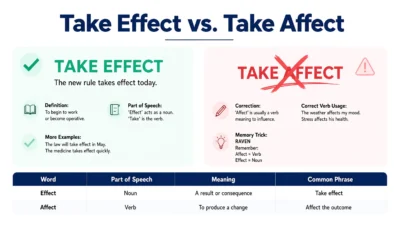

Many English learners and even confident writers get confused by “to that effect” vs. “affect” because the words sound similar and often appear in discussions about meaning, communication, and results. However, they serve different purposes in a sentence. Understanding the difference will help you write more clearly and avoid common grammar mistakes.
The phrase “to that effect” refers to the general meaning or idea of something someone said or wrote. It is often used when summarizing a statement without repeating the exact words. In contrast, “affect” is usually a verb meaning to influence, change, or have an impact on something.
For example, “She said something to that effect” means she expressed a similar idea, while “The if can affect your mood” means the weather can influence how you feel.
Both expressions are useful in everyday conversation, academic writing, and professional communication. Once you understand their meanings and grammatical roles, choosing the correct expression becomes much easier.
Quick Answer
“To that effect” means expressing an idea or message similar to something already mentioned. “Affect” usually means to influence or change something. For example, “He made a comment to that effect” refers to a similar message, while “Stress can affect sleep” means stress can influence sleep.
Why Do People Confuse “To That Effect” and “Affect”?
People confuse these expressions mainly because they contain similar-sounding words and are often used when discussing communication or consequences.
However, their meanings and grammatical functions are different.
- To that effect: An expression used to describe a statement with a similar meaning.
- Affect: Usually a verb that describes influencing or changing something.
Another source of confusion is the word effect, which appears in the expression “to that effect.” Effect is also a noun meaning a result or consequence. Although affect and effect are closely related, they are not interchangeable in most sentences.
What Does “To That Effect” Mean?
“To that effect” is an idiomatic expression meaning with approximately that meaning, in similar words, or expressing a similar idea.
Writers and speakers use it when they want to summarize what someone said without quoting the exact wording.
Examples of “To That Effect”
- She told me she was too busy to attend, or something to that effect.
- The manager made a statement to that effect during the meeting.
- He said he would support the project, or words to that effect.
- The email contained a message to that effect.
In each example, the speaker communicates the general meaning of a statement rather than its precise wording.
When Is “To That Effect” Used?
Use this expression when:
- Summarizing someone’s statement.
- Reporting a message without giving an exact quotation.
- Describing the general meaning of written communication.
- Indicating that someone’s words expressed a particular idea.
For example, “My teacher said something to that effect” suggests that the teacher expressed a similar idea, although the exact words may have been different.
What Does “Affect” Mean?
Affect is most commonly a verb meaning to influence, change, or make a difference to someone or something.
It can describe how one event, condition, decision, or action influences another.
Examples of “Affect”
- Lack of sleep can affect your concentration.
- The new policy may affect small businesses.
- Her kind words affected me deeply.
- Heavy rain could affect tomorrow’s plans.
In these examples, affect describes an influence or change.
When Is “Affect” Used?
Use affect when discussing:
- Changes in feelings or emotions.
- The influence of decisions or actions.
- Effects on health, performance, or behavior.
- Changes to plans, situations, or outcomes.
For instance, “Exercise can affect your energy levels” means exercise can influence how energetic you feel.
To That Effect vs. Affect: Comparison Table
| Feature | To that effect | Affect |
| Meaning | Expressing a similar idea | To influence or change |
| Grammatical role | Idiomatic phrase | Usually a verb |
| Main purpose | Summarizing a message | Describing an influence |
| Common context | Speech, writing, reporting | Health, emotions, decisions |
| Example | She said something to that effect. | Stress can affect health. |
| Similar expression | In similar words | Influence, impact |
The main distinction is simple: “to that effect” describes the meaning of a message, while “affect” describes an influence or change.
When Should You Use Each Expression?
Choosing the right expression depends on what you want to communicate.
Use “To That Effect” When Reporting Words
Use this phrase when you want to explain what someone communicated without repeating their exact statement.
Examples:
- The director said something to that effect.
- She sent me a message to that effect.
- The witness made a comment to that effect.
Use “Affect” When Describing Influence
Use affect when something influences a person, situation, or outcome.
Examples:
- The delay may affect our schedule.
- Your attitude can affect your relationships.
- The decision will affect many employees.
A Simple Way to Decide
Ask yourself whether you are talking about a message or an influence.
If you are describing what someone said, “to that effect” may be appropriate. If you are describing what changes or influences something, use “affect.”
12 Examples of “To That Effect” vs. “Affect”
These examples show how the expressions work in different situations.
- To that effect: He said he would return soon, or something to that effect.
- Affect: The delay could affect our travel plans.
- To that effect: The principal made an announcement to that effect.
- Affect: Poor lighting can affect your ability to read.
- To that effect: She wrote an email to that effect.
- Affect: A positive attitude can affect your performance.
- To that effect: The lawyer made a statement to that effect in court.
- Affect: The new rules will affect all team members.
- To that effect: My friend said something to that effect yesterday.
- Affect: Loud noise may affect your concentration.
- To that effect: The report included a recommendation to that effect.
- Affect: Changes in temperature can affect food quality.
Notice that “to that effect” usually refers to a message or statement, whereas affect identifies something being influenced.
Common Mistakes to Avoid
Understanding these expressions also means recognizing errors that can make your writing unclear.
Mistake 1: Using “Affect” to Mean “Similar Words”
Incorrect: She said affect that she was leaving.
Correct: She said something to that effect.
The correct expression refers to the general meaning of her statement.
Mistake 2: Using “To That Effect” to Describe a Change
Incorrect: The weather to that effect my mood.
Correct: The weather affects my mood.
Here, affects is the verb describing how the weather influences mood.
Mistake 3: Confusing “Affect” With “Effect”
Incorrect: The new rule will effect my schedule. (when you mean influence)
Correct: The new rule will affect my schedule.
In ordinary usage, affect is generally the verb, while effect is generally the noun.
Mistake 4: Assuming “To That Effect” Requires an Exact Quote
The expression does not require the original wording to be repeated exactly.
Correct: He explained that he needed more time, or words to that effect.
This means he expressed that general idea, possibly using different words.
What Is an Easy Memory Trick?
Use this simple trick to remember the difference:
- To that effect = similar message.
- Affect = influence something.
- Effect = result.
Think of these examples:
- “She said something to that effect” means she expressed a similar idea.
- “The news affected him” means the news influenced him.
- “The effect of the news was noticeable” means the result was noticeable.
Remembering the difference between a message, an influence, and a result will help you select the correct expression.
Is There a Difference in American and British English?
There is no significant difference in the meaning of “to that effect” or the usual verb affect between American and British English.
Both varieties use “to that effect” when referring to the general meaning of a statement. Both also use affect to describe influence or change.
Examples in American English:
- The announcement was something to that effect.
- The weather may affect our plans.
Examples in British English:
- He made a comment to that effect.
- The weather may affect our plans.
Spelling and usage remain the same in these examples. The main distinction is grammatical and semantic, not regional.
What Similar Words Should You Know?
Several related words and expressions can help you communicate more accurately.
Alternatives to “To That Effect”
- In similar words: Expressing a similar idea.
- Along those lines: Expressing a related thought.
- Or something similar: Indicating that the exact details may differ.
- To that end: With a particular goal or purpose in mind.
- In that sense: From that particular point of view.
These expressions are not always interchangeable. For example, “to that end” usually refers to a purpose, while “to that effect” refers to the meaning of a statement.
Words Related to “Affect”
- Influence: To have an effect on someone or something.
- Change: To make or become different.
- Alter: To modify something.
- Impact: To have a strong influence on something.
- Modify: To make partial changes.
For example, “The decision may influence the outcome” is similar to “The decision may affect the outcome.”
Final Verdict: To That Effect or Affect?
The correct choice depends on your intended meaning.
Use “to that effect” when referring to the general meaning of someone’s words or message. Use “affect” when explaining how something influences, changes, or impacts a person or situation.
Compare these sentences:
- “She made a comment to that effect.” — She expressed a similar idea.
- “Her comment affected me.” — Her comment influenced me emotionally.
Both expressions are correct, but they serve different purposes. Understanding this difference will make your writing more precise and your communication easier to follow.
FAQs:
1. What does “to that effect” mean?
“To that effect” means expressing an idea similar to something already mentioned. It is often used when summarizing a statement without repeating the exact words.
Example: “He said he would help, or something to that effect.”
2. Is “to that effect” the same as “affect”?
No. “To that effect” refers to the meaning of a message, while affect usually means to influence or change something.
Example: “She said something to that effect” versus “The news affected her.”
3. Should I use “affect” or “effect”?
Use affect when you mean to influence something. Use effect when you mean a result or consequence.
Examples:
- Lack of sleep can affect concentration.
- The effect of poor sleep was noticeable.
4. Is “words to that effect” grammatically correct?
Yes. “Words to that effect” is a common expression meaning that someone said something with approximately that meaning, although the exact wording may differ.
Example: “She promised to return soon, or words to that effect.”
5. Can I use “to that effect” in formal writing?
Yes. The expression is suitable for formal writing, including reports, academic discussions, and professional communication, when you need to summarize a statement.
Example: “The committee issued a recommendation to that effect.”
6. Can “affect” be a noun?
Yes, but this use is uncommon outside specialized contexts. In psychology, affect can refer to the outward expression of emotion or a person’s observable emotional state.
In everyday writing, affect is usually a verb meaning to influence.
7. What is another way to say “to that effect”?
Depending on the context, you can say “in similar words,” “along those lines,” “or something similar,” or “with a similar meaning.”
Choose the alternative that best matches your intended message.
8. What is the easiest way to remember the difference?
Remember that “to that effect” refers to a similar message, affect means influence, and effect usually means result.
This simple distinction will help you avoid most everyday mistakes.
Remember This
- To that effect: A similar meaning or message.
- Affect: To influence or change something.
- Effect: A result or consequence.
If you are reporting what someone said, consider “to that effect.” If you are describing an influence, use affect.
Conclusion
Understanding “to that effect vs. affect” is easier when you focus on the purpose of each expression. “To that effect” helps you describe the general meaning of a statement without quoting it word for word. “Affect,” on the other hand, usually describes how one thing influences another. Although the expressions may seem confusing at first, their different grammatical roles make them easier to distinguish.
To use them correctly, consider what you want your sentence to communicate. If you are summarizing someone’s words, use “to that effect” or “words to that effect.” If you are explaining how an event, decision, or action influences a person or situation, use affect.
Also, remember that effect usually refers to the resulting outcome. With regular practice and attention to context, you can use all three expressions confidently in everyday conversations, academic assignments, and professional writing.

I’m James Parker, Administrator at SynonymsHive. I oversee content quality, improve user experience, and ensure reliable synonym resources. My passion is making language learning simple, accurate, and accessible for everyone.