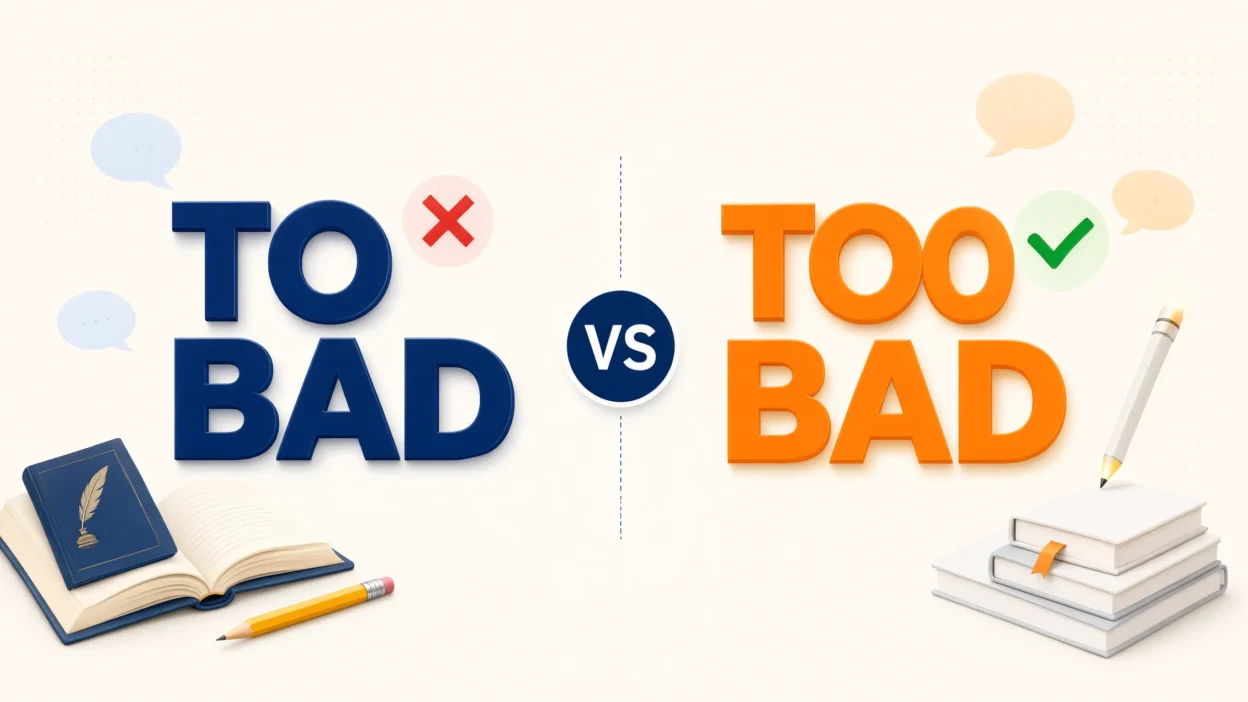
Many English learners get confused by “to bad” vs. “too bad” because the two expressions sound similar when spoken. However, only one is normally correct when you want to say that something is unfortunate, disappointing, or regrettable. The correct expression is “too bad,” while “to bad” is usually a spelling or grammar mistake in this context.
Understanding the difference is easier when you learn how the words to and too work in English. Although they differ by only one letter, they have different meanings and grammatical uses. Knowing when to use each word will help you write clearer sentences, avoid common mistakes, and communicate more confidently in school, at work, and in everyday conversations.
Quick Answer: To Bad vs. Too Bad
“Too bad” is the correct expression when you mean something is unfortunate, disappointing, or regrettable. For example, “It’s too bad that you missed the concert.” The word “too” can mean “unfortunately” in this expression or “more than is desirable” in other contexts. “To bad” is generally incorrect when used with this meaning, although “to” can correctly appear before the word “bad” in certain grammatical constructions.
Why Do People Confuse “To Bad” and “Too Bad”?
People confuse these expressions because to and too sound exactly alike in most varieties of English. They are homophones, meaning they have the same pronunciation but different spellings and meanings.
The extra letter o makes a significant difference:
- To: Commonly expresses direction, destination, purpose, or a relationship between words.
- Too: Means “also” or “more than necessary.” It also appears in the expression “too bad.”
Because pronunciation does not help distinguish the two words, you need to understand their meanings and grammatical roles to choose the correct spelling.
What Does “To” Mean?
The word “to” is commonly used as a preposition or as part of an infinitive verb. It often indicates movement toward a place, a recipient, a purpose, or an action.
Examples of “To” in Sentences
- I am going to school.
- She gave the book to her friend.
- We need to finish our homework.
- He walked to the store.
- I want to learn English.
In these sentences, “to” connects words or introduces an action. It does not mean “unfortunate” or “disappointing.”
Can You Ever Use “To Bad” Correctly?
Yes, the words can appear next to each other in a sentence when the grammar supports them, although this is uncommon.
For example:
– She went from feeling good to bad after hearing the news.
Here, “to” connects two states: feeling good and feeling bad. The sentence is grammatically possible, though “from feeling good to feeling bad” is more natural.
The important point is that “to bad” is not the standard expression for describing an unfortunate situation.
What Does “Too Bad” Mean?
The expression “too bad” commonly means that something is unfortunate, disappointing, or regrettable. It can express sympathy, disappointment, or, depending on the speaker’s tone, indifference.
Examples:
- It is too bad that you cannot come to the party.
- Too bad we missed the last bus.
- It’s too bad that the match was canceled.
“Too” can also mean “excessively” or “more than necessary,” especially when it modifies an adjective or adverb.
Examples:
- The coffee is too hot to drink.
- This bag is too heavy for me.
- She speaks too quickly for beginners to understand.
Remember that “too bad” does not always express sympathy. When spoken sarcastically, it can sound dismissive or mean that the speaker does not care about someone else’s problem.
To Bad vs. Too Bad: Comparison Table
| Feature | To Bad | Too Bad |
| Standard expression for disappointment | No | Yes |
| Meaning | Depends on the surrounding sentence | Unfortunate or disappointing |
| Common grammatical role | “To” as a preposition or infinitive marker | “Too” as an adverb |
| Example | She went from happy to bad moods. | It’s too bad that you missed it. |
| Correct for expressing regret | No | Yes |
| Pronunciation | /tuː/ or /tə/ | /tuː/ |
The key difference is meaning, not pronunciation. Use “too bad” when you want to express disappointment or describe something unfortunate.
When Should You Use “To” or “Too”?
Choose the word based on what you want to communicate.
Use “To” for Direction or Purpose
Use “to” when talking about movement, destinations, recipients, or actions.
Examples:
- We drove to the beach.
- Please send the email to my teacher.
- I hope to see you soon.
- She went to the library to study.
Use “Too” to Mean “Also”
Use “too” when you want to add information meaning “also” or “as well.”
Examples:
- I want to come too.
- She likes chocolate too.
- He is joining us too.
Use “Too” to Mean “Excessively”
Use “too” before an adjective or adverb when something exceeds a suitable or acceptable amount.
Examples:
- The room is too cold.
- You are driving too fast.
- The box is too large for the shelf.
Use “Too Bad” to Express Disappointment
Use “too bad” when something is unfortunate or disappointing.
Examples:
- It’s too bad that you missed the celebration.
- That’s too bad! I hope things improve.
- It’s too bad the restaurant is closed today.
12 Examples of “To Bad” vs. “Too Bad”
The following examples show how to choose the correct expression in everyday English.
| Incorrect or less natural | Correct or more natural |
| It is to bad that you are sick. | It is too bad that you are sick. |
| That’s to bad about your exam. | That’s too bad about your exam. |
| It’s to bad we missed the train. | It’s too bad we missed the train. |
| To bad you cannot join us. | Too bad you cannot join us. |
| It was to bad that it rained. | It was too bad that it rained. |
| That is to bad for them. | That is too bad for them. |
Here are six more examples showing correct usage in context:
- It’s too bad that the school trip was canceled.
- Too bad we arrived after the movie started.
- That’s too bad! I hope you feel better soon.
- I wanted to buy the jacket, but it was too expensive.
- I am going to the supermarket after work.
- My brother wants to play football too.
Notice that examples 1–3 express disappointment, example 4 means “excessively expensive,” and examples 5–6 use “to” and “too” in their other common meanings.
Common Mistakes to Avoid
Even experienced English speakers sometimes confuse words that sound alike. These tips can help you avoid common errors.
Mistake 1: Writing “To Bad” to Express Sympathy
Incorrect: “It’s to bad that you lost your job.”
Correct: “It’s too bad that you lost your job.”
Use “too bad” when expressing regret or sympathy about an unfortunate situation.
Mistake 2: Using “Too” for Direction
Incorrect: “I am going too school.”
Correct: “I am going to school.”
Use “to” when indicating a destination.
Mistake 3: Confusing “Too” With “Also”
Incorrect: “I want to come to.”
Correct: “I want to come too.”
When “too” means “also,” it often appears at the end of a sentence.
Mistake 4: Forgetting That Tone Changes Meaning
The expression “too bad” can sound sympathetic or dismissive.
- Sympathetic: “That’s too bad. I hope you get another chance.”
- Dismissive: “Too bad. You should have planned better.”
Consider the situation and your tone when speaking to other people.
Memory Trick: How to Remember “To Bad” vs. “Too Bad”
Use this simple memory trick to remember the difference:
- Too has an extra “o” — think of “extra” or “more.” In “too bad,” it is the correct spelling of the expression meaning unfortunate.
- To is for travel and tasks — “to school,” “to work,” and “to learn.”
You can also remember this sentence:
“It’s too bad I have to go to school.”
In this example, “too bad” expresses disappointment, while “to go” introduces an action.
American vs. British English: Is There a Difference?
There is no meaningful spelling difference between American and British English for “to” and “too.” Both varieties use the same spellings and grammatical rules.
Examples in American English:
- It’s too bad that the game was canceled.
- I am going to the store.
Examples in British English:
- It’s too bad that the match was cancelled.
- I am going to the shops.
The main difference in these examples is vocabulary or spelling elsewhere in the sentence, not the use of “to” or “too.” In both varieties, “too bad” is the standard expression for something unfortunate.
Similar Words and Expressions
Learning related expressions can help you communicate disappointment more naturally.
- What a shame: Expresses regret about an unfortunate situation.
- That’s unfortunate: A polite way to acknowledge something negative.
- What a pity: Expresses sadness or disappointment.
- Too bad: A common, informal expression of disappointment.
- Sadly: An adverb used to introduce or describe something unfortunate.
- Unfortunately: A more formal way to express regret about a situation.
- Excessively: Means more than is desirable or necessary.
- Also: Another meaning of “too,” often used to add information.
Examples:
- “It’s a shame that you missed the event.”
- “Unfortunately, we cannot attend the meeting.”
- “The soup is too salty.”
- “I would like to come too.”
These expressions are related in meaning or usage, but they are not interchangeable in every sentence.
Final Verdict: To Bad or Too Bad?
The correct choice depends on the meaning of your sentence, but when you want to express disappointment, “too bad” is the correct expression.
Use “too bad” to say that something is unfortunate, disappointing, or regrettable. Use “to” for direction, recipients, purpose, or infinitive verbs. Although the phrase “to bad” can occur in a grammatically valid sentence, it is not the standard way to express disappointment.
When in doubt, ask yourself whether you mean “unfortunate” or “excessively.” If you do, “too” is generally the word you need.
FAQs:
1. Is “to bad” correct or “too bad”?
“Too bad” is correct when expressing disappointment or regret. “To bad” is generally a spelling mistake in this context. However, the words “to” and “bad” can appear together in other grammatical constructions.
2. What does “too bad” mean?
“Too bad” usually means unfortunate, disappointing, or regrettable. For example, “It’s too bad that we missed the concert” means the speaker is disappointed that they missed it.
3. Why is “too bad” spelled with two o’s?
“Too” is a separate word from “to.” It can mean “also” or “more than necessary,” and it is the established spelling in the expression “too bad.”
4. Can I say “That’s to bad”?
No, not when you mean that something is unfortunate. The correct sentence is “That’s too bad.”
5. Does “too bad” always express sympathy?
No. Depending on tone and context, “too bad” can express sympathy, disappointment, resignation, or indifference. A sarcastic delivery can make it sound dismissive.
6. Is “too bad” formal or informal?
“Too bad” is generally conversational and informal. In formal writing, expressions such as “unfortunate” or “regrettable” may be more suitable.
7. What is an easy way to remember “to” and “too”?
Remember that “to” is commonly used for destinations and actions, as in “to school” and “to read.” “Too” means “also,” “excessively,” or appears in “too bad.”
Remember This
- Too bad = unfortunate or disappointing.
- To = direction, destination, purpose, or an infinitive verb marker.
- Too = also or more than necessary.
- “It’s too bad” is correct when expressing disappointment.
- “It’s to bad” is incorrect when used with that meaning.
Conclusion
The difference between “to bad” and “too bad” is simple once you understand what each word means. “Too bad” is the standard expression for something unfortunate or disappointing, while “to” is used for destinations, purposes, and actions. Because the words sound alike, remembering their different meanings is the easiest way to avoid spelling mistakes.
Practice using these words in everyday sentences, such as “It’s too bad that we missed the bus” and “I am going to work.” With a little practice, you will be able to choose the right word naturally and write with greater confidence.

I am Olivia Brooks, a language enthusiast and writer at SynonymsHive. I enjoy creating clear, engaging content about synonyms, vocabulary, and word meanings, helping readers improve their writing and communicate with confidence every day.