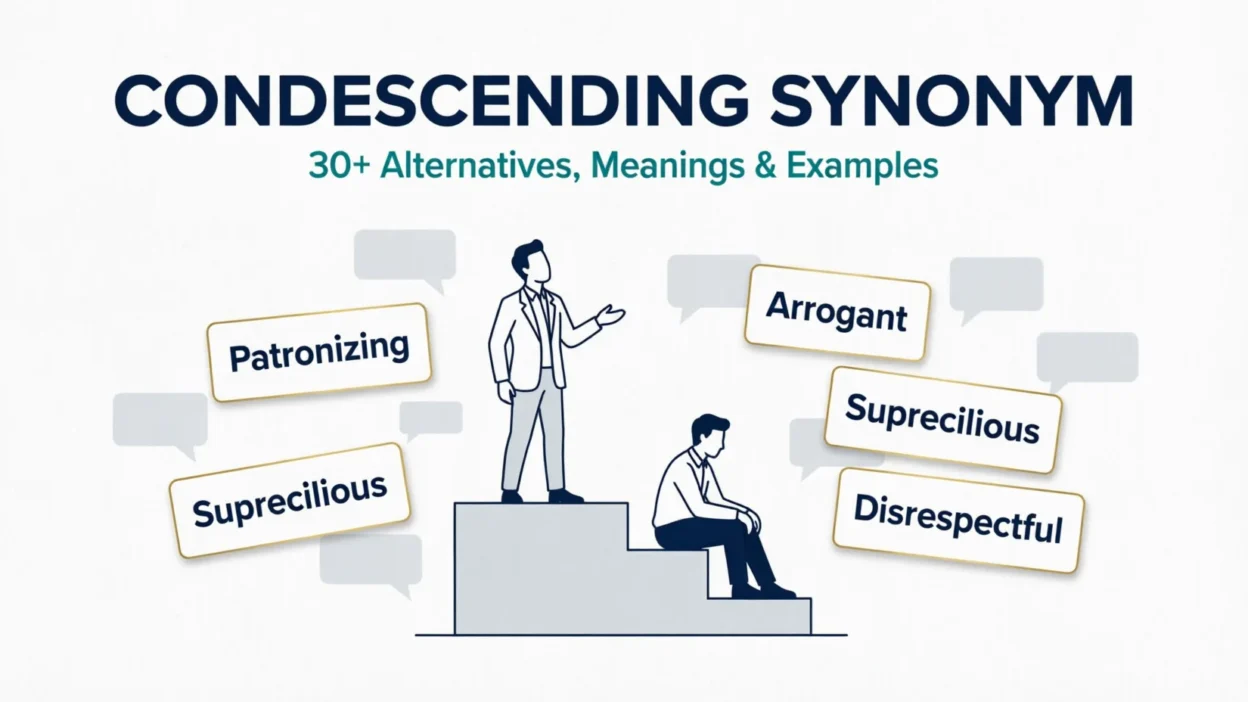
The best synonyms for condescending include patronizing, arrogant, superior, snobbish, disdainful, and talking down to someone. These words describe a person who behaves as if they are better, smarter, or more important than others. However, each word has a slightly different meaning, so choosing the right one depends on the tone and situation.
If you are writing an essay, improving your vocabulary, or describing someone’s behavior, understanding these alternatives can help you express your ideas more clearly.
Quick Answer: What Is a Synonym for Condescending?
A condescending synonym is a word or phrase that describes someone who treats others as less intelligent, less important, or less capable than themselves.
Here are some of the most useful alternatives:
- Patronizing: Treating someone as if they are less capable or knowledgeable.
- Arrogant: Believing you are more important or better than others.
- Supercilious: Behaving as if you are superior to other people.
- Disdainful: Showing that you consider someone unworthy of respect.
- Snobbish: Acting as if you are better because of your status, wealth, or background.
- Belittling: Making someone feel small or unimportant.
- Pompous: Acting overly important or impressive.
The closest everyday synonym for condescending is patronizing, especially when someone speaks to another person in a disrespectful or overly superior way.
What Does Condescending Mean?
The word condescending describes a way of speaking or behaving that makes another person feel inferior. A condescending person may act as if they know everything while assuming that others know very little.
Condescension often appears in conversations, workplaces, classrooms, friendships, and family relationships. It can involve a person’s words, tone of voice, facial expressions, or body language.
For example:
- “Let me explain this in simple words so even you can understand.”
- “That’s a cute little idea, but it probably won’t work.”
- “You will understand when you get older.”
These statements may sound helpful or harmless at first, but their tone can suggest that the speaker considers the other person less intelligent or experienced.
Is Condescending Always an Insult?
Not necessarily. The word describes an attitude or behavior that often feels disrespectful, but its impact depends on the context.
Someone may intend to help but accidentally sound condescending by overexplaining something. In other situations, a person may deliberately use a superior tone to embarrass or dismiss someone.
The important distinction is that condescending behavior communicates superiority rather than equal respect.
30 Synonyms for Condescending With Meanings and Examples
The following words and phrases can help you describe a superior attitude, disrespectful communication, or behavior that makes others feel inferior. Some are close synonyms, while others describe a particular part of condescension.
1. Patronizing
Simple meaning: Treating someone as if they are less intelligent, capable, or experienced than you.
Example sentence: Her patronizing comments made the new employee feel uncomfortable.
Best usage/context: Use this when someone speaks in an overly helpful or caring manner that actually sounds insulting. It is one of the closest synonyms for condescending.
2. Arrogant
Simple meaning: Believing you are better, more important, or more talented than other people.
Example sentence: His arrogant attitude made it difficult for his colleagues to work with him.
Best usage/context: Use this when describing excessive pride or a strong belief in one’s own superiority.
3. Supercilious
Simple meaning: Behaving as if you are superior to other people.
Example sentence: She gave him a supercilious smile when he asked a simple question.
Best usage/context: This is a formal word suitable for essays, literary writing, and detailed character descriptions.
4. Disdainful
Simple meaning: Showing that you consider someone or something unworthy of respect.
Example sentence: He made a disdainful remark about his teammate’s suggestion.
Best usage/context: Use this when a person expresses contempt or dismisses someone with disrespect.
5. Snobbish
Simple meaning: Acting as if you are better than others because of wealth, education, status, or social background.
Example sentence: His snobbish behavior made the guests feel unwelcome.
Best usage/context: This word works well when superiority is connected to social class, lifestyle, taste, or status.
6. Haughty
Simple meaning: Unfriendly and proud in a way that shows you think you are superior.
Example sentence: She responded with a haughty expression when he offered advice.
Best usage/context: Use it to describe a proud, distant, and dismissive attitude.
7. Superior
Simple meaning: Acting as if you are better or more capable than someone else.
Example sentence: He used a superior tone when discussing the junior staff’s mistakes.
Best usage/context: This is a useful everyday alternative when the main issue is an attitude of superiority.
8. Patronizingly
Simple meaning: In a way that treats another person as less capable or intelligent.
Example sentence: “Of course, I’ll show you how to do it,” she said patronizingly.
Best usage/context: Use this adverb when describing how someone speaks or acts rather than labeling the person.
9. Belittling
Simple meaning: Making someone feel small, foolish, or unimportant.
Example sentence: His belittling comments discouraged the students from sharing their ideas.
Best usage/context: Use this when someone’s words or actions reduce another person’s confidence or sense of worth.
10. Dismissive
Simple meaning: Showing that you do not consider someone’s opinion or concern important.
Example sentence: The manager was dismissive of her employee’s concerns.
Best usage/context: Best for conversations where a person ignores, rejects, or brushes aside another person’s ideas.
11. Pompous
Simple meaning: Behaving as if you are extremely important or impressive.
Example sentence: His pompous speech made a simple announcement sound like a royal address.
Best usage/context: Use this for exaggerated self-importance, especially when someone’s language or behavior seems overly grand.
12. Conceited
Simple meaning: Having an excessively high opinion of yourself.
Example sentence: The conceited speaker spent the entire evening praising his own achievements.
Best usage/context: Choose this when self-admiration is the main feature, even if the person does not openly insult others.
13. Snide
Simple meaning: Making indirect, mocking, or insulting remarks.
Example sentence: She made a snide comment about his lack of experience.
Best usage/context: Useful for describing sarcastic remarks that communicate disrespect or superiority.
14. Contemptuous
Simple meaning: Showing strong disrespect for someone you consider beneath you.
Example sentence: He gave a contemptuous laugh when his colleague made a suggestion.
Best usage/context: Use this when the attitude involves clear scorn or a strong lack of respect.
15. Derisive
Simple meaning: Expressing ridicule or mockery.
Example sentence: The audience heard a derisive comment from the back of the room.
Best usage/context: Suitable for situations where someone mocks another person’s ideas, mistakes, or abilities.
16. Condescendingly
Simple meaning: In a way that suggests you are better or more knowledgeable than someone else.
Example sentence: He condescendingly explained a basic rule to an experienced teacher.
Best usage/context: Use this adverb to describe a superior tone, manner, or action.
17. Haughty-minded
Simple meaning: Having a proud attitude that suggests superiority.
Example sentence: The haughty-minded character refused to accept advice from anyone.
Best usage/context: This expression is uncommon and often sounds unnatural in everyday English. Prefer haughty or arrogant in most writing.
18. Disrespectful
Simple meaning: Showing a lack of respect for another person.
Example sentence: His disrespectful response upset the team leader.
Best usage/context: Use this broad, familiar word when someone’s behavior is rude or fails to show proper respect, whether or not they feel superior.
19. Patronage-driven
Simple meaning: Influenced by a relationship in which one person acts as a powerful supporter or benefactor.
Example sentence: The discussion became focused on patronage-driven decisions rather than merit.
Best usage/context: This is not a direct synonym for condescending. It is relevant to institutional favoritism or patronage, so use it only when that is the intended meaning.
20. Imperious
Simple meaning: Expecting others to obey you and behaving as if you have authority over them.
Example sentence: The director gave an imperious order without listening to the staff.
Best usage/context: Use this in formal or literary writing when superiority appears through bossy, commanding behavior.
21. Snobbishness
Simple meaning: The attitude of believing you are better than people from certain social groups.
Example sentence: Her snobbishness was obvious when she criticized the guests’ clothing.
Best usage/context: This is a noun rather than an adjective. Use it when discussing the attitude itself, not simply describing a person.
22. Self-important
Simple meaning: Thinking you are more important than you really are.
Example sentence: The self-important official refused to wait in the same line as everyone else.
Best usage/context: Useful for describing exaggerated importance, especially when someone’s behavior seems entitled or pretentious.
23. Insolent
Simple meaning: Rude and disrespectful toward someone, particularly a person in authority.
Example sentence: The supervisor considered his insolent response unacceptable.
Best usage/context: Choose this when the behavior is openly rude or boldly disrespectful. It does not necessarily imply a feeling of superiority.
24. Patronizingly polite
Simple meaning: Being excessively polite in a way that sounds insincere or superior.
Example sentence: Her patronizingly polite response made it clear that she did not take his concern seriously.
Best usage/context: Use this phrase when politeness masks disrespect or an assumption that another person is less capable.
25. Condescending in tone
Simple meaning: Speaking in a way that makes someone feel inferior.
Example sentence: His words were reasonable, but his condescending tone offended the audience.
Best usage/context: This phrase is especially useful when the actual words are acceptable but the delivery feels disrespectful.
26. Scornful
Simple meaning: Showing strong dislike or disrespect through words, expressions, or behavior.
Example sentence: She gave a scornful look at the suggestion that she needed help.
Best usage/context: Use this when someone openly expresses contempt for an idea or another person.
27. Patronizingly superior
Simple meaning: Acting as though you are more knowledgeable or capable while treating others as inferior.
Example sentence: His patronizingly superior manner made even routine conversations unpleasant.
Best usage/context: This descriptive phrase works when you want to emphasize both condescension and an attitude of superiority.
28. Smug
Simple meaning: Too pleased with yourself, often in a way that annoys other people.
Example sentence: He wore a smug smile after pointing out his colleague’s mistake.
Best usage/context: Use this for self-satisfied behavior, particularly when someone seems pleased to be right or to have outperformed another person.
29. High-handed
Simple meaning: Using authority in an unfair, forceful, or dismissive way.
Example sentence: The committee’s high-handed decision left the members feeling ignored.
Best usage/context: This is useful when someone treats others as unimportant while making decisions or exercising power.
30. Talking down to someone
Simple meaning: Speaking to someone as if they are less intelligent or capable than you.
Example sentence: I wish my coworker would stop talking down to me during meetings.
Best usage/context: This is a natural, conversational expression and often the clearest choice when describing condescending speech.
Comparison Table: Which Condescending Synonym Should You Use?
Different synonyms emphasize different aspects of a superior attitude. Use this table to find the word that best fits your sentence.
| Synonym | Main meaning | Tone |
| Patronizing | Treating someone as less capable | Everyday, critical |
| Arrogant | Believing you are better than others | Strong, direct |
| Supercilious | Acting openly superior | Formal |
| Disdainful | Showing contempt or disrespect | Strong, serious |
| Haughty | Proud and distant | Formal, literary |
| Belittling | Making someone feel unimportant | Critical |
| Dismissive | Ignoring someone’s concerns | Neutral to critical |
| Pompous | Acting overly important | Critical, sometimes humorous |
| Snobbish | Feeling superior because of status | Informal to critical |
| Smug | Being annoyingly self-satisfied | Informal |
| Imperious | Expecting obedience | Formal |
| Talking down to someone | Speaking as if someone is inferior | Conversational |
Condescending vs. Patronizing
These words are very close in meaning. Condescending describes an attitude of superiority, while patronizing often emphasizes treating someone as if they need your help or guidance because they are less capable.
Example: “He was condescending when he discussed her career choices.”
Example: “He was patronizing when he explained a basic task to an experienced professional.”
Condescending vs. Arrogant
Arrogant describes an inflated sense of one’s own importance or abilities. Condescending focuses more specifically on treating other people as inferior.
Example: “She is arrogant about her achievements.”
Example: “She is condescending when speaking to new employees.”
A person can be arrogant without being openly condescending, although the two traits often overlap.
Condescending vs. Dismissive
A dismissive person may ignore your concerns without necessarily believing they are superior to you. A condescending person communicates that they consider you beneath them in some way.
Example: “The manager dismissed the complaint without investigating it.”
Example: “The manager condescendingly explained something the employee already understood.”
How to Choose the Right Condescending Synonym
The best word depends on what you want to communicate, how strong the criticism should be, and the context in which the behavior occurs.
Choose Based on Tone
- Mild criticism: Use patronizing or dismissive when describing behavior that feels disrespectful without being openly hostile.
- Strong criticism: Choose arrogant, contemptuous, or scornful when the behavior clearly expresses superiority or disrespect.
- Formal writing: Use supercilious, imperious, or haughty for essays, literary analysis, and formal descriptions.
- Casual conversation: Use smug, snobbish, or talking down to someone in everyday discussions.
- Humorous criticism: Use pompous when someone’s self-importance seems exaggerated or ridiculous.
Choose Based on Meaning
- Feeling better than others: Arrogant, conceited, superior.
- Treating others as less intelligent: Patronizing, condescending, talking down to someone.
- Showing contempt: Disdainful, contemptuous, scornful.
- Making someone feel unimportant: Belittling, dismissive.
- Acting socially superior: Snobbish, haughty.
- Expecting special treatment or obedience: Self-important, imperious, high-handed.
- Showing excessive self-satisfaction: Smug, pompous.
Choose Based on Intent
Consider what the person is doing rather than relying only on how the behavior makes you feel.
- If the person is explaining something in an insulting way, use patronizing.
- If the person repeatedly boasts about being better than others, use arrogant.
- If the person mocks another person’s abilities, use derisive or belittling.
- If the person ignores a valid concern, use dismissive.
- If the person uses authority to control others without listening, use high-handed or imperious.
This approach makes your writing more precise and helps you avoid using several similar adjectives interchangeably.
Common Mistakes When Using Condescending Synonyms
1. Treating Every Rude Person as Condescending
Not all rude behavior communicates superiority. A person can be impatient, angry, or disrespectful without believing they are better than others.
Better approach: Use condescending when the behavior suggests that another person is inferior. Use rude or disrespectful when the main issue is a lack of courtesy.
2. Confusing Confidence With Arrogance
Confidence means believing in your abilities. Arrogance means having an exaggerated sense of your own importance or superiority.
Better approach: Describe someone’s actual behavior before labeling their attitude.
3. Using Formal Words in Casual Conversations
Words such as supercilious and imperious are useful but may sound unnatural in everyday speech.
Better approach: Use patronizing, arrogant, or talking down to someone when communicating informally.
4. Using an Adjective When You Need an Adverb
Condescending describes a person, tone, or attitude. Condescendingly describes the manner in which someone acts or speaks.
Incorrect: “She spoke in a condescendingly manner.”
Correct: “She spoke in a condescending manner.”
Also correct: “She spoke condescendingly.”
5. Assuming That Patronizing Always Means Helpful
The word patronizing can sound positive because it resembles the idea of providing support. However, in common modern usage, it often describes help or kindness that communicates superiority.
Better approach: Consider whether the person is genuinely respecting the other person’s abilities or treating them as inferior.
FAQs:
1. What is the closest synonym for condescending?
Patronizing is usually the closest synonym. Both words describe behavior that makes someone feel inferior, especially through speech or an attitude of superiority.
2. What is another word for condescending in a professional setting?
Patronizing, dismissive, belittling, and arrogant can work in professional writing. For example, “The manager’s dismissive response discouraged employees from raising concerns.”
3. What is a polite word for condescending?
Patronizing is a common alternative, although it still expresses criticism. If you want softer wording, try “overly instructive,” “somewhat dismissive,” or “speaking in a way that may seem superior,” depending on the situation.
4. What is the opposite of condescending?
Possible opposites include respectful, humble, considerate, egalitarian, and approachable. The best choice depends on the intended meaning. Respectful is especially useful when the focus is on treating others as equals.
5. What is a stronger word for condescending?
Contemptuous, scornful, and supercilious can express stronger forms of superiority or disrespect. Contemptuous is especially suitable when someone openly shows that they consider another person unworthy of respect.
6. What does a condescending tone sound like?
A condescending tone often sounds patronizing, overly explanatory, sarcastic, or dismissive. Phrases such as “Let me explain this so you can understand” may sound condescending when they imply that the listener lacks basic intelligence.
7. Can condescending be used to describe a person?
Yes. You can say “He is condescending” to describe someone’s general behavior or “She has a condescending attitude” to focus on her manner. You can also describe a remark, voice, smile, or tone as condescending.
8. What is the difference between condescending and belittling?
Condescending suggests that someone is treating another person as inferior. Belittling focuses on words or actions that make someone feel small, foolish, or unimportant. A condescending remark can be belittling, but the terms emphasize different aspects of the behavior.
Conclusion
Learning synonyms for condescending helps you describe superior attitudes with greater accuracy. Words such as patronizing, arrogant, supercilious, dismissive, and belittling are useful alternatives, but each highlights a different aspect of a person’s behavior.
Choose patronizing when someone treats another person as less capable, arrogant when they believe they are better than others, and dismissive when they ignore another person’s concerns. For formal writing, supercilious and imperious can add precision, while “talking down to someone” is often the clearest choice in everyday English.
The key is to focus on the specific behavior you want to describe. Using the right synonym makes your writing clearer, more natural, and more expressive.

I am Andrew Foster, a passionate language writer who enjoys helping readers discover the right synonyms and improve their vocabulary. I create clear, accurate, and engaging content that makes learning English simple, practical, and enjoyable.