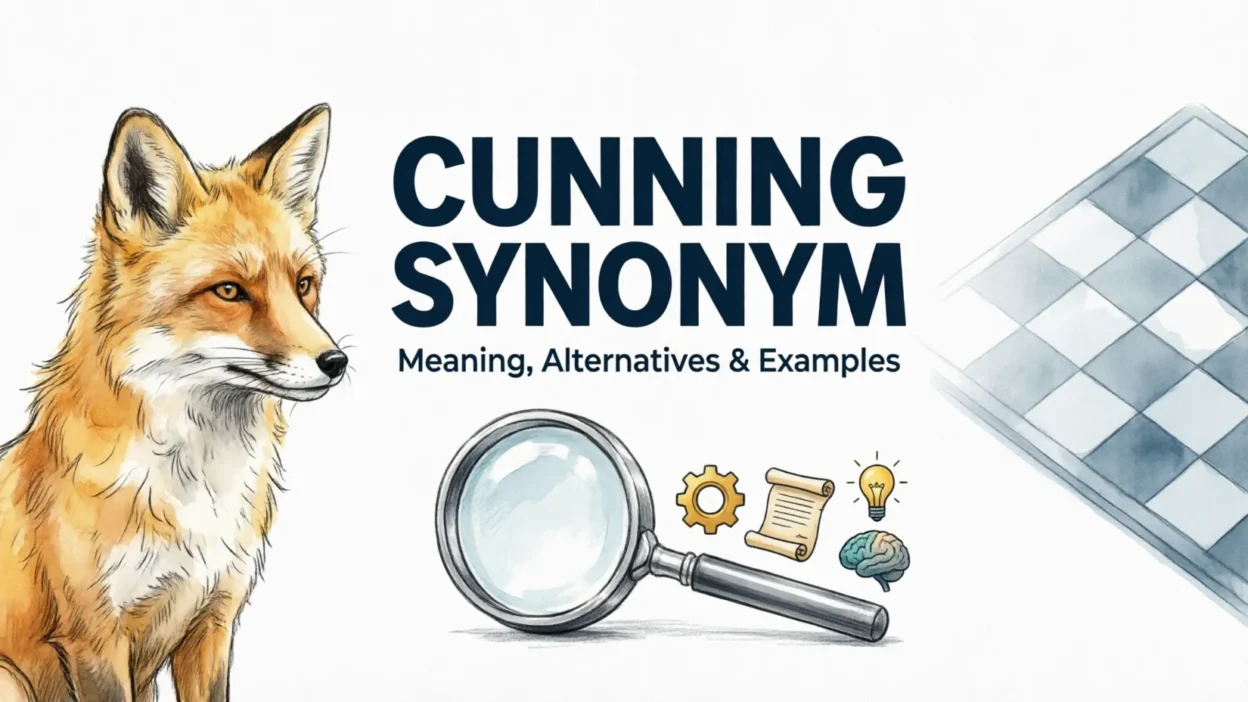
The best synonyms for cunning include clever, crafty, sly, shrewd, artful, devious, wily, and astute. These words describe someone who uses intelligence, planning, or clever strategies to achieve a goal.
However, some have positive meanings, while others suggest dishonesty, trickery, or hidden intentions. Choosing the right synonym depends on whether you want to describe intelligence, resourcefulness, or deceptive behavior.
Understanding these differences can help students, ESL learners, writers, and content creators express their ideas more clearly. Whether you are describing a clever character, a smart business decision, or a dishonest trick, the right word makes your writing more precise and natural.
Quick Answer: What Are the Best Synonyms for Cunning?
The most useful synonyms for cunning are:
- Clever: Quick to understand and solve problems.
- Crafty: Skilled at achieving goals through clever methods, sometimes dishonestly.
- Sly: Secretive and clever, often with a dishonest intention.
- Shrewd: Good at judging situations and making practical decisions.
- Wily: Skilled at avoiding tricks, danger, or opposition.
- Astute: Quick to notice important details and understand situations.
- Devious: Willing to use dishonest or indirect methods.
- Artful: Skillful in using clever techniques to achieve a result.
For a positive meaning, choose shrewd, astute, or resourceful. For a negative meaning, use sly, devious, or underhanded.
What Does Cunning Mean?
Cunning describes the ability to use intelligence, clever planning, and careful strategies to achieve a particular result. It often suggests that someone knows how to get what they want without making their intentions obvious.
The word can describe a person, an action, a plan, or a strategy. Its meaning depends on the situation.
For example:
- Positive or neutral: The detective used cunning to solve the complicated mystery.
- Negative: The cunning salesman tricked customers into buying unnecessary products.
- Strategic: The team developed a cunning plan to win the competition.
Cunning often carries a slightly negative meaning because it can suggest manipulation or dishonesty. However, it can also describe intelligence and strategic thinking.
Is Cunning a Positive or Negative Word?
Cunning can be either positive or negative, although it frequently has a negative connotation.
When it describes clever planning or strategic thinking, it may sound admiring. When it describes tricking or manipulating people, it sounds critical.
Compare these sentences:
- She used her cunning to escape a difficult situation. This emphasizes cleverness and resourcefulness.
- He used cunning to deceive his business partners. This emphasizes dishonesty.
The surrounding words and the situation help determine the intended meaning.
30 Synonyms for Cunning With Meanings and Examples
Below are 30 useful alternatives to cunning, including their simple meanings, example sentences, and best contexts.
1. Clever
Simple meaning: Able to think quickly and find effective solutions.
Example sentence: The clever student solved the difficult puzzle in minutes.
Best usage/context: Use clever when emphasizing intelligence, quick thinking, or an effective idea. It is usually more positive than cunning.
2. Crafty
Simple meaning: Good at using clever methods to get what you want, sometimes dishonestly.
Example sentence: The crafty negotiator found a way to gain an advantage.
Best usage/context: Use crafty for clever tactics, strategic behavior, or someone who knows how to work around obstacles.
3. Sly
Simple meaning: Secretive and clever, often in a dishonest way.
Example sentence: He gave a sly smile after hiding the surprise gift.
Best usage/context: Use sly when someone conceals their intentions or acts secretly. It can suggest mischief, secrecy, or dishonesty.
4. Shrewd
Simple meaning: Good at judging situations and making sensible decisions.
Example sentence: The shrewd investor recognized a promising opportunity.
Best usage/context: Use shrewd for business decisions, negotiations, financial judgment, and practical intelligence.
5. Wily
Simple meaning: Skilled at using clever tricks to overcome difficulties or opponents.
Example sentence: The wily fox escaped the hunters by taking a hidden path.
Best usage/context: Use wily when describing someone who is difficult to outsmart or defeat.
6. Astute
Simple meaning: Quick to understand situations and recognize important details.
Example sentence: Her astute observations helped the team avoid a costly mistake.
Best usage/context: Use astute in professional, academic, and formal writing when praising sharp judgment or understanding.
7. Devious
Simple meaning: Dishonest or indirect in achieving a goal.
Example sentence: The manager rejected the devious plan to mislead customers.
Best usage/context: Use devious when someone relies on dishonest methods, secret schemes, or misleading actions.
8. Artful
Simple meaning: Skillful at using clever techniques to achieve a result.
Example sentence: The lawyer presented an artful argument that persuaded the audience.
Best usage/context: Use artful for carefully planned arguments, persuasive communication, and skillful techniques. It can be positive or negative.
9. Scheming
Simple meaning: Making secret plans, often to gain an advantage.
Example sentence: The scheming rival tried to damage her colleague’s reputation.
Best usage/context: Use scheming when describing someone who secretly plans actions for personal benefit, especially at another person’s expense.
10. Manipulative
Simple meaning: Trying to control people through pressure, deception, or emotional influence.
Example sentence: His manipulative behavior made it difficult for others to trust him.
Best usage/context: Use manipulative when the focus is on controlling other people rather than simply being intelligent.
11. Resourceful
Simple meaning: Good at finding ways to solve problems with available resources.
Example sentence: The resourceful traveler found shelter during the unexpected storm.
Best usage/context: Use resourceful as a positive alternative when someone handles difficult situations creatively without necessarily deceiving anyone.
12. Ingenious
Simple meaning: Extremely clever and original in solving a problem.
Example sentence: She designed an ingenious device using inexpensive materials.
Best usage/context: Use ingenious for inventive ideas, clever inventions, and original solutions.
13. Strategic
Simple meaning: Carefully planned to achieve a particular goal.
Example sentence: The company made a strategic decision to enter a new market.
Best usage/context: Use strategic for business, competition, planning, and long-term decision-making. Unlike cunning, it does not imply dishonesty by itself.
14. Calculating
Simple meaning: Carefully planning actions to gain an advantage, often without considering others’ feelings.
Example sentence: His calculating approach to the negotiation surprised his colleagues.
Best usage/context: Use calculating when someone carefully weighs actions and consequences, particularly for personal gain.
15. Tricky
Simple meaning: Difficult to handle, understand, or solve; sometimes involving deception.
Example sentence: The tricky opponent changed tactics just before the final round.
Best usage/context: Use tricky for complicated situations, difficult problems, or behavior involving clever tactics.
16. Underhanded
Simple meaning: Dishonest or unfair, especially when actions are hidden.
Example sentence: The competitor used underhanded methods to win the contract.
Best usage/context: Use underhanded when emphasizing unfair or secretive behavior that violates trust.
17. Deceptive
Simple meaning: Intended to make someone believe something that is not true.
Example sentence: The advertisement used deceptive language to exaggerate the product’s benefits.
Best usage/context: Use deceptive when the main issue is misleading appearances, statements, advertisements, or actions.
18. Canny
Simple meaning: Clever and careful when making decisions, especially to avoid risks or gain an advantage.
Example sentence: The canny shopper waited for a major discount.
Best usage/context: Use canny for practical intelligence, careful judgment, and smart decisions. It is especially common in British English.
19. Astounding
Simple meaning: Very surprising or impressive.
Example sentence: Her astounding performance amazed the entire audience.
Best usage/context: Astounding is not a direct synonym for cunning. Use it when you mean remarkable or surprising, rather than clever or deceptive.
20. Perceptive
Simple meaning: Good at noticing and understanding things that others may miss.
Example sentence: The perceptive teacher noticed that the student needed extra support.
Best usage/context: Use perceptive when cunning refers to an ability to notice hidden details, motives, or patterns.
21. Intelligent
Simple meaning: Able to learn, understand, and reason effectively.
Example sentence: The intelligent researcher developed a practical solution to the problem.
Best usage/context: Use intelligent when emphasizing general mental ability without suggesting secrecy or dishonesty.
22. Sharp
Simple meaning: Quick to understand, notice, or respond to something.
Example sentence: She has a sharp mind and notices small inconsistencies.
Best usage/context: Use sharp in everyday conversation to describe quick thinking, alertness, and strong mental skills.
23. Schemingly
Simple meaning: In a way that involves secret planning, often for dishonest purposes.
Example sentence: He smiled schemingly while considering how to gain an unfair advantage.
Best usage/context: Use schemingly when describing how someone performs an action. It is less common than scheming and often sounds literary.
24. Subtle
Simple meaning: Not obvious or easy to notice.
Example sentence: She used a subtle hint to guide the discussion toward a solution.
Best usage/context: Use subtle when cunning involves indirect communication or small, carefully chosen actions. It does not automatically imply dishonesty.
25. Furtive
Simple meaning: Secretive because someone does not want to be noticed.
Example sentence: He cast a furtive glance at the unopened envelope.
Best usage/context: Use furtive for hidden looks, movements, or actions that suggest secrecy or guilt.
26. Artful-minded
Simple meaning: Inclined to think in clever, skillful ways.
Example sentence: The artful-minded designer found an unusual way to solve the challenge.
Best usage/context: This is an uncommon expression rather than a standard, widely interchangeable synonym. In most writing, artful, inventive, or clever will sound more natural.
27. Witty
Simple meaning: Clever and amusing, especially when using words.
Example sentence: His witty response made everyone in the room laugh.
Best usage/context: Use witty when cunning refers to clever remarks, humor, or quick verbal responses. It does not normally imply deception.
28. Prudent
Simple meaning: Careful and sensible when making decisions.
Example sentence: It was prudent to review the agreement before signing it.
Best usage/context: Use prudent when the emphasis is on caution, good judgment, and avoiding unnecessary risks.
29. Craftsmanship
Simple meaning: Skill and care used to make something well.
Example sentence: The craftsmanship of the wooden cabinet impressed every visitor.
Best usage/context: Craftsmanship is a noun describing the quality of skilled work, not a direct synonym for cunning. Use it when discussing careful construction or artistic skill.
30. Intriguing
Simple meaning: Interesting or mysterious enough to attract attention.
Example sentence: The detective uncovered an intriguing clue during the investigation.
Best usage/context: Intriguing describes something that creates curiosity, not necessarily someone who uses cunning. For a person who cleverly creates mystery, it may fit the broader context.
Comparison Table: Which Cunning Synonym Should You Choose?
The best synonym depends on the exact meaning you want to communicate.
| Synonym | Main meaning | Tone | Best context |
| Clever | Quick-thinking and intelligent | Positive | Everyday writing |
| Crafty | Clever with tactics | Mixed | Strategy and tricks |
| Sly | Secretive and clever | Negative or playful | Hidden intentions |
| Shrewd | Practical judgment | Positive | Business and decisions |
| Wily | Skilled at outsmarting others | Mixed | Competition and stories |
| Astute | Sharp understanding | Positive | Professional writing |
| Devious | Dishonest and indirect | Negative | Schemes and deception |
| Artful | Skillful and calculated | Mixed | Persuasion and techniques |
| Resourceful | Able to solve problems | Positive | Difficult situations |
| Manipulative | Controlling others unfairly | Negative | Relationships and behavior |
| Ingenious | Inventive and original | Positive | Ideas and inventions |
| Underhanded | Secretly unfair | Strongly negative | Dishonest actions |
| Canny | Careful and practical | Positive | Bargaining and judgment |
| Calculating | Deliberately self-interested | Negative or mixed | Personal ambition |
| Perceptive | Good at noticing details | Positive | Understanding people |
How to Choose the Right Synonym for Cunning
Not every synonym communicates the same attitude. Follow these guidelines to find the most suitable word for your sentence.
1. Choose According to Tone
For a positive tone: Use clever, astute, shrewd, ingenious, or resourceful.
Example: The resourceful engineer repaired the machine with limited equipment.
For a negative tone: Use devious, sly, manipulative, underhanded, or scheming.
Example: The devious politician spread false information to gain support.
For a neutral or mixed tone: Use strategic, artful, calculating, or wily when the surrounding context determines whether the behavior is admirable or dishonest.
Example: The team developed a strategic plan to outperform its competitors.
2. Choose According to Meaning
- Intelligence: Choose clever, intelligent, or sharp.
- Practical judgment: Choose shrewd, astute, or canny.
- Inventiveness: Choose ingenious or resourceful.
- Secret planning: Choose scheming, calculating, or furtive, depending on the sentence.
- Dishonesty: Choose devious, deceptive, or underhanded.
- Indirect communication: Choose subtle or artful.
For example, a clever solution demonstrates intelligence, while a deceptive solution deliberately misleads someone. These meanings are related but not interchangeable.
3. Choose According to Intent
Think about what you want readers to understand about the person or action.
If you want to praise someone’s ability to make smart decisions, shrewd or astute may be best.
If you want to show that someone is secretly planning to deceive others, scheming or devious is more accurate.
If you want to describe someone who solves difficult problems without cheating, resourceful is a stronger choice.
If you are writing a mystery or adventure story, wily can describe a character who repeatedly outsmarts opponents.
Common Mistakes When Using Cunning Synonyms
1. Treating Every Synonym as a Perfect Match
Words with similar meanings can have different emotional effects.
For example, astute usually praises someone’s judgment, while devious criticizes dishonest behavior. Replacing one with the other can completely change a sentence.
2. Using Cunning When You Only Mean Intelligent
Cunning often suggests strategic behavior, hidden intentions, or tricks. If you simply mean that someone learns quickly or understands difficult ideas, intelligent or clever may be more accurate.
3. Confusing Cunning With Resourcefulness
Resourcefulness means finding useful solutions with what is available. Cunning more often involves clever tactics or concealed intentions.
A resourceful person might repair a broken tool using household items. A cunning person might develop a secret strategy to defeat an opponent.
4. Using Negative Words in Positive Situations
Words such as manipulative, underhanded, and devious usually criticize behavior. Avoid them when you intend to praise someone’s honesty or sound judgment.
5. Choosing Unnatural or Uncommon Expressions
Some expressions, such as artful-minded, are uncommon, while words such as craftsmanship have different grammatical meanings. For natural writing, prefer familiar words that accurately express your intended idea.
FAQs:
1. What is the closest synonym for cunning?
Crafty is one of the closest synonyms because both words can describe cleverness used to achieve a goal through tactics or tricks. Sly and wily are also close alternatives, especially when secrecy is involved.
2. What is a positive synonym for cunning?
Shrewd, astute, clever, ingenious, and resourceful are positive alternatives. They emphasize intelligence, good judgment, or problem-solving ability without necessarily suggesting dishonesty.
3. What is a negative synonym for cunning?
Devious, sly, manipulative, scheming, and underhanded are common negative alternatives. They suggest deception, secret planning, or unfair behavior.
4. Is cunning the same as clever?
No. Clever generally means quick-thinking or intelligent, while cunning often suggests cleverness combined with strategy, secrecy, or trickery. A clever person may solve problems honestly, whereas a cunning person may use hidden tactics.
5. What is the difference between cunning and shrewd?
Cunning often emphasizes clever tactics and may suggest deception. Shrewd emphasizes practical judgment and the ability to recognize opportunities or make smart decisions. Shrewd is generally more positive in professional contexts.
6. What is another word for a cunning person?
Depending on the intended meaning, you can call someone crafty, sly, wily, shrewd, astute, or devious. Choose shrewd or astute to emphasize good judgment, and sly or devious to emphasize dishonest behavior.
7. Can cunning be used as a compliment?
Yes. Cunning can be a compliment when it refers to clever planning, strategic thinking, or the ability to overcome a challenge. However, it can also sound critical if the context suggests manipulation or dishonesty.
8. What is the opposite of cunning?
Possible opposites include naive, gullible, straightforward, and honest, depending on the intended contrast. Naive suggests a lack of experience or awareness, while honest emphasizes truthfulness rather than clever trickery.
Conclusion
Cunning describes the ability to use clever thinking and strategic methods to achieve a goal, sometimes through secrecy or deception. Its best synonyms include clever, crafty, sly, shrewd, wily, astute, and devious, but each word carries a slightly different meaning and tone.
Choose shrewd or astute when emphasizing good judgment, resourceful when describing practical problem-solving, and devious or underhanded when criticizing dishonest behavior. By understanding these differences, you can improve your vocabulary, write more precise sentences, and communicate your ideas naturally in academic, professional, and everyday English.

I’m James Parker, Administrator at SynonymsHive. I oversee content quality, improve user experience, and ensure reliable synonym resources. My passion is making language learning simple, accurate, and accessible for everyone.