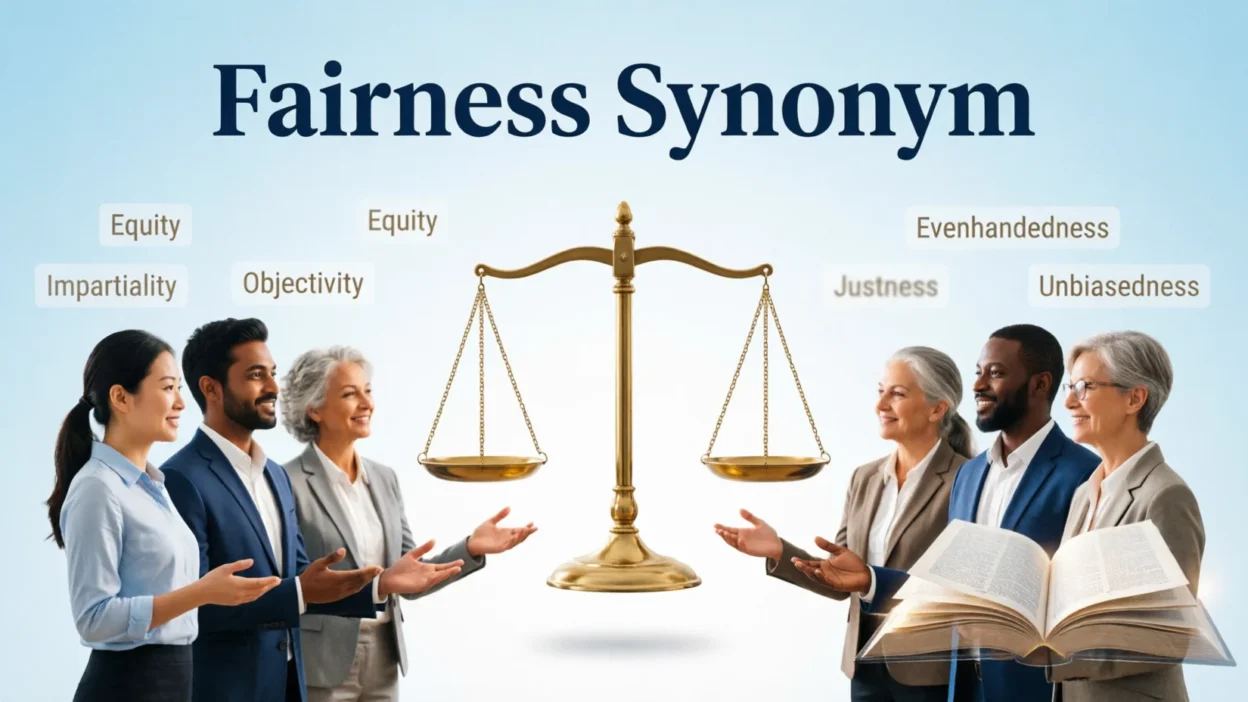
Finding the right fairness synonym depends on what you mean by fairness. Common alternatives include justice, equality, impartiality, equity, neutrality, objectivity, balance, and even-handedness. Each word has a slightly different meaning and works better in certain situations.
If you are writing an essay, improving your vocabulary, preparing for an English exam, or creating professional content, choosing the right synonym can make your writing clearer and more precise.
Quick Answer: What Is a Synonym for Fairness?
The best general synonym for fairness is justice. However, the appropriate word depends on the context.
- Justice — fair treatment according to what is right
- Equality — giving people the same rights or opportunities
- Equity — providing fair treatment according to individual needs
- Impartiality — avoiding favoritism
- Objectivity — making judgments based on facts rather than personal feelings
- Neutrality — not supporting either side
- Balance — treating different sides or interests fairly
- Even-handedness — treating everyone in an equally fair way
What Does Fairness Mean?
Fairness means treating people reasonably, equally, and without unfair favoritism or discrimination.
For example:
Fairness can involve equal treatment, but it does not always mean treating everyone exactly the same. In some situations, fairness means considering people’s different circumstances and giving them the support they need.
Fairness in Simple English
In simple words, fairness means doing what is reasonable and treating people in a just way.
The word can describe decisions, rules, relationships, competitions, workplaces, education, and everyday behavior.
Example Sentences
- Everyone deserves fairness at work.
- The referee was praised for his fairness.
- The new policy aims to improve fairness in education.
- She questioned the fairness of the decision.
- Fairness is important when resolving disagreements.
30 Synonyms for Fairness
The following words are related to fairness, but they are not always interchangeable. Their exact meaning depends on the sentence and situation.
1. Justice
Simple meaning: Fair treatment based on what is right or deserved.
Example: The community demanded justice after the unfair decision.
Best usage/context: Law, ethics, rights, social issues, and serious discussions.
2. Equality
Simple meaning: Treating people as equal or giving them equal rights and opportunities.
Example: The organization promotes equality in the workplace.
Best usage/context: Rights, opportunities, education, employment, and social issues.
3. Equity
Simple meaning: Fair treatment that considers people’s different needs or circumstances.
Example: The program was designed to improve equity in access to education.
Best usage/context: Education, healthcare, economics, workplace policies, and social discussions.
4. Impartiality
Simple meaning: Not favoring one person, group, or side over another.
Example: The judge was respected for her impartiality.
Best usage/context: Judges, referees, decision-makers, investigations, and formal situations.
5. Objectivity
Simple meaning: Making judgments based on facts rather than personal feelings.
Example: The reviewer tried to maintain objectivity when evaluating the products.
Best usage/context: Research, journalism, reviews, academic writing, and professional decisions.
6. Neutrality
Simple meaning: Not taking one side in a disagreement or conflict.
Example: The mediator maintained neutrality during the discussion.
Best usage/context: Conflicts, diplomacy, mediation, politics, and negotiations.
7. Even-handedness
Simple meaning: Treating different people or sides equally and fairly.
Example: The editor was known for her even-handedness when covering controversial issues.
Best usage/context: Journalism, leadership, management, and disputes.
8. Balance
Simple meaning: Giving appropriate consideration to different sides or interests.
Example: The report provides a balance of different viewpoints.
Best usage/context: Writing, journalism, decision-making, arguments, and discussions.
9. Fair-mindedness
Simple meaning: Being willing to consider different opinions fairly.
Example: His fair-mindedness helped the team resolve the disagreement.
Best usage/context: Personality, leadership, discussions, and interpersonal situations.
10. Reasonableness
Simple meaning: Being sensible, practical, and fair.
Example: The employee appealed to the manager’s sense of reasonableness.
Best usage/context: Requests, decisions, negotiations, rules, and everyday situations.
11. Justness
Simple meaning: The quality of being morally right or fair.
Example: The justness of the punishment was questioned.
Best usage/context: Formal writing, ethics, law, and philosophical discussions.
12. Righteousness
Simple meaning: Acting in a morally right way.
Example: The story explores the struggle between injustice and righteousness.
Best usage/context: Moral, religious, literary, and philosophical contexts.
13. Equity of treatment
Simple meaning: Fair treatment that takes circumstances into account.
Example: The company introduced new policies to promote equity of treatment.
Best usage/context: Formal discussions about workplaces, education, and social systems.
14. Non-discrimination
Simple meaning: Treating people without unfair discrimination.
Example: The policy emphasizes non-discrimination in hiring.
Best usage/context: Employment, law, human rights, institutions, and official policies.
15. Equality of opportunity
Simple meaning: Giving people the same chance to succeed.
Example: The scholarship program aims to provide equality of opportunity.
Best usage/context: Education, careers, employment, and social policy.
16. Fair play
Simple meaning: Honest and fair behavior, especially in competition.
Example: Good athletes understand the importance of fair play.
Best usage/context: Sports, games, competitions, and informal situations.
17. Honesty
Simple meaning: Being truthful and sincere.
Example: Honesty helped the manager make a fair decision.
Best usage/context: Personal relationships, business, communication, and ethics.
Note: Honesty is related to fairness but is not a direct synonym in every situation.
18. Integrity
Simple meaning: Strong moral principles and honest behavior.
Example: Her integrity made others trust her judgment.
Best usage/context: Leadership, professional behavior, ethics, and character.
19. Decency
Simple meaning: Acceptable, respectful, and morally appropriate behavior.
Example: Treating employees with decency should be expected from every manager.
Best usage/context: Everyday behavior, relationships, workplace culture, and moral discussions.
20. Propriety
Simple meaning: Appropriate and proper behavior.
Example: The committee considered whether the decision met professional standards of propriety.
Best usage/context: Formal writing, professional conduct, institutions, and official situations.
21. Nonpartisanship
Simple meaning: Not supporting one political side or party.
Example: The organization emphasized its nonpartisanship during the election period.
Best usage/context: Political, institutional, and organizational contexts.
22. Disinterest
Simple meaning: Lack of personal interest or involvement in an issue.
Example: The mediator’s disinterest helped reduce tensions.
Best usage/context: Formal contexts involving impartial decision-making.
Important: Disinterest means lack of personal interest, while uninterested usually means not interested. They should not automatically be treated as identical.
23. Detachment
Simple meaning: Remaining emotionally separate from a situation.
Example: The investigator approached the case with professional detachment.
Best usage/context: Investigations, analysis, professional decisions, and emotional situations.
24. Objectiveness
Simple meaning: The quality of being objective.
Example: The study emphasizes objectiveness in evaluating the evidence.
Best usage/context: Academic and formal writing.
Note: Objectivity is generally the more natural and common choice.
25. Equitableness
Simple meaning: The quality of being fair and impartial.
Example: The equitableness of the arrangement was discussed by both parties.
Best usage/context: Formal or specialized writing.
26. Fair treatment
Simple meaning: Treating someone in a reasonable and just way.
Example: Every employee deserves fair treatment.
Best usage/context: Workplace, education, customer service, relationships, and everyday English.
27. Equal treatment
Simple meaning: Treating people in the same way.
Example: The law requires equal treatment under the stated rules.
Best usage/context: Rights, laws, policies, workplaces, and institutions.
28. Due process
Simple meaning: Following proper and established procedures when making an official decision.
Example: The employee was given due process before disciplinary action was taken.
Best usage/context: Law, government, employment, institutions, and formal procedures.
Note: Due process is related to fairness but refers specifically to proper procedures rather than fairness in general.
29. Balance of interests
Simple meaning: Considering competing needs or interests fairly.
Example: The committee sought a balance of interests when creating the new policy.
Best usage/context: Negotiations, policy discussions, management, and decision-making.
30. Fair dealing
Simple meaning: Honest and reasonable treatment in a transaction or relationship.
Example: Customers expect fair dealing from businesses.
Best usage/context: Business, contracts, commerce, professional relationships, and consumer situations.
Fairness Synonyms Comparison Table
| Synonym | Main idea | Formality | Best context |
|---|---|---|---|
| Justice | What is right or deserved | High | Law, ethics, society |
| Equality | Same rights or opportunities | Medium | Rights, education, society |
| Equity | Fairness based on circumstances | High | Education, policy, workplaces |
| Impartiality | No favoritism | High | Judges, decisions |
| Objectivity | Fact-based judgment | High | Research, reviews |
| Neutrality | Taking neither side | High | Mediation, conflicts |
| Even-handedness | Equal treatment of sides | Medium | Leadership, journalism |
| Balance | Fair consideration of sides | Medium | Writing, decisions |
| Fair-mindedness | Open and fair thinking | Medium | Personality, discussions |
| Reasonableness | Sensible and fair behavior | Medium | Requests, negotiations |
| Fair play | Honest competition | Informal | Sports, games |
| Integrity | Strong moral character | Medium | Leadership, ethics |
| Non-discrimination | No unfair discrimination | High | Law, employment |
| Due process | Proper procedure | High | Law, institutions |
| Fair dealing | Honest treatment | Medium | Business, commerce |
Fairness vs. Equality vs. Equity
These three words are closely related, but they are not identical.
Fairness
Fairness is the broadest idea. It means treating people reasonably and justly.
Equality
Equality generally focuses on giving people the same rights, opportunities, or treatment.
Equity
Equity focuses on achieving fair outcomes or access by considering different circumstances and needs.
For example, imagine three students need help reaching a learning resource. Giving everyone exactly the same support represents equality. Providing different levels of assistance based on each student’s circumstances can represent equity. The broader goal of making sure students are treated reasonably is fairness.
How to Choose the Right Fairness Synonym
The best synonym depends on your intended meaning.
For Legal or Moral Contexts
Choose:
- Justice
- Justness
- Due process
- Fair treatment
- Non-discrimination
Example:
“The court considered the principles of justice.”
For Equal Rights and Opportunities
Choose:
- Equality
- Equality of opportunity
- Equal treatment
- Non-discrimination
Example:
“The organization supports equality of opportunity.”
For Different Needs and Circumstances
Choose:
- Equity
- Equity of treatment
- Balance of interests
Example:
“The policy was created to promote equity in education.”
For Neutral Decision-Making
Choose:
- Impartiality
- Objectivity
- Neutrality
- Even-handedness
Example:
“The referee demonstrated impartiality throughout the match.”
For Everyday Situations
Choose:
- Fair treatment
- Fair-mindedness
- Reasonableness
- Fair play
- Balance
Example:
“We simply want fair treatment.”
For Professional or Formal Writing
Choose:
- Impartiality
- Objectivity
- Equity
- Propriety
- Justice
- Due process
These words can make your writing more precise when the context genuinely calls for them.
Common Usage Mistakes
1. Using Equality When You Mean Equity
Equality usually emphasizes the same treatment or opportunities.
Equity emphasizes fairness while recognizing different circumstances.
Do not automatically substitute one for the other.
2. Treating Justice and Fairness as Identical Everywhere
Justice and fairness overlap, but justice often carries stronger legal, moral, or social meaning.
For everyday situations, “fair treatment” may sound more natural.
3. Confusing Neutrality With Fairness
Being neutral means not taking a side. However, neutrality does not automatically guarantee a fair result.
For example, a mediator may remain neutral while still ensuring that both parties have an opportunity to speak.
4. Using Objectivity When You Mean Equal Treatment
Objectivity means relying on facts and minimizing personal bias.
It does not necessarily mean giving everyone identical treatment.
5. Using Fair Play Outside Competitive Contexts
“Fair play” is strongly associated with sports, games, competition, and honest behavior.
For a legal or professional context, “fair treatment” or “impartiality” may be more appropriate.
Fairness Synonyms in Different Sentences
The same basic idea can be expressed differently depending on the situation.
- Fairness in sports: fair play
- Fairness in court: justice
- Fairness in judging: impartiality
- Fairness in research: objectivity
- Fairness in opportunities: equality
- Fairness based on individual needs: equity
- Fairness during mediation: neutrality
- Fairness in business: fair dealing
- Fairness in official procedures: due process
- Fairness in everyday treatment: fair treatment
Why Choosing the Right Synonym Matters
Using a precise synonym makes your writing easier to understand.
Consider these two sentences:
Both sentences can work, but impartiality specifically emphasizes that the judge did not favor one side.
Likewise:
The second sentence suggests that the program is concerned with fair access while taking differences in circumstances into account.
The right word communicates your exact idea instead of simply repeating the same vocabulary.
FAQs:
What is the best synonym for fairness?
Justice is one of the closest general synonyms for fairness. Depending on the context, equality, equity, impartiality, objectivity, neutrality, or fair treatment may be more precise.
What is a simple word for fairness?
Fair treatment is a simple and natural expression for fairness. Justice is also common but can sound more formal or serious.
Is equality a synonym for fairness?
Equality is closely related to fairness but does not mean exactly the same thing. Equality generally focuses on the same rights, opportunities, or treatment, while fairness is a broader concept.
Is equity the same as fairness?
Equity is a form or aspect of fairness that considers differences in circumstances or needs. The two words are closely related but should not always be used interchangeably.
What is a synonym for fairness in the workplace?
Useful choices include fair treatment, equality, equity, impartiality, non-discrimination, and equal opportunity, depending on what aspect of workplace fairness you mean.
What is a synonym for fairness in sports?
Fair play is the most natural expression in sports. Impartiality can also describe a referee or official who treats competitors fairly.
What is a synonym for fairness in an argument?
Balance, objectivity, impartiality, and fair-mindedness can work well. The best choice depends on whether you mean considering both sides, avoiding bias, or relying on evidence.
What is the opposite of fairness?
Common opposites include unfairness, injustice, inequality, bias, favoritism, discrimination, and partiality. The exact opposite depends on the situation.
Conclusion
The word fairness describes the idea of treating people reasonably, justly, and without unfair favoritism. Its closest alternatives include justice, equality, equity, impartiality, objectivity, neutrality, balance, and fair treatment.
However, these words have different shades of meaning. Use justice for moral or legal fairness, equality for equal rights or opportunities, equity when circumstances and needs matter, impartiality when avoiding favoritism is important, and objectivity when decisions should be based on facts.
Choosing the right fairness synonym can make your English more accurate, natural, and expressive. Instead of replacing “fairness” with any similar word, consider the exact meaning you want to communicate and choose the word that fits the context.

I’m James Parker, Administrator at SynonymsHive. I oversee content quality, improve user experience, and ensure reliable synonym resources. My passion is making language learning simple, accurate, and accessible for everyone.