
The words disorganized and unorganized are often confused because both describe situations where things lack order, structure, or proper arrangement. Although they have similar meanings, they are not always interchangeable. Understanding the difference can help you choose the right word in everyday conversations, academic writing, professional communication, and other situations.
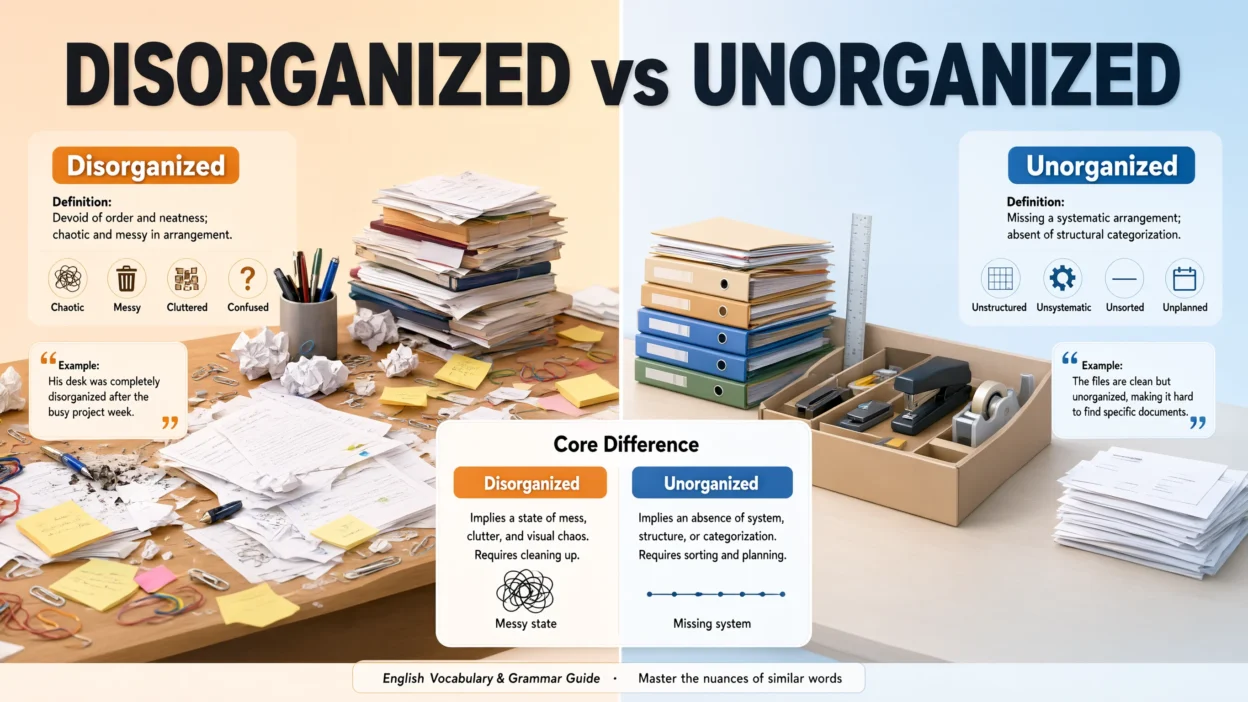
The main difference between disorganized and unorganized is that disorganized usually describes something messy, poorly arranged, or lacking effective organization, while unorganized often describes something that has not been arranged, structured, or formally organized.
For example, a messy office can be disorganized, while a group that has not formed an official organization can be described as unorganized. Both words are correct, but their meanings depend on context. Learning when to use each one will make your English clearer and more precise.
Quick Answer: Disorganized vs Unorganized
Disorganized means lacking order, structure, or effective arrangement, often resulting in confusion or messiness. Unorganized means not organized, arranged, or formally structured. Use disorganized for messy systems, workplaces, schedules, or behavior. Use unorganized when something has not yet been arranged or established. Both words can describe a lack of organization.
Why Do People Confuse Disorganized and Unorganized?
People confuse these words because both contain the word “organized” and have the negative prefixes “dis-” and “un-.
Both prefixes can change a positive word into its opposite, but they do not always create exactly the same meaning.
Here are three reasons for the confusion:
- Similar meanings: Both words can describe a lack of order, planning, or structure.
- Overlapping usage: In everyday English, people sometimes use them interchangeably.
- Different emphasis: Disorganized often emphasizes disorder or poor organization, while unorganized can emphasize the absence of organization.
For example:
- The classroom was disorganized because books and papers were scattered everywhere.
- The students formed an unorganized group because they had not established any formal structure.
The difference becomes clearer when you consider the situation being described.
What Does Disorganized Mean?
Disorganized is an adjective that describes something that lacks proper order, arrangement, planning, or structure.
It often suggests that something is messy, confusing, poorly managed, or not functioning as it should.
A disorganized person may struggle to manage responsibilities, remember appointments, or keep belongings in order. Similarly, a disorganized workplace may have unclear responsibilities, misplaced documents, or inefficient processes.
Simple meaning: Messy, poorly arranged, confusing, or lacking proper organization.
Examples of Disorganized in Sentences
- My bedroom is disorganized because I have not put away my clothes.
- The manager runs a disorganized office with no clear schedule.
- She felt disorganized after managing several projects at once.
- The meeting became disorganized because nobody followed the agenda.
- His disorganized notes made studying difficult.
- The company needs to improve its disorganized management system.
Synonyms of Disorganized
Some useful synonyms include:
- Messy
- Chaotic
- Disorderly
- Unsystematic
- Confused
- Unstructured
- Scattered
- Haphazard
- Untidy
- Poorly arranged
These alternatives have slightly different meanings, so choose one that best matches the situation.
What Does Unorganized Mean?
Unorganized is an adjective that describes something that has not been organized, arranged, planned, or given a proper structure.
It can refer to people, groups, activities, events, or materials that lack an established organizational system.
Unlike disorganized, which often suggests existing disorder or poor management, unorganized can simply indicate that organization has not taken place.
Simple meaning: Not arranged, planned, structured, or formally organized.
Examples of Unorganized in Sentences
- The documents remained unorganized after the office renovation.
- We joined an unorganized group of volunteers.
- The event was unorganized because nobody prepared a schedule.
- These files are still unorganized and need to be sorted.
- The workers were unorganized and had no clear plan.
- The community started as an unorganized collection of local volunteers.
Synonyms of Unorganized
Depending on the context, useful alternatives include:
- Unstructured
- Unarranged
- Unplanned
- Unsystematic
- Informal
- Uncoordinated
- Unsorted
- Unregulated
- Unclassified
- Unprepared
Remember that these synonyms are not perfect replacements in every sentence.
Disorganized vs Unorganized: Comparison Table
The following table explains the main differences between the two words.
| Feature | Disorganized | Unorganized |
| Part of speech | Adjective | Adjective |
| Basic meaning | Lacking proper order | Not organized or arranged |
| Main emphasis | Disorder or poor organization | Absence of organization |
| Common usage | Messy systems and behavior | Unarranged things and informal groups |
| Implied condition | Often suggests confusion | May simply mean organization is absent |
| Workplace | Poorly managed workplace | Workplace without an established structure |
| Person | Someone who struggles with organization | Someone who has not organized something |
| Tone | Often negative | Neutral or negative |
| Example | His desk is disorganized. | His files are unorganized. |
Important: This is a general distinction, not an absolute grammatical rule. Both words can describe the same situation, and their meanings sometimes overlap.
When Should You Use Disorganized vs Unorganized?
Choosing between these words becomes easier when you understand what you want to communicate.
When to Use Disorganized
Use disorganized when something has poor organization, lacks order, or creates confusion.
Common situations include:
- Messy spaces: A bedroom, kitchen, office, or classroom with misplaced items.
- Poor management: A business with unclear responsibilities or inefficient systems.
- Confusing activities: A meeting, event, or project without proper coordination.
- Personal behavior: Someone who struggles to manage time or responsibilities.
Examples:
- The disorganized kitchen needs cleaning.
- Our team has a disorganized working process.
- He is disorganized and frequently forgets appointments.
When to Use Unorganized
Use unorganized when something has not been arranged, planned, or formally structured.
Common situations include:
- Unsorted materials: Documents, photographs, books, or files that have not been arranged.
- Informal groups: People working together without an established organizational structure.
- Unplanned activities: Events or projects that have not received proper preparation.
- Unstructured systems: Activities without a formal arrangement or framework.
Examples:
- The photographs are unorganized.
- They worked as an unorganized group of volunteers.
- The project remains unorganized because nobody has created a plan.
Disorganized vs Unorganized: 12 Examples in Everyday English
These examples show how both words work in natural sentences.
| No. | Disorganized | Unorganized |
| 1 | My desk is disorganized. | My documents are unorganized. |
| 2 | The office has a disorganized management system. | The office files are unorganized. |
| 3 | Her schedule is disorganized. | Her activities are unorganized. |
| 4 | The meeting became disorganized. | The event was unorganized. |
| 5 | His notes are disorganized. | His research materials are unorganized. |
| 6 | The classroom looks disorganized. | The classroom supplies are unorganized. |
| 7 | Their business operations are disorganized. | Their new business structure is unorganized. |
| 8 | The team became disorganized during the match. | The volunteers were an unorganized group. |
| 9 | My daily routine is disorganized. | My weekly tasks are unorganized. |
| 10 | The presentation was disorganized. | The presentation materials were unorganized. |
| 11 | Her thoughts seemed disorganized. | The collected information was unorganized. |
| 12 | The company’s leadership is disorganized. | The company has an unorganized administrative structure. |
Some sentences use the words in similar ways. This reflects their overlapping meanings in modern English.
Common Mistakes When Using Disorganized and Unorganized
Even experienced English speakers sometimes use these words without considering their slight differences.
Here are some common mistakes to avoid.
1. Assuming Both Words Always Mean Exactly the Same Thing
Although they overlap, their emphasis can differ.
Incorrect assumption: Disorganized and unorganized are always interchangeable.
Better understanding: Disorganized often suggests disorder, while unorganized can indicate that something has not been arranged.
2. Using Disorganized Only for Physical Messes
Disorganized does not describe only messy rooms or desks.
It can also describe:
- Disorganized thinking
- Disorganized management
- Disorganized communication
- Disorganized planning
- Disorganized behavior
3. Thinking Unorganized Is Always Incorrect
Unorganized is a correct English adjective.
For example:
“The documents are still unorganized.”
This sentence is grammatically correct and natural.
4. Confusing Unorganized with Unorganised
Both spellings are correct.
- Unorganized is the standard American English spelling.
- Unorganised is the standard British English spelling.
The same spelling difference applies to organized and organised.
5. Using the Wrong Word for Formal Groups
When describing a group that has not established an official structure, unorganized may be more appropriate.
Example:
“The volunteers worked as an unorganized group.”
However, if the group has poor coordination and creates confusion, disorganized may communicate the situation better.
What Is an Easy Way to Remember Disorganized vs Unorganized?
A simple memory trick can help you remember the difference.
Think of “disorganized” as disorder and “unorganized” as not organized yet.
- Disorganized = Disorder: Something has poor order or arrangement.
- Unorganized = Not organized: Something lacks an established arrangement or structure.
For example:
- A bedroom full of scattered clothes is disorganized.
- A collection of photographs that has never been sorted is unorganized.
This trick is a useful guide, although context can sometimes make both words appropriate.
Disorganized vs Unorganized in American and British English
Both words are used in American and British English. The main difference between the varieties is spelling rather than meaning.
| American English | British English |
| Disorganized | Disorganised |
| Unorganized | Unorganised |
| Organized | Organised |
| Organization | Organisation |
| Organizing | Organising |
American English Examples
- My office is disorganized.
- The files are unorganized.
- She organized the entire event.
British English Examples
- My office is disorganised.
- The files are unorganised.
- She organised the entire event.
The meanings remain essentially the same in both varieties.
If you are writing for an American audience, use the “-ize” spelling. For a British audience, the “-ise” spelling is generally preferred.
Similar Words Related to Disorganized and Unorganized
Several English words have meanings similar to disorganized and unorganized. However, each has its own usage and meaning.
| Word | Simple Meaning | Example |
| Chaotic | Completely confusing or disorderly | The office was chaotic. |
| Disorderly | Lacking order or discipline | The room looked disorderly. |
| Messy | Dirty or untidy | His desk is messy. |
| Unstructured | Without a clear structure | The discussion was unstructured. |
| Unsystematic | Without an organized method | Their research was unsystematic. |
| Unplanned | Not prepared in advance | It was an unplanned meeting. |
| Haphazard | Done without a proper plan | The work was completed haphazardly. |
| Untidy | Not neat or arranged | Her bedroom is untidy. |
| Uncoordinated | Lacking effective cooperation | The team appeared uncoordinated. |
| Scattered | Spread around without order | The papers were scattered everywhere. |
These words can help you express different types of disorder more accurately.
Final Verdict: Disorganized vs Unorganized
Both disorganized and unorganized are correct English words that describe a lack of organization. However, they have slightly different shades of meaning.
Use disorganized when describing something messy, confusing, poorly managed, or lacking proper order.
Use unorganized when describing something that has not been arranged, planned, or formally structured.
For example:
- “My workspace is disorganized” means the workspace is messy or poorly arranged.
- “My files are unorganized” means the files have not been properly sorted or arranged.
The best word depends on your intended meaning and the context of your sentence.
FAQs:
1. Are disorganized and unorganized the same?
No, they are not exactly the same, although their meanings overlap. Disorganized generally describes something messy or poorly arranged, while unorganized often describes something that has not been organized or structured.
2. Is disorganized a real word?
Yes, disorganized is a correct English adjective. It describes something that lacks proper order, arrangement, planning, or structure.
Example: “My workspace is disorganized because I have too many papers.”
3. Is unorganized grammatically correct?
Yes, unorganized is grammatically correct and widely understood. It describes something that has not been arranged, planned, or organized.
Example: “The documents are still unorganized.”
4. Which word is more appropriate for a messy room: disorganized or unorganized?
Disorganized is generally the more natural choice when describing a messy room. It suggests that the room lacks proper order and that belongings are not arranged neatly.
Example: “My bedroom is disorganized.”
5. Can you call a person disorganized?
Yes. You can describe someone as disorganized if they struggle to manage their time, responsibilities, belongings, or daily activities.
Example: “He is disorganized and often forgets important appointments.”
6. What is the opposite of disorganized?
The opposite of disorganized is organized. Other possible opposites include orderly, systematic, structured, and well-arranged.
Example: “Her organized workspace makes it easier to complete tasks.”
7. Is unorganised British English or American English?
Unorganised is the standard British English spelling, while unorganized is the standard American English spelling. Both have the same basic meaning.
Remember This
- Disorganized = Messy, confusing, or poorly arranged.
- Unorganized = Not arranged, planned, or formally structured.
- Both are correct English adjectives.
- Their meanings sometimes overlap.
- American English generally uses “-ize,” while British English generally uses “-ise.”
The easiest way to remember the distinction is to associate disorganized with disorder and unorganized with the absence of organization.
Conclusion
Understanding the difference between disorganized and unorganized can help you communicate more clearly in everyday conversations, academic writing, and professional situations. Although both words describe a lack of organization, disorganized usually emphasizes messiness, confusion, or poor management, while unorganized often emphasizes the absence of an established arrangement or structure.
Remember that context matters when choosing between these adjectives. If something is messy or poorly managed, disorganized is usually the better choice. If something has not yet been arranged or formally structured, unorganized may be more suitable. With regular practice and attention to context, you can use both words naturally and confidently.

I am Olivia Brooks, a language enthusiast and writer at SynonymsHive. I enjoy creating clear, engaging content about synonyms, vocabulary, and word meanings, helping readers improve their writing and communicate with confidence every day.