
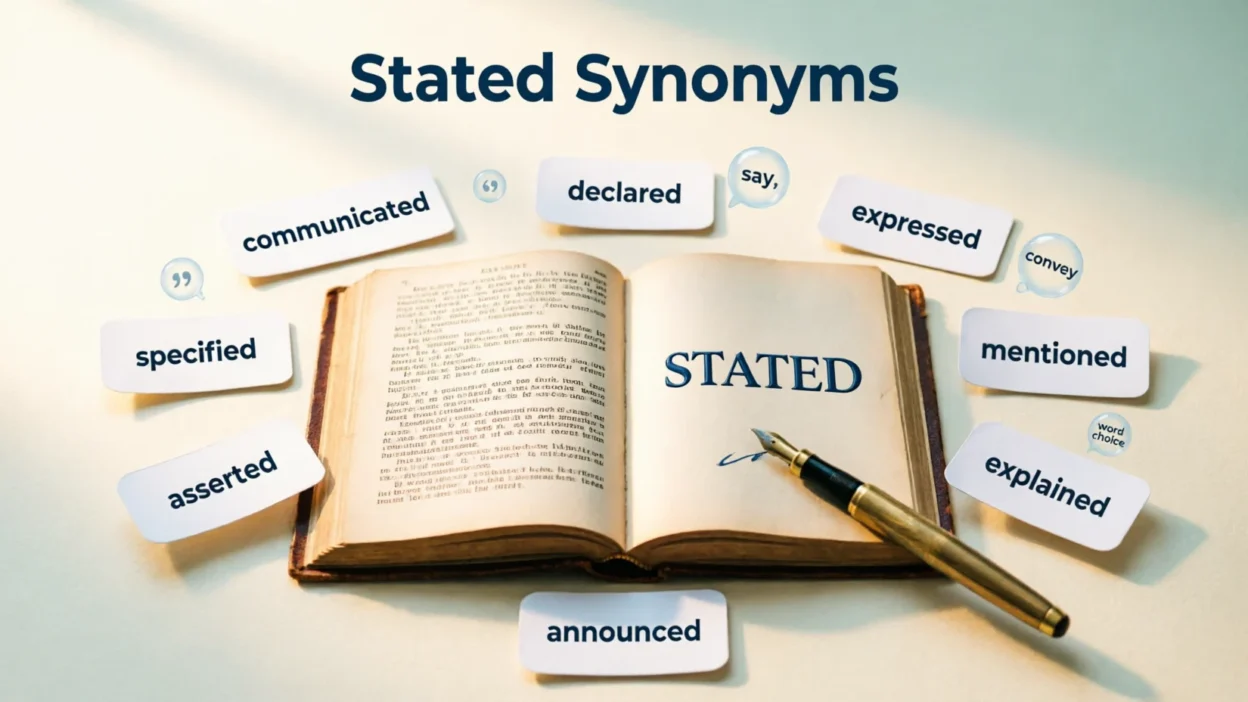
When you want to say that someone stated something, you usually mean that they expressed an idea, opinion, fact, or piece of information clearly in speech or writing.
Depending on the situation, you can use words such as said, expressed, declared, mentioned, explained, reported, announced, asserted, or specified. However, these words are not always interchangeable. Each carries a slightly different meaning or tone.
Quick Answer
Stated means said, expressed, or clearly communicated something, especially in words. The best synonym depends on whether the person is simply speaking, formally announcing something, explaining an idea, or strongly claiming that something is true.
What Does “Stated” Mean?
Stated is the past tense and past participle of state. It means to express something clearly, usually through spoken or written words.
For example:
Here, stated means said or communicated clearly.
The word can be used in everyday English, academic writing, business communication, journalism, legal documents, and formal reports.
Simple Meaning of Stated
Stated = said or expressed something clearly and directly.
Examples of Stated
- She stated her opinion during the meeting.
- The report stated that sales had increased.
- He stated his reasons for leaving.
- The rules stated that visitors needed identification.
The exact synonym you choose should match the meaning and level of formality.
30 Synonyms for Stated
Below are 30 useful alternatives to stated, with simple meanings, examples, and guidance on when to use each one.
1. Said
Simple meaning: Spoke or expressed something in words.
Example:
She said that she needed more time.
Best usage/context: Everyday conversation and general writing.
Said is the most natural and common replacement for stated in informal English.
2. Expressed
Simple meaning: Communicated a thought, feeling, or opinion.
Example:
He expressed his concerns about the new plan.
Best usage/context: Opinions, emotions, concerns, and ideas.
Use expressed when you want to focus on communicating a thought or feeling rather than simply speaking.
3. Declared
Simple meaning: Said something clearly and firmly.
Example:
The company declared that the product was safe.
Best usage/context: Formal announcements, strong statements, and public positions.
Declared often sounds stronger and more formal than stated.
4. Announced
Simple meaning: Told people about something officially or publicly.
Example:
The school announced the date of the annual event.
Best usage/context: News, public information, decisions, events, and official communications.
Use announced when information is being made known to a group of people.
5. Mentioned
Simple meaning: Referred to something briefly.
Example:
She mentioned that she had visited London.
Best usage/context: Brief references or casual conversation.
Mentioned is usually weaker than stated because it does not necessarily suggest a detailed or important statement.
6. Explained
Simple meaning: Made something clear by giving information or reasons.
Example:
The teacher explained why the answer was incorrect.
Best usage/context: Instructions, reasons, concepts, and clarification.
Choose explained when the person gives details to help someone understand something.
7. Asserted
Simple meaning: Said something confidently or firmly.
Example:
The witness asserted that he had seen the accident.
Best usage/context: Formal writing, arguments, claims, and situations involving strong confidence.
Asserted can suggest that the speaker strongly presented something as true.
8. Reported
Simple meaning: Gave information about something that happened or was discovered.
Example:
The newspaper reported that the company had opened a new office.
Best usage/context: Journalism, research, official information, and factual accounts.
Use reported when information is being passed on rather than simply expressed.
9. Specified
Simple meaning: Gave exact details or clearly identified something.
Example:
The instructions specified that all forms must be submitted by Friday.
Best usage/context: Rules, instructions, requirements, contracts, and technical writing.
Specified is especially useful when precision matters.
10. Communicated
Simple meaning: Shared information, ideas, or feelings with someone.
Example:
The manager communicated the new policy to the staff.
Best usage/context: Business, professional writing, relationships, and general communication.
This word focuses on the act of transferring information.
11. Conveyed
Simple meaning: Communicated an idea, feeling, or message.
Example:
Her expression conveyed a sense of disappointment.
Best usage/context: Formal writing, emotions, messages, ideas, and indirect communication.
Conveyed can be used when something is communicated through words, actions, tone, or appearance.
12. Affirmed
Simple meaning: Confirmed or stated that something was true.
Example:
The official affirmed his commitment to the project.
Best usage/context: Formal statements, confirmation, agreements, and official contexts.
Use affirmed when the speaker confirms something rather than simply mentioning it.
13. Confirmed
Simple meaning: Said that something was true, correct, or definite.
Example:
The airline confirmed that the flight would leave on time.
Best usage/context: Facts, arrangements, appointments, decisions, and official information.
Confirmed is more specific than stated because it implies verification or certainty.
14. Claimed
Simple meaning: Said that something was true, especially when it may need proof.
Example:
The man claimed that he had never seen the document.
Best usage/context: Arguments, disputed statements, journalism, and uncertain information.
Be careful with claimed because it can suggest that the statement has not been proven.
15. Asserted
Simple meaning: Declared something confidently or strongly.
Example:
The lawyer asserted that the evidence was unreliable.
Best usage/context: Formal arguments, debates, legal contexts, and strong opinions.
Asserted is similar to declared, but it often emphasizes confidence in a claim.
16. Remarked
Simple meaning: Said something as a comment or observation.
Example:
She remarked that the weather was unusually cold.
Best usage/context: Conversations, observations, narratives, and literary writing.
It often introduces a short comment rather than an important formal statement.
17. Observed
Simple meaning: Said something based on what someone noticed.
Example:
The researcher observed that the results were different from earlier findings.
Best usage/context: Academic writing, research, analysis, and careful observations.
It often suggests thoughtful or evidence-based commentary.
18. Noted
Simple meaning: Mentioned or pointed out something important.
Example:
The report noted several problems with the existing system.
Best usage/context: Academic, professional, analytical, and formal writing.
Noted is particularly common in reports and research.
19. Pointed Out
Simple meaning: Drew attention to a particular fact or issue.
Example:
The manager pointed out that the deadline had changed.
Best usage/context: Discussions, explanations, corrections, and highlighting information.
It works well when the speaker wants others to notice something.
20. Revealed
Simple meaning: Made previously unknown information known.
Example:
The investigation revealed several important facts.
Best usage/context: Discoveries, investigations, confidential information, and new findings.
Use revealed when information was previously hidden or unknown.
21. Disclosed
Simple meaning: Made private or previously unknown information public.
Example:
The company disclosed details about the agreement.
Best usage/context: Business, legal writing, finance, privacy, and formal communication.
Disclosed is more formal than stated and usually involves information that was not previously public.
22. Communicated
Simple meaning: Passed information, thoughts, or feelings to another person.
Example:
The director communicated the decision to the team.
Best usage/context: Professional, academic, and general communication.
It emphasizes the process of sharing information.
23. Informed
Simple meaning: Gave someone information about something.
Example:
The doctor informed the patient about the available options.
Best usage/context: Professional communication, instructions, notices, and official situations.
Use informed when someone gives information to another person.
24. Admitted
Simple meaning: Accepted or acknowledged that something was true.
Example:
He admitted that he had made a mistake.
Best usage/context: Mistakes, wrongdoing, facts, and personal acknowledgments.
Admitted has a specific meaning, so it cannot replace stated in every sentence.
25. Acknowledged
Simple meaning: Accepted or recognized something as true or important.
Example:
The author acknowledged the limitations of the study.
Best usage/context: Academic writing, formal discussions, problems, facts, and recognition.
It often suggests acceptance rather than simple communication.
26. Described
Simple meaning: Gave details about something or someone.
Example:
The witness described what happened that evening.
Best usage/context: Events, people, places, experiences, and detailed explanations.
Use described when the speaker provides characteristics or details.
27. Explained
Simple meaning: Made an idea or situation easier to understand.
Example:
The professor explained the main cause of the problem.
Best usage/context: Education, instructions, causes, and clarification.
It is more specific than stated when the purpose is to make something understandable.
28. Proposed
Simple meaning: Suggested an idea or plan for consideration.
Example:
The committee proposed a new approach to the problem.
Best usage/context: Plans, suggestions, policies, projects, and formal discussions.
Do not use proposed simply because someone stated an idea; it implies that the idea was offered for consideration.
29. Declared
Simple meaning: Made a strong or official statement.
Example:
The mayor declared the area a protected zone.
Best usage/context: Official decisions, public announcements, strong statements, and formal situations.
Declared often carries more authority than stated.
30. Replied
Simple meaning: Answered someone who had spoken or asked a question.
Example:
She replied that she would arrive later.
Best usage/context: Conversations, emails, questions, messages, and dialogue.
Use replied only when the statement is an answer or response.
Comparison Table: Stated Synonyms
| Synonym | Main meaning | Tone | Best context |
|---|---|---|---|
| Said | Spoke words | Neutral | Everyday English |
| Expressed | Communicated a thought or feeling | Neutral | Opinions and emotions |
| Declared | Said firmly or officially | Formal | Public statements |
| Announced | Made information public | Formal | News and decisions |
| Mentioned | Referred to briefly | Neutral | Casual conversation |
| Explained | Made something clear | Neutral | Teaching and clarification |
| Asserted | Claimed firmly | Formal | Arguments and claims |
| Reported | Gave information | Formal | News and research |
| Specified | Gave exact details | Formal | Rules and instructions |
| Conveyed | Communicated a message | Formal | Ideas and feelings |
| Confirmed | Verified as true | Neutral/Formal | Facts and arrangements |
| Claimed | Said something was true | Neutral | Disputed information |
| Noted | Pointed out | Formal | Reports and analysis |
| Observed | Commented based on noticing | Formal | Research and analysis |
| Disclosed | Made private information known | Formal | Legal and business contexts |
| Proposed | Suggested an idea | Formal | Plans and proposals |
| Described | Gave details | Neutral | People, places, events |
| Replied | Answered | Neutral | Conversations |
| Acknowledged | Recognized or accepted | Formal | Academic and professional writing |
| Revealed | Made hidden information known | Neutral/Formal | Discoveries and investigations |
How to Choose the Right Synonym for Stated
The best synonym depends on what the person did with the information.
For Casual or Everyday English
Choose:
- Said
- Mentioned
- Replied
- Remarked
- Pointed out
For example:
This sounds more natural in everyday conversation than:
For Formal Writing
Choose:
- Declared
- Asserted
- Reported
- Specified
- Affirmed
- Disclosed
- Acknowledged
- Noted
For example:
This sounds appropriate for academic or professional writing.
When Someone Gives an Opinion
Choose:
- Expressed
- Asserted
- Remarked
- Observed
- Commented
Example:
When Someone Gives Information
Choose:
- Reported
- Communicated
- Informed
- Explained
- Announced
Example:
When Someone Makes a Strong Claim
Choose:
- Asserted
- Declared
- Claimed
- Affirmed
Example:
However, claimed can suggest that the truth of the statement is uncertain.
When Someone Gives Exact Details
Choose:
- Specified
- Described
- Explained
- Noted
Example:
When Something Was Previously Unknown
Choose:
- Revealed
- Disclosed
- Reported
Example:
These words are not simply interchangeable with stated because they add the idea of making information known.
Common Mistakes When Using Stated Synonyms
Choosing a synonym only because it looks similar can sometimes change the meaning of your sentence.
1. Using “claimed” for every statement
Claimed can imply that the statement is unverified or disputed.
Instead of:
If the information is simply official, use:
2. Using “announced” for a private statement
Announced usually suggests that information was communicated publicly or to a group.
For a personal conversation, said or mentioned may be more natural.
3. Confusing “explained” with “stated”
Stated means communicating something.
Explained means making something understandable, usually by adding details or reasons.
4. Using “declared” when the statement is ordinary
Declared can sound dramatic or highly formal.
This is grammatically possible, but said or mentioned would usually sound more natural.
5. Using “confirmed” without certainty
Confirmed suggests that information has been verified or established.
If someone simply gives an opinion, stated or said may be better.
6. Using “proposed” as a general synonym
Proposed means suggested something for consideration.
It does not simply mean that the committee talked about the policy.
Stated vs. Said
Stated and said are very close in meaning, but their tone is different.
Said is the normal everyday choice.
Stated sounds more deliberate and is particularly common in formal, academic, legal, and professional writing.
Compare:
Both sentences are correct, but the second sounds more formal.
Stated vs. Declared
Stated means expressed something clearly.
Declared means made a firm, official, or public statement.
For example:
The second sentence involves an official decision, so declared is more precise.
Stated vs. Mentioned
Stated usually suggests a clear statement.
Mentioned usually suggests a brief reference.
Compare:
The first focuses on a specific piece of information. The second simply indicates that the subject was brought up.
Stated vs. Asserted
Stated is relatively neutral.
Asserted suggests that someone presented something confidently or firmly as true.
The second sentence gives the statement a stronger sense of confidence.
FAQs:
What is the best synonym for stated?
The best synonym depends on the sentence. Said is the most common general alternative, while expressed, declared, mentioned, explained, reported, asserted, and specified are better in particular contexts.
What is a formal synonym for stated?
Useful formal alternatives include declared, asserted, reported, specified, affirmed, noted, disclosed, communicated, and acknowledged.
Is “said” the same as “stated”?
They have very similar meanings, but they are not always interchangeable in tone. Said is more common in everyday English, while stated often sounds more formal and deliberate.
What is the opposite of stated?
The opposite depends on the context. Possible ideas include withheld, concealed, omitted, suppressed, or unstated. For example, if someone deliberately does not communicate information, withheld may be appropriate.
Can “mentioned” replace “stated”?
Sometimes, but not always. Mentioned usually means that something was referred to briefly, while stated generally suggests that something was clearly expressed.
What is a strong synonym for stated?
Asserted or declared can work when someone expresses something firmly. However, the best choice depends on the exact meaning and context.
What is an academic synonym for stated?
Common academic alternatives include noted, reported, observed, asserted, indicated, specified, and argued, depending on what the writer is communicating.
What is a synonym for “as stated”?
Depending on the sentence, alternatives include as mentioned, as noted, as explained, as indicated, as reported, and as described.
Conclusion
Stated is a useful word for describing information, opinions, facts, or ideas that someone has clearly communicated. However, choosing a more precise synonym can make your writing sound more natural and accurate.
Use said for ordinary conversation, expressed for thoughts and feelings, mentioned for brief references, explained for clarification, reported for information, declared for strong or official statements, and specified for exact details. Words such as asserted, confirmed, disclosed, acknowledged, and proposed add their own meanings and should therefore be used carefully.
The key is not simply to find another word for stated. Instead, ask what the speaker actually did: Did they say it, explain it, confirm it, announce it, suggest it, or strongly claim it? Once you identify that purpose, choosing the right synonym becomes much easier.

I am Olivia Brooks, a language enthusiast and writer at SynonymsHive. I enjoy creating clear, engaging content about synonyms, vocabulary, and word meanings, helping readers improve their writing and communicate with confidence every day.