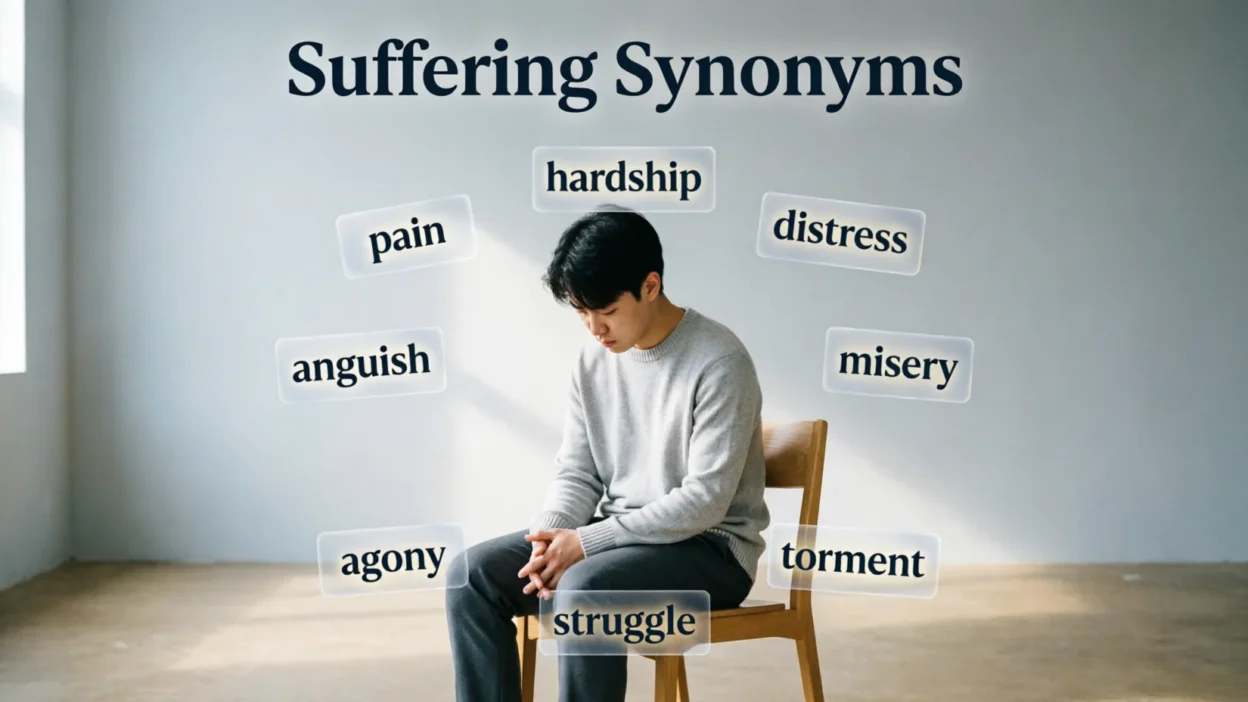
When looking for a suffering synonym, the best word depends on the type of pain or difficulty you mean. Common alternatives include pain, distress, agony, hardship, misery, anguish, torment, and adversity. Some words describe physical pain, while others refer to emotional distress, difficult circumstances, or prolonged hardship.
Quick Answer
Suffering means experiencing physical or emotional pain, distress, difficulty, or hardship. The most suitable synonym depends on context:
- Pain — general physical or emotional discomfort
- Agony — extremely severe pain or distress
- Anguish — intense emotional suffering
- Hardship — difficult life circumstances
- Misery — prolonged unhappiness or suffering
- Distress — serious worry, sadness, or discomfort
- Torment — severe and often prolonged suffering
- Adversity — difficult circumstances or challenges
What Does Suffering Mean?
Suffering is the experience of physical pain, emotional distress, mental difficulty, or serious hardship. It can be temporary or long-lasting.
For example:
Here, suffering describes deep emotional pain.
The word can also describe physical discomfort:
It can refer to difficult circumstances as well:
Because the word covers several types of difficulty, choosing a more specific synonym can make your writing clearer.
30 Suffering Synonyms
1. Pain
Simple meaning: Physical or emotional discomfort.
Example:
He was in considerable pain after the accident.
Best usage/context: Use pain as a general synonym for suffering, especially when referring to physical discomfort.
2. Distress
Simple meaning: Serious emotional or physical discomfort.
Example:
The news caused great distress among the community.
Best usage/context: Useful for emotional worry, sadness, fear, or discomfort.
3. Agony
Simple meaning: Extremely severe physical or emotional pain.
Example:
She cried out in agony after the injury.
Best usage/context: Use agony when the suffering is exceptionally intense.
4. Anguish
Simple meaning: Deep emotional pain or sadness.
Example:
He felt intense anguish after hearing the tragic news.
Best usage/context: Best for emotional or psychological suffering.
5. Misery
Simple meaning: A state of great unhappiness or suffering.
Example:
The long period of isolation left him in misery.
Best usage/context: Use it for prolonged unhappiness, unpleasant conditions, or emotional suffering.
6. Torment
Simple meaning: Severe physical or emotional suffering.
Example:
The painful memories continued to torment her.
Best usage/context: Strong word for prolonged or intense suffering.
7. Hardship
Simple meaning: A difficult situation or condition.
Example:
The family faced financial hardship for several years.
Best usage/context: Use hardship for difficult living conditions, financial problems, or challenging circumstances.
8. Adversity
Simple meaning: A difficult or challenging situation.
Example:
She remained hopeful despite years of adversity.
Best usage/context: Common in formal writing when discussing serious challenges or difficulties.
9. Tribulation
Simple meaning: Great difficulty or suffering.
Example:
The community endured many tribulations during the war.
Best usage/context: More formal or literary; useful for serious and prolonged difficulties.
10. Grief
Simple meaning: Deep sadness, especially after a loss.
Example:
He struggled with grief after his father’s death.
Best usage/context: Specifically appropriate for emotional suffering caused by loss.
11. Woe
Simple meaning: Great sadness, trouble, or suffering.
Example:
The story describes the woes of people living through conflict.
Best usage/context: Literary, formal, or expressive writing.
12. Aggravation
Simple meaning: Annoyance or frustration.
Example:
The constant delays caused considerable aggravation.
Best usage/context: Suitable for relatively mild emotional difficulty rather than extreme suffering.
13. Discomfort
Simple meaning: A feeling of physical or emotional uneasiness.
Example:
The treatment caused some temporary discomfort.
Best usage/context: Use when the suffering is mild or moderate.
14. Hurt
Simple meaning: Physical or emotional pain.
Example:
Her harsh words caused him a lot of hurt.
Best usage/context: Common and conversational; especially useful for emotional pain.
15. Disturbance
Simple meaning: A state of emotional or mental upset.
Example:
The experience caused significant emotional disturbance.
Best usage/context: More appropriate when something disrupts emotional or mental stability.
16. Affliction
Simple meaning: Something that causes continuing pain or suffering.
Example:
The disease became a serious affliction for the elderly patient.
Best usage/context: Formal writing about illness, hardship, or persistent suffering.
17. Oppression
Simple meaning: Cruel or unfair treatment that causes suffering.
Example:
The novel explores the suffering caused by oppression.
Best usage/context: Use when suffering results from unjust control or treatment.
18. Despair
Simple meaning: A complete loss of hope.
Example:
After repeated failures, he fell into despair.
Best usage/context: Best when suffering involves hopelessness rather than physical pain.
19. Desolation
Simple meaning: Extreme loneliness, sadness, or emptiness.
Example:
She felt a deep sense of desolation after leaving her hometown.
Best usage/context: Literary and emotional contexts involving loneliness or emptiness.
20. Wretchedness
Simple meaning: Extreme unhappiness or poor condition.
Example:
The memoir describes the wretchedness of life during the famine.
Best usage/context: Strong, expressive language for severe unhappiness or poor living conditions.
21. Difficulty
Simple meaning: A problem or challenging situation.
Example:
They faced many difficulties while rebuilding their home.
Best usage/context: A neutral, everyday alternative when you do not want to suggest extreme suffering.
22. Struggle
Simple meaning: A difficult effort or challenging experience.
Example:
She described her struggle to recover from the setback.
Best usage/context: Useful for ongoing challenges, efforts, or difficult personal experiences.
23. Trial
Simple meaning: A difficult experience that tests someone.
Example:
The illness was one of the hardest trials of his life.
Best usage/context: Appropriate for difficult experiences, especially in formal or reflective writing.
24. Ordeal
Simple meaning: An extremely difficult or unpleasant experience.
Example:
The rescue operation was a terrifying ordeal.
Best usage/context: Use when someone has gone through a particularly challenging experience.
25. Burden
Simple meaning: Something difficult that causes worry or pressure.
Example:
Caring for a sick relative became an emotional burden.
Best usage/context: Suitable when suffering comes from responsibility, pressure, or a heavy problem.
26. Stress
Simple meaning: Mental or emotional pressure.
Example:
Financial problems caused significant stress.
Best usage/context: Common in everyday and professional language for psychological pressure.
27. Frustration
Simple meaning: Annoyance caused by problems or inability to achieve something.
Example:
Repeated technical problems led to frustration.
Best usage/context: Use when suffering is mainly caused by irritation or blocked progress.
28. Despondency
Simple meaning: A state of low spirits and loss of hope.
Example:
Months of unemployment caused feelings of despondency.
Best usage/context: Formal or literary writing about prolonged sadness and discouragement.
29. Persecution
Simple meaning: Cruel or unfair treatment directed at a person or group.
Example:
The community fled the region because of persecution.
Best usage/context: Use when suffering results from targeted mistreatment.
30. Painfulness
Simple meaning: The quality of causing or involving pain.
Example:
The painfulness of the experience stayed with him for years.
Best usage/context: Less common than pain, but useful in formal or descriptive contexts when discussing the nature of an experience.
Suffering Synonyms Comparison Table
| Synonym | Main Meaning | Intensity | Best Context |
|---|---|---|---|
| Pain | Physical or emotional discomfort | Medium | General use |
| Distress | Serious upset or discomfort | Medium–High | Emotional situations |
| Agony | Extreme pain | Very high | Severe physical/emotional pain |
| Anguish | Deep emotional pain | Very high | Grief and emotional suffering |
| Misery | Prolonged unhappiness | High | Emotional or difficult conditions |
| Torment | Severe prolonged suffering | Very high | Physical or emotional suffering |
| Hardship | Difficult circumstances | Medium–High | Financial/life challenges |
| Adversity | Serious challenges | Medium–High | Formal writing |
| Grief | Pain caused by loss | High | Bereavement |
| Ordeal | Extremely difficult experience | High | Difficult experiences |
| Stress | Mental pressure | Medium | Work, life, relationships |
| Despair | Loss of hope | High | Emotional suffering |
| Discomfort | Mild uneasiness | Low–Medium | Health and everyday situations |
How to Choose the Right Suffering Synonym
The right word depends on what kind of suffering you want to describe.
For Physical Pain
Choose words such as:
- Pain
- Agony
- Discomfort
- Hurt
- Torment
Example:
Instead of saying:
You could say:
If the pain is extreme:
For Emotional Pain
Use:
- Anguish
- Distress
- Grief
- Misery
- Despair
- Desolation
For example:
Here, anguish is more precise than the general word suffering.
For Difficult Life Circumstances
Use:
- Hardship
- Adversity
- Difficulty
- Struggle
- Trial
- Ordeal
For example:
The word hardship works better than pain because the problem involves difficult circumstances rather than physical injury.
For Severe or Prolonged Suffering
Choose stronger words such as:
- Agony
- Torment
- Misery
- Tribulation
- Wretchedness
These words suggest that the experience is serious, intense, or prolonged.
For Formal Writing
Consider:
- Adversity
- Affliction
- Tribulation
- Oppression
- Despondency
- Persecution
These words can work well in academic, historical, literary, or formal writing when their specific meanings fit the context.
Suffering vs. Pain
Suffering and pain are closely related, but they are not always interchangeable.
Pain usually refers to a physical or emotional sensation.
Suffering is broader. It can include pain, distress, hardship, grief, fear, or difficult circumstances.
For example:
But:
The second sentence can include physical pain, emotional distress, financial problems, and other consequences.
Suffering vs. Hardship
Hardship usually describes difficult circumstances rather than a feeling of pain.
This means their circumstances were difficult.
This focuses more directly on their internal emotional pain.
Suffering vs. Misery
Misery generally suggests prolonged unhappiness or an unpleasant condition.
The second example describes a deeper and more prolonged condition.
Common Mistakes When Using Suffering Synonyms
1. Using “Agony” for Minor Problems
Agony is a very strong word.
Saying:
can sound exaggerated in most everyday contexts.
For a minor problem, frustration or annoyance may be more appropriate.
2. Using “Grief” for Every Kind of Sadness
Grief usually refers to deep sadness connected with loss.
For general sadness, words such as distress, sadness, or misery may be more suitable.
3. Confusing Hardship With Pain
Hardship refers to difficult circumstances.
Pain refers more directly to physical or emotional discomfort.
4. Using Formal Words in Casual Conversations
Words such as tribulation, despondency, and wretchedness can sound formal or literary.
In everyday conversation, simpler words like pain, stress, difficulty, or struggle are often more natural.
5. Ignoring Context
Not every synonym can replace suffering in every sentence.
For example:
You cannot always replace suffered with celebrated, struggled, or grieved without changing the meaning.
Always consider whether the suffering is physical, emotional, social, financial, or situational.
FAQs:
What is the best synonym for suffering?
There is no single synonym that fits every situation. Pain, distress, hardship, anguish, misery, and agony are useful alternatives depending on the context.
What is a strong word for suffering?
Agony, torment, anguish, and tribulation can describe intense or serious suffering. The appropriate choice depends on whether the suffering is physical, emotional, or related to difficult circumstances.
What is a synonym for emotional suffering?
Common choices include anguish, distress, grief, misery, despair, and desolation.
What is a synonym for physical suffering?
Pain, agony, discomfort, hurt, and torment can describe physical suffering, with different levels of intensity.
What is a synonym for suffering in difficult times?
Hardship, adversity, struggle, difficulty, trial, and ordeal are useful choices.
What is a formal synonym for suffering?
Depending on the context, affliction, adversity, tribulation, despondency, oppression, or wretchedness may work in formal writing.
What is the opposite of suffering?
Depending on the context, possible opposites include comfort, pleasure, happiness, relief, well-being, and contentment.
Conclusion
The best suffering synonym depends on the exact type of difficulty you want to describe. Pain is a broad choice for physical or emotional discomfort, while anguish emphasizes deep emotional suffering. Agony suggests extreme pain, hardship describes difficult circumstances, and adversity refers to serious challenges.
Choosing a precise synonym makes your writing clearer and more expressive. Instead of using suffering repeatedly, consider the specific meaning you want to communicate—physical pain, emotional distress, grief, hardship, stress, or prolonged difficulty.

I’m James Parker, Administrator at SynonymsHive. I oversee content quality, improve user experience, and ensure reliable synonym resources. My passion is making language learning simple, accurate, and accessible for everyone.