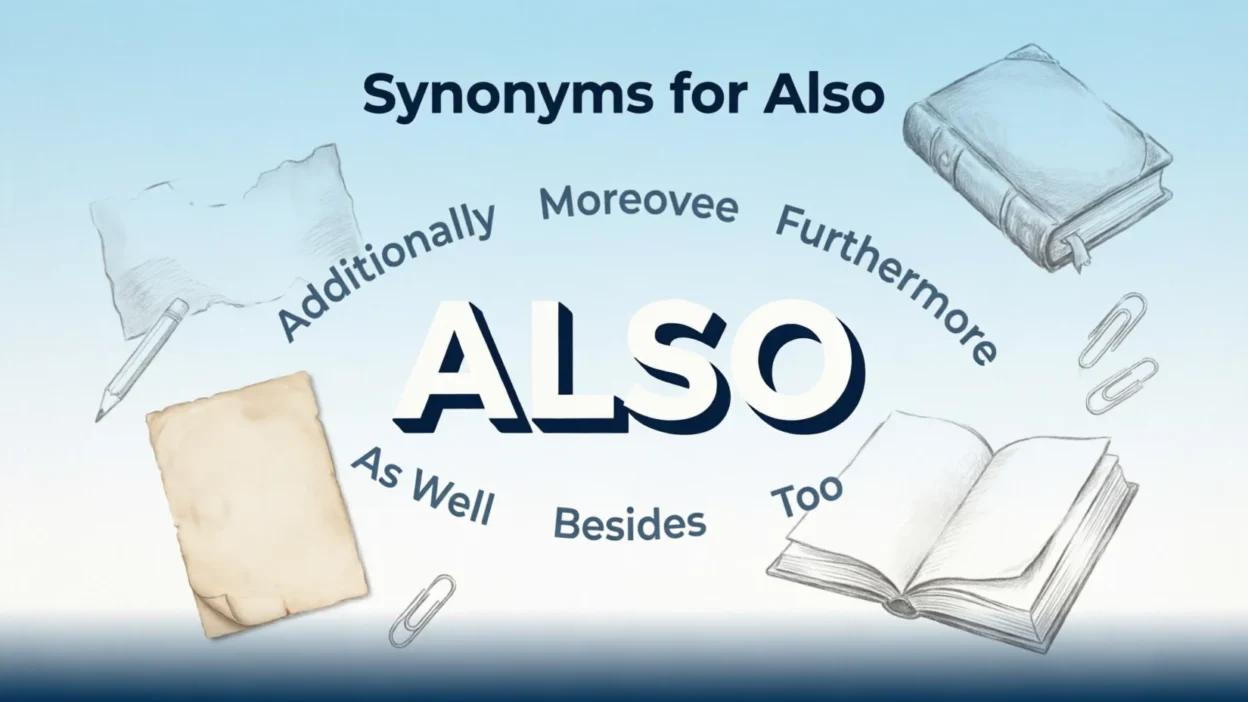
The word “also” is used to add information, express agreement, or show that something is included in addition to something else. However, repeating it too often can make your writing sound monotonous. Learning synonyms for also helps you communicate more clearly, connect ideas naturally, and choose the right words for essays, emails, conversations, and professional writing.
Common alternatives include additionally, furthermore, moreover, too, as well, besides, and in addition. Although these words share similar meanings, each has a slightly different tone and purpose. Some work best in formal writing, while others sound more natural in everyday conversation.
If you are a student, English learner, writer, or content creator, this guide will help you understand 30 alternatives to “also” with simple meanings, practical examples, and advice on when to use each one.
Quick Answer: What Are the Best Synonyms for Also?
The best synonyms for also include additionally, furthermore, moreover, too, as well, in addition, besides, likewise, equally, and along with. Use additionally in formal writing, too in everyday conversation, furthermore to introduce another supporting point, and as well to add information naturally.
The best choice depends on your sentence, writing style, and intended meaning.
What Does Also Mean?
“Also” is an adverb that means in addition, too, or as well. It introduces extra information or indicates that another person or thing shares a particular quality, action, or situation.
For example:
- She plays the guitar and also sings beautifully.
- He is a talented writer. He is also a skilled editor.
- I would like some water and a sandwich, too.
In each sentence, “also” or its alternative adds another piece of information without changing the main idea.
When Should You Use Also?
Use “also” when you want to:
- Add another fact or idea.
- Mention an additional person, object, or activity.
- Show that something is true in another situation.
- Make your writing more connected and complete.
For example, instead of writing, “The course teaches grammar. The course also teaches vocabulary,” you could write, “The course teaches grammar and vocabulary as well.”
Both versions communicate the same basic information, but the second sounds more connected.
30 Synonyms for Also With Meanings and Examples
Below are 30 useful alternatives to “also,” including formal expressions, conversational words, and phrases for adding related information.
1. Additionally
Simple meaning: In addition to something already mentioned.
Example: The library offers free Wi-Fi. Additionally, it provides quiet study rooms.
Best usage/context: Formal writing, reports, academic assignments, and professional communication.
2. Furthermore
Simple meaning: In addition to what has already been said, especially when adding a supporting point.
Example: The new system saves time. Furthermore, it reduces unnecessary expenses.
Best usage/context: Essays, research papers, presentations, and persuasive writing.
3. Moreover
Simple meaning: In addition, often introducing a point that strengthens the previous statement.
Example: The proposal is affordable. Moreover, it is easy to implement.
Best usage/context: Formal arguments, analytical writing, and professional reports.
4. Too
Simple meaning: Also or in addition.
Example: I enjoy reading mystery novels, and my sister does too.
Best usage/context: Everyday conversation, informal writing, and friendly messages. It commonly appears at the end of a clause.
5. As Well
Simple meaning: In addition or too.
Example: She speaks English and understands Spanish as well.
Best usage/context: Everyday English, emails, conversations, and natural-sounding sentences.
6. In Addition
Simple meaning: Along with something else.
Example: In addition to his regular duties, he helps train new employees.
Best usage/context: Formal and semi-formal writing. Use “in addition to” before a noun or noun phrase.
7. Besides
Simple meaning: In addition to; sometimes used to introduce another reason.
Example: Besides mathematics, she enjoys studying history.
Best usage/context: Conversations, explanations, and writing that introduces an extra fact or reason.
8. Likewise
Simple meaning: In the same way or similarly.
Example: The manager values honesty. Likewise, the employees appreciate open communication.
Best usage/context: When connecting similar ideas, actions, opinions, or situations.
9. Similarly
Simple meaning: In a similar way.
Example: The first program supports beginners. Similarly, the second program helps new learners build confidence.
Best usage/context: Academic writing, comparisons, explanations, and analytical discussions.
10. Equally
Simple meaning: To the same degree or with equal importance.
Example: Experience matters, but communication skills are equally important.
Best usage/context: When emphasizing equal importance, value, or degree rather than simply adding information.
11. Plus
Simple meaning: In addition to something else.
Example: The apartment is spacious, plus it is close to public transportation.
Best usage/context: Informal conversation, casual writing, and simple explanations.
12. What Is More
Simple meaning: In addition, often introducing a stronger or more important point.
Example: The hotel is affordable. What is more, it offers complimentary breakfast.
Best usage/context: Persuasive writing and conversational explanations that build on an earlier point.
13. On Top of That
Simple meaning: In addition to everything already mentioned.
Example: She completed the project early, and on top of that, she helped her colleagues.
Best usage/context: Informal conversations, storytelling, and friendly writing.
14. Along With
Simple meaning: Together with or in addition to.
Example: The application includes a calendar along with a task manager.
Best usage/context: Describing multiple people, objects, features, or activities in the same sentence.
15. Coupled With
Simple meaning: Combined with another thing.
Example: Her practical experience, coupled with strong communication skills, makes her a valuable employee.
Best usage/context: Formal writing, business reports, and explanations of combined factors.
16. Together With
Simple meaning: In the company of or in combination with.
Example: The teacher, together with her students, organized a charity event.
Best usage/context: Describing people or things that participate in an activity or occur together.
17. Not to Mention
Simple meaning: Used to introduce an additional point that deserves attention.
Example: The trip was expensive, not to mention exhausting.
Best usage/context: Informal writing and conversation, particularly when emphasizing an extra difficulty or advantage.
18. As Well As
Simple meaning: In addition to.
Example: He studies biology as well as chemistry.
Best usage/context: Connecting related nouns, phrases, or activities in a sentence.
19. Further
Simple meaning: Additional or more.
Example: Please contact the office if you need further information.
Best usage/context: Formal communication, instructions, and expressions such as “further details” or “further assistance.” It is not a direct replacement for “also” in every sentence.
20. Over and Above
Simple meaning: In addition to something already included or expected.
Example: The employee received a bonus over and above her regular salary.
Best usage/context: Situations involving extra benefits, amounts, responsibilities, or achievements.
21. In the Same Way
Simple meaning: Similarly or using a similar approach.
Example: Parents encourage children to read. In the same way, teachers help them develop a love of books.
Best usage/context: Explaining similarities between actions, methods, or situations.
22. By the Same Token
Simple meaning: For the same reason or by similar reasoning.
Example: We should respect other people’s opinions. By the same token, we should expect them to respect ours.
Best usage/context: Formal discussions, reasoning, and balanced arguments. It expresses a logical relationship rather than simple addition.
23. Correspondingly
Simple meaning: In a way that matches or relates to something else.
Example: Demand increased throughout the year, and production rose correspondingly.
Best usage/context: Reports, academic writing, and explanations of related changes.
24. Identically
Simple meaning: In exactly the same way.
Example: Both devices were tested identically under laboratory conditions.
Best usage/context: Technical writing and situations where two actions or processes are exactly alike. It is not a general substitute for “also.”
25. In Like Manner
Simple meaning: In a similar way.
Example: The first department follows strict safety rules. In like manner, the second department maintains careful procedures.
Best usage/context: Formal or traditional writing. In everyday English, “similarly” is usually more natural.
26. Additionally to This
Simple meaning: Intended to mean in addition to this.
Example: Additionally to this, the team prepared a detailed budget.
Best usage/context: This phrase is generally awkward in standard English. Prefer “in addition to this” or “additionally” for clearer writing.
27. Not Only That
Simple meaning: Used to introduce another point, often a stronger one.
Example: The restaurant serves excellent food. Not only that, it offers outstanding customer service.
Best usage/context: Conversations, persuasive writing, and storytelling.
28. To Boot
Simple meaning: In addition, often adding an extra positive or negative detail.
Example: The house is spacious and affordable, with a beautiful garden to boot.
Best usage/context: Informal English, expressive writing, and conversational descriptions.
29. In Conjunction With
Simple meaning: Together with or in combination with.
Example: The school organized the event in conjunction with a local charity.
Best usage/context: Formal documents, business communication, institutional announcements, and descriptions of joint activities.
30. Over and Above That
Simple meaning: In addition to what has already been mentioned.
Example: He completed all his assignments. Over and above that, he volunteered to help his classmates.
Best usage/context: Emphatic explanations and conversational writing. In many sentences, the shorter “on top of that” or “furthermore” is more natural.
Comparison Table: Which Synonym for Also Should You Use?
The following table compares common alternatives by tone and purpose.
| Synonym | Tone | Best purpose |
|---|---|---|
| Additionally | Formal | Adding another fact |
| Furthermore | Formal | Supporting an argument |
| Moreover | Formal | Strengthening a point |
| Too | Casual | Adding information at the end |
| As well | Neutral | Natural additional information |
| In addition | Formal | Introducing another item or fact |
| Besides | Neutral | Adding a fact or reason |
| Likewise | Neutral | Showing similarity |
| Similarly | Neutral/formal | Connecting comparable ideas |
| Equally | Neutral/formal | Emphasizing equal importance |
| Plus | Casual | Adding an extra point |
| What is more | Neutral/formal | Introducing a stronger point |
| Along with | Neutral | Combining related things |
| As well as | Neutral | Connecting items or activities |
| Not only that | Conversational | Adding emphasis |
Quick Examples of Different Alternatives
- Formal: The report identifies several challenges. Furthermore, it recommends practical solutions.
- Academic: The study examines language learning. Additionally, it considers the role of motivation.
- Conversational: I enjoy cooking, and I like baking too.
- Neutral: She speaks French as well.
- Similarity: The first method is effective. Similarly, the second approach produces good results.
- Equal importance: Accuracy is important, and clarity is equally important.
How to Choose the Right Synonym for Also
Choosing the right alternative depends on your tone, meaning, and purpose. Not every synonym fits every sentence.
1. For Formal and Academic Writing
Choose additionally, furthermore, moreover, or in addition when writing essays, reports, assignments, or research papers.
Example:
Original: The program improves reading skills. It also develops vocabulary.
Improved: The program improves reading skills. Furthermore, it develops vocabulary.
Use these transitions when you want to present ideas clearly and maintain a formal tone. However, do not add a transition word to every sentence, as this can make your writing feel repetitive.
2. For Everyday Conversation
Choose too, as well, plus, or on top of that when speaking naturally or writing casual messages.
Example:
Original: I want to visit London. I also want to see Manchester.
Natural alternative: I want to visit London, and I want to see Manchester too.
These expressions sound friendly and are easy for English learners to use.
3. For Adding Supporting Evidence
Choose furthermore, moreover, or what is more when your next statement strengthens your previous point.
Example:
The product is affordable. Moreover, it is easy to maintain.
These expressions work well when explaining why an idea, proposal, or decision is convincing.
4. For Showing Similarity
Choose likewise, similarly, or in the same way when two ideas share a feature or follow a comparable pattern.
Example:
The first student improved through regular practice. Similarly, the second student made progress through consistent effort.
Remember that these expressions show a relationship between ideas, not merely the presence of extra information.
5. For Combining People or Things
Choose along with, as well as, together with, or in conjunction with when describing things that occur or work together.
Example:
The school organized a workshop along with a career guidance session.
For formal descriptions of partnerships, “in conjunction with” is particularly useful.
6. For Adding Emphasis
Choose not only that, on top of that, not to mention, or to boot when you want to highlight an extra detail.
Example:
The team finished the project ahead of schedule. On top of that, it stayed within budget.
These expressions are useful in storytelling, informal explanations, and persuasive writing.
Common Mistakes When Using Synonyms for Also
Although many words have a similar meaning, using them correctly requires attention to grammar and context.
Mistake 1: Using Formal Words in Casual Conversations
Incorrect or unnatural: I would like a cup of tea; furthermore, I would like a biscuit.
More natural: I would like a cup of tea and a biscuit too.
“Furthermore” is grammatically possible, but it sounds unnecessarily formal in this simple request.
Mistake 2: Confusing Also With Similarly
“Also” adds information. “Similarly” shows that two things are alike.
Example:
- Addition: She teaches English. She also teaches mathematics.
- Similarity: She teaches English creatively. Similarly, she encourages creative thinking in mathematics lessons.
Choose the word that expresses your intended relationship.
Mistake 3: Using Also and Too Unnecessarily Together
Awkward: I also want to come too.
Better: I also want to come.
Or: I want to come too.
Using both is sometimes possible for emphasis, but it is usually unnecessary.
Mistake 4: Using As Well As Without Checking the Sentence
Example: She enjoys reading as well as writing.
This sentence is correct. However, “as well as” can affect the balance of a sentence, especially when connecting longer phrases.
For clarity, make sure the connected ideas fit grammatically.
Mistake 5: Treating Every Alternative as Interchangeable
“Equally” emphasizes the same degree or importance. “Likewise” expresses similarity. “Furthermore” adds a supporting point. “Too” commonly adds information at the end of a sentence.
Example:
- Both subjects are equally important.
- My brother enjoys football, and I do too.
- The policy is affordable. Furthermore, it is practical.
Choosing the correct word makes your meaning more precise.
Mistake 6: Overusing Transition Words
Repeating “additionally,” “furthermore,” or “moreover” at the beginning of every paragraph can make writing sound mechanical.
Instead, vary your sentence structure. Sometimes combine related ideas with “and,” use “too” at the end, or simply introduce the next sentence without a transition.
FAQs:
1. What is the most common synonym for also?
“Too” and “as well” are common alternatives in everyday English. “Additionally” and “in addition” are useful in formal writing. The best choice depends on the sentence.
2. What is a formal word for also?
“Additionally,” “furthermore,” and “moreover” are common formal alternatives. Use “additionally” to introduce another fact and “furthermore” or “moreover” when adding support to an argument.
3. What is another word for also in an essay?
Useful choices include “furthermore,” “moreover,” “additionally,” “in addition,” and “similarly.” Choose “similarly” only when the ideas are alike rather than simply adding a new point.
4. Can I use too instead of also?
Yes. “Too” often replaces “also,” especially at the end of a sentence.
Example: “She likes music too” and “She also likes music” express similar meanings.
The placement and emphasis differ slightly.
5. What is the difference between also and as well?
Both mean “in addition.” “Also” often appears before the main verb or after the verb “be,” while “as well” commonly appears at the end of a clause.
Examples:
- She also works on weekends.
- She works on weekends as well.
6. Is besides a synonym for also?
Yes, in many contexts. “Besides” can introduce additional information or another reason. However, it can also mean “apart from,” so the sentence determines its meaning.
Example: “Besides English, he studies German.”
7. How can I avoid repeating also in my writing?
Vary your vocabulary and sentence structure. Use “too,” “as well,” “additionally,” or “in addition” where appropriate. Use “likewise” for similarities and “furthermore” for supporting points. You can also combine related ideas into one clear sentence.
Conclusion
Learning synonyms for also helps you express additional information more clearly and naturally. Words such as additionally, furthermore, moreover, too, as well, and in addition can make your writing more varied and effective.
For formal writing, choose “additionally” or “furthermore.” For everyday conversations, “too” and “as well” are natural choices. When comparing related ideas, use “likewise” or “similarly.” When adding emphasis, expressions such as “on top of that” can work well.
The most important lesson is to choose a synonym according to its meaning, tone, and grammatical role. Instead of replacing “also” with a different word every time, focus on making each sentence clear, accurate, and easy to understand.

I’m James Parker, Administrator at SynonymsHive. I oversee content quality, improve user experience, and ensure reliable synonym resources. My passion is making language learning simple, accurate, and accessible for everyone.