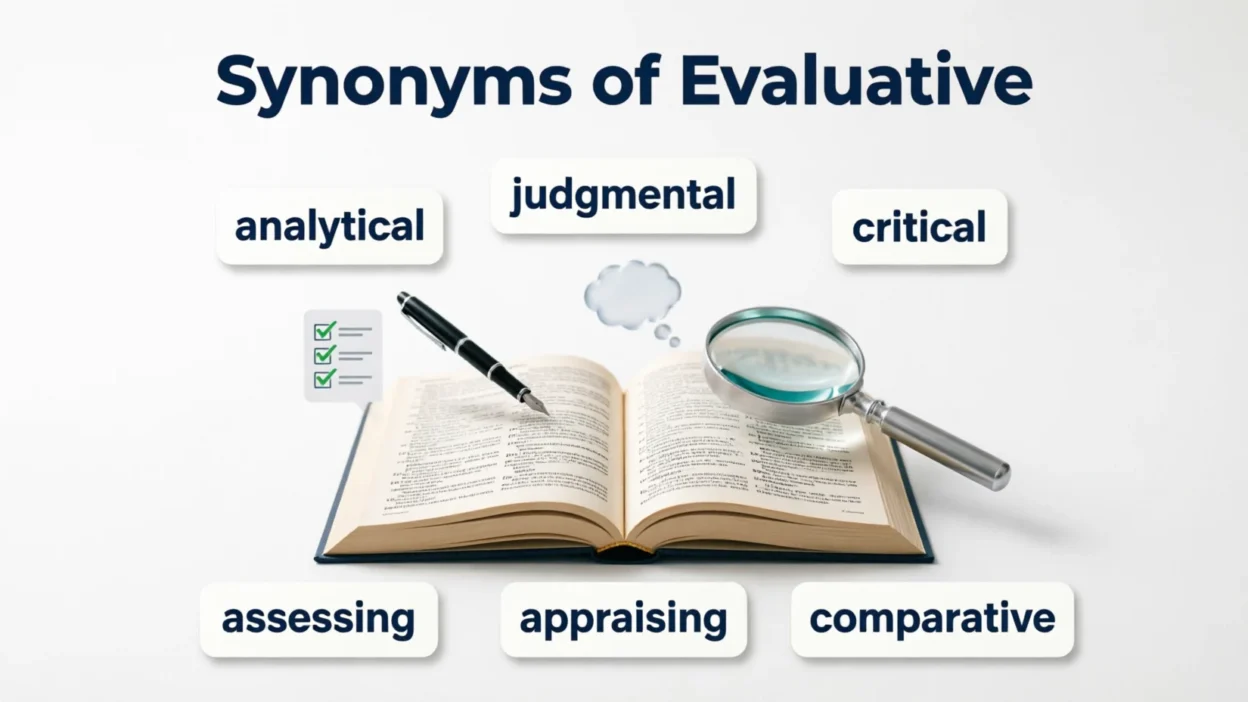
When something is evaluative, it involves judging, assessing, reviewing, or forming an opinion about the quality, value, importance, or performance of something. Common synonyms of evaluative include assessing, analytical, judgmental, critical, appraising, reviewing, and diagnostic. The best choice depends on if you are talking about careful assessment, criticism, measurement, or judgment.
Quick Answer
Evaluative means “related to judging or assessing something.” Depending on the context, you can use words such as assessing, analytical, critical, judgmental, appraising, reviewing, examining, rating, or diagnostic.
For example:
- Evaluative: The teacher used an evaluative approach to assess the student’s writing.
- Assessing: The teacher was assessing the student’s writing.
- Critical: The article provides a critical analysis of the proposal.
- Appraising: The expert was appraising the value of the property.
What Does Evaluative Mean?
Evaluative is an adjective that describes something involving assessment or judgment.
When you evaluate something, you look at its qualities, strengths, weaknesses, effectiveness, value, or overall performance and then make a judgment.
For example:
This means the report examines the employee’s performance and gives an assessment of it.
Simple Definition of Evaluative
Evaluative = involving the process of judging or assessing something.
The word is commonly used in education, research, business, criticism, management, and professional writing.
Evaluative in Different Contexts
Education:
An evaluative essay may judge the strengths and weaknesses of an argument.
Business:
An evaluative report may assess the performance of a company or project.
Research:
An evaluative study may examine whether a program achieved its intended results.
Writing:
An evaluative review may judge the quality or effectiveness of a book, film, product, or idea.
30 Synonyms of Evaluative
Not every synonym has exactly the same meaning. Some emphasize assessment, while others emphasize criticism, measurement, examination, or judgment.
1. Assessing
Simple meaning: Judging the quality, value, or performance of something.
Example:
The teacher is assessing the students’ writing skills.
Best usage/context: Education, performance reviews, projects, and formal assessments.
2. Analytical
Simple meaning: Involving careful examination of information or ideas.
Example:
She wrote an analytical report about the company’s performance.
Best usage/context: Academic writing, research, reports, and detailed discussions.
3. Critical
Simple meaning: Carefully examining the good and bad aspects of something.
Example:
The reviewer gave a critical analysis of the new policy.
Best usage/context: Reviews, academic writing, criticism, and detailed evaluation.
4. Judgmental
Simple meaning: Involving an opinion or judgment about someone or something.
Example:
The report takes a judgmental approach to the proposed changes.
Best usage/context: Situations involving personal or subjective judgments. Be careful because this word can have a negative tone.
5. Appraising
Simple meaning: Carefully judging the value or quality of something.
Example:
The specialist is appraising the painting’s value.
Best usage/context: Property, art, antiques, financial value, and professional assessment.
6. Assessive
Simple meaning: Related to assessment or judging something.
Example:
The course includes several assessive activities.
Best usage/context: Formal or specialized contexts. “Evaluative” or “assessment-based” is often more natural.
7. Reviewing
Simple meaning: Examining something and giving an opinion about it.
Example:
The committee is reviewing the project’s results.
Best usage/context: Books, projects, policies, applications, reports, and professional work.
8. Examining
Simple meaning: Looking at something carefully to understand or judge it.
Example:
The researcher is examining the effects of the new program.
Best usage/context: Research, investigation, education, and formal analysis.
9. Judging
Simple meaning: Forming an opinion about the quality, value, or success of something.
Example:
The panel is judging the quality of each presentation.
Best usage/context: Competitions, decisions, performance, and general assessment.
10. Rating
Simple meaning: Giving something a score or level based on its qualities.
Example:
Customers are rating the service after their visit.
Best usage/context: Surveys, reviews, products, services, entertainment, and performance measurement.
11. Scoring
Simple meaning: Giving points to measure performance or quality.
Example:
The examiner is scoring the students’ written responses.
Best usage/context: Tests, competitions, examinations, and structured assessments.
12. Measuring
Simple meaning: Determining the level, amount, or effectiveness of something.
Example:
The study focuses on measuring customer satisfaction.
Best usage/context: Research, statistics, performance, and quantitative evaluation.
13. Diagnostic
Simple meaning: Designed to identify strengths, weaknesses, problems, or causes.
Example:
The teacher gave students a diagnostic test before starting the course.
Best usage/context: Education, medicine, testing, and problem identification.
14. Investigative
Simple meaning: Involving detailed examination to discover facts.
Example:
The committee conducted an investigative review of the incident.
Best usage/context: Research, journalism, investigations, and formal inquiries.
15. Analytical
Simple meaning: Based on careful examination and reasoning.
Example:
His analytical approach helped identify weaknesses in the proposal.
Best usage/context: Academic, scientific, business, and professional contexts.
16. Critical-thinking
Simple meaning: Involving careful reasoning and examination before reaching a conclusion.
Example:
The assignment encourages critical-thinking skills.
Best usage/context: Education, academic discussions, decision-making, and problem-solving.
17. Comparative
Simple meaning: Involving a comparison between two or more things.
Example:
The researcher conducted a comparative evaluation of the two programs.
Best usage/context: Research, academic writing, products, services, and competing ideas.
18. Appraisal-based
Simple meaning: Based on an assessment of value, quality, or performance.
Example:
The company uses an appraisal-based system for employee reviews.
Best usage/context: Business, management, employment, and professional assessments.
19. Review-based
Simple meaning: Based on examining something and forming an opinion about it.
Example:
The website provides review-based recommendations.
Best usage/context: Products, services, books, films, websites, and consumer decisions.
20. Assessive
Simple meaning: Connected with the process of assessment.
Example:
The program uses assessive methods to monitor student progress.
Best usage/context: Specialized educational or professional contexts.
21. Estimative
Simple meaning: Involving an estimate or approximate judgment.
Example:
The report provides an estimative calculation of future costs.
Best usage/context: Finance, planning, forecasting, and situations where exact measurement is difficult.
22. Diagnostic
Simple meaning: Used to identify a problem or weakness.
Example:
The diagnostic assessment revealed gaps in the student’s understanding.
Best usage/context: Education, healthcare, testing, and troubleshooting.
23. Discerning
Simple meaning: Showing good judgment and the ability to notice important differences.
Example:
The editor has a discerning eye for quality writing.
Best usage/context: Art, writing, quality judgments, taste, and expert opinions.
24. Appraising
Simple meaning: Evaluating something carefully, especially its value.
Example:
The agent is appraising the house before it is listed.
Best usage/context: Real estate, antiques, art, collectibles, and financial assessment.
25. Reviewing
Simple meaning: Looking at something carefully to decide whether it is satisfactory or effective.
Example:
The board is reviewing the organization’s annual performance.
Best usage/context: Business, administration, documents, policies, and performance.
26. Scrutinizing
Simple meaning: Examining something extremely carefully.
Example:
The auditors are scrutinizing the company’s financial records.
Best usage/context: Auditing, investigations, contracts, financial documents, and detailed examination.
27. Inspecting
Simple meaning: Looking closely at something to check its condition or quality.
Example:
The engineer inspected the building for structural problems.
Best usage/context: Buildings, products, equipment, safety, and quality control.
28. Analyzing
Simple meaning: Examining information carefully to understand it.
Example:
The researcher is analyzing the survey results.
Best usage/context: Research, data, literature, business, and academic work.
29. Valuing
Simple meaning: Determining or considering the worth or importance of something.
Example:
The expert is valuing the collection before the auction.
Best usage/context: Finance, property, art, business, and discussions of importance or worth.
30. Critiquing
Simple meaning: Carefully examining something and discussing its strengths and weaknesses.
Example:
Students spent the class critiquing each other’s essays.
Best usage/context: Academic writing, art, literature, design, reviews, and professional feedback.
Comparison Table: Evaluative Synonyms
| Synonym | Main idea | Tone | Common context |
|---|---|---|---|
| Assessing | Judging quality or performance | Neutral | Education, work |
| Analytical | Careful examination | Neutral | Research, academics |
| Critical | Examining strengths and weaknesses | Neutral to negative | Reviews, essays |
| Judgmental | Forming a judgment | Often negative | Personal opinions |
| Appraising | Determining value | Professional | Property, art |
| Reviewing | Examining and commenting | Neutral | Books, projects |
| Examining | Looking closely | Neutral | Research, education |
| Rating | Giving a score | Neutral | Products, services |
| Scoring | Assigning points | Formal | Tests, competitions |
| Measuring | Determining a level | Technical | Research, performance |
| Diagnostic | Identifying problems | Technical | Education, medicine |
| Investigative | Searching for facts | Formal | Research, inquiries |
| Comparative | Comparing alternatives | Neutral | Research, analysis |
| Discerning | Showing refined judgment | Positive | Quality, art |
| Scrutinizing | Examining very closely | Strong | Auditing, investigations |
| Inspecting | Checking condition | Practical | Safety, quality control |
| Analyzing | Breaking information down | Neutral | Data, research |
| Valuing | Determining worth | Neutral | Finance, property |
| Critiquing | Discussing strengths and weaknesses | Academic | Writing, art |
Evaluative vs. Analytical
These words are closely related but are not identical.
Analytical focuses mainly on examining and understanding something.
Evaluative focuses more on judging its quality, value, effectiveness, or success.
For example:
- Analytical: The researcher analyzed the causes of the problem.
- Evaluative: The researcher evaluated whether the solution worked.
An analysis can lead to an evaluation, but analysis and evaluation are not always the same thing.
Evaluative vs. Critical
Critical can mean careful and detailed examination, but it can also suggest criticism.
For example:
This does not necessarily mean the professor disliked the study. It may simply mean the study was examined carefully.
By contrast
This more clearly suggests that the reviewer identified problems or weaknesses.
Evaluative vs. Judgmental
Evaluative is usually neutral and professional.
Judgmental often has a negative meaning because it can suggest that someone is making an unfair or overly personal judgment.
Compare:
with:
The first describes a formal assessment. The second may suggest an attitude or behavior.
How to Choose the Right Synonym
The best synonym depends on what kind of judgment you are describing.
For Formal Assessment
Use:
- Assessing
- Evaluative
- Reviewing
- Appraising
- Measuring
Example:
The committee is assessing the project’s effectiveness.
For Careful Examination
Use:
- Analytical
- Examining
- Analyzing
- Scrutinizing
- Inspecting
Example:
The researcher is analyzing the survey results.
For Strengths and Weaknesses
Use:
- Critical
- Critiquing
- Analytical
- Discerning
Example:
The student wrote a critical review of the article.
For Assigning Scores
Use:
- Rating
- Scoring
- Measuring
Example:
The judges are scoring each performance.
For Determining Value
Use:
- Appraising
- Valuing
- Assessing
Example:
The expert is appraising the antique.
For Identifying Problems
Use:
- Diagnostic
- Investigative
- Examining
- Scrutinizing
Example:
The school used a diagnostic assessment to identify learning gaps.
For a More Negative Tone
Use:
- Judgmental
- Critical
Use these carefully because they can imply criticism or an unfavorable attitude.
Common Mistakes When Using Evaluative Synonyms
1. Treating Every Synonym as Completely Interchangeable
Words such as evaluative, analytical, critical, and diagnostic overlap, but they have different meanings.
For example, an analytical report may explain evidence without necessarily judging the final quality of something.
2. Using “Judgmental” as a Neutral Replacement
Judgmental often has a negative tone.
If you simply mean “involving assessment,” evaluative or assessing is usually clearer.
3. Confusing Analysis With Evaluation
Analysis means examining something to understand it.
Evaluation means making a judgment about its quality, value, effectiveness, or significance.
4. Using “Rating” When No Score Is Involved
Rating usually suggests assigning a score, level, or category.
If someone is simply examining a subject without assigning a rating, assessing or evaluating may be more appropriate.
5. Using “Diagnostic” for Every Assessment
A diagnostic assessment has a specific purpose: identifying problems, weaknesses, or areas that need attention.
Not every evaluation is diagnostic.
FAQs:
What is the closest synonym for evaluative?
The closest general synonyms are assessing, appraising, judging, reviewing, and analytical. The best choice depends on the sentence and whether you are emphasizing judgment, examination, value, or performance.
What does evaluative mean in simple English?
Evaluative means involving the process of judging or assessing something. It often means looking at the strengths, weaknesses, quality, value, or effectiveness of something.
Is “critical” a synonym for evaluative?
Yes, in some contexts. Critical can describe careful evaluation, especially when examining strengths and weaknesses. However, it can also suggest negative criticism, so it is not always interchangeable with evaluative.
Is “judgmental” the same as evaluative?
No. They are related, but judgmental often carries a negative meaning and can describe someone who makes overly personal or unfair judgments. Evaluative is generally more neutral.
What is the difference between analytical and evaluative?
Analytical focuses on examining information to understand it, while evaluative focuses on judging quality, value, effectiveness, or success.
What is an evaluative essay?
An evaluative essay examines a subject and makes a reasoned judgment about its quality, effectiveness, value, or significance. It normally supports the judgment with evidence and explanation.
What is an evaluative statement?
An evaluative statement expresses a judgment about something. For example, “The proposed method is highly effective” is evaluative because it makes a judgment about effectiveness.
Which synonym should I use in academic writing?
For academic writing, assessing, evaluating, analytical, critical, examining, appraising, and comparative can work well depending on the intended meaning. Choose the word that accurately describes the type of assessment being made.
Conclusion
Evaluative describes something connected with assessing, judging, or determining the quality, value, effectiveness, or importance of something. Its synonyms include assessing, analytical, critical, appraising, reviewing, examining, rating, measuring, diagnostic, comparative, scrutinizing, analyzing, valuing, and critiquing.
The right synonym depends on your intended meaning. Use assessing for general evaluation, analytical for careful examination, critical for strengths and weaknesses, appraising for value, rating for scores, and diagnostic for identifying problems.
Understanding these differences can help you write more naturally and choose precise vocabulary for academic, professional, and everyday communication.

I’m Nathan Collins, a language enthusiast passionate about exploring synonyms and improving everyday writing. I create clear, accurate, and helpful content that helps readers expand vocabulary and communicate with confidence.