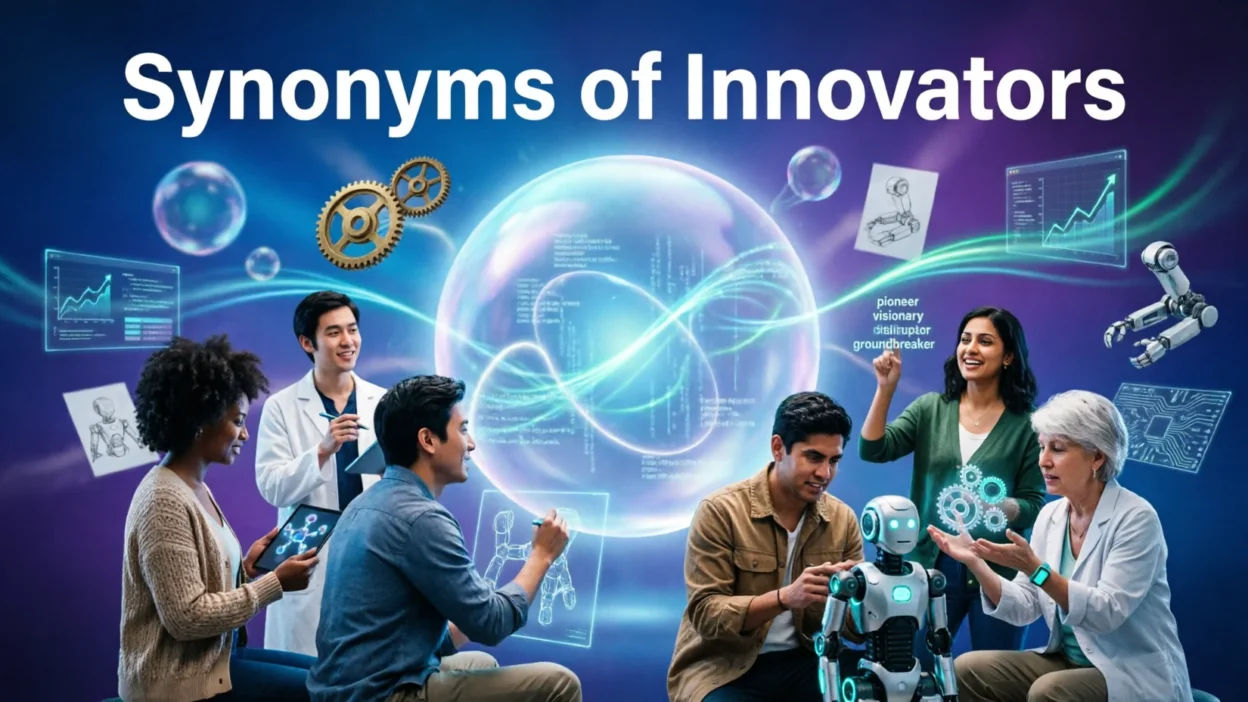
Innovators are people who introduce new ideas, methods, products, or solutions. Common synonyms of innovators include pioneers, inventors, trailblazers, visionaries, creators, reformers, originators, and entrepreneurs. However, these words are not always interchangeable because each one highlights a slightly different kind of innovation.
Choosing the right word depends on what you want to emphasize. Someone who creates a new device may be an inventor, while someone who introduces a new approach in a field may be a pioneer or trailblazer. Understanding these differences can help students, writers, and English learners communicate more precisely.
Quick Answer: What Are the Synonyms of Innovators?
The most useful synonyms of innovators include:
Pioneers, inventors, trailblazers, visionaries, creators, originators, reformers, entrepreneurs, developers, designers, creators, experimenters, revolutionaries, groundbreakers, pathfinders, thinkers, strategists, leaders, architects, pioneers, discoverers, builders, transformers, disruptors, problem-solvers, entrepreneurs, researchers, masterminds, change-makers, and idea-makers.
The best choice depends on the context. Inventor focuses on creating something new, pioneer emphasizes being among the first, and visionary describes someone with an original view of the future.
What Does “Innovators” Mean?
Innovators are people who develop or introduce new ideas, products, processes, technologies, or ways of doing things.
The word comes from innovate, which means to introduce something new or make meaningful improvements to an existing idea or system.
For example:
Here, innovators refers to people who create new approaches and improve existing possibilities.
The word can be used in business, technology, science, education, design, art, medicine, and many other fields.
30 Synonyms of Innovators
1. Pioneers
Simple meaning: People who are among the first to develop or use something new.
Example:
The pioneers of modern computing changed the way people work.
Best usage/context: Use pioneers when emphasizing that someone was one of the first in a particular field.
2. Inventors
Simple meaning: People who create new products, devices, or methods.
Example:
The inventors developed a device that uses less energy.
Best usage/context: Best when innovation involves creating something that did not previously exist.
3. Trailblazers
Simple meaning: People who create a new path for others to follow.
Example:
These trailblazers transformed the fashion industry.
Best usage/context: Useful when describing people who introduce major changes or open opportunities for others.
4. Visionaries
Simple meaning: People who have original and forward-looking ideas.
Example:
The visionary predicted that digital communication would transform education.
Best usage/context: Use this word when focusing on imagination, long-term thinking, and future possibilities.
5. Creators
Simple meaning: People who make or develop something new.
Example:
The creators designed an innovative learning platform.
Best usage/context: A broad and flexible choice for technology, art, media, design, and business.
6. Originators
Simple meaning: People who first think of or develop an idea.
Example:
She was the originator of the campaign’s central concept.
Best usage/context: Use when you want to emphasize who first introduced an idea.
7. Reformers
Simple meaning: People who work to improve an existing system.
Example:
The reformers proposed new methods for improving public education.
Best usage/context: Particularly suitable for social, political, educational, and institutional change.
8. Entrepreneurs
Simple meaning: People who start and develop businesses, often using new ideas.
Example:
Many entrepreneurs use technology to solve everyday problems.
Best usage/context: Best when innovation is connected with starting or growing a business.
9. Developers
Simple meaning: People who create, improve, or build products and systems.
Example:
The developers created a faster payment system.
Best usage/context: Common in technology, software, engineering, product development, and business.
10. Designers
Simple meaning: People who plan and create the form or function of something.
Example:
The designers developed a simpler interface for the application.
Best usage/context: Appropriate for product design, architecture, graphics, fashion, technology, and user experiences.
11. Experimenters
Simple meaning: People who test new ideas or methods.
Example:
The experimenters tried several approaches before finding a solution.
Best usage/context: Useful when innovation involves testing, research, trial, and discovery.
12. Groundbreakers
Simple meaning: People who introduce something completely new and important.
Example:
The groundbreakers introduced a new approach to medical research.
Best usage/context: Strong choice when emphasizing significant or pioneering change.
13. Pathfinders
Simple meaning: People who discover or create a new way forward.
Example:
These pathfinders opened new opportunities for future researchers.
Best usage/context: Suitable for people who explore unfamiliar areas or establish new directions.
14. Discoverers
Simple meaning: People who find something previously unknown.
Example:
The discoverers identified a new species in the region.
Best usage/context: Best when innovation involves finding or recognizing something that already exists but was previously unknown.
15. Thinkers
Simple meaning: People who develop thoughtful or original ideas.
Example:
The influential thinkers proposed new ways of understanding society.
Best usage/context: Useful when focusing on ideas, reasoning, philosophy, or intellectual creativity.
16. Strategists
Simple meaning: People who develop plans to achieve a particular goal.
Example:
The strategists created a new approach to reaching customers.
Best usage/context: Use when innovation involves planning, decision-making, and new approaches rather than physical invention.
17. Leaders
Simple meaning: People who guide others or influence change.
Example:
The industry leaders introduced new standards for sustainable production.
Best usage/context: Suitable when innovators are influencing organizations, industries, or communities.
18. Architects
Simple meaning: People who design or develop something important.
Example:
They were the architects of the company’s new digital strategy.
Best usage/context: Often used figuratively for people responsible for designing major systems, plans, or movements.
19. Builders
Simple meaning: People who create, develop, or establish something.
Example:
The builders of the new platform focused on accessibility.
Best usage/context: A broad term that works well for organizations, systems, communities, and technologies.
20. Transformers
Simple meaning: People who make significant changes to something.
Example:
The transformers of the industry introduced more efficient production methods.
Best usage/context: Use when the focus is on substantial change rather than simply creating a new idea.
21. Disruptors
Simple meaning: People or companies that change an established industry or market.
Example:
The new company became a major disruptor in online retail.
Best usage/context: Common in business and technology when a new approach challenges established practices.
22. Problem-Solvers
Simple meaning: People who find effective answers to difficult problems.
Example:
The team consisted of creative problem-solvers who developed a practical solution.
Best usage/context: Useful when innovation is primarily about solving challenges.
23. Change-Makers
Simple meaning: People who create meaningful change.
Example:
Young change-makers are developing new approaches to environmental challenges.
Best usage/context: Good for social, environmental, educational, and community-focused innovation.
24. Researchers
Simple meaning: People who investigate questions and develop knowledge.
Example:
The researchers developed a new method for analyzing the data.
Best usage/context: Best when innovation comes through scientific or academic investigation.
25. Idea-Makers
Simple meaning: People who generate new ideas.
Example:
The company’s idea-makers suggested several creative solutions.
Best usage/context: Informal and accessible; suitable for creative discussions and general writing.
26. Masterminds
Simple meaning: People who plan or create something complex and successful.
Example:
The masterminds behind the project developed a completely new system.
Best usage/context: Often used informally or dramatically for people responsible for complex ideas or projects.
27. Creatives
Simple meaning: People who use imagination to produce original ideas or work.
Example:
The creative team developed an innovative advertising campaign.
Best usage/context: Common in advertising, design, media, entertainment, and creative industries.
28. Solution-Makers
Simple meaning: People who develop answers to problems or challenges.
Example:
The solution-makers introduced a practical way to reduce waste.
Best usage/context: Useful in business, technology, sustainability, and professional writing.
29. Improvement-Makers
Simple meaning: People who make existing things better.
Example:
The improvement-makers redesigned the process to save time.
Best usage/context: Appropriate when innovation involves improving an existing system rather than creating something entirely new.
30. Forward-Thinkers
Simple meaning: People who think about future possibilities and new approaches.
Example:
Forward-thinkers are exploring how artificial intelligence may change education.
Best usage/context: Use when emphasizing future-focused thinking and openness to new possibilities.
Comparison Table: Synonyms of Innovators
| Synonym | Main idea | Common context | Tone |
|---|---|---|---|
| Pioneers | First to develop something | Science, business, technology | Positive |
| Inventors | Create something new | Technology, engineering | Neutral |
| Trailblazers | Open a new path | Business, culture, society | Positive |
| Visionaries | Imagine the future | Business, technology, leadership | Positive |
| Creators | Make something new | Art, media, technology | Neutral |
| Originators | Start an idea | Writing, business, concepts | Neutral |
| Reformers | Improve systems | Education, society | Positive |
| Entrepreneurs | Build businesses | Business, startups | Neutral |
| Developers | Build or improve products | Technology, software | Neutral |
| Designers | Plan and create | Design, technology | Neutral |
| Experimenters | Test new ideas | Science, research | Neutral |
| Groundbreakers | Introduce major change | Science, technology | Strong |
| Pathfinders | Find a new direction | Exploration, research | Positive |
| Discoverers | Find something unknown | Science, exploration | Neutral |
| Thinkers | Develop ideas | Philosophy, academia | Neutral |
| Strategists | Create new plans | Business, leadership | Neutral |
| Leaders | Guide change | Organizations, industries | Neutral |
| Architects | Design major systems | Business, projects | Formal |
| Transformers | Cause major change | Industry, society | Strong |
| Disruptors | Challenge established systems | Business, technology | Modern |
| Problem-solvers | Find solutions | Business, education | Positive |
| Change-makers | Create meaningful change | Social causes, communities | Positive |
| Researchers | Investigate and develop knowledge | Science, academia | Formal |
| Idea-makers | Generate ideas | Creative work | Informal |
| Masterminds | Plan complex ideas | Projects, business | Informal |
| Creatives | Produce imaginative work | Media, design | Modern |
| Solution-makers | Develop solutions | Business, technology | Professional |
| Improvement-makers | Make things better | Processes, systems | Descriptive |
| Forward-thinkers | Focus on the future | Technology, society | Positive |
How to Choose the Right Synonym for Innovators
The best synonym depends on meaning, tone, and intent. Before replacing “innovators,” ask what quality you want to emphasize.
For People Who Create Something New
Choose:
- Inventors
- Creators
- Originators
- Developers
- Designers
These words work well when the person’s contribution involves making a new product, idea, system, or design.
For People Who Are First
Choose:
- Pioneers
- Trailblazers
- Groundbreakers
- Pathfinders
These terms emphasize being among the first to introduce a new approach.
For Future-Focused People
Choose:
- Visionaries
- Forward-thinkers
- Thinkers
- Strategists
These words are useful when the person’s main contribution is their ability to imagine possibilities or develop new approaches.
For Business Innovation
Choose:
- Entrepreneurs
- Developers
- Disruptors
- Strategists
- Business innovators
These choices fit startups, companies, products, markets, and commercial ideas.
For Social or Institutional Change
Choose:
- Reformers
- Change-makers
- Transformers
- Pioneers
These words work when someone is improving social systems, education, communities, or institutions.
For Scientific and Academic Innovation
Choose:
- Researchers
- Inventors
- Discoverers
- Experimenters
- Pioneers
These terms are especially useful when innovation results from research, experimentation, or discovery.
Common Mistakes When Using Synonyms of Innovators
1. Treating Every Synonym as Identical
The words innovator, inventor, and discoverer are related, but they do not mean exactly the same thing.
An inventor creates something new. A discoverer finds something that already exists but was previously unknown. An innovator may create something new or significantly improve an existing idea.
2. Using “Entrepreneur” for Every Innovator
Not every innovator is an entrepreneur.
A scientist, teacher, artist, engineer, or researcher can innovate without owning or starting a business.
3. Confusing Discovery With Invention
A discovery reveals something. An invention creates something.
For example, discovering a scientific principle and inventing a machine based on that principle are different activities.
4. Using “Disruptor” Without Considering Context
Disruptor is especially common in business and technology. It suggests that a new product, company, or approach significantly changes an established market.
For ordinary creative work, creator, designer, or originator may be more precise.
5. Choosing a Word Only Because It Sounds Strong
Words such as groundbreaker, visionary, and trailblazer have strong positive associations. In formal writing, choose them when the person’s documented contribution actually fits the meaning.
Innovator vs. Inventor vs. Pioneer
These three words are closely related but have different focuses.
Innovator focuses on introducing new ideas or improving existing ones.
Inventor focuses on creating a new product, device, method, or process.
Pioneer focuses on being among the first to develop or use a new idea.
For example, a person could be an inventor because they created a new device, an innovator because they improved how it is used, and a pioneer because they were among the first people in that field.
Innovator vs. Visionary
An innovator usually puts new ideas into practice.
A visionary is someone who imagines possibilities or directions that may shape the future.
A person can be both. However, someone may have a highly original vision without personally developing or implementing the resulting innovation.
Innovator vs. Entrepreneur
An innovator introduces new ideas, products, methods, or improvements.
An entrepreneur starts or manages a business venture and takes responsibility for developing it.
Some entrepreneurs are innovators, but entrepreneurship and innovation are not identical concepts.
FAQs:
What is the best synonym for innovators?
There is no single synonym that works in every situation. Pioneers, inventors, trailblazers, visionaries, and creators are common choices, but the best word depends on what the person actually does.
What is another word for an innovative person?
You can describe an innovative person as a pioneer, inventor, innovator, trailblazer, visionary, creator, originator, problem-solver, or forward-thinker, depending on the context.
What is a synonym for a creative innovator?
Useful choices include creator, inventor, visionary, originator, trailblazer, designer, creative thinker, and forward-thinker.
Are “innovator” and “inventor” the same?
No. An inventor creates something new, while an innovator can create something new or improve an existing product, process, or idea.
What is a synonym for a technology innovator?
Depending on the context, you can use technology pioneer, inventor, developer, technology visionary, trailblazer, disruptor, or technology creator.
What is the opposite of an innovator?
Depending on the context, possible contrasts include traditionalist, conservative thinker, follower, or conventionalist. The exact opposite depends on whether you mean resistance to change, reliance on established methods, or simply following existing ideas.
Is “pioneer” a synonym for “innovator”?
Often, yes, but the meanings are slightly different. Pioneer emphasizes being among the first, while innovator emphasizes introducing or improving something new.
Can “visionary” replace “innovator”?
Sometimes. Visionary emphasizes a person’s ability to imagine future possibilities, whereas innovator more directly suggests introducing or developing new ideas or solutions.
Conclusion
The synonyms of innovators offer different ways to describe people who introduce new ideas, create original solutions, improve existing systems, or open new paths. Words such as inventors, pioneers, trailblazers, visionaries, creators, reformers, developers, and change-makers each highlight a particular aspect of innovation.
When choosing a synonym, focus on the person’s actual contribution. Use inventor for creation, pioneer for being among the first, visionary for future-focused thinking, reformer for improving systems, and entrepreneur when innovation is connected to business creation.
Using these distinctions will make your writing more accurate, natural, and expressive.

I am Andrew Foster, a passionate language writer who enjoys helping readers discover the right synonyms and improve their vocabulary. I create clear, accurate, and engaging content that makes learning English simple, practical, and enjoyable.