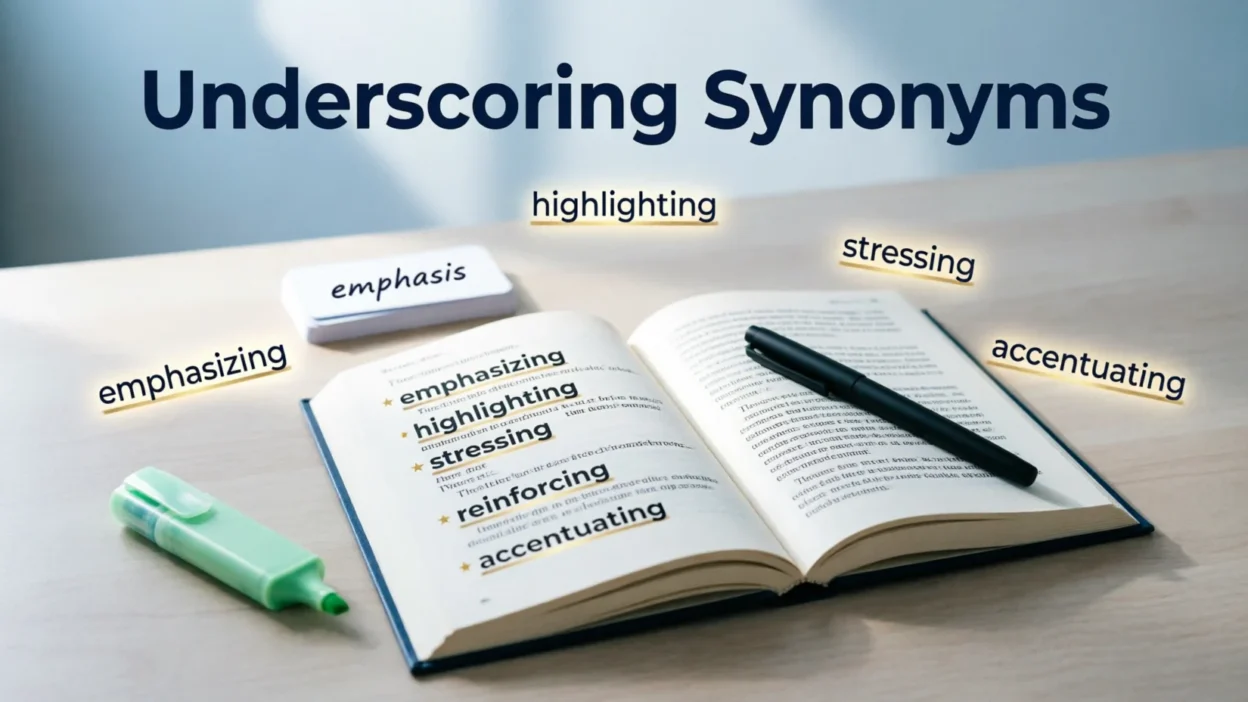
When you need a synonym for underscoring, the best choice depends on what you mean. Common alternatives include emphasizing, highlighting, stressing, accentuating, reinforcing, underlining, and pointing out.
These words can describe drawing attention to an important idea, fact, message, or detail. Some are formal and suitable for academic writing, while others sound more natural in everyday conversation.
Quick Answer
Underscoring means emphasizing or drawing special attention to something important. For example, “The report is underscoring the need for better communication” means the report is strongly emphasizing that better communication is necessary.
Depending on context, you can replace underscoring with emphasizing, highlighting, stressing, reinforcing, accentuating, underlining, demonstrating, showing, noting, or pointing out.
What Does “Underscoring” Mean?
Underscoring is the -ing form of the verb underscore. In its figurative sense, to underscore something means to make its importance especially clear.
For example:
This means the teacher’s example emphasized or clearly demonstrated why careful research matters.
The word can also have a literal meaning. To underscore text literally means to draw a line underneath it, although this meaning is less common in ordinary modern writing.
Tone of “Underscoring”
“Underscoring” usually has a formal or professional tone. It is common in:
- Academic writing
- Business reports
- News articles
- Research papers
- Presentations
- Formal speeches
- Professional communication
For casual conversation, words such as showing, stressing, or pointing out may sound more natural.
30 Synonyms for Underscoring
Below are 30 useful alternatives, along with their meanings, examples, and best contexts.
1. Emphasizing
Simple meaning: Giving something extra importance or attention.
Example: The speaker is emphasizing the importance of teamwork.
Best usage/context: General, academic, professional, and everyday writing.
2. Highlighting
Simple meaning: Drawing attention to something important.
Example: The report highlights the need for better training.
Best usage/context: Reports, presentations, articles, and professional writing.
3. Stressing
Simple meaning: Saying or showing that something is particularly important.
Example: The doctor stressed the importance of regular exercise.
Best usage/context: Formal and informal communication.
4. Underlining
Simple meaning: Making an important point especially clear.
Example: The results underline the value of early preparation.
Best usage/context: Academic, analytical, and formal writing.
5. Reinforcing
Simple meaning: Making an idea, message, or belief stronger.
Example: The new evidence reinforces the original conclusion.
Best usage/context: Research, education, business, and persuasive writing.
6. Accentuating
Simple meaning: Making a particular feature or quality more noticeable.
Example: The lighting accentuates the building’s unique design.
Best usage/context: Descriptive, artistic, and formal contexts.
7. Emphasizing the importance of
Simple meaning: Clearly showing why something matters.
Example: The campaign emphasizes the importance of protecting local wildlife.
Best usage/context: Public communication, education, and formal writing.
8. Calling attention to
Simple meaning: Asking people to notice something.
Example: The article calls attention to an often-overlooked problem.
Best usage/context: Articles, speeches, reports, and general writing.
9. Pointing out
Simple meaning: Directing someone’s attention toward a fact or detail.
Example: She pointed out several errors in the document.
Best usage/context: Everyday speech and informal or neutral writing.
10. Drawing attention to
Simple meaning: Making people notice something.
Example: The study draws attention to the effects of poor sleep.
Best usage/context: Academic, professional, and general writing.
11. Reinforcing the idea
Simple meaning: Making an existing idea seem stronger or more convincing.
Example: Her findings reinforce the idea that practice improves performance.
Best usage/context: Academic and analytical writing.
12. Accentuating
Simple meaning: Making something stand out more clearly.
Example: The design accentuates the natural beauty of the landscape.
Best usage/context: Design, art, writing, and descriptive contexts.
13. Highlighting the significance of
Simple meaning: Showing why something is important.
Example: The discovery highlights the significance of continued research.
Best usage/context: Academic and scientific writing.
14. Calling out
Simple meaning: Specifically mentioning or drawing attention to something.
Example: The manager called out the team’s excellent performance.
Best usage/context: Conversational, business, and contemporary communication.
15. Focusing on
Simple meaning: Giving particular attention to something.
Example: The lesson focuses on improving vocabulary.
Best usage/context: Education, presentations, articles, and everyday writing.
16. Bringing attention to
Simple meaning: Making something noticeable to others.
Example: The organization is bringing attention to the issue of food waste.
Best usage/context: Campaigns, articles, speeches, and public communication.
17. Making clear
Simple meaning: Removing uncertainty and showing something plainly.
Example: The results make clear why additional research is necessary.
Best usage/context: Formal, academic, and professional writing.
18. Demonstrating
Simple meaning: Showing something clearly through evidence or an example.
Example: The experiment demonstrates the effectiveness of the new method.
Best usage/context: Academic, scientific, and explanatory writing.
19. Showing
Simple meaning: Making something understandable or noticeable.
Example: The survey shows the growing demand for online education.
Best usage/context: Everyday, academic, and general writing.
20. Indicating
Simple meaning: Showing or suggesting that something is true.
Example: The findings indicate a need for further investigation.
Best usage/context: Research, reports, academic writing, and formal communication.
21. Signaling
Simple meaning: Giving a clear sign or indication of something.
Example: The change in policy signals a new direction for the organization.
Best usage/context: Business, politics, journalism, and analytical writing.
22. Expressing
Simple meaning: Communicating an idea, feeling, or opinion.
Example: The statement expresses strong support for the proposal.
Best usage/context: General, professional, and formal writing.
23. Reinforcing the message
Simple meaning: Making a message stronger and easier to remember.
Example: The photograph reinforces the message of environmental responsibility.
Best usage/context: Advertising, presentations, campaigns, and communication.
24. Amplifying
Simple meaning: Making something stronger, louder, or more noticeable.
Example: Social media amplified public awareness of the issue.
Best usage/context: Media, communication, technology, and contemporary writing.
25. Clarifying
Simple meaning: Making something easier to understand.
Example: The example clarifies the difference between the two concepts.
Best usage/context: Education, explanations, professional writing, and conversation.
26. Confirming
Simple meaning: Showing that something is true or correct.
Example: The new evidence confirms the original findings.
Best usage/context: Research, reports, professional communication, and everyday language.
27. Demonstrating the importance of
Simple meaning: Clearly showing why something matters.
Example: The results demonstrate the importance of accurate data.
Best usage/context: Academic, scientific, and professional contexts.
28. Drawing out
Simple meaning: Bringing an important point, quality, or feature into greater focus.
Example: The discussion drew out several important concerns.
Best usage/context: Discussions, analysis, education, and writing.
29. Giving prominence to
Simple meaning: Giving something a more important or noticeable position.
Example: The new policy gives prominence to employee well-being.
Best usage/context: Formal, academic, business, and institutional writing.
30. Making prominent
Simple meaning: Making something stand out or become more noticeable.
Example: The design makes the main message prominent.
Best usage/context: Design, communication, presentations, and formal writing.
Comparison Table: Underscoring Synonyms
| Synonym | Main idea | Tone | Common context |
|---|---|---|---|
| Emphasizing | Giving importance | Neutral | General |
| Highlighting | Drawing attention | Neutral | Reports, articles |
| Stressing | Showing importance | Neutral | Speech, writing |
| Underlining | Making a point clear | Formal | Academic writing |
| Reinforcing | Making stronger | Formal | Research, analysis |
| Accentuating | Making noticeable | Formal | Art, description |
| Pointing out | Directing attention | Casual/neutral | Conversation |
| Drawing attention to | Making noticeable | Neutral | General writing |
| Demonstrating | Showing with evidence | Formal | Academic writing |
| Indicating | Showing or suggesting | Formal | Reports |
| Signaling | Giving a sign | Formal | Business, analysis |
| Focusing on | Giving attention | Neutral | Education, articles |
| Calling attention to | Directing notice | Neutral | Speeches, articles |
| Amplifying | Making stronger | Modern/formal | Media, communication |
| Clarifying | Making understandable | Neutral | Education |
| Confirming | Establishing as true | Neutral/formal | Research |
How to Choose the Right Synonym for Underscoring
The best synonym depends on what you are trying to communicate.
For General Emphasis
Use:
- Emphasizing
- Highlighting
- Stressing
- Underlining
Example:
These are the safest choices when you simply want to say that something has been given extra importance.
For Academic Writing
Use:
- Underlining
- Reinforcing
- Demonstrating
- Indicating
- Highlighting
- Emphasizing
Example:
You could write:
Or:
For Casual Conversation
Use:
- Pointing out
- Showing
- Stressing
- Calling attention to
Example:
This generally sounds more natural than:
When You Mean “Make Stronger”
Choose:
- Reinforcing
- Strengthening
- Amplifying
Example:
Here, reinforcing is more precise than simply saying highlighting because the evidence does not merely attract attention—it makes the argument stronger.
When You Mean “Show Clearly”
Choose:
- Demonstrating
- Showing
- Making clear
- Indicating
Example:
These words work particularly well when evidence supports the point being made.
Underscoring vs. Emphasizing
Underscoring and emphasizing are very close in meaning.
Both sentences mean that the report gives special importance to safety.
The main difference is tone. Underscoring can sound slightly more formal or deliberate, while emphasizing is extremely versatile.
Underscoring vs. Highlighting
Both words can mean drawing attention to something important.
Highlighting often suggests making something stand out.
Underscoring often suggests emphasizing the importance or significance of a point.
When discussing importance or significance, underscoring can be especially natural.
Underscoring vs. Reinforcing
These words are related but not identical.
Underscoring means emphasizing or making something noticeable.
Reinforcing means making an existing idea, argument, belief, or message stronger.
Compare:
The first sentence draws attention to the importance. The second suggests that the evidence provides additional support for that idea.
Common Mistakes When Using “Underscoring”
1. Using “underscoring” when you simply mean “explaining”
Underscoring means emphasizing, not necessarily explaining.
Less precise:
Better:
Use underscoring when the purpose is to emphasize significance or importance.
2. Confusing “underscoring” with “underlining”
Although the two words are related, they can have different meanings.
Underlining can literally mean putting a line beneath text.
Figuratively, underlining can also mean emphasizing an idea.
3. Using overly formal language in casual situations
“Underscoring” is perfectly correct, but sometimes a simpler word sounds more natural.
Formal:
Casual:
Very conversational:
4. Treating every synonym as interchangeable
Synonyms often have slightly different meanings.
For example:
- Highlight → attract attention
- Emphasize → give importance
- Reinforce → make stronger
- Demonstrate → show through evidence
- Indicate → suggest or show
- Clarify → make easier to understand
Choosing the closest meaning makes your writing more precise.
FAQs:
What is the closest synonym for underscoring?
Emphasizing is one of the closest general synonyms for underscoring. Other strong alternatives include highlighting, stressing, underlining, and reinforcing, depending on the context.
What does underscoring mean in simple English?
Underscoring means making something especially important or drawing attention to it.
Is “highlighting” a synonym for “underscoring”?
Yes. In many contexts, highlighting and underscoring can be used interchangeably when they mean drawing attention to an important fact or idea.
Is “stressing” a synonym for underscoring?
Yes. Stressing can mean emphasizing the importance of something and is often a natural replacement for underscoring.
What is a formal synonym for underscoring?
Formal alternatives include emphasizing, reinforcing, accentuating, underlining, demonstrating, indicating, and giving prominence to.
What is a simple synonym for underscoring?
Showing, highlighting, emphasizing, and pointing out are simple alternatives that are easy for English learners to understand.
Is underscoring positive or negative?
The word itself is neutral. It simply means emphasizing or drawing attention to something. The positive or negative meaning comes from the subject being emphasized.
Can “underscoring” be used in academic writing?
Yes. Underscoring is commonly suitable for formal and academic writing, especially when discussing the significance of evidence, findings, trends, or arguments.
Conclusion
Underscoring means emphasizing something or drawing special attention to its importance. Depending on your sentence, useful synonyms include emphasizing, highlighting, stressing, underlining, reinforcing, accentuating, demonstrating, indicating, and pointing out.
The most suitable synonym depends on your exact meaning. Choose emphasizing for general use, highlighting when something needs attention, reinforcing when evidence makes an idea stronger, and demonstrating when something is shown through evidence. Using the right synonym can make your English clearer, more natural, and more precise.

I’m Nathan Collins, a language enthusiast passionate about exploring synonyms and improving everyday writing. I create clear, accurate, and helpful content that helps readers expand vocabulary and communicate with confidence.