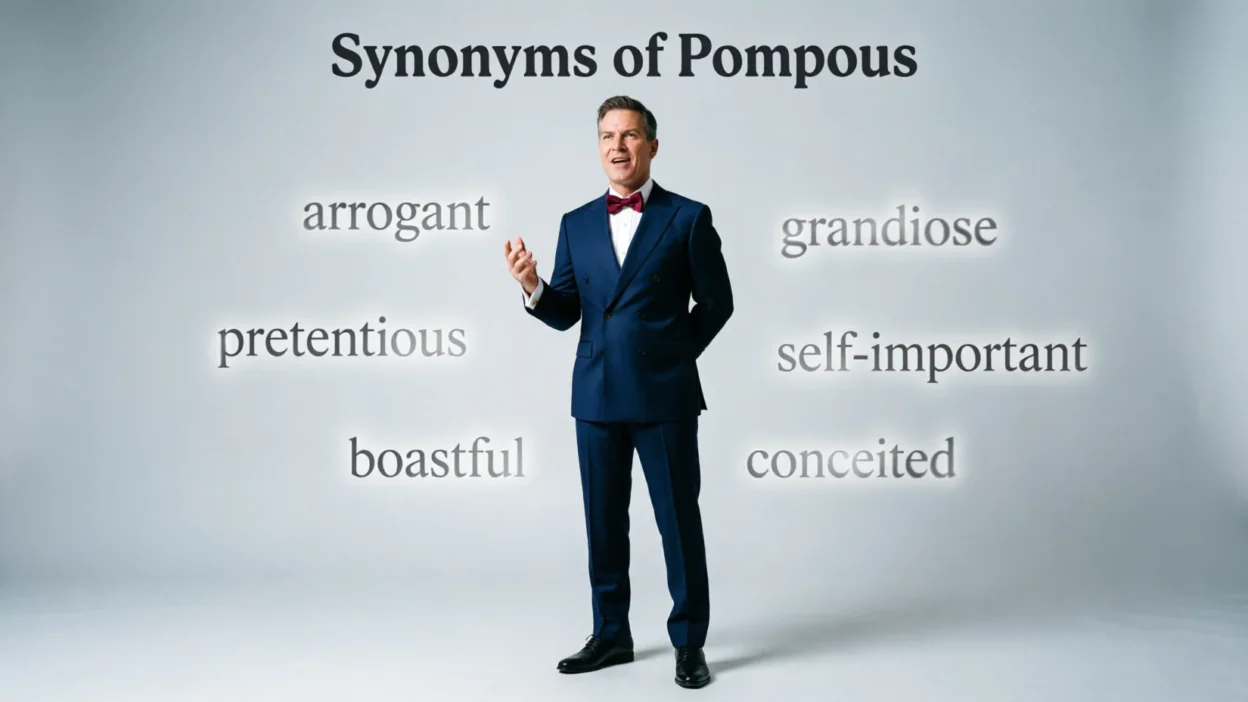
When you need synonyms of pompous, the best word depends on what you mean. If someone speaks as though they are more important than others, words like arrogant, pretentious, self-important, and conceited work well. If the language itself sounds excessively formal or grand, grandiose, bombastic, or overblown may be more accurate.
Quick Answer
The most useful synonyms of pompous include arrogant, pretentious, self-important, conceited, haughty, boastful, grandiose, bombastic, ostentatious, and affected.
Pompous usually describes a person, manner, speech, or style that seems overly important, proud, formal, or impressive in a way that feels unnatural or annoying.
What Does Pompous Mean?
Pompous is an adjective used for someone or something that tries too hard to appear important, intelligent, impressive, or dignified.
It can describe a person’s behavior, speech, writing, or appearance.
For example:
The professor’s pompous speech made a simple idea sound unnecessarily complicated.
Here, pompous suggests that the speech was excessively grand or self-important.
The word can have slightly different meanings depending on context. A pompous person may think they are superior to others, while pompous writing may use unnecessarily grand or complicated language.
Pompous for a Person
When describing a person, pompous often suggests self-importance, arrogance, or an exaggerated sense of superiority.
Example:
The manager sounded pompous when he spoke about his achievements.
Pompous for Speech or Writing
When describing language, pompous often means overly formal, grand, complicated, or self-important.
Example:
The article uses pompous language instead of explaining the issue clearly.
Pompous for Behavior or Appearance
Pompous can also describe behavior that seems unnecessarily formal, dignified, or showy.
Example:
His pompous manner made it difficult for people to feel comfortable around him.
30 Synonyms of Pompous
1. Arrogant
Simple meaning: Having an exaggerated sense of your own importance or abilities.
Example:
His arrogant attitude annoyed everyone in the meeting.
Best usage/context: Use arrogant when someone behaves as though they are better or more capable than others.
2. Pretentious
Simple meaning: Trying to appear more important, intelligent, cultured, or sophisticated than you really are.
Example:
The restaurant’s pretentious description made a simple dish sound extraordinary.
Best usage/context: Excellent for people, writing, speech, art, or behavior that tries too hard to impress.
3. Self-important
Simple meaning: Believing that you are more important than you really are.
Example:
His self-important manner made ordinary conversations uncomfortable.
Best usage/context: Best when the main idea is an exaggerated belief in one’s own importance.
4. Conceited
Simple meaning: Having too much pride in yourself and your abilities.
Example:
She became so conceited that she stopped listening to other people’s advice.
Best usage/context: Use it for excessive pride in one’s appearance, intelligence, talent, or achievements.
5. Haughty
Simple meaning: Acting as though you are better or more important than other people.
Example:
The haughty official refused to speak with the local residents.
Best usage/context: Useful for formal descriptions of proud, superior, or dismissive behavior.
6. Grandiose
Simple meaning: Extremely impressive, ambitious, or exaggerated in a way that may seem unrealistic.
Example:
He presented a grandiose plan that would completely transform the company.
Best usage/context: Especially useful for plans, ideas, language, claims, or ambitions that are excessively grand.
7. Bombastic
Simple meaning: Using language that sounds very important or impressive but has little real meaning.
Example:
The politician’s bombastic speech offered few practical solutions.
Best usage/context: Particularly strong for speeches, writing, and public statements.
8. Ostentatious
Simple meaning: Designed to attract attention by being expensive, impressive, or showy.
Example:
They arrived at the event in an ostentatious luxury car.
Best usage/context: Best for possessions, clothing, buildings, lifestyles, or displays of wealth.
9. Boastful
Simple meaning: Talking too proudly about your achievements or abilities.
Example:
His boastful comments quickly irritated his colleagues.
Best usage/context: Use when someone openly talks too much about how good or successful they are.
10. Egotistical
Simple meaning: Thinking excessively highly of yourself.
Example:
His egotistical behavior made teamwork difficult.
Best usage/context: Useful when excessive self-focus and self-admiration are the main ideas.
11. Overbearing
Simple meaning: Too controlling, forceful, or dominant.
Example:
The overbearing supervisor rarely allowed employees to make their own decisions.
Best usage/context: Best when pompous behavior also involves dominating or controlling others.
12. Snobbish
Simple meaning: Believing that you are better than people because of social position, wealth, education, or taste.
Example:
His snobbish attitude made new employees feel unwelcome.
Best usage/context: Use when superiority is connected to social class, status, or supposedly refined taste.
13. Superior
Simple meaning: Acting as though you are better than other people.
Example:
She gave him a superior look when he asked a simple question.
Best usage/context: Useful for attitudes, expressions, or behavior that communicate superiority.
14. Lofty
Simple meaning: Grand or elevated, sometimes in a way that seems unrealistic or overly proud.
Example:
The speaker made lofty promises about changing society.
Best usage/context: Works well for ideals, goals, language, claims, and ambitions.
15. Magniloquent
Simple meaning: Using very grand or impressive words.
Example:
The author’s magniloquent style sometimes distracted from the main argument.
Best usage/context: A more formal and literary choice for excessively grand language.
16. Highfalutin
Simple meaning: Trying to sound important, educated, or impressive, often unnecessarily.
Example:
The report was filled with highfalutin expressions that ordinary readers could not understand.
Best usage/context: Good for informal or humorous criticism of unnecessarily sophisticated language.
17. Affected
Simple meaning: Deliberately behaving or speaking in an unnatural way to impress others.
Example:
His affected accent sounded unnatural to everyone in the room.
Best usage/context: Use when someone’s manner, speech, or behavior feels deliberately artificial.
18. Ostentatious
Simple meaning: Excessively showy or designed to attract attention.
Example:
The celebrity’s ostentatious outfit attracted everyone’s attention.
Best usage/context: Particularly suitable for appearance, possessions, decoration, and displays of wealth.
19. Overblown
Simple meaning: Made to seem more important, impressive, or serious than it really is.
Example:
The advertisement made overblown claims about the product.
Best usage/context: Excellent for claims, descriptions, publicity, writing, and dramatic language.
20. Inflated
Simple meaning: Excessively exaggerated in importance, value, or size.
Example:
The article contains inflated descriptions of the company’s success.
Best usage/context: Useful for claims, opinions, egos, reputations, prices, and descriptions.
21. Pretentious
Simple meaning: Trying too hard to appear impressive or sophisticated.
Example:
The author’s pretentious style made the novel difficult to enjoy.
Best usage/context: One of the closest everyday alternatives to pompous, especially for language and behavior.
22. Dignified
Simple meaning: Calm, serious, and worthy of respect.
Example:
She maintained a dignified manner throughout the ceremony.
Best usage/context: This is not always a direct synonym. It can replace pompous only when the intended meaning is formal or ceremonious rather than arrogant.
23. Formalistic
Simple meaning: Following formal rules or traditions in an excessive or rigid way.
Example:
The company’s formalistic procedures slowed down simple decisions.
Best usage/context: Useful in academic, organizational, legal, or administrative contexts.
24. Self-aggrandizing
Simple meaning: Trying to make yourself seem more important or impressive.
Example:
The article seemed like a self-aggrandizing account of his career.
Best usage/context: Particularly useful for speeches, autobiographical writing, publicity, and personal promotion.
25. Vainglorious
Simple meaning: Excessively proud of your achievements or abilities.
Example:
His vainglorious speech focused entirely on his own accomplishments.
Best usage/context: A formal or literary choice for excessive pride and self-admiration.
26. Imperious
Simple meaning: Acting as though you have the right to command others.
Example:
Her imperious tone discouraged employees from asking questions.
Best usage/context: Use when someone’s proud manner is combined with authority or commanding behavior.
27. Grandiloquent
Simple meaning: Using complicated and impressive-sounding language.
Example:
The student’s grandiloquent essay used impressive words without explaining the idea clearly.
Best usage/context: Strong choice for unnecessarily elaborate speech or writing.
28. Self-satisfied
Simple meaning: Too pleased with yourself or your achievements.
Example:
His self-satisfied smile suggested that he believed he had solved every problem.
Best usage/context: Use when someone appears excessively pleased with themselves.
29. Pretender-like
Simple meaning: Behaving as though you possess qualities or status that you do not really have.
Example:
His pretender-like behavior made his claims of expertise difficult to believe.
Best usage/context: This is uncommon in everyday English, so pretentious is usually the more natural choice.
30. Showy
Simple meaning: Designed to attract attention or admiration.
Example:
His showy presentation focused more on appearance than useful information.
Best usage/context: Good for clothing, possessions, behavior, presentations, and displays intended to attract attention.
Comparison Table: Pompous Synonyms
| Synonym | Main idea | Tone | Common context |
| Arrogant | Feeling superior | Negative | People |
| Pretentious | Trying to impress | Negative | People, writing, speech |
| Self-important | Thinking too highly of yourself | Negative | People |
| Conceited | Excessive self-pride | Negative | People |
| Haughty | Superior and dismissive | Strong negative | People |
| Grandiose | Excessively grand | Negative/neutral | Plans, ideas, claims |
| Bombastic | Grand but empty language | Negative | Speech, writing |
| Ostentatious | Excessively showy | Negative | Wealth, clothing, possessions |
| Boastful | Talking proudly about yourself | Negative | Speech, behavior |
| Egotistical | Excessively self-focused | Negative | Personality |
| Overbearing | Too dominant | Negative | Behavior, authority |
| Snobbish | Social superiority | Negative | People, attitudes |
| Lofty | Grand or elevated | Neutral/negative | Ideas, goals |
| Magniloquent | Grand language | Formal | Writing, speech |
| Highfalutin | Unnecessarily fancy | Informal | Language, writing |
| Affected | Artificial behavior | Negative | Speech, manner |
| Overblown | Excessively exaggerated | Negative | Claims, descriptions |
| Inflated | Exaggerated importance | Negative | Claims, reputation |
| Imperious | Commanding and superior | Negative | Authority, behavior |
| Grandiloquent | Excessively elaborate language | Negative | Writing, speeches |
Pompous vs. Pretentious
These words are closely related, but they are not identical.
Pompous often emphasizes an exaggerated sense of importance or excessively grand behavior and language.
Pretentious focuses more strongly on trying to appear more sophisticated, intelligent, cultured, or important than one really is.
Pompous:
The director gave a pompous speech about his leadership.
Pretentious:
The director used pretentious language to make himself sound intellectual.
Pompous vs. Arrogant
Arrogant usually describes an attitude of superiority.
Pompous can describe that attitude, but it can also describe unnecessarily grand speech, writing, manners, or appearance.
Arrogant:
He is arrogant and believes he is always right.
Pompous:
His pompous speech made him sound as though he were the most important person in the room.
Pompous vs. Grandiose
Grandiose is often about something being excessively ambitious, impressive, or elaborate.
Pompous more strongly suggests that the exaggerated grandeur is irritating, self-important, or ridiculous.
Grandiose:
They announced a grandiose plan to rebuild the entire city.
Pompous:
The mayor delivered a pompous speech about his achievements.
How to Choose the Right Synonym
For Someone Who Thinks They Are Better Than Others
Choose:
- Arrogant
- Haughty
- Conceited
- Self-important
- Superior
These words focus mainly on a person’s attitude toward themselves and other people.
For Someone Trying Too Hard to Impress
Choose:
- Pretentious
- Affected
- Showy
- Snobbish
- Self-aggrandizing
These are useful when someone appears to be deliberately creating an impressive image.
For Excessively Grand Language
Choose:
- Bombastic
- Grandiloquent
- Magniloquent
- Highfalutin
- Overblown
These are especially useful when discussing speeches, essays, articles, advertisements, or formal writing.
For Excessive Displays of Wealth or Style
Choose:
- Ostentatious
- Showy
- Grandiose
These words work well for clothing, homes, cars, decorations, parties, and lifestyles.
For Excessive Ambition or Scale
Choose:
- Grandiose
- Lofty
- Inflated
- Overblown
These are better choices for plans, promises, goals, claims, and expectations.
Common Usage Mistakes
Mistake 1: Treating Every Synonym as Identical
Not every synonym can replace pompous in every sentence.
For example, ostentatious is usually about being showy, while arrogant is mainly about superiority.
Incorrect choice:
“He gave an ostentatious answer because he thought he was better than everyone.”
Better:
“He gave a pompous or arrogant answer because he thought he was better than everyone.”
Mistake 2: Using “Dignified” as a Direct Negative Synonym
Dignified is generally positive. It means calm, respectable, and controlled.
Pompous is usually critical.
Compare:
- Dignified: She gave a dignified response.
- Pompous: She gave a pompous response.
The first praises her behavior, while the second criticizes it.
Mistake 3: Confusing Pompous With Confident
Confidence means having a reasonable belief in your abilities.
Pompous behavior involves excessive self-importance or unnecessary grandness.
Someone can be confident without being pompous.
Mistake 4: Using Very Formal Words in Everyday Conversation
Words such as magniloquent, grandiloquent, and vainglorious are relatively formal or literary.
In everyday English, arrogant, pretentious, conceited, or self-important will usually sound more natural.
FAQs:
What is the best synonym for pompous?
Pretentious is one of the closest general synonyms, especially when someone is trying too hard to appear impressive or sophisticated. Arrogant is better when the focus is on superiority.
What is a polite word for pompous?
Depending on the situation, formal, grand, elaborate, or self-assured may communicate part of the meaning without sounding as strongly critical. However, these words are not exact synonyms.
What is the opposite of pompous?
Possible opposites include humble, modest, simple, unassuming, natural, and down-to-earth.
Is arrogant the same as pompous?
No. Arrogant mainly describes an attitude of superiority. Pompous can describe superiority but can also refer to excessively grand speech, writing, manners, or behavior.
What is a synonym for pompous writing?
Good choices include pretentious, bombastic, grandiloquent, magniloquent, overblown, and highfalutin.
What is a synonym for a pompous person?
Depending on the exact meaning, you can use arrogant, conceited, haughty, self-important, egotistical, pretentious, or snobbish.
Is “grandiose” a synonym for pompous?
Yes, in some contexts. Grandiose describes something excessively grand or ambitious, while pompous often adds the idea of self-importance or irritating formality.
What is the simplest synonym for pompous?
Arrogant or pretentious is usually easiest for beginners, but the best choice depends on the sentence.
Conclusion
The best synonyms of pompous depend on the exact idea you want to express. Use arrogant or haughty for a person who acts superior, pretentious for someone trying too hard to impress, bombastic for overly grand language, and ostentatious for excessive displays of wealth or style.
For formal writing, grandiloquent, magniloquent, vainglorious, and self-aggrandizing can provide more precise alternatives. Choosing the right synonym makes your writing clearer because each word carries its own tone and meaning.

I’m James Parker, Administrator at SynonymsHive. I oversee content quality, improve user experience, and ensure reliable synonym resources. My passion is making language learning simple, accurate, and accessible for everyone.