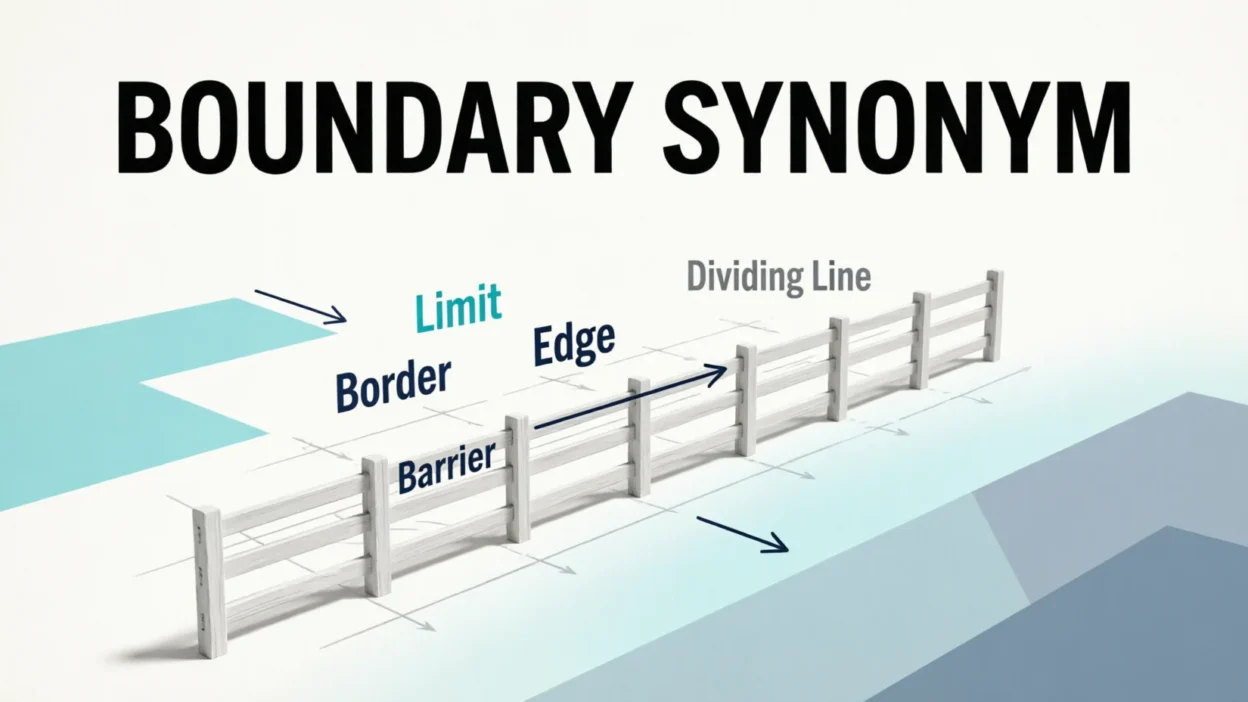
The best synonyms for boundary include limit, border, edge, barrier, perimeter, dividing line, and restriction. The right word depends on if you are describing a physical area, a personal limit, a legal restriction, or the point where something ends. Understanding these alternatives helps you communicate more clearly in everyday conversations, academic writing, and professional settings.
Quick Answer: What Is a Synonym for Boundary?
A synonym for boundary is a word or phrase that describes a limit, dividing line, or edge that separates one thing from another.
Common synonyms for boundary include:
- Limit — a point beyond which something cannot or should not go.
- Border — a line separating two places or regions.
- Edge — the outermost part of something.
- Barrier — something that blocks movement or access.
- Perimeter — the outer boundary of an enclosed area.
- Restriction — a rule that limits what someone can do.
- Demarcation — a clear line separating two areas or concepts.
- Threshold — the point at which something begins or changes.
What Does Boundary Mean?
A boundary is a line, limit, or dividing point that separates one area, person, idea, or activity from another. It can be physical, emotional, social, legal, or conceptual.
For example, a fence may mark the boundary between two properties. In a relationship, a boundary may describe what a person considers acceptable behavior.
The word can be used as both a concrete and an abstract noun. Its meaning changes slightly depending on the situation.
Different Types of Boundaries
1. Physical boundaries
Physical boundaries separate places, spaces, or objects.
Example: The river forms a natural boundary between the two regions.
2. Personal boundaries
Personal boundaries define what someone is comfortable with in relationships and social interactions.
Example: She established clear boundaries about her private life.
3. Legal boundaries
Legal boundaries define the limits of rights, authority, property, or permitted behavior.
Example: The surveyor identified the legal boundary of the property.
4. Conceptual boundaries
Conceptual boundaries distinguish between ideas, subjects, or areas of responsibility.
Example: The research explores the boundary between science and philosophy.
30 Synonyms for Boundary With Meanings and Examples
The following 30 alternatives cover physical borders, personal limits, rules, divisions, and abstract concepts. Some are close synonyms, while others work best in specific contexts.
1. Limit
Simple meaning: The point beyond which something cannot or should not continue.
Example: Everyone has a limit to how much work they can handle.
Best usage/context: Use limit for personal abilities, quantities, time, rules, and acceptable behavior.
2. Border
Simple meaning: A line that separates two countries, regions, or areas.
Example: The town lies close to the border between two states.
Best usage/context: Best for geographical areas, national boundaries, and the edges of regions.
3. Edge
Simple meaning: The outermost part of something.
Example: She stood near the edge of the field.
Best usage/context: Use edge when referring to the outer part of a physical object or area.
4. Barrier
Simple meaning: Something that prevents movement, access, or progress.
Example: A locked gate served as a barrier between the gardens.
Best usage/context: Suitable when a boundary blocks entry, movement, communication, or progress.
5. Perimeter
Simple meaning: The outer line or edge surrounding an area.
Example: Security guards walked around the perimeter of the building.
Best usage/context: Best for buildings, gardens, compounds, restricted areas, and geometric shapes.
6. Borderline
Simple meaning: A position close to the limit between two conditions or categories.
Example: His score was borderline between passing and failing.
Best usage/context: Use borderline as an adjective or noun when something lies near a dividing point.
7. Demarcation
Simple meaning: A clear separation or marking between two areas or things.
Example: The road provides a clear demarcation between the residential and commercial zones.
Best usage/context: Suitable for formal, technical, geographical, and professional writing.
8. Division
Simple meaning: A separation into different parts or groups.
Example: The wall marked the division between the two rooms.
Best usage/context: Use division when emphasizing the separation of spaces, groups, responsibilities, or ideas.
9. Separation
Simple meaning: The act or state of keeping things apart.
Example: The separation between work and personal life is important to her.
Best usage/context: Useful for relationships, categories, spaces, and areas of responsibility.
10. Delineation
Simple meaning: The clear description or marking of limits.
Example: The contract provides a delineation of each department’s responsibilities.
Best usage/context: Best for formal writing about duties, concepts, roles, and clearly defined areas.
11. Restriction
Simple meaning: A rule or condition that limits freedom or activity.
Example: The new restriction prevents visitors from entering the private area.
Best usage/context: Use restriction when a boundary is imposed by a rule, law, policy, or requirement.
12. Constraint
Simple meaning: Something that limits what a person can do.
Example: A limited budget placed a constraint on the project.
Best usage/context: Suitable for discussions about resources, freedom, choices, time, and professional responsibilities.
13. Fence
Simple meaning: A structure that marks or protects the edge of an area.
Example: They built a fence around the backyard.
Best usage/context: Use fence for a physical boundary around land, gardens, farms, or properties.
14. Wall
Simple meaning: A solid structure that separates or encloses spaces.
Example: A low wall marked the boundary of the courtyard.
Best usage/context: Best when a physical structure separates areas or prevents access.
15. Frontier
Simple meaning: A border of a country or the outer edge of an area of development.
Example: The explorers traveled toward the frontier.
Best usage/context: Useful for geographical borders, historical settings, and the limits of knowledge or development.
16. Threshold
Simple meaning: The point at which something begins or a condition changes.
Example: The discussion crossed the threshold from disagreement into hostility.
Best usage/context: Use threshold for turning points, minimum levels, entry points, and transitions between conditions.
17. Margin
Simple meaning: An outer edge or an amount of space between limits.
Example: The village sits on the margin of the forest.
Best usage/context: Suitable for edges, spare room, financial differences, and safety margins.
18. Scope
Simple meaning: The range of what something includes or covers.
Example: The agreement defines the scope of each team’s responsibilities.
Best usage/context: Use scope for projects, research, authority, duties, and areas of activity.
19. Range
Simple meaning: The span between two points or the variety covered by something.
Example: The policy applies within a specific range of circumstances.
Best usage/context: Best for measurable limits, choices, values, abilities, and coverage.
20. Ceiling
Simple meaning: An upper limit on something.
Example: The organization introduced a ceiling on annual spending.
Best usage/context: Use ceiling for maximum amounts, prices, salaries, budgets, and permitted levels.
21. Floor
Simple meaning: A minimum acceptable level or lower limit.
Example: The law established a floor for minimum wages.
Best usage/context: Best for minimum prices, wages, standards, and required levels.
22. Cap
Simple meaning: A maximum amount or limit.
Example: The school placed a cap on the number of students in each class.
Best usage/context: Use cap for maximum quantities, spending, enrollment, or participation.
23. Regulation
Simple meaning: An official rule that controls an activity.
Example: The regulation sets boundaries on how the equipment may be used.
Best usage/context: Suitable for government rules, workplace policies, safety standards, and controlled activities.
24. Prohibition
Simple meaning: A rule or law that completely forbids something.
Example: The prohibition on parking kept the entrance clear.
Best usage/context: Use prohibition when a boundary means something is not allowed at all.
25. Guardrail
Simple meaning: A protective barrier or a rule that helps prevent harmful actions.
Example: Clear workplace guardrails helped employees make responsible decisions.
Best usage/context: Useful for physical safety and figurative limits that prevent excessive or risky behavior.
26. Divide
Simple meaning: A line or difference that separates people, areas, or ideas.
Example: The mountain range forms a natural divide between the valleys.
Best usage/context: Use divide when emphasizing a separating line or a significant difference.
27. Partition
Simple meaning: A structure or division that separates one space or section from another.
Example: A wooden partition created a separate office area.
Best usage/context: Best for rooms, buildings, land, organizational sections, and divided spaces.
28. Enclosure
Simple meaning: An area surrounded by a boundary or barrier.
Example: The animals remained inside a secure enclosure.
Best usage/context: Use enclosure for fenced spaces, animal habitats, courtyards, and contained areas.
29. Limit line
Simple meaning: A line marking the point beyond which something should not extend.
Example: The workers marked the limit line before construction began.
Best usage/context: Useful in technical instructions, construction, sports, and spatial planning.
30. Breakpoint
Simple meaning: A point at which a change, separation, or interruption occurs.
Example: The team identified a breakpoint where the old system stopped working effectively.
Best usage/context: Best for technical processes, computing, analysis, and situations where one condition changes into another.
Boundary Synonyms Comparison Table
Choosing the right synonym depends on the type of boundary you want to describe. This table highlights the most useful alternatives and their differences.
| Synonym | Main meaning | Best context |
| Limit | Point that cannot be exceeded | Personal or general limits |
| Border | Separating line between places | Geography |
| Edge | Outermost part | Physical objects or areas |
| Barrier | Something that blocks access | Physical or figurative obstacles |
| Perimeter | Outer line around an area | Security and measurement |
| Demarcation | Clear distinction or marking | Formal writing |
| Restriction | Rule limiting an action | Laws and policies |
| Constraint | Factor limiting choices | Work and resources |
| Threshold | Point of entry or change | Conditions and transitions |
| Scope | Range of coverage | Projects and responsibilities |
| Ceiling | Maximum level | Spending and quantities |
| Floor | Minimum level | Standards and minimums |
| Fence | Physical dividing structure | Property and land |
| Division | Separation into parts | Groups and concepts |
| Guardrail | Protective limit | Safety and responsible behavior |
How to Choose the Right Synonym for Boundary
Not every synonym for boundary fits every sentence. Choose the word that reflects your intended meaning, tone, and purpose.
1. For a Physical Boundary
Choose border, edge, perimeter, fence, wall, or enclosure.
- Use border for the line between countries or regions.
- Use edge for the outer part of an object.
- Use perimeter for the complete outer line around an area.
- Use fence or wall when a physical structure marks a separation.
Example: “The fence marks the boundary of the property.”
Alternative: “The fence marks the perimeter of the property.”
The second sentence emphasizes the outer line surrounding the land.
2. For Personal Boundaries
Choose limit, restriction, separation, or constraint, depending on your meaning.
- Use limit for what you are willing to accept.
- Use restriction for a specific rule.
- Use separation when keeping personal and professional life apart.
- Use constraint when circumstances reduce your freedom.
Example: “He set a boundary about discussing his private life.”
Alternative: “He set a limit on discussions about his private life.”
Both communicate a personal limit, but limit can sound more direct.
3. For Formal and Academic Writing
Choose demarcation, delineation, division, scope, or threshold.
These words are useful when discussing research, responsibilities, theories, or professional rules.
Example: “The study examines the boundary between ethics and law.”
Alternative: “The study examines the demarcation between ethics and law.”
The alternative emphasizes the distinction between the two fields.
4. For Rules and Restrictions
Choose restriction, constraint, regulation, prohibition, or cap.
- Use restriction for a limit on an activity.
- Use constraint for a factor that reduces options.
- Use regulation for an official rule.
- Use prohibition for a complete ban.
- Use cap for a maximum quantity.
Example: “The school established a boundary on class size.”
More natural: “The school placed a cap on class size.”
5. For Figurative or Abstract Boundaries
Choose threshold, divide, frontier, scope, or breakpoint.
These alternatives can describe the limits of knowledge, progress, relationships, and changing conditions.
Example: “The scientists pushed the boundaries of existing knowledge.”
Alternative: “The scientists pushed the frontiers of existing knowledge.”
The second sentence emphasizes exploring new areas of discovery.
Common Mistakes When Using Boundary Synonyms
Some words related to boundary overlap in meaning but are not interchangeable in every situation.
1. Using Border and Boundary Interchangeably
A border usually separates geographical areas, while boundary can refer to physical, personal, legal, or abstract limits.
- Natural: “The river forms the boundary of the property.”
- Natural: “The border separates the two countries.”
Both words can describe geographical divisions, but their usual contexts differ.
2. Confusing a Barrier With a Boundary
A boundary marks a limit or separation. A barrier actively blocks movement, access, or progress.
- Boundary: A painted line marks the playing area’s limits.
- Barrier: A locked gate prevents entry.
A boundary does not always stop someone from crossing it.
3. Using Perimeter for Personal Limits
Perimeter usually refers to the outer line surrounding a physical area. It is not a natural substitute for personal or emotional boundaries.
Instead of “I need to protect my emotional perimeter,” write “I need to maintain my emotional boundaries.”
4. Confusing Scope With Restriction
Scope describes what an activity includes. Restriction describes what is limited or not permitted.
For example, the scope of a project may include three departments, while restrictions may prevent the team from accessing certain information.
5. Assuming Every Synonym Has the Same Tone
Words such as limit and cap are straightforward, while demarcation and delineation sound more formal.
Choose words that fit your audience and sentence rather than selecting an alternative simply because it has a similar dictionary meaning.
FAQs:
1. What is the most common synonym for boundary?
Limit is one of the most common alternatives. However, border may be more appropriate for geographical areas, while edge is often better for physical objects.
2. What is a formal synonym for boundary?
Demarcation and delineation are formal alternatives. They are useful in academic, legal, technical, and professional writing when describing clear distinctions or defined limits.
3. What is another word for personal boundaries?
Common alternatives include personal limits, acceptable limits, and individual restrictions. The best choice depends on whether you mean emotional comfort, privacy, behavior, or personal expectations.
4. What is a synonym for boundary in geography?
Border, frontier, dividing line, and demarcation can describe geographical boundaries. Use border for countries or regions and perimeter for the outer line surrounding a specific area.
5. What is the opposite of boundary?
Possible opposites include openness, freedom, continuity, and unrestricted access, depending on the intended meaning. There is no single opposite that works in every context.
6. What is a synonym for boundary in academic writing?
Demarcation, delineation, division, and scope can work in academic writing. Use demarcation for a distinction, delineation for defining limits, and scope for the range a study covers.
7. What is the difference between a boundary and a limit?
A boundary often separates one area, person, or concept from another. A limit identifies the point beyond which something cannot or should not go. The terms overlap, especially when discussing personal expectations or acceptable behavior.
8. How can I use boundary synonyms in a sentence?
First, identify what the boundary represents. Use border for geographical separation, perimeter for an area’s outer line, restriction for a rule, and threshold for a point of change. Then check that the chosen word sounds natural in the sentence.
Conclusion
The best synonym for boundary depends on the meaning you want to express. Words such as limit, border, edge, barrier, and perimeter work well for physical or general boundaries, while restriction, constraint, and regulation describe rules or limitations. For formal writing, demarcation and delineation can communicate precise distinctions.
Understanding these differences helps you choose words that are accurate, natural, and appropriate for your audience. If you are writing an academic paper, explaining personal boundaries, or describing a geographical border, the right synonym makes your message clearer.

I am Olivia Brooks, a language enthusiast and writer at SynonymsHive. I enjoy creating clear, engaging content about synonyms, vocabulary, and word meanings, helping readers improve their writing and communicate with confidence every day.