
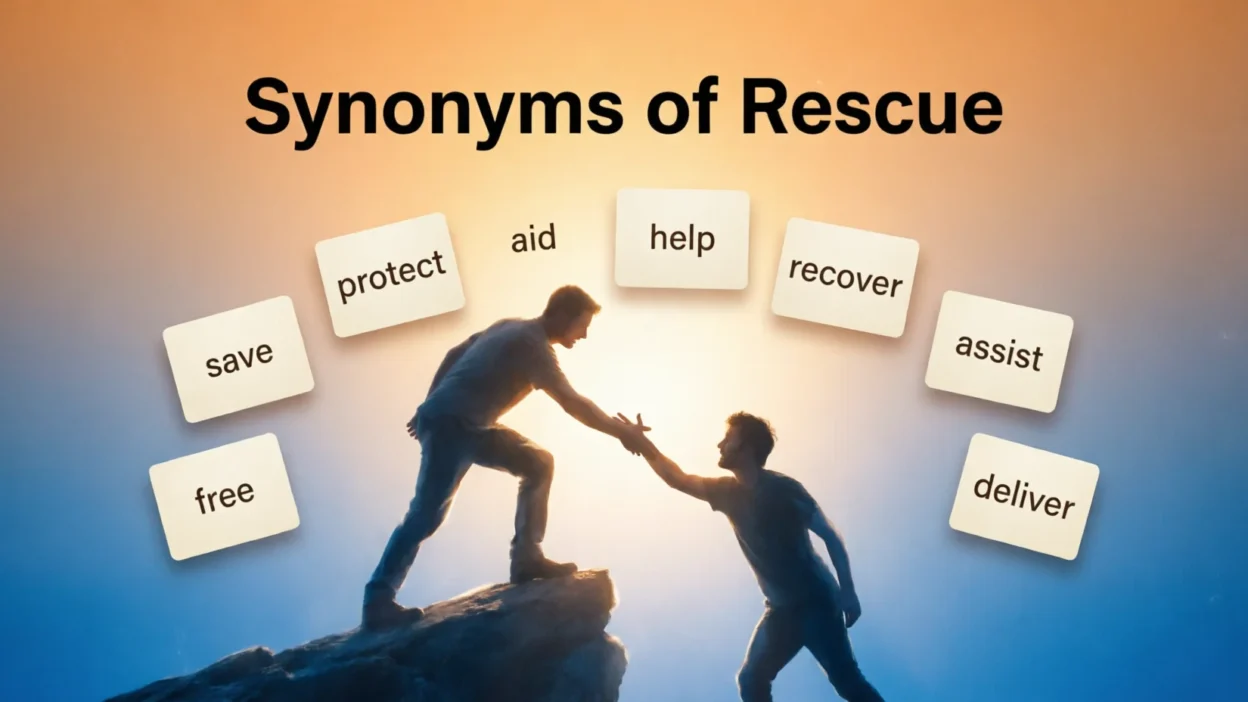
Finding the right synonyms of rescue can make your writing clearer, more precise, and more engaging. The word rescue usually means saving someone or something from danger, harm, difficulty, or an unpleasant situation. Depending on the context, you may want a stronger, more formal, emotional, or practical alternative.
For example, a firefighter may save a person from a burning building, while an organization may assist people affected by a disaster. A lifeguard might retrieve someone from the water, while a government program may relieve people from financial hardship. Understanding these differences helps students, ESL learners, writers, and content creators choose the most natural word.
Quick Answer: What Are the Best Synonyms of Rescue?
Some common synonyms of rescue include save, recover, retrieve, liberate, free, protect, assist, aid, help, deliver, evacuate, release, retrieve, preserve, salvage, defend, shelter, support, relieve, extricate, recover, restore, redeem, reclaim, safeguard, secure, intervene, emancipate, rehabilitate, and save from harm.
The best synonym depends on what is being rescued and why. Save is the most general choice, while words such as evacuate, liberate, salvage, retrieve, and extricate have more specific meanings.
What Does “Rescue” Mean?
Rescue means to save someone or something from danger, harm, loss, or a difficult situation.
Example:
- The firefighters rescued the family from the burning house.
The word can describe physical situations, such as saving someone from a flood, as well as figurative situations, such as helping a company avoid financial failure.
Tone: Neutral and widely used.
Usage: Rescue works well in everyday conversation, news reports, stories, academic writing, and professional communication.
30 Synonyms of Rescue
1. Save
Meaning: To prevent someone or something from being harmed, lost, or destroyed.
Example: The lifeguard saved the swimmer from drowning.
Best usage: The most general and natural alternative to rescue.
2. Recover
Meaning: To get someone or something back after they have been lost or endangered.
Example: The team recovered the hikers after several hours of searching.
Best usage: Useful for people, objects, data, or situations that can be regained.
3. Retrieve
Meaning: To bring someone or something back from a particular place.
Example: The search team retrieved the injured climber from the mountain.
Best usage: Best when emphasizing bringing something or someone back.
4. Liberate
Meaning: To free someone from control, imprisonment, or oppression.
Example: The soldiers helped liberate the prisoners.
Best usage: Formal, historical, political, or serious contexts.
5. Free
Meaning: To release someone from confinement, restriction, or danger.
Example: The firefighters freed the driver from the damaged vehicle.
Best usage: Everyday language and situations involving physical or figurative restriction.
6. Assist
Meaning: To help someone who needs support.
Example: Volunteers assisted families affected by the flood.
Best usage: Formal and professional writing.
7. Aid
Meaning: To provide help or support.
Example: Several organizations aided people displaced by the disaster.
Best usage: Formal writing, humanitarian situations, and news reports.
8. Help
Meaning: To make a difficult situation easier for someone.
Example: Neighbors helped the elderly residents leave the building safely.
Best usage: Simple, conversational English.
9. Protect
Meaning: To keep someone or something safe from harm.
Example: The shelter protected the animals from the storm.
Best usage: When the main idea is preventing harm rather than saving someone after danger occurs.
10. Defend
Meaning: To protect someone or something from attack or harm.
Example: The guards defended the villagers against the attackers.
Best usage: Conflict, security, legal, and military contexts.
11. Evacuate
Meaning: To move people away from a dangerous location to a safer place.
Example: Authorities evacuated residents before the hurricane arrived.
Best usage: Fires, floods, hurricanes, wars, chemical accidents, and other emergencies.
12. Release
Meaning: To allow someone to leave confinement or captivity.
Example: The trapped animal was released after being examined by veterinarians.
Best usage: Captivity, imprisonment, confinement, and controlled situations.
13. Deliver
Meaning: To bring someone out of danger or difficulty.
Example: The rescue workers delivered the passengers from the dangerous area.
Best usage: Formal, literary, or religious contexts; less common than save in everyday English.
14. Preserve
Meaning: To protect something from damage, destruction, or loss.
Example: The conservation team worked to preserve the endangered habitat.
Best usage: Historical objects, nature, culture, resources, and valuable things.
15. Salvage
Meaning: To save something from damage or destruction.
Example: Workers salvaged valuable equipment from the flooded building.
Best usage: Property, materials, vehicles, ships, equipment, or useful items.
16. Relieve
Meaning: To reduce someone’s suffering, difficulty, or distress.
Example: Emergency supplies helped relieve the suffering of displaced families.
Best usage: Humanitarian, medical, financial, and emotional situations.
17. Support
Meaning: To give someone the help or resources they need.
Example: The charity supports families during difficult times.
Best usage: Long-term help rather than an immediate emergency rescue.
18. Shelter
Meaning: To provide a safe place from danger or bad conditions.
Example: The community center sheltered hundreds of people during the storm.
Best usage: Natural disasters, homelessness, war, and dangerous weather.
19. Safeguard
Meaning: To protect someone or something from harm or risk.
Example: New rules were introduced to safeguard children online.
Best usage: Formal, professional, legal, and policy-related writing.
20. Secure
Meaning: To make someone or something safe or protected.
Example: The team secured the injured passengers before moving them.
Best usage: Safety, security, emergency operations, and professional contexts.
21. Extricate
Meaning: To carefully remove someone or something from a difficult or dangerous situation.
Example: Firefighters extricated the driver from the wrecked car.
Best usage: Technical, formal, or emergency situations.
22. Intervene
Meaning: To become involved in a situation to prevent harm or solve a problem.
Example: A teacher intervened when the argument became dangerous.
Best usage: Conflicts, emergencies, social situations, and professional contexts.
23. Reclaim
Meaning: To take back something that was lost, stolen, or taken away.
Example: The owner reclaimed the property after the legal dispute.
Best usage: Property, rights, land, possessions, or something previously lost.
24. Redeem
Meaning: To recover or save something from failure, loss, or a negative situation.
Example: A late goal redeemed the team’s disappointing performance.
Best usage: Figurative and literary contexts.
25. Restore
Meaning: To bring something back to its previous condition.
Example: Engineers restored the damaged bridge after the earthquake.
Best usage: Buildings, systems, services, relationships, environments, and conditions.
26. Rehabilitate
Meaning: To help someone or something return to a healthy or functional condition.
Example: The center rehabilitates injured wildlife before releasing it.
Best usage: Medical, social, environmental, and professional contexts.
27. Emancipate
Meaning: To free someone from legal, social, or political control.
Example: The law was created to emancipate people from an oppressive system.
Best usage: Historical, legal, social, and political writing.
28. Recover from
Meaning: To return to a normal or healthy condition after difficulty or harm.
Example: The community slowly recovered from the devastating flood.
Best usage: Health, disasters, financial problems, and difficult experiences.
29. Preserve from harm
Meaning: To keep someone or something safe from damage or destruction.
Example: The measures were designed to preserve the historic building from further damage.
Best usage: Formal writing when protection and prevention are the focus.
30. Come to someone’s aid
Meaning: To help someone who is experiencing danger or difficulty.
Example: Several hikers came to the injured man’s aid.
Best usage: Natural in storytelling, journalism, and descriptive writing.
Comparison Guide: Which Synonym of Rescue Should You Use?
| Synonym | Main idea | Common context | Tone |
|---|---|---|---|
| Save | Prevent harm | General situations | Neutral |
| Recover | Get back | People or things | Neutral |
| Retrieve | Bring back | Objects or people | Neutral/Formal |
| Liberate | Set free | Captivity or oppression | Formal |
| Free | Release from restriction | General situations | Neutral |
| Assist | Give help | Professional settings | Formal |
| Aid | Provide support | Disasters and humanitarian work | Formal |
| Protect | Prevent harm | Safety | Neutral |
| Evacuate | Move to safety | Disasters | Formal |
| Salvage | Save useful things | Damaged property | Technical |
| Relieve | Reduce suffering | Humanitarian situations | Formal |
| Shelter | Provide safety | Storms and emergencies | Neutral |
| Safeguard | Protect from risk | Policy and professional writing | Formal |
| Extricate | Remove from difficulty | Accidents | Formal |
| Restore | Return to former condition | Buildings or systems | Neutral/Formal |
| Rehabilitate | Return to healthy condition | People or animals | Formal |
Rescue vs. Save: What’s the Difference?
Rescue and save are closely related, but they are not always interchangeable.
Save is broader. It can mean preventing harm, preserving something, or helping someone avoid a negative outcome.
Rescue often suggests actively removing someone or something from danger.
Compare:
- The doctor saved the patient’s life.
- The firefighters rescued the patient from the burning building.
Both words involve preventing harm, but rescue emphasizes removal from danger.
Rescue vs. Evacuate
Rescue means saving people who are already in danger or difficulty.
Evacuate means moving people away from a dangerous location.
For example:
- Firefighters rescued people trapped inside the building.
- Authorities evacuated nearby residents before the fire spread.
Therefore, evacuate is especially useful when people are being moved to safety as a group.
Rescue vs. Retrieve
These words can overlap, but their emphasis is different.
Retrieve focuses on bringing someone or something back.
Rescue focuses on saving someone or something from danger.
For example:
- The search team retrieved the equipment.
- The search team rescued the injured climber.
When danger is central to the situation, rescue is usually more appropriate.
How to Choose the Right Synonym
Choosing among synonyms depends on the situation, the person or thing involved, and the tone of your writing.
For Everyday English
Use:
- Save
- Help
- Free
- Protect
These are simple and easy for ESL learners to understand.
Example:
“The lifeguard saved the child.”
For Emergencies
Use:
- Rescue
- Evacuate
- Extricate
- Retrieve
- Secure
These words work well in emergency reports and news stories.
Example:
“Firefighters extricated the driver from the vehicle.”
For Formal or Academic Writing
Use:
- Assist
- Aid
- Safeguard
- Preserve
- Relieve
- Intervene
These words can make professional and academic writing more precise.
Example:
“The organization provides emergency aid to affected communities.”
For Freedom or Captivity
Use:
- Free
- Liberate
- Release
- Emancipate
These words are appropriate when someone is being freed from imprisonment, control, or oppression.
Example:
“The prisoners were released after the agreement.”
For Damaged Objects or Property
Use:
- Salvage
- Recover
- Retrieve
- Preserve
- Restore
These are useful when talking about objects, buildings, vehicles, documents, or other physical things.
Example:
“Workers managed to salvage several valuable items from the damaged building.”
For Long-Term Help
Use:
- Support
- Assist
- Aid
- Rehabilitate
- Relieve
These words are better when assistance happens over time rather than during one immediate rescue.
Example:
“The charity supports families recovering from the disaster.”
Why Using the Right Synonym Matters
Using different synonyms can make your writing more accurate.
Consider the sentence:
This sentence is understandable, but it does not explain exactly what the organization did.
A more precise version might be:
Or:
The second and third examples give readers more information. Good vocabulary is not simply about using complicated words. It is about choosing a word that expresses your exact meaning.
Common Mistakes When Using Synonyms of Rescue
Using “evacuate” when you mean “save”
Evacuating people means moving them away from danger. It does not necessarily mean rescuing people who are trapped.
Using “salvage” for people
Salvage normally refers to property, materials, or useful items that have been damaged or are at risk of being lost.
Say:
- “Workers salvaged the equipment.”
Avoid using salvage as the normal replacement for rescuing a person.
Using “liberate” in casual situations
Liberate has a strong formal or historical sense. In ordinary situations, free is usually more natural.
Assuming every synonym has exactly the same meaning
Synonyms often overlap, but they are rarely identical in every situation. Save, rescue, assist, protect, and retrieve each emphasize a slightly different action.
FAQs:
What is the closest synonym for rescue?
Save is generally the closest everyday synonym for rescue. However, the best alternative depends on context. Evacuate, retrieve, liberate, and extricate can be more precise in specific situations.
What is a formal synonym for rescue?
Formal alternatives include assist, aid, safeguard, extricate, liberate, intervene, and preserve, depending on the context.
What is another word for rescue someone?
Common alternatives include save, help, assist, free, retrieve, liberate, and extricate.
What is the difference between rescue and save?
Rescue usually emphasizes removing someone or something from danger, while save has a broader meaning that includes preventing harm, loss, or failure.
What is a synonym for rescue in an emergency?
Depending on the situation, you can use save, evacuate, retrieve, extricate, assist, aid, or secure.
What is a synonym for rescuing someone from danger?
Saving, helping, freeing, protecting, extricating, and bringing someone to safety can all express this idea.
What is a synonym for rescue in formal writing?
Words such as assist, aid, safeguard, extricate, liberate, and intervene can work in formal writing when their specific meanings match the situation.
Can “recover” mean rescue?
Sometimes. Recover can mean finding and bringing back someone or something that has been lost or endangered. However, it does not always imply immediate danger, so rescue may be more accurate in an emergency.
Conclusion
Learning the synonyms of rescue can help you make your English more precise and expressive. While save is the most common general alternative, other words provide more specific meanings.
Use evacuate when people are moved away from danger, extricate when someone is removed from a difficult situation, liberate when someone is freed from control, salvage when damaged property is saved, and assist or aid when the focus is on providing help.
The key is to choose a synonym based on meaning, context, and tone rather than simply replacing rescue with another word. The right vocabulary makes your writing clearer, more natural, and easier for readers to understand.

I am Olivia Brooks, a language enthusiast and writer at SynonymsHive. I enjoy creating clear, engaging content about synonyms, vocabulary, and word meanings, helping readers improve their writing and communicate with confidence every day.