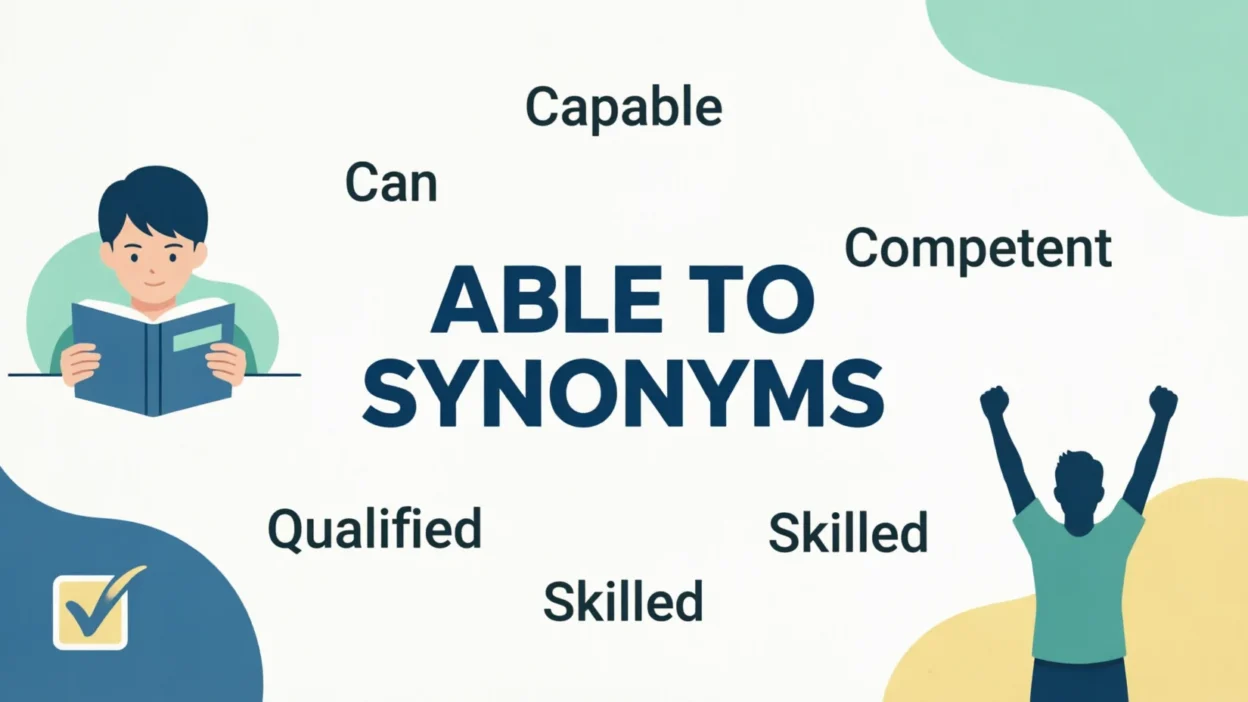
Finding the right synonyms for “able to” can make your English clearer, more natural, and more expressive. If you are writing an essay, preparing for an exam, speaking professionally, or improving your everyday vocabulary, learning alternatives to “able to” helps you communicate your ideas with confidence.
The phrase “able to” means having the skill, strength, opportunity, or capability to do something. Depending on the context, you can replace it with words and phrases such as capable of, can, competent to, in a position to, qualified to, and having the ability to. Each alternative has a slightly different meaning, so choosing the right one is important.
Quick Answer: What Are the Best Synonyms for Able To?
The best synonyms for “able to” include capable of, can, competent to, in a position to, qualified to, equipped to, prepared to, and having the ability to.
Use “can” for everyday communication, “capable of” to emphasize ability, “qualified to” for professional qualifications, and “in a position to” when someone has the opportunity or resources to do something.
What Does “Able To” Mean?
“Able to” means having the ability, skill, strength, knowledge, or opportunity to perform an action successfully.
It is commonly used before a verb to explain what a person or thing can do.
Examples:
- She is able to solve difficult mathematics problems.
- We were able to finish the project before the deadline.
- He will be able to attend the meeting tomorrow.
- The new software is able to process large amounts of data.
The phrase can describe physical ability, mental skills, practical opportunities, or successful results.
Different Uses of “Able To”
1. Physical ability: Describes what someone can physically do.
Example: After several weeks of recovery, she was able to walk independently.
2. Mental ability: Describes knowledge, understanding, or problem-solving skills.
Example: He is able to understand complex scientific concepts.
3. Practical opportunity: Describes having the resources or circumstances necessary to act.
Example: With financial support, the family was able to buy a new home.
4. Successful achievement: Often describes something that someone managed to accomplish.
Example: Despite the difficult conditions, the team was able to complete the assignment.
30 Synonyms for Able To With Meanings and Examples
The following alternatives can help you express ability, competence, readiness, opportunity, and achievement more precisely.
1. Capable Of
Simple meaning: Having the ability or potential to do something.
Example: She is capable of managing a large team.
Best usage/context: Use this phrase when emphasizing someone’s skills, potential, or capacity.
2. Can
Simple meaning: Having the ability or opportunity to do something.
Example: I can speak three languages.
Best usage/context: Best for everyday conversations, simple sentences, and informal writing.
3. Competent To
Simple meaning: Having the necessary skills or knowledge to perform a task.
Example: She is competent to handle the responsibilities of the position.
Best usage/context: Suitable for professional, academic, and formal situations. It is often more natural to say “competent to perform” or “competent in.”
4. In A Position To
Simple meaning: Having the circumstances, resources, or authority needed to do something.
Example: The company is now in a position to expand its operations.
Best usage/context: Use it when the ability depends on resources, opportunity, or authority rather than skill alone.
5. Qualified To
Simple meaning: Having the required training, education, or experience.
Example: He is qualified to teach English at the secondary level.
Best usage/context: Ideal for employment, professional credentials, certifications, and formal responsibilities.
6. Equipped To
Simple meaning: Having the tools, knowledge, or resources needed for a task.
Example: The students are equipped to handle challenging assignments.
Best usage/context: Use it when preparation, training, equipment, or resources make an action possible.
7. Skilled At
Simple meaning: Being good at performing a particular activity.
Example: She is skilled at negotiating business deals.
Best usage/context: Best for describing practical abilities, talents, and learned skills. Use “skilled in” for many fields or areas of expertise.
8. Proficient In
Simple meaning: Having a high level of skill in something.
Example: He is proficient in using advanced design software.
Best usage/context: Suitable for resumes, professional profiles, academic writing, and language abilities.
9. Adept At
Simple meaning: Very good at doing something.
Example: Maya is adept at finding creative solutions to problems.
Best usage/context: Use it when describing someone who performs a task with considerable skill.
10. Have The Ability To
Simple meaning: Possessing the power or skill to perform an action.
Example: The device has the ability to detect small changes in temperature.
Best usage/context: Useful in formal writing, technical explanations, reports, and educational material.
11. Have The Capacity To
Simple meaning: Having the potential, space, resources, or power to do something.
Example: The organization has the capacity to support more families.
Best usage/context: Appropriate for discussing potential, resources, systems, and organizational capabilities.
12. Have The Power To
Simple meaning: Having the authority, strength, or ability to make something happen.
Example: Local leaders have the power to introduce new policies.
Best usage/context: Use it when authority, influence, or control is important.
13. Have The Skills To
Simple meaning: Possessing the practical abilities required for a task.
Example: She has the skills to lead a successful marketing campaign.
Best usage/context: Best for workplaces, education, job applications, and performance discussions.
14. Prepared To
Simple meaning: Being ready to do something.
Example: The volunteers are prepared to help during the emergency.
Best usage/context: Use it when readiness matters more than natural ability or technical skill.
15. Ready To
Simple meaning: Being willing or prepared to act.
Example: I am ready to present my research.
Best usage/context: Ideal for everyday speech, announcements, teamwork, and situations requiring immediate action.
16. In A Position To Act
Simple meaning: Having the opportunity, authority, or resources to take action.
Example: After receiving approval, the manager was in a position to act.
Best usage/context: Useful in business, management, formal discussions, and decision-making.
17. Authorized To
Simple meaning: Having official permission to do something.
Example: Only trained employees are authorized to operate the machine.
Best usage/context: Use it when permission or legal authority is the main consideration.
18. Entitled To
Simple meaning: Having a legal or established right to something or to perform an action.
Example: Eligible employees are entitled to request paid leave.
Best usage/context: Suitable for policies, laws, benefits, contracts, and formal rights. It does not simply mean having a skill.
19. Free To
Simple meaning: Being allowed or having the freedom to do something.
Example: You are free to choose whichever topic interests you.
Best usage/context: Use it when someone has freedom or permission without unnecessary restrictions.
20. Permitted To
Simple meaning: Being allowed to do something.
Example: Visitors are permitted to enter the library after registration.
Best usage/context: Best for rules, instructions, formal notices, and official policies.
21. Allowed To
Simple meaning: Having permission to do something.
Example: Students are allowed to use dictionaries during the exercise.
Best usage/context: A natural, everyday alternative when permission is the intended meaning.
22. Fit To
Simple meaning: Being suitable or physically or mentally capable of doing something.
Example: After resting, he felt fit to return to training.
Best usage/context: Use it when suitability, fitness, or readiness is important. It can also refer to being suitable for a role or task.
23. Up To The Task
Simple meaning: Having what is needed to handle a particular responsibility.
Example: We believe she is up to the task of leading the project.
Best usage/context: Ideal for encouraging language, workplace discussions, and evaluations of someone’s readiness.
24. Equal To
Simple meaning: Having the ability to deal with a challenge or responsibility.
Example: The experienced engineer was equal to the challenge.
Best usage/context: Use it to emphasize the ability to meet a demanding challenge.
25. Successful In
Simple meaning: Achieving good results in an activity.
Example: He has been successful in building strong professional relationships.
Best usage/context: Suitable when focusing on results rather than simply possessing the ability to act.
26. Manage To
Simple meaning: Succeeding in doing something, often despite difficulty.
Example: We managed to reach the station before the train departed.
Best usage/context: Best for describing completed actions that required effort or overcoming obstacles.
27. Able-Qualified
Simple meaning: This is not a standard English synonym for “able to.”
Example: Instead of writing “She is able-qualified to teach,” write “She is qualified to teach.”
Best usage/context: Avoid this expression. Use “qualified,” “capable,” or “competent,” depending on the intended meaning.
28. Effective At
Simple meaning: Producing good results when doing something.
Example: The new supervisor is effective at resolving workplace conflicts.
Best usage/context: Use it when the focus is on successful performance or results rather than basic ability.
29. Versed In
Simple meaning: Having good knowledge of a subject or area.
Example: The consultant is well versed in international trade regulations.
Best usage/context: Suitable for formal writing when describing knowledge, expertise, or familiarity with a subject.
30. Skilled Enough To
Simple meaning: Having sufficient skill to perform a particular action.
Example: He is skilled enough to repair the computer without assistance.
Best usage/context: Use it when emphasizing that a person’s level of skill meets a specific requirement.
Comparison Table: Which Synonym for Able To Should You Use?
Different expressions communicate different types of ability. This table helps you select the most appropriate alternative.
| Synonym | Main meaning | Best context |
| Can | General ability | Everyday conversation |
| Capable of | Ability or potential | General and professional writing |
| Competent to | Sufficient skill | Professional situations |
| Qualified to | Required credentials | Jobs and certifications |
| Proficient in | Advanced skill | Resumes and academic writing |
| Adept at | Considerable skill | Describing talents |
| Equipped to | Necessary resources | Preparation and training |
| In a position to | Opportunity or resources | Business and decisions |
| Authorized to | Official permission | Rules and responsibilities |
| Permitted to | Permission | Formal instructions |
| Prepared to | Readiness | Planning and emergencies |
| Manage to | Successful achievement | Past events and challenges |
| Up to the task | Readiness for responsibility | Encouragement and evaluation |
| Equal to | Ability to meet a challenge | Difficult situations |
| Have the capacity to | Potential or resources | Organizations and systems |
How to Choose the Right Synonym for Able To
The best alternative depends on what you want to communicate. Consider whether you mean skill, permission, opportunity, readiness, or achievement.
1. For Everyday Conversations
Use simple, familiar alternatives such as:
- Can: I can help you with your homework.
- Ready to: We are ready to leave.
- Allowed to: You are allowed to sit here.
- Free to: You are free to ask questions.
These expressions sound natural in casual conversations and simple written communication.
2. For Formal and Academic Writing
Choose alternatives that communicate a specific type of ability.
- Capable of: The method is capable of producing reliable results.
- Competent to: The candidate is competent to perform the required duties.
- Have the capacity to: The system has the capacity to process additional data.
- Proficient in: The researcher is proficient in statistical analysis.
These expressions are useful when precision and clarity are important.
3. For Professional and Business Writing
When describing workplace skills, qualifications, or responsibilities, consider:
- Qualified to: She is qualified to manage the department.
- Skilled at: He is skilled at resolving customer complaints.
- Equipped to: The team is equipped to handle the new project.
- Effective at: The manager is effective at coordinating multiple teams.
Choose the phrase that accurately describes the person’s qualifications or performance.
4. For Permission and Authority
When the main idea is permission rather than ability, use:
- Authorized to: Employees are authorized to access the records.
- Permitted to: Visitors are permitted to enter the building.
- Allowed to: Children are allowed to use the playground.
- Free to: You are free to change your selection.
Remember that permission and ability are different. A person may be capable of doing something but not authorized to do it.
5. For Challenges and Achievements
When describing difficult tasks or successful outcomes, use:
- Manage to: She managed to finish the assignment on time.
- Equal to: He was equal to the challenge.
- Up to the task: The team is up to the task.
- Successful in: They were successful in completing the negotiations.
These expressions add context by showing effort, confidence, readiness, or results.
Common Mistakes When Using Synonyms for Able To
Choosing a synonym without considering its meaning can make a sentence confusing. Avoid these common mistakes.
1. Using “Capable Of” With the Wrong Verb Form
Incorrect: She is capable of to solve the problem.
Correct: She is capable of solving the problem.
After “capable of,” use a noun or a verb ending in “-ing.”
2. Confusing “Can” With “Could”
“Can” generally describes present ability or possibility, while “could” can describe past ability, hypothetical situations, or polite requests.
Example: I can swim now, but I could not swim when I was younger.
3. Confusing Ability With Permission
Incorrect: I am able to enter the restricted area because I want to.
Correct: I am authorized to enter the restricted area.
Wanting to do something does not automatically grant permission.
4. Using “Qualified” When You Mean “Capable”
“Qualified” usually suggests that someone meets established requirements, while “capable” describes ability or potential.
Example: A person may be capable of performing a task but may not have the formal qualifications required for the job.
5. Using “Manage To” for General Ability
“Manage to” often emphasizes success despite difficulty. It is not always interchangeable with “can.”
General ability: She can solve complex puzzles.
Successful achievement: She managed to solve the puzzle after several attempts.
6. Forgetting the Correct Preposition
Some expressions require specific prepositions:
- Capable of doing something.
- Skilled at doing something.
- Proficient in a subject or skill.
- Adept at handling a task.
- Qualified to perform a duty.
Learning these patterns helps you write grammatically correct sentences.
FAQs:
1. What is the most common synonym for able to?
“Can” is usually the simplest and most common alternative. For example, “I am able to swim” can become “I can swim.” However, “can” does not fit every context, especially when discussing formal qualifications or completed achievements.
2. What is a formal synonym for able to?
“Capable of,” “competent to,” “qualified to,” and “in a position to” are useful formal alternatives. The best choice depends on whether you mean skill, credentials, or practical opportunity.
3. What is another word for able to do something?
You can use “capable of doing,” “skilled enough to do,” “competent to perform,” or “have the ability to do.” For example, “She is able to solve the problem” can become “She is capable of solving the problem.”
4. What is the difference between able to and capable of?
“Able to” is followed by the base form of a verb, while “capable of” is normally followed by a noun or an “-ing” verb form.
Examples:
- He is able to drive.
- He is capable of driving long distances.
Both express ability, but “capable of” can place more emphasis on capacity or potential.
5. Can I use “can” instead of “able to”?
Yes. In many sentences, the two expressions have the same meaning.
Example: “She is able to speak French” and “She can speak French.”
However, “be able to” can be useful in different tenses and constructions where “can” is not available in the same form.
6. What is a synonym for able to in professional writing?
“Qualified to,” “proficient in,” “competent to,” and “equipped to” are useful professional expressions. Use “qualified to” for credentials, “proficient in” for strong skills, and “equipped to” for having the resources or preparation needed.
7. What is the opposite of able to?
Common opposites include “unable to,” “incapable of,” and “not in a position to.” Their meanings differ slightly: “unable to” describes a lack of ability or opportunity, “incapable of” emphasizes a lack of capacity, and “not in a position to” suggests that circumstances prevent action.
8. How can I avoid repeating able to in an essay?
Choose alternatives according to the meaning of each sentence. Use “can” for simple ability, “capable of” for potential, “proficient in” for skill, “qualified to” for credentials, and “managed to” for successful achievement. Do not replace every instance mechanically; sometimes “able to” is the clearest option.
Conclusion
Learning synonyms for “able to” helps you express skills, opportunities, qualifications, readiness, and achievements more precisely. While “can” is ideal for everyday communication, alternatives such as “capable of,” “proficient in,” “qualified to,” and “in a position to” can communicate more specific meanings.
The key is to choose a phrase that matches your intended message and fits naturally into your sentence. Practise using these alternatives in conversations, essays, emails, and professional documents to develop a more varied and confident English vocabulary.

I am Andrew Foster, a passionate language writer who enjoys helping readers discover the right synonyms and improve their vocabulary. I create clear, accurate, and engaging content that makes learning English simple, practical, and enjoyable.