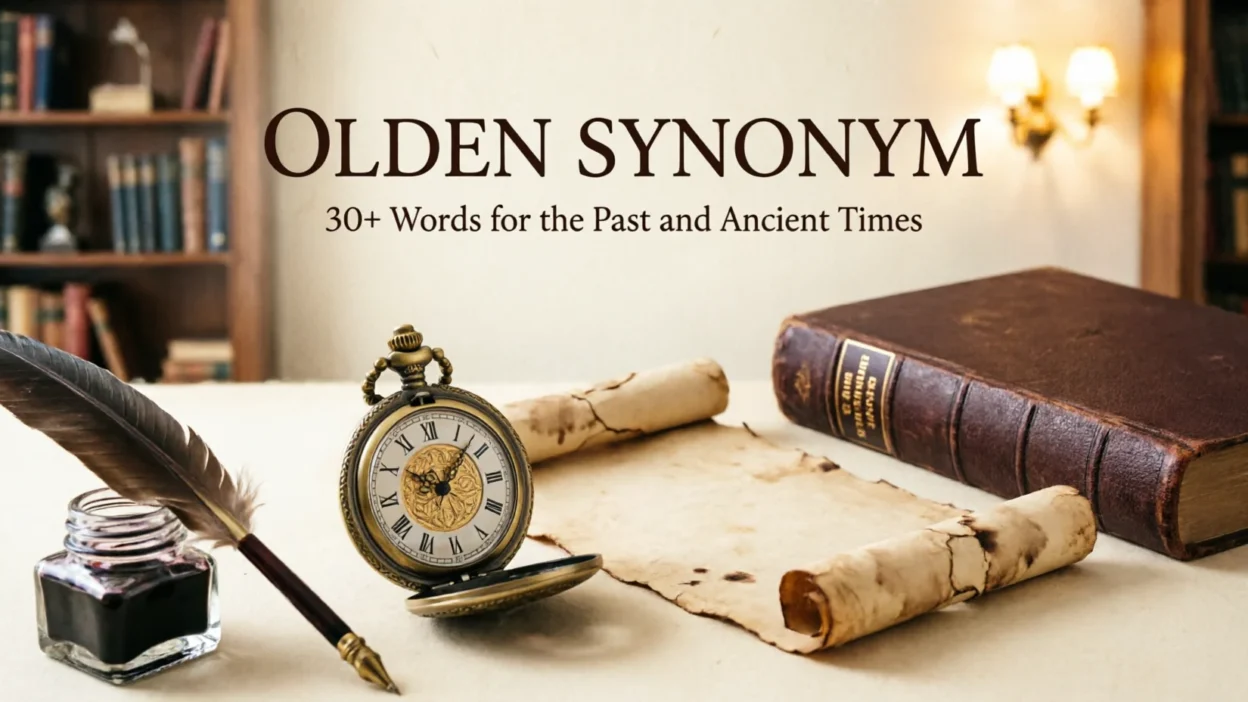
The word olden describes something from a long time ago, especially something connected with the past, history, or an earlier period. Common olden synonyms include ancient, old-fashioned, bygone, former, historic, traditional, and yesteryear. The best alternative depends on if you are describing a historical event, an old custom, a past era, or something that feels outdated.
If you are a student, writer, English learner, or content creator, understanding these related words can help you communicate more clearly and make your writing more expressive.
Quick Answer: What Are the Best Synonyms for Olden?
The best synonyms for olden are:
- Ancient — belonging to the distant past.
- Bygone — belonging to a time that has passed.
- Old-fashioned — following styles or customs from an earlier period.
- Historic — important in history.
- Former — having existed or held a position in the past.
- Traditional — following customs passed down through generations.
- Past — referring to an earlier time.
- Yesteryear — a literary term for a time long ago.
- Antique — old and often valuable because of age or craftsmanship.
- Archaic — extremely old-fashioned, especially in language or practices.
These words are related to olden, but they are not interchangeable in every sentence. For example, ancient ruins refers to something very old, while old-fashioned manners describes behavior associated with an earlier period.
Meaning of Olden and How to Use It
What Does Olden Mean?
Olden is an adjective meaning belonging to or associated with a time long ago. It is most often used in expressions such as olden days and olden times.
The word often creates a nostalgic, historical, or storytelling atmosphere. It may suggest a simpler time, a traditional way of life, or a distant period in history.
Examples:
- My grandmother often tells stories about the olden days.
- The village preserves traditions from olden times.
- The novel takes readers back to an olden age of kings and castles.
Is Olden Formal or Informal?
Olden is generally a literary or nostalgic word rather than a common everyday adjective. The expression the olden days is familiar in conversation, while ancient, historical, or former may be more suitable in formal writing, depending on the intended meaning.
When Should You Use an Olden Synonym?
Choose a synonym according to what you want to communicate:
- For a very distant historical period, use ancient.
- For a time that has passed, use bygone.
- For outdated styles or habits, use old-fashioned.
- For events that are important to history, use historic.
- For customs passed down through generations, use traditional.
- For a person, position, or situation that existed previously, use former.
30 Best Synonyms for Olden With Meanings and Examples
The following 30 words can replace olden in suitable contexts. Each word has a simple definition, an example sentence, and guidance on when to use it.
1. Ancient
Simple meaning: Very old; belonging to the distant past.
Example sentence: The explorers discovered an ancient temple hidden in the forest.
Best usage/context: Use ancient for civilizations, monuments, artifacts, traditions, and historical periods that date back a very long time.
2. Bygone
Simple meaning: Belonging to a time that has passed.
Example sentence: The museum displays photographs of a bygone era.
Best usage/context: Ideal for nostalgic writing, historical descriptions, and references to lifestyles that no longer exist.
3. Old-fashioned
Simple meaning: Following styles, ideas, or customs from an earlier time.
Example sentence: My grandfather prefers old-fashioned methods of communication.
Best usage/context: Use it for clothing, manners, habits, beliefs, and styles. It can be neutral, affectionate, or critical.
4. Historic
Simple meaning: Important or significant in history.
Example sentence: The country celebrated a historic agreement that changed its future.
Best usage/context: Best for significant events, places, achievements, and decisions. It does not simply mean very old.
5. Historical
Simple meaning: Connected with the past or the study of history.
Example sentence: She enjoys reading historical novels about ancient kingdoms.
Best usage/context: Use historical when discussing research, records, fiction, events, or objects related to history.
6. Former
Simple meaning: Having been something or held a position in the past.
Example sentence: The former school building has been converted into a library.
Best usage/context: Suitable for previous jobs, positions, owners, relationships, and situations.
7. Past
Simple meaning: Belonging to a time that has already happened.
Example sentence: The town’s past traditions still influence its celebrations.
Best usage/context: Use it in everyday conversation and writing about earlier experiences, events, or periods.
8. Traditional
Simple meaning: Based on customs or beliefs passed down through generations.
Example sentence: The family prepares traditional meals during the annual festival.
Best usage/context: Best for cultural practices, celebrations, clothing, food, music, and inherited customs.
9. Antique
Simple meaning: An object that is old, often valued for its age, rarity, or craftsmanship.
Example sentence: They purchased an antique clock at the weekend market.
Best usage/context: Use it mainly for furniture, jewelry, decorative objects, and collectibles rather than as a general synonym for olden.
10. Archaic
Simple meaning: Very old-fashioned or no longer commonly used.
Example sentence: The poem contains archaic words that modern readers may find unfamiliar.
Best usage/context: Appropriate for outdated language, obsolete rules, and practices that seem out of date.
11. Yesteryear
Simple meaning: A time in the past, especially one remembered with nostalgia.
Example sentence: The festival recreates the music and fashion of yesteryear.
Best usage/context: Use it in expressive, nostalgic, literary, or promotional writing.
12. Age-old
Simple meaning: Existing for a very long time.
Example sentence: The community continues an age-old tradition of welcoming travelers.
Best usage/context: Ideal for long-standing customs, questions, beliefs, conflicts, and practices.
13. Timeworn
Simple meaning: Worn or affected by the passage of time.
Example sentence: The timeworn staircase creaked beneath their feet.
Best usage/context: Use it for physical objects, buildings, paths, books, and things showing signs of age.
14. Antique-style
Simple meaning: Designed to look like an object from an earlier historical period.
Example sentence: The restaurant features antique-style furniture and vintage decorations.
Best usage/context: Useful for design, decor, fashion, and products inspired by older periods. It describes appearance, not necessarily actual age.
15. Obsolete
Simple meaning: No longer used because something newer or more suitable has replaced it.
Example sentence: The company replaced its obsolete computer equipment.
Best usage/context: Best for technology, equipment, procedures, and systems that are no longer useful or current.
16. Outdated
Simple meaning: No longer modern, current, or appropriate.
Example sentence: The website uses outdated information about the application process.
Best usage/context: Use it for information, ideas, technology, methods, and rules that need updating.
17. Vintage
Simple meaning: From an earlier period and often valued for its style or character.
Example sentence: She wore a vintage dress from the 1960s.
Best usage/context: Common in fashion, furniture, cars, photography, and collectibles. Its precise meaning depends on the item and context.
18. Ancestral
Simple meaning: Connected with ancestors or earlier generations of a family.
Example sentence: The family returned to its ancestral home for the celebration.
Best usage/context: Use it for family homes, lands, traditions, heritage, and inherited connections.
19. Rudimentary
Simple meaning: Belonging to an early stage of development or using basic methods.
Example sentence: The documentary explains how early communities developed rudimentary tools.
Best usage/context: Suitable for certain historical or technical descriptions, but use carefully because it can sound judgmental when applied to cultures or people.
20. Primeval
Simple meaning: Belonging to the earliest stages of the world’s or nature’s existence.
Example sentence: A primeval forest stretched across the remote valley.
Best usage/context: Best for ancient natural environments, early geological periods, and literary descriptions of the distant past.
21. Prehistoric
Simple meaning: Belonging to the period before written historical records.
Example sentence: Scientists discovered prehistoric animal bones in the cave.
Best usage/context: Use it for early humans, fossils, animals, tools, and periods before recorded history.
22. Anachronistic
Simple meaning: Belonging to a different time period than the one in which something appears.
Example sentence: The movie’s modern wristwatch looked anachronistic in a scene set in medieval times.
Best usage/context: Useful for historical criticism, literature, films, costumes, and details that do not fit their supposed era.
23. Bygone-era
Simple meaning: Relating to a period that has ended.
Example sentence: The restored railway station captures the charm of a bygone era.
Best usage/context: Best used in descriptive writing, travel articles, and nostalgic discussions of earlier lifestyles. In most sentences, bygone era is the more natural form.
24. Long-standing
Simple meaning: Existing or continuing for a long time.
Example sentence: The school maintains a long-standing tradition of community service.
Best usage/context: Use it for relationships, traditions, agreements, habits, and institutions that have endured.
25. Earlier
Simple meaning: Happening or existing before a particular time.
Example sentence: An earlier version of the manuscript contained a different ending.
Best usage/context: Suitable for comparisons, historical accounts, previous versions, and references to an earlier point in time.
26. Preceding
Simple meaning: Coming before something else in time, order, or position.
Example sentence: The preceding chapter explains the origins of the kingdom.
Best usage/context: Best for formal writing, academic work, instructions, and descriptions of events or sections that come before others.
27. Old-time
Simple meaning: Associated with an earlier period, often in a nostalgic way.
Example sentence: The band played old-time songs at the village gathering.
Best usage/context: Use it for music, entertainment, customs, and activities that evoke an earlier way of life.
28. Time-honored
Simple meaning: Respected because it has existed for a long time.
Example sentence: The ceremony follows a time-honored tradition.
Best usage/context: Ideal for customs, principles, practices, and rituals that have earned respect over many years.
29. Forgotten
Simple meaning: No longer remembered or given attention.
Example sentence: The historian uncovered a forgotten story from the town’s past.
Best usage/context: Use it when something from the past has been neglected, lost from memory, or overlooked. It does not necessarily mean ancient.
30. Vestigial
Simple meaning: Remaining as a small trace of something that existed or functioned more fully in the past.
Example sentence: The old building retained vestigial features of its original design.
Best usage/context: Most suitable for scientific, technical, and formal descriptions of remnants from an earlier stage.
Comparison Table: Which Olden Synonym Is Best?
| Synonym | Main meaning | Best context |
|---|---|---|
| Ancient | Very old | Ruins, civilizations, artifacts |
| Bygone | From a past era | Nostalgic writing |
| Old-fashioned | From an earlier style | Habits, manners, clothing |
| Historic | Important in history | Events and achievements |
| Historical | Related to history | Research, novels, records |
| Former | Previously existing | Jobs, owners, positions |
| Traditional | Passed down through generations | Culture and customs |
| Antique | Old and often collectible | Furniture and objects |
| Archaic | No longer commonly used | Language and outdated practices |
| Vintage | From an earlier period, valued for style | Fashion and decor |
| Obsolete | Replaced or no longer used | Technology and systems |
| Prehistoric | Before recorded history | Fossils and early humans |
| Age-old | Existing for a long time | Customs and beliefs |
| Time-honored | Long respected | Ceremonies and traditions |
| Yesteryear | A nostalgically remembered past | Literary descriptions |
How to Choose the Right Synonym for Olden
Not every synonym communicates the same idea. Choose the word that matches your meaning, tone, and purpose.
1. For Historical and Academic Writing
Choose ancient, historical, prehistoric, or former.
- Ancient civilization refers to a civilization from the distant past.
- Historical document refers to a document connected with history.
- Prehistoric settlement refers to a settlement from before recorded history.
- Former capital identifies a city that previously served as a capital.
These terms are more precise than olden when writing research papers, essays, or educational content.
2. For Nostalgic and Creative Writing
Choose bygone, yesteryear, old-time, or vintage.
- A bygone era creates a sense of a past period.
- The fashions of yesteryear sounds nostalgic and expressive.
- Old-time music suggests a traditional or earlier musical style.
- Vintage photographs suggests images from an earlier period.
These expressions work well in stories, memoirs, travel writing, and descriptive articles.
3. For Traditions and Cultural Practices
Choose traditional, age-old, time-honored, or long-standing.
- Traditional clothing emphasizes cultural customs.
- An age-old belief emphasizes the belief’s long history.
- A time-honored ceremony suggests a respected custom.
- A long-standing relationship emphasizes continuity over time.
Use these words when the duration or cultural importance of a practice matters.
4. For Outdated Ideas or Methods
Choose old-fashioned, outdated, obsolete, or archaic.
- Old-fashioned manners may be charming or unusual.
- Outdated information is no longer current.
- Obsolete machinery is no longer useful or in regular use.
- Archaic wording sounds extremely old-fashioned.
Be careful with tone. Calling a custom traditional can be respectful, while calling it outdated suggests that it should change.
5. For Describing Old Objects and Buildings
Choose antique, vintage, timeworn, or primeval, depending on the subject.
- Antique furniture often refers to old collectible furniture.
- Vintage clothing refers to clothing from an earlier period.
- Timeworn stone walls emphasizes visible signs of age.
- A primeval landscape suggests an ancient, natural environment.
The most accurate choice depends on the object’s actual age, condition, and historical setting.
Common Mistakes When Using Olden Synonyms
Mistake 1: Using Historic and Historical Interchangeably
Although the words are related, their meanings differ.
- Historic: important or significant in history.
- Historical: connected with history.
Correct: The treaty was a historic achievement.
Correct: The researcher examined historical records.
Mistake 2: Treating Ancient as a Perfect Replacement for Olden
Ancient usually suggests great age, while olden often evokes a general past period.
Correct: Ancient Egyptian monuments attract visitors.
Correct: Stories of the olden days filled the evening.
Mistake 3: Using Antique for Every Old Object
An old object is not automatically an antique. The word often implies collectible value, historical interest, or craftsmanship.
Better: The family keeps an old wooden chair.
Use antique chair when the chair’s age or collectible character supports that description.
Mistake 4: Confusing Traditional With Outdated
Traditional describes customs or practices passed down over time. Outdated means something is no longer current or suitable.
A traditional recipe may still be useful and popular today, while an outdated instruction may need revision.
Mistake 5: Using Archaic in Everyday Situations
Archaic is a relatively formal word and often suggests that something is no longer in ordinary use.
Instead of saying This phone is archaic, you may find This phone is outdated more natural in everyday conversation.
Mistake 6: Writing Olden When a More Specific Word Is Needed
Olden works naturally in expressions such as olden days and olden times. For more precise descriptions, choose the word that identifies the actual relationship with the past.
For example, use former manager for a previous position and prehistoric fossils for remains from before recorded history.
FAQs:
1. What is the closest synonym for olden?
Bygone is one of the closest synonyms when olden refers to a time that has passed. Ancient is more suitable when you mean a very distant historical period.
2. What is another word for olden days?
Common alternatives include bygone days, the past, yesteryear, and a bygone era. The expression bygone days is especially useful in nostalgic writing.
3. Is ancient a synonym for olden?
Yes, in some contexts. Ancient describes something very old or from the distant past, while olden generally refers to an earlier period. Ancient often implies a greater age.
4. What is a formal synonym for olden?
Depending on the context, formal alternatives include historical, former, preceding, ancient, and archaic. Choose the word that accurately expresses the intended meaning.
5. What is the opposite of olden?
Possible opposites include modern, contemporary, current, and new. The best antonym depends on the sentence. For example, olden times contrasts naturally with modern times.
6. Can vintage replace olden?
Sometimes, but not always. Vintage usually describes objects, styles, or items associated with an earlier period. It does not work as a natural replacement in every expression containing olden.
7. Is olden still used in modern English?
Yes. Olden remains familiar in expressions such as the olden days. It is less common as a general adjective in everyday speech, where words such as old, former, and historical may be more natural.
8. What is the difference between bygone and outdated?
Bygone describes something belonging to a past period. Outdated describes something that is no longer current or suitable. A bygone tradition may be remembered fondly, while an outdated method may need replacing.
Conclusion
Choosing the right olden synonym makes your writing clearer, more precise, and more engaging. Words such as ancient, bygone, old-fashioned, historic, and traditional all relate to the past, but each carries a different meaning and tone.
Use ancient for distant history, bygone for a time that has passed, old-fashioned for earlier styles, and traditional for customs passed down through generations. For academic writing, words such as historical, former, and preceding may be more precise.
The key is to consider what you want to express before choosing a replacement. With these 30 synonyms, you can describe the past more naturally and confidently in essays, stories, conversations, and professional writing.

I am Olivia Brooks, a language enthusiast and writer at SynonymsHive. I enjoy creating clear, engaging content about synonyms, vocabulary, and word meanings, helping readers improve their writing and communicate with confidence every day.