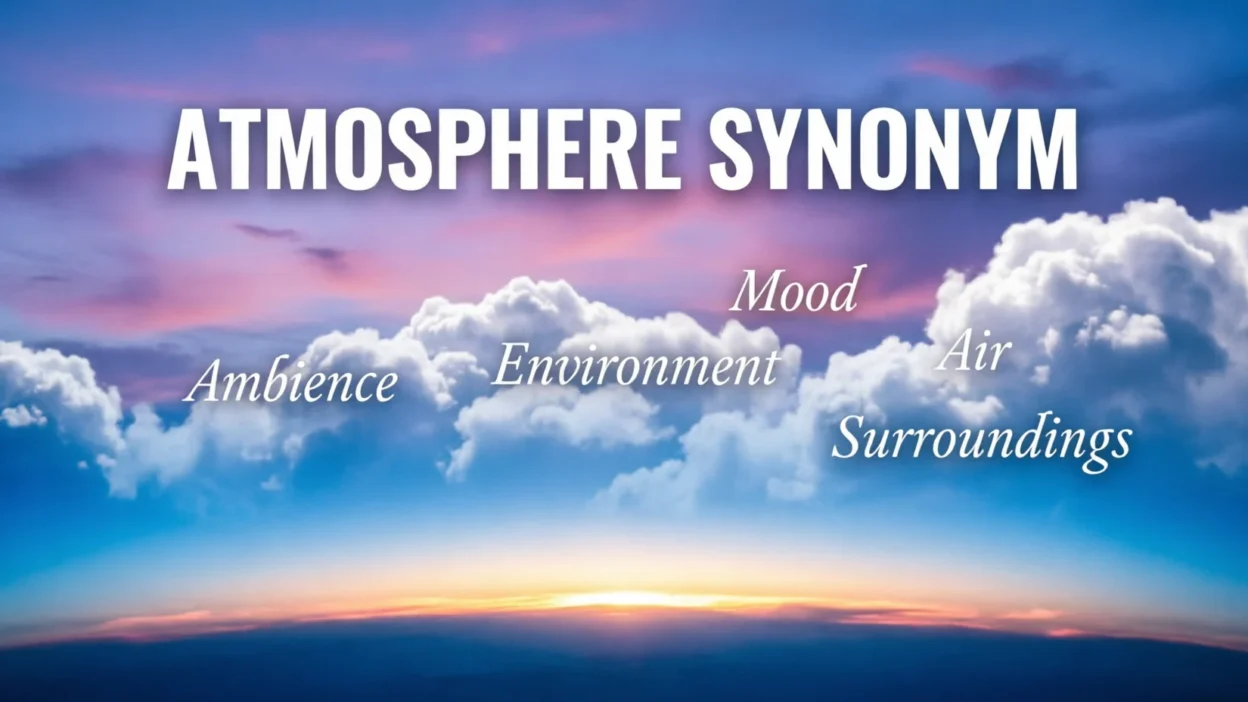
The best synonyms for atmosphere include ambience, mood, feeling, environment, setting, aura, and vibe. The right word depends on what you want to describe, such as the emotional feeling of a room, the character of a place, the mood of a story, or the layer of gases surrounding a planet. Understanding these alternatives helps you write more clearly, express emotions accurately, and choose words that fit different situations.
Quick Answer: What Is a Synonym for Atmosphere?
A synonym for atmosphere is a word that describes a similar feeling, environment, or surrounding condition. Ambience is often the best alternative when describing the feeling of a place, while mood works well for emotions and environment suits broader surroundings.
Here are some useful alternatives:
- Ambience: The overall feeling of a place.
- Mood: The emotional feeling of a person, place, or situation.
- Vibe: The general impression something creates.
- Environment: The surrounding conditions or setting.
- Aura: A distinctive feeling or quality associated with someone or something.
- Setting: The place and surroundings where something happens.
- Air: A particular quality or impression that something seems to have.
- Climate: The general conditions or prevailing attitude within a place or group.
What Does Atmosphere Mean?
The word atmosphere has several meanings, depending on the context.
1. The Feeling of a Place
Atmosphere can describe the mood or character of a place. Lighting, music, decoration, sounds, and people’s behavior can all contribute to it.
Example: The restaurant has a warm and welcoming atmosphere.
In this context, words such as ambience, mood, vibe, and feeling may work as synonyms.
2. The Mood of a Situation or Story
Atmosphere can describe the emotional quality created by a situation, book, movie, or event.
Example: The dark corridors created an atmosphere of mystery.
In this sense, mood, tone, feeling, and ambience may be suitable alternatives.
3. The Surrounding Conditions
Atmosphere can also refer to the general conditions surrounding an activity, workplace, community, or event.
Example: The school encourages an atmosphere of cooperation.
Words such as environment, climate, and setting may fit this meaning.
4. The Layer of Gases Around a Planet
In science, the atmosphere is the layer of gases surrounding a planet or another celestial body.
Example: Earth’s atmosphere contains the gases necessary for life as we know it.
In this scientific context, words such as gaseous envelope or layer of gases may describe the concept, although they are explanatory alternatives rather than exact synonyms.
30 Synonyms for Atmosphere With Meanings and Examples
The following 30 words and expressions can replace atmosphere in suitable contexts. Each has a slightly different meaning, so choose the one that best expresses your intended idea.
1. Ambience
Simple meaning: The overall feeling or character of a place.
Example: Soft lighting gives the café a relaxing ambience.
Best usage/context: Restaurants, hotels, homes, events, shops, and other places where the surroundings create a particular experience.
2. Mood
Simple meaning: The emotional feeling associated with a person, place, or situation.
Example: The gentle music created a peaceful mood.
Best usage/context: Literature, films, social situations, events, and descriptions of emotional experiences.
3. Environment
Simple meaning: The surroundings and conditions in which someone lives, works, or does something.
Example: The company provides a supportive work environment.
Best usage/context: Workplaces, schools, homes, communities, and natural surroundings.
4. Vibe
Simple meaning: The general feeling or impression that someone or something gives.
Example: This little bookstore has a friendly vibe.
Best usage/context: Informal conversations, social media captions, lifestyle writing, and casual descriptions.
5. Aura
Simple meaning: A distinctive feeling or quality that seems to surround someone or something.
Example: The historic building has an aura of mystery.
Best usage/context: Descriptive writing, personality descriptions, art, and places with a distinctive character.
6. Feeling
Simple meaning: The emotional impression created by a person, place, or situation.
Example: There was a feeling of excitement throughout the stadium.
Best usage/context: Everyday English, personal writing, storytelling, and descriptions of shared emotions.
7. Setting
Simple meaning: The place and surroundings where something happens.
Example: The quiet village provides the perfect setting for the story.
Best usage/context: Novels, films, events, travel writing, and descriptions of locations.
8. Air
Simple meaning: A noticeable quality or impression associated with someone or something.
Example: The old library has an air of elegance.
Best usage/context: Literary writing and expressions such as “an air of confidence,” “an air of mystery,” or “an air of sadness.”
9. Climate
Simple meaning: The general conditions or prevailing attitude within a group or organization.
Example: The manager created a climate of trust and cooperation.
Best usage/context: Business, politics, education, social relationships, and discussions of organizational culture.
10. Tone
Simple meaning: The general attitude or emotional quality expressed in communication or creative work.
Example: The writer establishes a serious tone from the opening paragraph.
Best usage/context: Essays, speeches, books, films, professional communication, and discussions of writing style.
11. Character
Simple meaning: The distinctive qualities that make a place or thing recognizable.
Example: The old neighborhood has a unique character.
Best usage/context: Architecture, communities, historical places, buildings, and cultural descriptions.
12. Spirit
Simple meaning: The shared feeling, attitude, or energy of a person or group.
Example: The festival captured the joyful spirit of the community.
Best usage/context: Celebrations, teamwork, traditions, communities, and descriptions of collective enthusiasm.
13. Atmospherics
Simple meaning: Elements that create a particular mood or sensory impression.
Example: The film’s atmospheric sound design adds tension to every scene.
Best usage/context: Film, theater, photography, music, and discussions of how artistic effects create a mood. This is a related term rather than a direct substitute in every sentence.
14. Ambiance
Simple meaning: The overall character or feeling of a place.
Example: Candles and soft music create a romantic ambiance.
Best usage/context: Restaurants, hotels, interior design, hospitality, and lifestyle writing. Ambiance is an alternative spelling of ambience.
15. Impression
Simple meaning: The idea or feeling someone develops about a person, place, or situation.
Example: The welcoming staff gave visitors a positive impression of the hotel.
Best usage/context: Reviews, personal experiences, customer service, and descriptions of how something appears to others.
16. Quality
Simple meaning: A distinctive feature or characteristic of something.
Example: The garden has a peaceful quality that encourages visitors to relax.
Best usage/context: Descriptive prose, reviews, creative writing, and explanations of a place’s special character.
17. Feel
Simple meaning: The general character or emotional impression of a place or situation.
Example: The renovated office has a modern feel.
Best usage/context: Casual conversation, interior design, travel writing, and informal reviews.
18. Energy
Simple meaning: The level of activity, excitement, or enthusiasm in a place or group.
Example: The concert hall was filled with positive energy.
Best usage/context: Events, workplaces, performances, social gatherings, and descriptions of lively places.
19. Presence
Simple meaning: A noticeable or influential quality that someone or something has.
Example: The ancient monument has a powerful presence.
Best usage/context: Describing people, buildings, landmarks, performances, and places that make a strong impression.
20. Surroundings
Simple meaning: The things, places, or conditions around someone or something.
Example: The peaceful surroundings made the retreat especially relaxing.
Best usage/context: Travel writing, nature descriptions, homes, outdoor spaces, and physical environments.
21. Milieu
Simple meaning: The social or cultural environment in which someone lives or works.
Example: She developed her artistic style in a creative academic milieu.
Best usage/context: Academic writing, sociology, cultural studies, biography, and formal discussions of social settings.
22. Context
Simple meaning: The circumstances that help explain an event, statement, or situation.
Example: The tense political context influenced the atmosphere of the meeting.
Best usage/context: Academic writing, analysis, communication, and explanations of how surrounding circumstances affect an experience. It is related to atmosphere but is not always interchangeable with it.
23. Backdrop
Simple meaning: The background against which something happens.
Example: The peaceful countryside provided a beautiful backdrop for the wedding.
Best usage/context: Photography, storytelling, events, travel writing, and descriptions of scenery or circumstances.
24. Surrounding conditions
Simple meaning: The circumstances or physical conditions in which something occurs.
Example: The surrounding conditions made it difficult for the team to concentrate.
Best usage/context: Technical writing, workplace discussions, scientific explanations, and descriptions of practical circumstances.
25. Emotional tone
Simple meaning: The emotional character communicated by a situation or piece of work.
Example: The emotional tone of the novel becomes darker as the story progresses.
Best usage/context: Literary analysis, reviews, storytelling, speeches, and discussions of emotional expression.
26. General feeling
Simple meaning: The overall impression or emotion associated with a place or situation.
Example: The general feeling at the reunion was one of happiness and relief.
Best usage/context: Everyday English, summaries, event descriptions, and situations where a simple, accessible expression is preferred.
27. Social climate
Simple meaning: The prevailing attitudes and relationships within a community or group.
Example: The school is working to improve its social climate.
Best usage/context: Education, communities, organizations, public policy, and discussions of inclusion or cooperation.
28. Mystique
Simple meaning: An unusual quality that makes someone or something fascinating or mysterious.
Example: The remote island has a mystique that attracts adventurous travelers.
Best usage/context: Travel writing, celebrity profiles, cultural descriptions, and subjects surrounded by fascination or mystery.
29. Gaseous envelope
Simple meaning: A layer of gases surrounding a planet or other celestial body.
Example: A planet’s gaseous envelope influences its temperature and surface conditions.
Best usage/context: Scientific explanations of planetary atmospheres. This is a descriptive scientific expression, not a universal synonym for atmosphere.
30. General character
Simple meaning: The overall qualities or distinctive nature of a place or situation.
Example: The general character of the neighborhood is peaceful and welcoming.
Best usage/context: Formal descriptions, reports, reviews, travel writing, and summaries of a place’s defining qualities.
Atmosphere Synonyms Comparison Table
Use this table to quickly identify the best word for your sentence.
| Synonym | Main meaning | Tone | Best example |
| Ambience | Feeling of a place | Neutral | A relaxing ambience |
| Mood | Emotional state or quality | Neutral | A cheerful mood |
| Environment | Surrounding conditions | Neutral/formal | A safe environment |
| Vibe | General impression | Informal | A positive vibe |
| Aura | Distinctive quality | Descriptive | An aura of mystery |
| Setting | Place where something happens | Neutral | A rural setting |
| Air | Noticeable quality | Literary | An air of confidence |
| Climate | Prevailing conditions or attitudes | Formal | A climate of trust |
| Tone | Attitude or emotional quality | Neutral/formal | A serious tone |
| Spirit | Shared attitude or energy | Positive/descriptive | A spirit of unity |
| Milieu | Social or cultural surroundings | Formal | An artistic milieu |
| Mystique | Fascinating mystery | Descriptive | The mystique of an old city |
How to Choose the Right Synonym for Atmosphere
Not every synonym fits every sentence. The best choice depends on what you are describing and the impression you want to create.
1. For a Positive Atmosphere
Choose words that communicate comfort, happiness, or encouragement.
- Welcoming ambience: A place that makes people feel comfortable.
- Friendly vibe: A relaxed, approachable feeling.
- Positive environment: Surroundings that encourage well-being or success.
- Joyful spirit: A shared feeling of happiness.
- Supportive climate: Conditions that encourage cooperation and growth.
Example: The teacher created a supportive classroom environment.
2. For a Negative Atmosphere
Use words that communicate tension, sadness, discomfort, or hostility.
- Tense mood: A feeling of stress or uncertainty.
- Hostile environment: Surroundings in which people experience opposition or aggression.
- Gloomy ambience: A dark or depressing feeling associated with a place.
- Oppressive atmosphere: A feeling of pressure, discomfort, or restriction.
- Unfriendly climate: A situation in which people feel unwelcome or unsupported.
Example: An atmosphere of fear spread through the town.
3. For a Mysterious or Dramatic Atmosphere
These words are especially useful in storytelling and creative writing.
- Aura of mystery: A quality that makes something seem mysterious.
- Air of suspense: A feeling that something important or uncertain may happen.
- Mystique: A fascinating quality that is difficult to explain.
- Dark mood: An emotionally heavy or unsettling feeling.
- Atmospheric setting: A place described in a way that strongly establishes mood.
Example: The abandoned mansion had an eerie ambience.
4. For Professional or Academic Writing
Choose words that sound precise and appropriate for formal communication.
- Environment: Suitable for workplaces and educational settings.
- Climate: Useful for describing prevailing organizational or social attitudes.
- Milieu: Appropriate for cultural and academic discussions.
- Context: Useful for explaining surrounding circumstances.
- Conditions: Suitable for practical, technical, and scientific descriptions.
Example: The institution aims to establish a climate of academic integrity.
5. For Casual Conversations and Social Media
Use simple, natural expressions that people commonly understand.
- Vibe: “This place has a great vibe.”
- Feel: “I love the feel of this room.”
- Mood: “The music changed the mood.”
- Energy: “The crowd had amazing energy.”
- Ambience: “The restaurant has beautiful ambience.”
Example: The café has a cozy vibe and excellent music.
Common Mistakes When Using Atmosphere Synonyms
Choosing a similar word without checking its meaning can make a sentence unclear. Here are some common mistakes to avoid.
1. Using Mood and Atmosphere as Exact Equivalents
Mood and atmosphere overlap, but they are not always interchangeable. Mood often refers to an emotional state or the emotion created by a work, while atmosphere can also refer to the broader character of a place.
- Less precise: The office had a happy mood because of its modern furniture.
- Better: The office had a welcoming atmosphere because of its modern furniture.
2. Using Vibe in Highly Formal Writing
Vibe is natural in everyday conversation but may sound too informal in academic reports or professional documents.
- Informal: The workplace has a friendly vibe.
- Formal: The workplace has a supportive environment.
3. Confusing Atmosphere With Environment
Atmosphere often emphasizes the feeling or character of a situation. Environment usually refers to the broader physical, social, or working conditions.
Example: A classroom may have a calm atmosphere and a well-equipped learning environment.
Both terms work, but they describe different aspects of the classroom.
4. Treating Climate as a Weather-Only Word
Climate can refer to long-term weather patterns, but it also describes prevailing attitudes or conditions within an organization or society.
Example: The organization has a climate of openness and trust.
This use is common in professional and social discussions.
5. Using Scientific Alternatives in Emotional Descriptions
Expressions such as gaseous envelope are appropriate for planetary science, not for describing a restaurant or a tense meeting.
Incorrect: The restaurant had a relaxing gaseous envelope.
Better: The restaurant had a relaxing ambience.
Always match the synonym to the intended meaning.
FAQs:
1. What is the best synonym for atmosphere?
Ambience is often the best synonym when describing the overall feeling of a place. However, mood may be better for emotions, environment for surrounding conditions, and vibe for informal descriptions.
2. What is another word for atmosphere in a room?
Good choices include ambience, mood, feel, vibe, and environment. For example, “The room has a peaceful ambience” describes the feeling created by the room’s lighting, furniture, and decoration.
3. What is a synonym for a good atmosphere?
Useful alternatives include welcoming ambience, positive environment, friendly vibe, supportive climate, and cheerful mood. The best option depends on whether you are describing a physical place, workplace, or social situation.
4. What is a synonym for a bad atmosphere?
Words and expressions include tense mood, hostile environment, gloomy ambience, oppressive atmosphere, and unfriendly climate. Choose the term that best describes the problem, such as tension, sadness, or hostility.
5. What is a formal word for atmosphere?
Environment, climate, milieu, and general character can work in formal writing. For example, “The university promotes a climate of intellectual curiosity” is suitable for academic or professional communication.
6. What is another word for atmosphere in literature?
Common alternatives include mood, tone, ambience, setting, and emotional tone. In literary analysis, mood describes the feeling experienced by the reader, while tone often describes the author’s attitude toward the subject.
7. What is the difference between ambience and atmosphere?
Both words can describe the overall feeling or character of a place. Ambience is especially common when discussing lighting, music, decoration, and comfort, while atmosphere has broader uses in emotional, social, literary, and scientific contexts.
8. What is the synonym for atmosphere in science?
In planetary science, gaseous envelope or layer of gases can describe the atmosphere surrounding a planet. These are explanatory expressions rather than exact replacements in every scientific sentence.
Conclusion
The best atmosphere synonym depends on the meaning you want to communicate. Ambience is an excellent choice for describing the feeling of a place, mood is useful for emotional experiences, environment describes surrounding conditions, and vibe works well in casual conversations. Words such as aura, climate, tone, spirit, and milieu offer more specific meanings for creative, professional, and academic writing.
Before choosing a synonym, consider the context, tone, and intended message. Using the right word makes your writing more natural, precise, and engaging while helping readers understand exactly what you mean.

I am Olivia Brooks, a language enthusiast and writer at SynonymsHive. I enjoy creating clear, engaging content about synonyms, vocabulary, and word meanings, helping readers improve their writing and communicate with confidence every day.