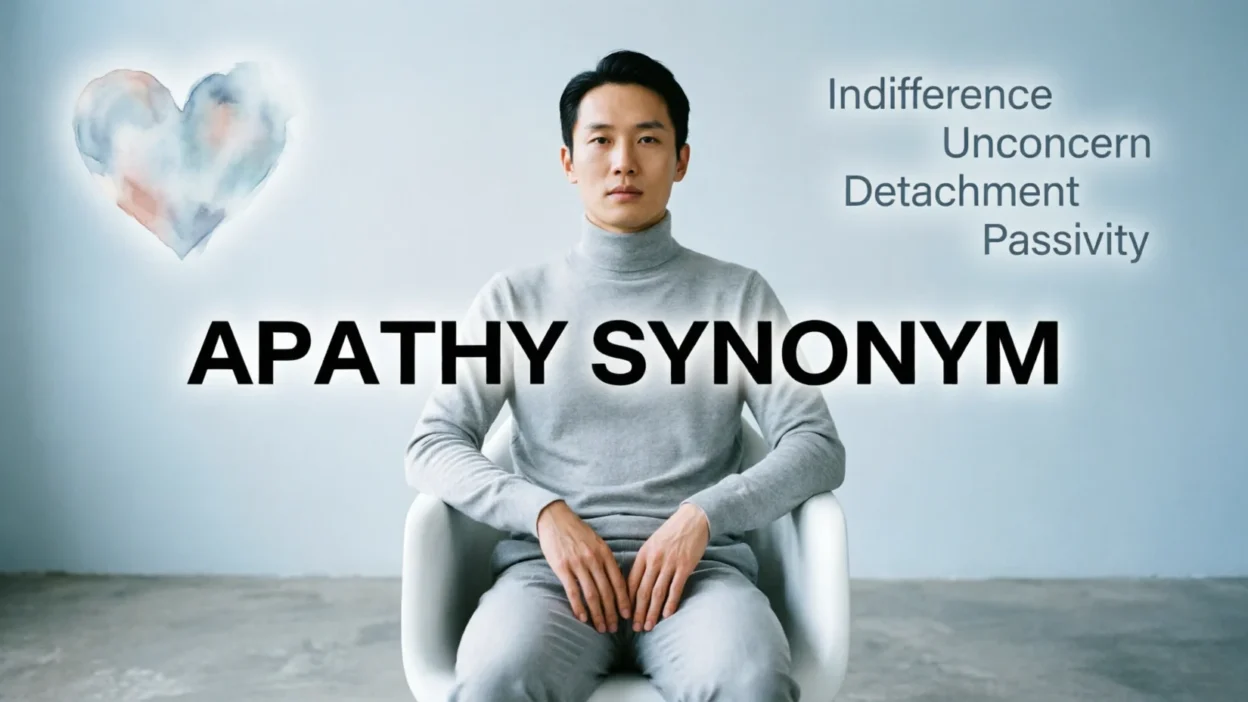
Apathy means a lack of interest, enthusiasm, concern, or emotion toward something. Common synonyms for apathy include indifference, unconcern, disinterest, detachment, passivity, and listlessness.
The best alternative depends on the situation: indifference describes a lack of concern, disinterest suggests a lack of interest, and detachment means being emotionally distant.
If you are writing an essay, improving your vocabulary, or looking for a more precise word, understanding the differences between apathy synonyms can help you express your ideas clearly.
Quick Answer: What Is a Synonym for Apathy?
The most common synonym for apathy is indifference. Other useful alternatives include unconcern, disinterest, passivity, detachment, listlessness, and unresponsiveness.
- For everyday writing: Indifference, disinterest, unconcern
- For emotional distance: Detachment, aloofness, impassivity
- For low energy: Listlessness, lethargy, sluggishness
- For a lack of motivation: Inertia, passivity, unenthusiasm
- For a lack of compassion: Unconcern, insensitivity, coldness
What Does Apathy Mean?
Apathy is a noun that describes a state of having little or no interest, enthusiasm, motivation, or emotional concern. An apathetic person may seem uninterested in activities, relationships, responsibilities, or events that would usually attract attention.
For example, if a student stops caring about schoolwork and no longer feels motivated to participate in class, the student may be described as showing apathy.
Apathy does not always mean that someone is deliberately rude or unkind. Sometimes, it describes emotional withdrawal, low motivation, or a reduced ability to feel interested in things.
Understanding Apathy in Different Situations
The meaning of apathy can change slightly depending on the context.
- In education: A student shows little interest in lessons or assignments.
- In relationships: Someone appears unconcerned about another person’s feelings.
- In society: People show little interest in public issues or community problems.
- At work: An employee lacks enthusiasm for tasks or workplace goals.
- In everyday life: A person feels unmotivated to participate in usual activities.
Choosing the right synonym helps explain exactly what kind of apathy you mean.
30 Synonyms for Apathy With Meanings and Examples
The following words are related to apathy, but they are not all interchangeable. Some describe a lack of interest, while others refer to emotional distance, low energy, or a lack of motivation.
1. Indifference
Simple meaning: A lack of interest, concern, or preference.
Example sentence: Her indifference toward the team’s problems surprised everyone.
Best usage/context: Use indifference when someone does not seem to care about an issue, outcome, or situation. It is one of the closest synonyms for apathy.
2. Disinterest
Simple meaning: A lack of interest in something.
Example sentence: His disinterest in politics became clear during the discussion.
Best usage/context: Use this word when someone is not interested in a subject, activity, or event. In some contexts, disinterest can also mean impartiality, so context matters.
3. Unconcern
Simple meaning: A lack of worry or concern.
Example sentence: Her unconcern about the approaching deadline worried her manager.
Best usage/context: Choose unconcern when a person appears not to worry about something that may deserve attention.
4. Detachment
Simple meaning: Emotional distance from a person or situation.
Example sentence: He discussed the disagreement with surprising detachment.
Best usage/context: Use detachment when someone remains emotionally distant or does not become personally involved.
5. Passivity
Simple meaning: A tendency not to act, respond, or take initiative.
Example sentence: The team’s passivity prevented it from solving the problem quickly.
Best usage/context: This word is useful when apathy appears through inaction rather than an openly expressed lack of concern.
6. Listlessness
Simple meaning: A lack of energy, interest, or enthusiasm.
Example sentence: She approached her usual hobbies with unusual listlessness.
Best usage/context: Use listlessness when someone seems low in energy or enthusiasm, especially during activities they once enjoyed.
7. Lethargy
Simple meaning: A state of unusual tiredness, sluggishness, or low energy.
Example sentence: His lethargy made it difficult to complete the afternoon’s work.
Best usage/context: Choose lethargy when low energy is the main idea. Unlike apathy, lethargy does not necessarily mean a lack of concern.
8. Inertia
Simple meaning: A tendency to remain inactive or resist change.
Example sentence: Organizational inertia delayed the introduction of new ideas.
Best usage/context: Use inertia when a person or group fails to act because of habit, resistance, or a lack of momentum.
9. Unresponsiveness
Simple meaning: A failure to react, respond, or show interest.
Example sentence: The manager’s unresponsiveness left the employees feeling ignored.
Best usage/context: This word works well when someone does not react appropriately to questions, requests, emotions, or events.
10. Aloofness
Simple meaning: A distant or unfriendly manner.
Example sentence: His aloofness made it difficult for new colleagues to approach him.
Best usage/context: Use aloofness when someone seems socially or emotionally distant. It often describes outward behavior rather than an internal lack of motivation.
11. Impassivity
Simple meaning: A lack of visible emotion.
Example sentence: She listened to the unexpected news with complete impassivity.
Best usage/context: Choose impassivity when a person does not show feelings on their face or through their behavior. They may still care internally.
12. Insensibility
Simple meaning: A lack of sensitivity or awareness, especially toward feelings or experiences.
Example sentence: His insensibility to the suffering around him upset the volunteers.
Best usage/context: Use this word when someone seems unable to recognize or respond to the emotional significance of a situation. In other contexts, it can refer to physical unconsciousness or a loss of sensation.
13. Apathy of feeling: Emotional numbness
Simple meaning: A state in which emotions feel weak, distant, or absent.
Example sentence: After a difficult experience, she described a period of emotional numbness.
Best usage/context: Use emotional numbness when the main idea is an inability or difficulty in feeling emotions. It is a phrase rather than a single-word synonym.
14. Coldness
Simple meaning: A lack of warmth, sympathy, or affection.
Example sentence: His coldness toward the worried child was difficult to understand.
Best usage/context: Choose coldness when apathy appears as a lack of kindness, warmth, or emotional connection.
15. Insensitivity
Simple meaning: A lack of awareness or concern for other people’s feelings.
Example sentence: Her insensitivity toward her friend’s disappointment damaged their relationship.
Best usage/context: Use this word when a person fails to consider how their words or actions affect others.
16. Unemotionality
Simple meaning: A tendency to show little or no emotion.
Example sentence: His unemotionality during the meeting made his reaction difficult to interpret.
Best usage/context: Use unemotionality to describe a person’s outward emotional style. It does not automatically mean the person is apathetic.
17. Inactivity
Simple meaning: A state of not doing anything or not taking action.
Example sentence: Prolonged inactivity prevented the group from making progress.
Best usage/context: This word is suitable when the focus is on a lack of activity or effort rather than a lack of feeling.
18. Sluggishness
Simple meaning: Slowness or a lack of energy and responsiveness.
Example sentence: The team’s sluggishness during the project affected its performance.
Best usage/context: Use sluggishness when someone or something responds slowly or lacks energy.
19. Unenthusiasm
Simple meaning: A lack of excitement or eagerness.
Example sentence: The students’ unenthusiasm for the activity was obvious.
Best usage/context: Choose this word when someone participates without excitement or shows little eagerness to get involved.
20. Dispassion
Simple meaning: A lack of strong emotion or personal bias.
Example sentence: The judge considered the evidence with dispassion.
Best usage/context: Use dispassion when calm, objective judgment is important. It can be positive and is not necessarily a form of apathy.
21. Detachment from reality
Simple meaning: A feeling of distance from one’s surroundings or circumstances.
Example sentence: The character’s detachment from reality shaped the story’s central conflict.
Best usage/context: Use this phrase only when the context genuinely involves a sense of separation from reality. It is more specific than ordinary apathy.
22. Neglect
Simple meaning: A failure to give something the care or attention it needs.
Example sentence: The garden suffered from neglect during the winter.
Best usage/context: Choose neglect when apathy leads to ignored duties, unmet needs, or a failure to provide proper care. Neglect describes an action or omission, not just a feeling.
23. Disengagement
Simple meaning: A lack of involvement or participation.
Example sentence: Employee disengagement became noticeable during team meetings.
Best usage/context: Use disengagement in workplaces, classrooms, relationships, and community settings when people stop participating actively.
24. Uninterestedness
Simple meaning: A state of not being interested.
Example sentence: His uninterestedness in the lecture was clear from his lack of participation.
Best usage/context: This word communicates a direct lack of interest, although lack of interest or disinterest often sounds more natural in everyday English.
25. Unconcernedness
Simple meaning: A state of not appearing worried or concerned.
Example sentence: Her unconcernedness about the warning frustrated her teammates.
Best usage/context: This is a less common noun form. In most writing, unconcern or a lack of concern is more natural.
26. Torpor
Simple meaning: A state of physical or mental inactivity.
Example sentence: The long, repetitive routine left the team in a state of torpor.
Best usage/context: Use torpor in formal or literary writing when describing sluggishness, inactivity, or a dull lack of energy.
27. Acedia
Simple meaning: A state of spiritual apathy, listlessness, or lack of motivation.
Example sentence: The writer described a period of acedia in which even meaningful tasks felt pointless.
Best usage/context: This uncommon word is most appropriate in literary, historical, philosophical, or religious discussions.
28. Stagnation
Simple meaning: A lack of development, movement, or progress.
Example sentence: Apathy among team members contributed to stagnation in the project.
Best usage/context: Use stagnation when a lack of initiative causes progress to stop. It describes a condition or outcome rather than a person’s emotional state.
29. Withdrawal
Simple meaning: The act of pulling away from people, activities, or situations.
Example sentence: His withdrawal from social activities concerned his family.
Best usage/context: Choose withdrawal when apathy is accompanied by reduced social contact or participation. Withdrawal can have many causes and does not always indicate indifference.
30. Complacency
Simple meaning: A state of being too satisfied or comfortable to notice problems or make improvements.
Example sentence: Complacency prevented the company from responding quickly to changing customer needs.
Best usage/context: Use complacency when someone becomes inactive because they believe everything is already good enough. Unlike apathy, complacency can involve satisfaction or overconfidence.
Comparison Table: Which Apathy Synonym Fits Best?
The following table highlights the main differences between commonly confused alternatives.
| Synonym | Main meaning | Best context |
| Indifference | Lack of concern | Opinions, choices, problems |
| Disinterest | Lack of interest | Subjects, hobbies, activities |
| Unconcern | Lack of worry | Risks, duties, consequences |
| Detachment | Emotional distance | Relationships, observation |
| Passivity | Lack of action | Leadership, teamwork |
| Listlessness | Low energy and enthusiasm | Daily activities, behavior |
| Lethargy | Sluggishness or tiredness | Physical or mental energy |
| Inertia | Resistance to action or change | Organizations, habits |
| Aloofness | Social or emotional distance | Personality, relationships |
| Impassivity | No visible emotion | Reactions, difficult situations |
| Insensitivity | Lack of awareness of feelings | Social behavior, communication |
| Disengagement | Lack of participation | School, work, communities |
| Complacency | Excessive satisfaction | Performance, improvement |
| Neglect | Failure to provide care | Responsibilities, maintenance |
| Torpor | Deep inactivity or sluggishness | Literary or formal writing |
How to Choose the Right Apathy Synonym
The best synonym depends on the message you want to communicate. Before replacing apathy, identify whether you mean a lack of interest, emotional distance, low energy, or failure to act.
1. Choose a Synonym Based on Tone
For neutral, everyday writing
Use indifference, disinterest, or unconcern.
Example: “His indifference toward the proposal surprised the team.”
These words are clear and familiar to most English readers.
For formal or academic writing
Use disengagement, passivity, inertia, or dispassion, depending on the meaning.
Example: “Student disengagement can reduce participation in classroom activities.”
These alternatives are useful when discussing behavior, institutions, or decision-making.
For literary or expressive writing
Use torpor, listlessness, aloofness, or coldness.
Example: “A sense of torpor settled over the quiet town.”
These words create a more specific mood or image.
2. Choose a Synonym Based on Meaning
- Lack of care: Indifference, unconcern
- Lack of interest: Disinterest, uninterestedness
- Lack of energy: Listlessness, lethargy, sluggishness
- Lack of action: Passivity, inactivity, inertia
- Emotional distance: Detachment, aloofness
- Lack of visible emotion: Impassivity, unemotionality
- Lack of compassion: Insensitivity, coldness
- Lack of participation: Disengagement, withdrawal
- Failure to care for responsibilities: Neglect
- Failure to improve: Complacency, stagnation
3. Choose a Synonym Based on Intent
Your purpose also affects the best word choice.
If you want to describe someone’s feelings, indifference or unconcern may be appropriate.
If you want to describe someone’s behavior, passivity or disengagement may fit better.
If you want to explain a lack of energy, use listlessness or lethargy.
If you want to criticize a failure to care for others, insensitivity or coldness may communicate the point more clearly.
If you want to explain why progress has stopped, inertia or stagnation may be more accurate.
Common Mistakes When Using Apathy Synonyms
Although many words are related to apathy, using them as exact replacements can change the meaning of a sentence.
Mistake 1: Treating Apathy and Laziness as the Same
Apathy describes a lack of interest, concern, or motivation. Laziness usually suggests an unwillingness to make an effort.
Better approach: Use apathy when the issue is a lack of concern and laziness when you specifically mean unwillingness to work.
Mistake 2: Confusing Apathy With Depression
Apathy can occur in different circumstances, while depression is a mental health condition that may include loss of interest or pleasure. The two can overlap, but they are not interchangeable.
Better approach: Describe the behavior you observe without assuming a diagnosis.
Mistake 3: Using Detachment to Mean Indifference Every Time
Detachment means emotional distance, while indifference means a lack of concern or preference.
Better approach: Write “She observed the argument with detachment” if you mean she remained emotionally distant. Use “She showed indifference to the outcome” if you mean she did not care what happened.
Mistake 4: Confusing Disinterest With Impartiality
Disinterest usually means a lack of interest, although it can also mean impartiality in certain contexts.
Better approach: When you mean fairness or freedom from bias, consider impartiality or neutrality.
Mistake 5: Using Lethargy When You Mean a Lack of Concern
Lethargy emphasizes low energy or sluggishness, not necessarily a lack of interest.
Better approach: Use indifference when concern is missing and lethargy when energy is low.
Mistake 6: Assuming an Apathetic Person Does Not Care About Anything
Apathy may be limited to one activity, situation, or period of life. Someone who seems apathetic at work may still care deeply about family, hobbies, or other responsibilities.
Better approach: Describe the specific situation rather than making a broad judgment about someone’s character.
FAQs:
1. What is the closest synonym for apathy?
Indifference is usually the closest synonym because both words describe a lack of interest or concern. However, disinterest may be better when the emphasis is specifically on a lack of interest.
2. What is another word for apathy in a sentence?
You can use indifference, disinterest, passivity, or detachment, depending on the meaning.
Example: “The audience’s indifference to the announcement surprised the speaker.”
3. What is a stronger word for apathy?
Words such as callousness, insensitivity, and coldness can express a stronger lack of concern for other people’s feelings. However, they carry more negative meanings and should not be used when you simply mean a lack of interest.
4. What is the opposite of apathy?
Common opposites include enthusiasm, interest, concern, passion, engagement, and compassion. The best antonym depends on the context.
For example, enthusiasm is the opposite of a lack of excitement, while compassion contrasts with a lack of concern for others’ suffering.
5. Is apathy a positive or negative word?
Apathy usually has a negative meaning because it suggests a lack of interest, motivation, or concern. However, its meaning depends on context. It may describe a person’s temporary reaction without necessarily judging their character.
6. What is the difference between apathy and indifference?
Apathy can include a broader lack of motivation, enthusiasm, and emotional engagement. Indifference more specifically describes not caring or having no strong preference about something.
Example: “His apathy affected his participation in the project.” This suggests low motivation or engagement. “His indifference to the result” means the result did not matter much to him.
7. What is a formal synonym for apathy?
Formal alternatives include disengagement, passivity, indifference, inertia, and dispassion. Choose the word that matches your intended meaning rather than selecting a formal-sounding word automatically.
8. Can apathy be used to describe society?
Yes. Social apathy describes a lack of interest or concern about social issues, community activities, or public affairs.
Example: “The campaign aimed to address public apathy toward local environmental problems.”
Conclusion
Apathy describes a lack of interest, enthusiasm, motivation, or concern. Its closest synonym is usually indifference, but words such as disinterest, unconcern, detachment, passivity, and disengagement can communicate more specific meanings.
For everyday writing, choose familiar alternatives such as indifference and disinterest. For academic or professional writing, consider disengagement, inertia, or passivity. When describing low energy, listlessness or lethargy may be more accurate.
The key is to understand the difference between a lack of concern, a lack of energy, and a lack of action. Choosing the right word makes your writing more precise, natural, and meaningful.

I’m James Parker, Administrator at SynonymsHive. I oversee content quality, improve user experience, and ensure reliable synonym resources. My passion is making language learning simple, accurate, and accessible for everyone.