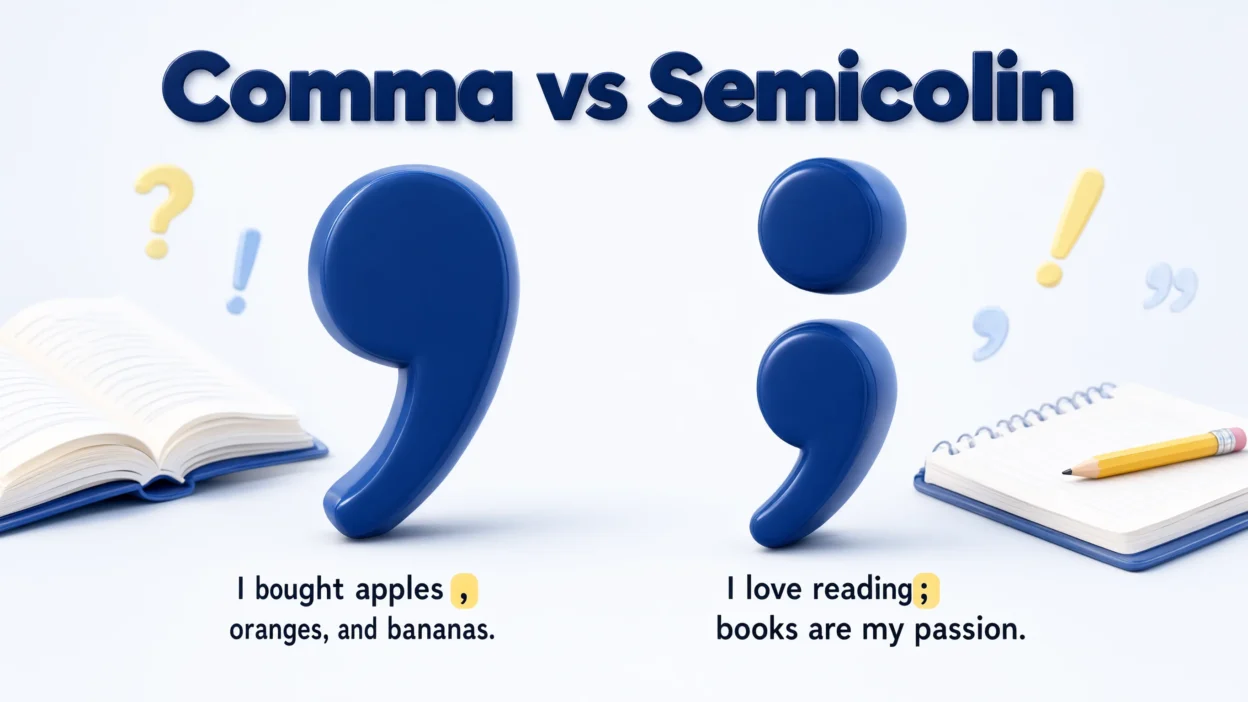
Punctuation helps readers understand how sentences are organized and how ideas connect. Two punctuation marks that often confuse students and writers are the comma (,) and the semicolon (;). Although both create connections between parts of a sentence, they serve different purposes. Understanding comma vs semicolon can make your writing clearer, smoother, and easier to read.
A comma is generally used to separate items in a list, introduce additional information, connect certain sentence elements, and separate introductory phrases. A semicolon, on the other hand, connects two closely related independent clauses or separates complicated items in a list that already contain commas.
The main difference is that a semicolon creates a stronger separation than a comma but does not end the sentence like a period. In this guide, you will learn what each punctuation mark means, how to use it correctly, and how to avoid common punctuation mistakes. Simple explanations and practical examples will help you choose the right mark with confidence.
Quick Answer: Comma vs Semicolon
A comma (,) separates words, phrases, and clauses within a sentence, while a semicolon (;) connects two closely related independent clauses or separates complex list items. A comma creates a shorter pause, whereas a semicolon creates a stronger connection between two complete thoughts without ending the sentence.
Why Do People Confuse Commas and Semicolons?
People often confuse commas and semicolons because both punctuation marks help organize information within sentences. They can also appear between related ideas, which makes their purposes seem similar.
However, their grammatical functions are different.
Here are three common reasons for the confusion:
- Similar appearance: Both marks are used inside sentences rather than only at the end.
- Connecting ideas: Both can help organize related information, although they follow different grammatical rules.
- Unclear sentence structure: Writers sometimes struggle to identify whether a group of words is a complete sentence or a dependent phrase.
The easiest way to understand their difference is to remember that a comma usually separates sentence elements, while a semicolon can connect two complete sentences that are closely related.
What Is a Comma?
A comma (,) is a punctuation mark used to separate words, phrases, clauses, and other elements within a sentence. It helps readers understand the structure of a sentence and prevents confusion.
Commas are among the most frequently used punctuation marks in English. They appear in everyday writing, academic assignments, emails, articles, and professional communication.
When Should You Use a Comma?
Here are the most common situations where a comma is necessary.
1. To Separate Items in a List
Use commas to separate three or more items in a series.
Examples:
- I bought apples, oranges, bananas, and grapes.
- She enjoys reading, writing, painting, and cooking.
- We need pens, notebooks, folders, and markers.
2. After an Introductory Phrase
Use a comma after an introductory word, phrase, or dependent clause when appropriate.
Examples:
- After finishing her homework, Sara went outside.
- Fortunately, everyone arrived safely.
- Before the meeting, I reviewed my notes.
3. To Separate Independent Clauses with Coordinating Conjunctions
A comma is generally used before coordinating conjunctions such as and, but, or, so, yet, and for when they connect two independent clauses.
Examples:
- I wanted to go outside, but it started raining.
- She studied hard, and she passed the examination.
- He was tired, so he went to bed early.
4. To Add Nonessential Information
Use commas around information that can be removed without changing the essential meaning of the sentence.
Examples:
- My brother, who lives in London, is visiting us.
- Paris, the capital of France, attracts millions of visitors.
- Mr. Ahmed, our English teacher, explained the lesson.
5. To Separate Direct Address
Use a comma when directly addressing someone.
Examples:
- Sarah, please close the door.
- Thank you, John, for your help.
- Could you help me, Ali?
What Is a Semicolon?
A semicolon (;) is a punctuation mark that connects two closely related independent clauses or separates complex items in a list.
It is stronger than a comma but weaker than a period. It allows writers to connect related thoughts while keeping them in one sentence.
Unlike a comma, a semicolon can connect two complete sentences without using a coordinating conjunction.
When Should You Use a Semicolon?
Here are the main situations where semicolons are useful.
1. To Connect Two Related Independent Clauses
Use a semicolon when two complete sentences are closely connected in meaning.
Examples:
- I love reading; my sister prefers writing.
- The weather was beautiful; we decided to go hiking.
- He worked hard; his efforts finally paid off.
Both sides of the semicolon can stand alone as complete sentences.
2. Before Conjunctive Adverbs
Use a semicolon before conjunctive adverbs such as however, therefore, moreover, consequently, and nevertheless when they connect two independent clauses. A comma generally follows the conjunctive adverb.
Examples:
- I was feeling sick; however, I attended the meeting.
- She practiced every day; therefore, she improved quickly.
- The task was difficult; nevertheless, we completed it.
3. To Separate Complex Items in a List
Use semicolons when individual list items already contain commas. This makes the list easier to understand.
Examples:
- The conference included guests from Lahore, Pakistan; London, England; and Toronto, Canada.
- We visited Paris, France; Rome, Italy; and Madrid, Spain.
- The team included Sarah, the manager; John, the designer; and David, the developer.
4. To Connect Closely Related Ideas
A semicolon can make a relationship between two complete thoughts more noticeable.
Examples:
- Some people enjoy working alone; others prefer teamwork.
- The restaurant was fully booked; we decided to eat elsewhere.
- She loves classical music; her brother enjoys jazz.
Comma vs Semicolon: Comparison Table
The following table highlights the main differences between these two punctuation marks.
| Feature | Comma (,) | Semicolon (;) |
| Main purpose | Separates sentence elements | Connects related complete clauses |
| Strength | Lighter separation | Stronger separation |
| Independent clauses | Usually needs a conjunction when connecting two | Can connect two without a conjunction |
| Lists | Separates simple list items | Separates complex list items |
| Before however | Usually not sufficient alone | Often used before however |
| Sentence structure | Does not independently connect two complete sentences | Can connect two complete sentences |
| Appearance | , | ; |
| Common use | Lists, phrases, clauses | Related sentences and complex lists |
The key difference: A comma separates parts of a sentence, while a semicolon can join two complete and closely related thoughts.
When Should You Use a Comma or Semicolon?
Choosing between a comma and a semicolon becomes easier when you understand the structure of your sentence.
Use a Comma When:
- You are separating items in a simple list.
- You are introducing additional information.
- You are separating an introductory phrase from the main clause.
- You are connecting independent clauses with a coordinating conjunction.
- You are separating words or phrases that need clearer organization.
Examples:
- I like tea, coffee, and juice.
- Although it was late, we continued studying.
- She wanted to travel, but she had no money.
Use a Semicolon When:
- You want to connect two closely related independent clauses.
- You are connecting complete sentences with conjunctive adverbs.
- You are separating complex items that already contain commas.
Examples:
- I enjoy swimming; my brother prefers running.
- He missed the bus; therefore, he arrived late.
- We invited Emma, our neighbor; James, our cousin; and Olivia, our friend.
15 Examples of Comma vs Semicolon in Sentences
Examples make punctuation rules easier to understand. Below are 15 sentences showing how commas and semicolons work in different situations.
| No. | Comma Example | Semicolon Example |
| 1 | I bought milk, bread, and eggs. | I bought milk and bread; my sister bought eggs. |
| 2 | She was tired, but she continued working. | She was tired; she continued working. |
| 3 | After lunch, we went shopping. | We finished lunch; then, we went shopping. |
| 4 | My friend, who lives nearby, visited me. | My friend lives nearby; she visits me often. |
| 5 | I like reading, writing, and drawing. | I like reading; my brother likes drawing. |
| 6 | It was raining, so we stayed home. | It was raining; therefore, we stayed home. |
| 7 | Yes, I understand your question. | I understand your question; I will explain it. |
| 8 | Sarah, please bring your notebook. | Sarah finished her work; John started his. |
| 9 | We visited Lahore, Islamabad, and Karachi. | We visited Lahore, Pakistan; Dubai, UAE; and London, England. |
| 10 | Although he was nervous, he spoke confidently. | He was nervous; however, he spoke confidently. |
| 11 | The movie was long, but it was interesting. | The movie was long; it was also interesting. |
| 12 | My father, a doctor, works at a hospital. | My father is a doctor; my mother is a teacher. |
| 13 | She studied English, mathematics, and science. | She studied English; her brother studied mathematics. |
| 14 | I called him, but he did not answer. | I called him; nevertheless, he did not answer. |
| 15 | When the bell rang, the students left. | The bell rang; the students left the classroom. |
Notice that commas and semicolons sometimes appear in sentences with similar meanings, but they follow different grammatical structures.
Common Mistakes When Using Commas and Semicolons
Even experienced writers sometimes misuse commas and semicolons. Understanding these common errors can help you improve your punctuation.
1. Using a Comma to Join Two Complete Sentences
This mistake is known as a comma splice.
Incorrect: I love reading, my brother loves writing.
Correct: I love reading; my brother loves writing.
You can also use a coordinating conjunction:
Correct: I love reading, and my brother loves writing.
2. Using a Semicolon Before an Incomplete Sentence
A semicolon should generally connect two independent clauses.
Incorrect: I went to bed early; because I was tired.
Correct: I went to bed early because I was tired.
The words after the semicolon in the incorrect example cannot stand alone as a complete sentence.
3. Using a Comma Before However Without Proper Sentence Structure
Incorrect: I wanted to go; however I was busy.
Correct: I wanted to go; however, I was busy.
Remember that a comma generally follows however when it connects two independent clauses.
4. Using Semicolons Between Simple List Items
Incorrect: I bought apples; oranges; and bananas.
Correct: I bought apples, oranges, and bananas.
Simple lists generally require commas, not semicolons.
5. Using a Comma Instead of a Semicolon in Complex Lists
Incorrect: The speakers came from Lahore, Pakistan, London, England, and Paris, France.
Correct: The speakers came from Lahore, Pakistan; London, England; and Paris, France.
Semicolons make complex lists easier to read.
Easy Memory Trick: How to Remember Comma vs Semicolon
If you frequently forget which punctuation mark to use, try this simple memory trick.
- Comma = Small separation: Think of a comma as a small break between words, phrases, or clauses.
- Semicolon = Strong connection: Think of a semicolon as a bridge connecting two complete but related thoughts.
Another useful trick is to check whether both sides of the punctuation mark can stand alone as complete sentences.
If both sides are independent clauses and closely related, a semicolon may work.
If you are separating list items, introductory phrases, or other sentence elements, a comma is usually the better choice.
Comma vs Semicolon in American and British English
The basic rules for commas and semicolons are largely the same in American and British English. Both varieties use commas to separate sentence elements and semicolons to connect closely related independent clauses or organize complex lists.
However, some differences in punctuation style can appear.
American English
American English commonly uses the Oxford comma in lists of three or more items.
Example:
– I bought apples, oranges, and bananas.
The comma before and is called the Oxford comma. It is widely used in American writing, although some publications follow different style preferences.
British English
British English also uses commas and semicolons according to standard grammatical rules. However, the Oxford comma is often omitted unless needed for clarity or required by a particular style guide.
Example:
– I bought apples, oranges and bananas.
Are Semicolon Rules Different?
No major grammatical difference exists between American and British English regarding semicolon usage.
Both varieties use semicolons to connect related independent clauses and separate complex list items.
The main takeaway is that punctuation rules remain consistent, although some stylistic preferences may vary.
Similar Punctuation Marks You Should Know
Commas and semicolons are not the only punctuation marks used to organize English sentences. Understanding related punctuation marks can help you write more effectively.
1. Period (.)
A period ends a declarative sentence or statement.
Example: I enjoy learning English.
2. Colon (:)
A colon introduces an explanation, example, quotation, or list.
Example: I need three things: a pen, a notebook, and a ruler.
3. Apostrophe (‘)
An apostrophe shows possession or represents missing letters in contractions.
Example: Sarah’s book is on the table.
4. Dash (—)
A dash creates emphasis, adds extra information, or indicates a break in a sentence.
Example: I finally understood the lesson—it was easier than I expected.
5. Parentheses ( )
Parentheses include additional information that is not essential to the main sentence.
Example: My brother (who lives in London) is visiting next week.
Each punctuation mark has a different purpose, so choosing the correct one makes your writing easier to understand.
FAQs:
1. What Is the Main Difference Between a Comma and a Semicolon?
A comma separates words, phrases, and clauses within a sentence, while a semicolon connects two closely related independent clauses or separates complex list items. A semicolon creates a stronger separation than a comma.
2. Can a Semicolon Replace a Comma?
Sometimes, but not always. A semicolon can replace a comma when connecting two closely related independent clauses. However, it cannot replace commas used to separate ordinary list items, introductory phrases, or nonessential information.
3. Can You Use a Comma and Semicolon in the Same Sentence?
Yes. A sentence can contain both punctuation marks when each serves a different grammatical purpose.
Example: I invited Sarah, my best friend; John, my cousin; and Emma, my neighbor.
The commas separate descriptive information, while the semicolons separate the complex list items.
4. Do You Use a Semicolon Before However?
Yes. When however connects two independent clauses, a semicolon generally comes before it, and a comma follows it.
Example: I wanted to attend the event; however, I was feeling unwell.
5. Is a Semicolon Stronger Than a Comma?
Yes. A semicolon creates a stronger separation than a comma because it can connect two complete sentences. A comma generally creates a lighter separation between sentence elements.
6. Can a Semicolon Replace a Period?
Sometimes. A semicolon can replace a period when two independent clauses are closely related in meaning. However, a period is better when the ideas are separate or when you want a stronger break.
Example:
With a semicolon: I love reading; it helps me relax.
With a period: I love reading. It helps me relax.
Both versions are grammatically correct.
7. Should You Use a Comma or Semicolon Before And?
Generally, use a comma before and when it connects two independent clauses. Do not use a semicolon before and in an ordinary sentence because the conjunction already connects the clauses.
Example: I finished my homework, and I went outside.
A semicolon can also connect two independent clauses without and: I finished my homework; I went outside.
Remember This: Comma vs Semicolon
Here is a quick summary to help you remember the difference:
- Comma (,): Separates words, phrases, clauses, and simple list items.
- Semicolon (;): Connects two closely related complete sentences or separates complex list items.
- Comma with conjunctions: Connects independent clauses using words such as and, but, and so.
- Semicolon with however: Connects independent clauses using conjunctive adverbs such as however and therefore.
- Simple rule: A comma creates a small separation, while a semicolon creates a stronger connection.
Conclusion
Understanding comma vs semicolon is an important part of developing clear and effective writing skills. Although both punctuation marks organize information, they serve different grammatical purposes. A comma separates words, phrases, clauses, and simple list items, while a semicolon connects closely related independent clauses and separates complicated list items. Learning these differences can help you avoid common punctuation mistakes and make your sentences easier to understand.
The best way to master commas and semicolons is through regular reading and writing practice. Pay attention to sentence structure, check if both sides of a semicolon form complete sentences, and use commas where smaller separations are needed.
With a little practice, you will become more confident about choosing the correct punctuation mark in everyday writing, academic assignments, and professional communication.

I’m James Parker, Administrator at SynonymsHive. I oversee content quality, improve user experience, and ensure reliable synonym resources. My passion is making language learning simple, accurate, and accessible for everyone.