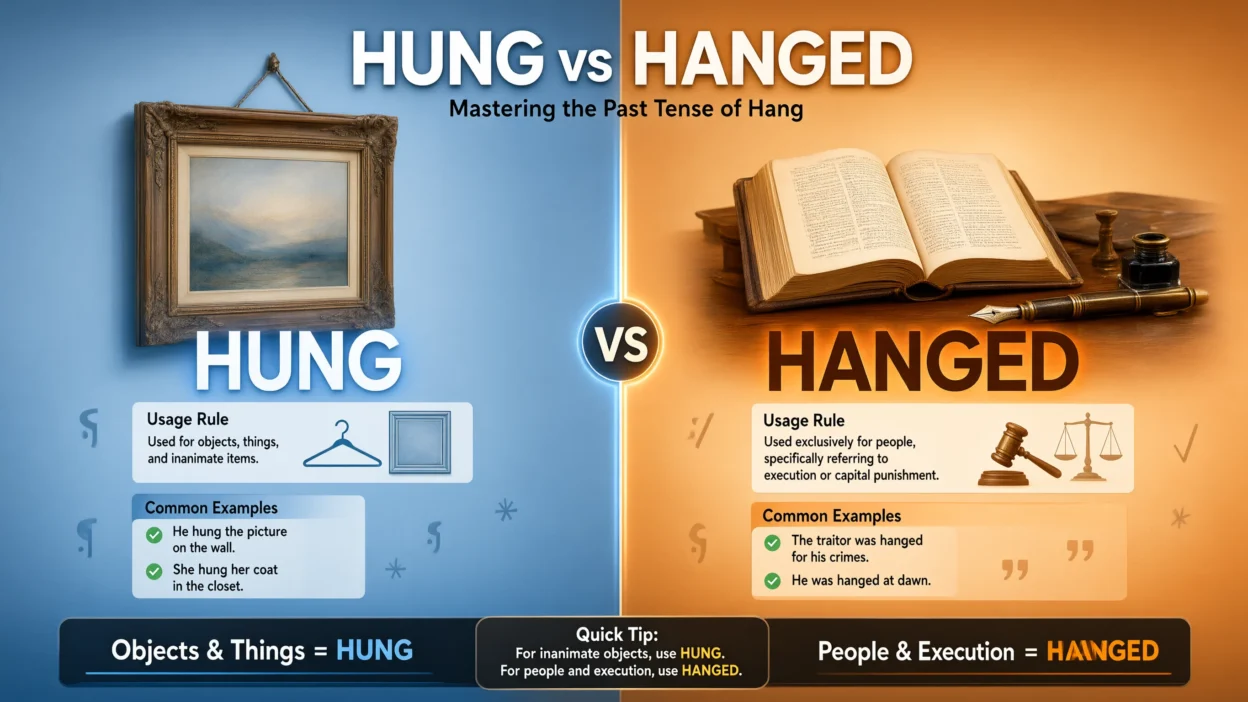
The words hung and hanged are both past-tense forms of the verb hang, but they are not interchangeable in every situation. Although they look and sound similar, each word has a different use. Understanding the difference between hung vs hanged can help you avoid common grammar mistakes and make your writing clearer.
The main difference is that hung is generally used when something is suspended from a particular place or position, while hanged is traditionally used when someone is put to death by hanging. For example, you would say, “She hung the picture on the wall,” but “The prisoner was hanged.”
Both forms are grammatically correct when used in the appropriate context. Learning when to use each one is easier than it might seem, especially when you look at simple examples and remember one basic rule.
Quick Answer: Hung vs Hanged
Hung is the past tense and past participle of hang when referring to placing or suspending something. Hanged is traditionally used when referring to execution by hanging. For example, “He hung his coat on the hook,” but “The criminal was hanged.” The correct choice depends on the meaning.
Why Do People Confuse Hung and Hanged?
People often confuse these words because both come from the same verb, hang. They also describe actions that happened in the past, making it difficult to know which form to choose.
However, English has two established past-tense forms of this verb:
- Hung: Used for ordinary situations involving suspension, attachment, or placement.
- Hanged: Used specifically for execution by hanging.
Another reason for the confusion is that regular and irregular verb patterns do not always follow predictable rules in English.
For example:
- Sing → Sang → Sung
- Bring → Brought → Brought
- Hang → Hung → Hung (ordinary meaning)
The special form hanged is an exception associated with the execution meaning.
First Word: What Does Hung Mean?
Hung is the past tense and past participle of hang. It describes an action in which something is suspended, attached, displayed, or positioned above the ground.
It is the correct word for most everyday situations involving the verb hang.
Meaning of Hung
Hung means that something was placed or remained in a suspended position, usually supported by a hook, rope, nail, wire, or another object.
It can also describe displaying something, such as a painting, photograph, or decoration.
Examples of Hung in Sentences
- She hung her jacket behind the door.
- We hung colorful lights around the garden.
- He hung the painting above the sofa.
- They hung the curtains before moving in.
- I hung my clothes outside to dry.
When Is Hung Used?
Use hung in these situations:
- Hanging clothes: She hung her dress in the wardrobe.
- Displaying pictures: They hung family photographs on the wall.
- Decorating spaces: We hung balloons around the room.
- Suspending objects: He hung the basket from a metal hook.
- Putting up decorations: She hung a beautiful wreath on the door.
In each example, the word describes an ordinary action rather than an execution.
Second Word: What Does Hanged Mean?
Hanged is another past-tense and past-participle form of hang. It is traditionally used when referring to a person who was put to death by hanging.
Unlike hung, this word has a specific meaning connected to capital punishment.
Meaning of Hanged
Hanged means executed by hanging, traditionally using a rope around the neck.
The word is commonly found in historical accounts, legal discussions, literature, and descriptions of capital punishment.
Examples of Hanged in Sentences
- The prisoner was hanged for his crimes.
- The historical records state that the man was hanged.
- Several people were hanged during that period.
- The novel describes how the criminal was hanged.
- The convicted prisoner was hanged after the trial.
When Is Hanged Used?
Use hanged when describing execution by hanging.
Common contexts include:
- Historical events: The prisoner was hanged in the eighteenth century.
- Legal history: The convicted man was hanged following his sentence.
- Historical literature: The character was hanged for treason.
- Capital punishment: The prisoner was hanged as part of the execution.
Remember that hanged does not normally describe ordinary objects hanging from something.
Hung vs Hanged: Comparison Table
The following table highlights the main differences between these two words.
| Feature | Hung | Hanged |
| Base verb | Hang | Hang |
| Word form | Irregular | Special past form |
| Main meaning | Suspended or attached | Executed by hanging |
| Common use | Everyday situations | Historical and legal contexts |
| Clothes | Hung | Incorrect |
| Pictures | Hung | Incorrect |
| Decorations | Hung | Incorrect |
| Execution | Generally incorrect | Correct |
| Example | She hung the coat. | He was hanged. |
Key difference: Use hung for ordinary suspension and hanged for execution by hanging.
When Should You Use Hung or Hanged?
Choosing between these words becomes simple when you understand what the sentence describes.
Use Hung for Ordinary Actions
Choose hung when something is placed, attached, displayed, or suspended.
Examples:
- She hung her bag on the chair.
- I hung the towel outside.
- They hung a sign above the entrance.
- He hung his uniform in the closet.
Use Hanged for Execution
Choose hanged when describing someone who was executed by hanging.
Examples:
- The prisoner was hanged for murder.
- The historical figure was hanged for treason.
- The convicted man was hanged after the court’s decision.
What About the Phrase “Hanged Himself”?
When discussing suicide by hanging, hanged himself is the traditional grammatical expression.
For example:
– The historical report stated that the man hanged himself.
In ordinary descriptions of a person being suspended without reference to execution, hung is generally used.
15 Examples of Hung vs Hanged in Sentences
Here are practical examples to help you understand how both words work in everyday English and historical writing.
Examples Using Hung
- She hung her favorite dress in the wardrobe.
- My father hung a new clock on the wall.
- We hung decorations for the birthday party.
- He hung his wet towel near the window.
- They hung a beautiful painting in the living room.
- I hung the Christmas lights around the house.
- The teacher hung the students’ artwork on the classroom wall.
- She hung her handbag on the back of the chair.
Examples Using Hanged
- The prisoner was hanged after being convicted of treason.
- Historical documents explain how the criminal was hanged.
- The king ordered that the traitor be hanged.
- Several convicted prisoners were hanged during that period.
- The historical novel describes a man who was hanged for his crimes.
- The execution records confirm that the prisoner was hanged.
- The man was hanged following his conviction.
These examples show that the correct form depends on the intended meaning, not simply whether the subject is a person or an object.
Common Mistakes When Using Hung and Hanged
Even experienced English speakers sometimes confuse these forms. Here are some mistakes worth avoiding.
Mistake 1: Using Hanged for Clothes
Incorrect: She hanged her coat on the hook.
Correct: She hung her coat on the hook.
Explanation: Clothes are suspended during an ordinary action, so hung is correct.
Mistake 2: Using Hung for Execution
Incorrect: The prisoner was hung for his crimes.
Correct: The prisoner was hanged for his crimes.
Explanation: The traditional word for execution by hanging is hanged.
Mistake 3: Thinking Hanged Is Always Wrong
Incorrect belief: Hanged is not a real English word.
Correct understanding: Both hung and hanged are correct forms of the verb hang, but they have different uses.
Mistake 4: Choosing Based on the Subject Alone
Incorrect belief: Use hanged whenever the subject is a person.
Correct understanding: The meaning determines the correct word.
For example:
- He hung his jacket on the wall.
- He was hanged for his crimes.
The first sentence describes an ordinary action, while the second describes an execution.
Easy Memory Trick to Remember Hung vs Hanged
If you struggle to remember which word to use, try this simple trick:
HUNG = Objects hanging.
HANGED = Execution by hanging.
Think about these two examples:
- Picture on a wall → Hung.
- Prisoner executed → Hanged.
You can also remember this simple question:
Is something simply being suspended, or is someone being executed?
- If it is ordinary suspension, use hung.
- If it is execution, use hanged.
This quick rule will help you choose the correct word in most situations.
Hung vs Hanged in American and British English
The distinction between hung and hanged is generally the same in American and British English.
Both varieties traditionally use hung for ordinary suspension and hanged for execution by hanging.
| Situation | American English | British English |
| Hanging a picture | Hung | Hung |
| Hanging clothes | Hung | Hung |
| Hanging decorations | Hung | Hung |
| Execution by hanging | Hanged | Hanged |
| Historical execution | Hanged | Hanged |
There is no major regional difference in this grammatical rule. Whether you are writing for an American or British audience, the same distinction applies.
Similar Words Related to Hung and Hanged
Understanding related words can help expand your vocabulary and improve your grammar.
| Word | Meaning | Example |
| Hang | To suspend something | Hang your coat here. |
| Hanging | The act of suspending | The hanging decoration looks beautiful. |
| Suspended | Held from above | The lamp was suspended from the ceiling. |
| Attached | Connected to something | The picture was attached to the wall. |
| Displayed | Shown publicly | The artwork was displayed in the gallery. |
| Hung | Suspended in the past | She hung the curtains. |
| Hanged | Executed by hanging | The prisoner was hanged. |
| Dangling | Hanging loosely | A wire was dangling from the ceiling. |
These words are related in meaning, but they cannot always replace one another. Choose the word that best communicates the action you want to describe.
Final Verdict: Hung vs Hanged
The difference between hung and hanged is based on their meaning and usage.
- Hung is used for ordinary actions involving suspension, attachment, or display.
- Hanged is traditionally used when someone is executed by hanging.
For example, say, “She hung the picture on the wall,” but say, “The prisoner was hanged.”
Both words are grammatically correct. The important thing is to understand the situation before choosing one.
FAQs:
1. Is it hung or hanged?
Both words are correct, but they have different meanings. Hung is used for ordinary suspension, while hanged is traditionally used for execution by hanging.
2. Is someone hung or hanged?
It depends on the context. If someone is executed by hanging, the traditional expression is hanged. If someone is simply suspended or positioned by something, hung is generally correct.
3. Is it hung myself or hanged myself?
In the traditional expression describing suicide by hanging, hanged myself is grammatically correct. Hung myself is generally not the standard choice for this meaning.
4. Why do people say hanged instead of hung?
People use hanged because English preserves a special past-tense form of hang for execution. It distinguishes this meaning from ordinary suspension.
5. Is hanged a real word?
Yes. Hanged is a correct English word. It is the past tense and past participle of hang when referring to execution by hanging.
6. Can I say a picture was hanged?
No, not in standard modern English when describing an ordinary picture on a wall. The correct expression is “The picture was hung on the wall.”
7. Is it hung or hanged in British English?
British English follows the same traditional distinction as American English. Use hung for ordinary suspension and hanged for execution by hanging.
Remember This
The easiest way to remember the difference is:
- Hung: Something is suspended, attached, or displayed.
- Hanged: Someone is executed by hanging.
Examples:
- She hung the curtains.
- He hung his coat.
- The prisoner was hanged.
Keep this simple distinction in mind, and you will be able to use both words correctly.
Conclusion
Understanding the difference between hung vs hanged is an important part of learning English grammar. Although both words come from the verb hang, they serve different purposes. Use hung when talking about ordinary actions such as hanging clothes, pictures, curtains, or decorations. Use hanged when referring to execution by hanging.
The next time you are unsure which word to choose, focus on the meaning of your sentence. If something is simply suspended, choose hung. If someone was executed by hanging, choose hanged. Remembering this straightforward rule will help you write more clearly, avoid common grammar mistakes, and communicate confidently.

I’m James Parker, Administrator at SynonymsHive. I oversee content quality, improve user experience, and ensure reliable synonym resources. My passion is making language learning simple, accurate, and accessible for everyone.