The words continually and continuously look and sound similar, so it is easy to confuse them. Both describe something that happens over time, but they do not mean exactly the same thing. Understanding the difference can help you choose the right word in everyday conversations, academic writing, professional communication, and English exams.
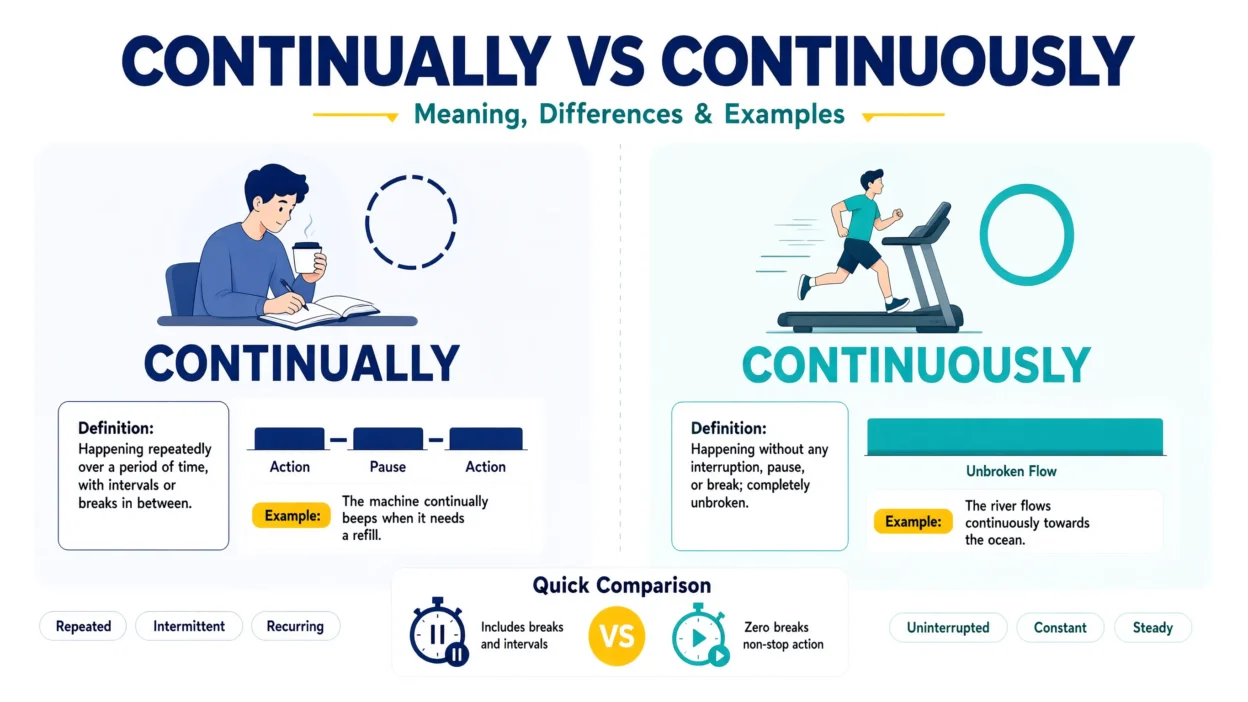
Although both words are related to the idea of continuation, they describe different patterns of action. Continually means something happens repeatedly, often with breaks between events, while continuously means something happens without stopping or interruption.
For example, if someone continually checks their phone, they check it again and again. If a machine runs continuously, it operates without stopping.
Learning when to use each word makes your writing clearer and more accurate. In this guide, you will discover their meanings, differences, grammatical uses, practical examples, common mistakes, and simple memory tricks to help you remember the correct choice.
Quick Answer: Continually vs Continuously
Continually means happening repeatedly or frequently, usually with breaks between events. Continuously means happening without stopping or interruption. For example, it may rain continually throughout the week, with periods of sunshine between showers, but a continuously running machine operates without a break.
Why Do People Confuse Continually and Continuously?
People often confuse these words because they share the same root word, continue. Both describe actions, events, or situations that extend over time.
However, the main difference is the pattern of continuation:
- Continually: Something happens repeatedly, stops, and happens again.
- Continuously: Something keeps happening without interruption.
Another reason for confusion is that people sometimes use these words interchangeably in casual conversations. Although their meanings can overlap in certain contexts, they are not always interchangeable.
Understanding whether an action repeats or remains uninterrupted will help you select the correct word.
What Does Continually Mean?
Continually is an adverb that means happening repeatedly, frequently, or at regular or irregular intervals. It describes something that happens again and again, often with short or long breaks between occurrences.
It is commonly used for repeated actions, changing situations, recurring problems, and habits.
Simple meaning: Happening repeatedly, with breaks in between.
Examples:
- She continually checks her email during the day.
- The children continually ask questions during class.
- He continually forgets where he puts his keys.
- Our company is continually improving its services.
- The teacher continually encourages students to practice.
In these examples, the actions happen more than once rather than remaining active without interruption.
When Is Continually Used?
Use continually when describing:
- Repeated actions or activities.
- Habits that happen frequently.
- Recurring problems or difficulties.
- Changes that happen repeatedly over time.
- Events that occur at different intervals.
Example: My neighbor continually plays loud music.
This means the neighbor plays loud music repeatedly, not necessarily every second or without a break.
What Does Continuously Mean?
Continuously is an adverb that means happening without stopping, interruption, or a break. It describes an activity, process, or condition that continues steadily over a period of time.
It is commonly used when discussing uninterrupted movement, operations, sounds, processes, or activities.
Simple meaning: Happening without stopping.
Examples:
- The machine runs continuously throughout the night.
- The river flows continuously toward the sea.
- The computer continuously records temperature changes.
- The baby cried continuously for an hour.
- The factory operates continuously during the production period.
In these examples, the actions or processes continue without interruption during the specified period.
When Is Continuously Used?
Use continuously when describing:
- Uninterrupted activities.
- Machines or equipment that keep operating.
- Sounds that continue without a pause.
- Processes that remain active.
- Movement or flow without stopping.
Example: The internet connection worked continuously for 24 hours.
This means the connection remained active throughout the entire period without interruption.
Continually vs Continuously: Comparison Table
The following table highlights the main differences between continually and continuously.
| Feature | Continually | Continuously |
| Meaning | Repeatedly or frequently | Without interruption |
| Pattern | Starts and stops | Keeps going |
| Breaks | Usually has breaks | Has no breaks |
| Focus | Repetition | Uninterrupted duration |
| Usage | Habits and recurring events | Ongoing activities and processes |
| Example | She continually calls me. | The alarm rings continuously. |
| Main idea | Again and again | Without stopping |
The easiest way to remember: Continually focuses on repetition, while continuously focuses on uninterrupted continuation.
When Should You Use Continually vs Continuously?
Choosing between these words becomes easier when you focus on what you want to describe.
1. Use Continually for Repeated Actions
When something happens several times, with pauses between occurrences, continually is usually the better choice.
Example: He continually interrupts the conversation.
This means he interrupts several times rather than speaking without stopping.
2. Use Continuously for Uninterrupted Actions
When something continues without a break, use continuously.
Example: The security camera continuously records the entrance.
This means the camera records without interruption.
3. Use Continually for Recurring Problems
Continually works well when describing problems that happen repeatedly.
Example: The company continually faces delivery delays.
The delays occur repeatedly rather than remaining one uninterrupted event.
4. Use Continuously for Ongoing Processes
Use continuously when describing an activity or process that remains active.
Example: The system continuously monitors air quality.
The monitoring process runs without stopping.
5. Consider the Intended Meaning
Sometimes both words can work, but they communicate slightly different ideas.
Example:
- She continually talks during meetings.
- She talks continuously during meetings.
The first sentence suggests that she speaks repeatedly, perhaps with pauses. The second suggests that she talks without stopping.
15 Examples of Continually vs Continuously in Sentences
Examples make it easier to understand how these words work in everyday English.
Examples of Continually
- He continually checks his phone while studying.
- The students continually ask their teacher for help.
- My little brother continually changes his mind.
- The company continually introduces new products.
- She continually practices to improve her English.
- The dog continually barks whenever someone walks past.
- Our team continually looks for better solutions.
- Prices continually change in the market.
- The child continually interrupts his parents.
- Technology is continually changing our lives.
Examples of Continuously
- The machine operates continuously throughout the day.
- The river flows continuously through the valley.
- The engine runs continuously during the test.
- It rained continuously for six hours.
- The hospital provides continuously available emergency services.
These examples show that continually describes repeated occurrences, while continuously describes uninterrupted activities or conditions.
Common Mistakes When Using Continually and Continuously
Even experienced English speakers sometimes mix up these words. Here are some common mistakes and their corrections.
Mistake 1: Using Continually for an Uninterrupted Action
Incorrect or less precise: The machine runs continually without stopping.
Better: The machine runs continuously without stopping.
Why? The sentence specifically describes uninterrupted operation.
Mistake 2: Using Continuously for Repeated Actions
Less precise: She continuously visits her grandmother every weekend.
Better: She continually visits her grandmother every weekend.
Why? The visits happen repeatedly, with breaks between them.
Mistake 3: Assuming Both Words Always Mean the Same Thing
Although both words relate to continuation, they express different patterns.
- Continually = repeatedly.
- Continuously = without interruption.
Always consider the intended meaning before choosing one.
Mistake 4: Ignoring Context
Sometimes the surrounding sentence determines which word is more appropriate.
For example:
- The phone continually rings throughout the afternoon. (It rings repeatedly.)
- The phone rings continuously for ten minutes. (It does not stop ringing during those ten minutes.)
The context makes the distinction clearer.
What Is an Easy Memory Trick for Continually vs Continuously?
A simple memory trick can help you remember the difference between these two words.
Continually = Again and Again
Think of something that happens repeatedly, with breaks between events.
Example: She continually drinks coffee throughout the day.
Continuously = Without Stopping
Think of something that keeps going without interruption.
Example: The water flows continuously from the pipe.
Remember these two simple questions:
- Does it happen again and again? Use continually.
- Does it happen without stopping? Use continuously.
This trick works for everyday conversations, school assignments, and professional writing.
Continually vs Continuously in American and British English
There is no major difference between American and British English in the meanings or standard usage of continually and continuously.
Both varieties of English use these words to describe repeated and uninterrupted actions.
| Usage | American English | British English |
| Repeated actions | Continually | Continually |
| Uninterrupted actions | Continuously | Continuously |
| Spelling | Same | Same |
| Meaning | Same distinction | Same distinction |
American English example: The machine operates continuously during the test.
British English example: The machine operates continuously during the test.
Both sentences are correct.
The distinction is based on meaning, not regional spelling or grammar rules.
Similar Words to Continually and Continuously
Several English words have meanings related to repetition, duration, and uninterrupted activity. However, they are not always exact substitutes.
| Word | Simple Meaning | Example |
| Repeatedly | Happening again and again | He repeatedly calls me. |
| Frequently | Happening often | She frequently visits us. |
| Regularly | Happening at regular intervals | I regularly exercise. |
| Constantly | Happening very often or without stopping | He constantly complains. |
| Persistently | Continuing despite difficulty | She persistently works toward her goal. |
| Steadily | Happening at a consistent rate | The temperature steadily rises. |
| Uninterruptedly | Without any interruption | The system operated uninterruptedly. |
| Incessantly | Happening without stopping, often annoyingly | The baby cried incessantly. |
| Endlessly | Seemingly continuing forever | They talked endlessly. |
| Consistently | Happening in a stable or reliable way | He consistently performs well. |
Are Constantly and Continually the Same?
Not exactly. Constantly can describe something happening very frequently or seemingly without interruption. Continually usually emphasizes repeated occurrences.
Are Continuously and Constantly Interchangeable?
Sometimes. Both can describe ongoing activities, but continuously more clearly emphasizes the absence of interruptions. Constantly can also suggest frequent repetition.
Final Verdict: Continually vs Continuously
The difference between continually and continuously is simple once you understand their meanings.
- Continually means repeatedly or frequently, usually with breaks between occurrences.
- Continuously means happening without stopping or interruption.
For example, someone who continually checks their phone does it repeatedly throughout the day. However, a machine that operates continuously keeps running without a break.
Both words are correct English adverbs, but choosing the right one depends on the situation. Focus on whether the action repeats or remains uninterrupted, and you will usually make the right choice.
FAQs:
1. What is the main difference between continually and continuously?
The main difference is that continually describes something happening repeatedly, often with breaks, while continuously describes something happening without interruption. Continually focuses on repetition, whereas continuously focuses on uninterrupted duration.
2. Is continually the same as continuously?
No, they are not exactly the same. Although both words describe something that continues over time, continually means repeatedly, while continuously means without stopping. Their meanings can overlap in some contexts, but they are not always interchangeable.
3. When should I use continually in a sentence?
Use continually when describing repeated actions, recurring events, or activities that happen frequently with breaks between them.
Example: She continually checks her messages during the day.
This means she checks her messages several times rather than without stopping.
4. When should I use continuously in a sentence?
Use continuously when describing an action, process, or condition that continues without interruption.
Example: The machine operates continuously for eight hours.
This means the machine keeps working throughout the entire eight-hour period.
5. Is continuously more correct than continually?
Neither word is more correct than the other. Both are grammatically correct, but they have different meanings. The right choice depends on whether you are describing repeated events or uninterrupted activity.
6. Can I use continually and continuously in formal writing?
Yes. Both words are appropriate for formal, academic, and professional writing. Use continually for recurring actions and continuously for uninterrupted processes to make your meaning clear.
7. What is another word for continually and continuously?
Synonyms for continually include repeatedly, frequently, regularly, and persistently. Synonyms for continuously include uninterruptedly, constantly, incessantly, and without stopping. The best alternative depends on the context.
Remember This
- Continually = Again and again.
- Continuously = Without stopping.
- Use continually for repeated actions and recurring events.
- Use continuously for uninterrupted activities and processes.
- Both words are correct, but their meanings are different.
Conclusion
Understanding the difference between continually and continuously can make your English more accurate and natural. Although these words look similar, they describe two different ways something can continue. Continually refers to repeated actions or events that happen with breaks, while continuously describes something that goes on without interruption.
The easiest way to remember the difference is to think of continually as again and again and continuously as without stopping. With regular practice and attention to context, you can use both words confidently in conversations, academic assignments, and professional writing.

I am Andrew Foster, a passionate language writer who enjoys helping readers discover the right synonyms and improve their vocabulary. I create clear, accurate, and engaging content that makes learning English simple, practical, and enjoyable.