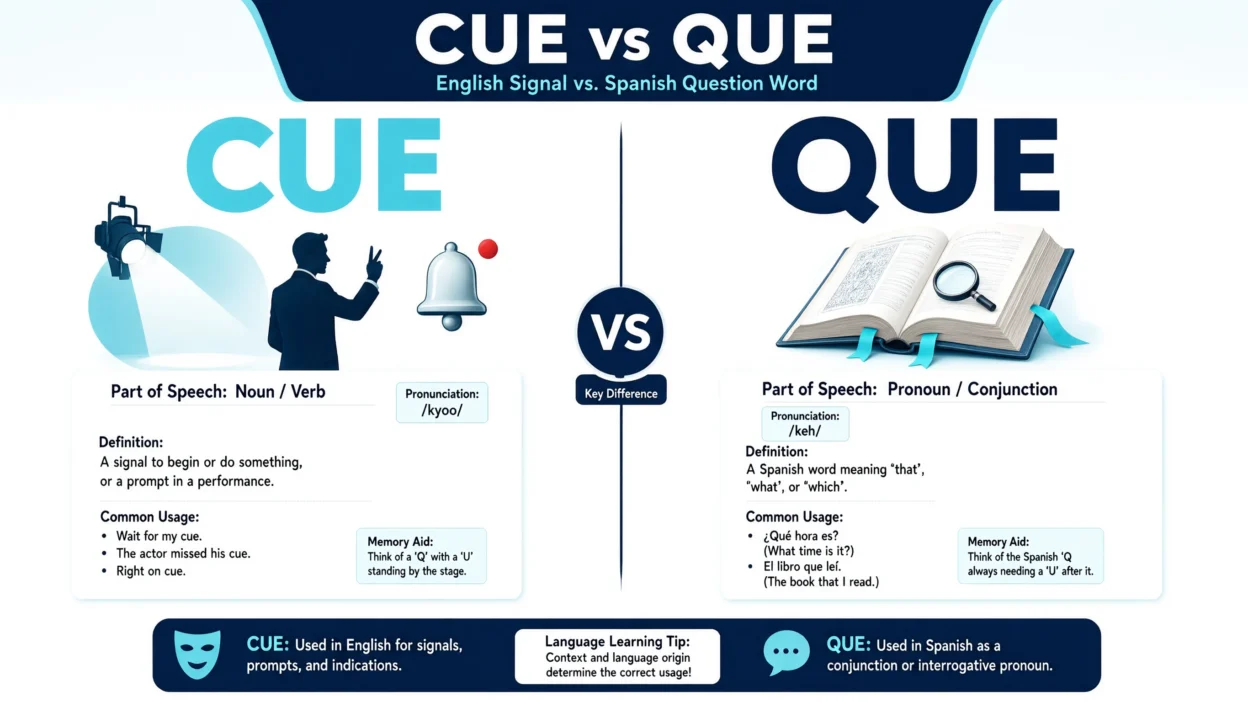
The English words cue vs que can be confusing because they sound similar, but they have very different meanings and uses. One is a common English word, while the other is generally a Spanish word or part of certain foreign expressions. Understanding this difference can help you avoid spelling mistakes and choose the correct word when writing or speaking.
A cue is a signal, hint, or prompt that tells someone when to do something or how to respond. For example, an actor waits for a cue before speaking, and a speaker may use visual cues to guide an audience. In contrast, que is a Spanish word that can mean that, which, who, or what, depending on the sentence.
It also appears in some English expressions borrowed from other languages. Although the two words may sound alike, they are not interchangeable. In this guide, you will learn their meanings, differences, grammatical uses, and practical examples.
Quick Answer
Cue is an English noun or verb meaning a signal, hint, prompt, or indication to do something. Que is primarily a Spanish word meaning that, which, who, or what, depending on context. Although they can sound similar, they have different spellings, meanings, and grammatical functions.
Why Do People Confuse Cue and Que?
People often confuse cue and que because they can sound alike in English pronunciation. However, their meanings, origins, and grammatical roles are different.
Here are the main reasons for the confusion:
- Similar pronunciation: Both may sound like the letter name Q in English.
- Different languages: Cue is a standard English word, while que is commonly used in Spanish and other Romance languages.
- Unfamiliar spelling: English learners may assume that both spellings represent the same word.
- Different contexts: Cue appears in everyday English, while que is more common in Spanish sentences and foreign expressions.
The easiest way to avoid mistakes is to understand what each word means before using it.
1. What Does Cue Mean?
Cue is an English word that means a signal, hint, reminder, or prompt that tells someone when to act or respond.
It can function as both a noun and a verb.
Cue as a Noun
As a noun, cue refers to a signal or indication that something should happen.
Examples:
- The actor waited for his cue before entering the stage.
- Her smile was my cue to begin speaking.
- The teacher gave students a cue to start the activity.
- The music provided a cue for the dancers.
Cue as a Verb
As a verb, cue means to give someone a signal or prompt to do something.
Examples:
- The director cued the actors to begin.
- Please cue the music when everyone is ready.
- She cued the next speaker to come forward.
Common Uses of Cue
The word cue appears in several everyday situations:
- Theater: A signal telling an actor when to speak or move.
- Music: A signal indicating when a musician should begin.
- Communication: A facial expression or gesture that provides information.
- Presentations: A reminder or prompt for the next point.
- Sports: A signal that indicates when an action should happen.
2. What Does Que Mean?
Que is primarily a Spanish word used as a conjunction or pronoun. Its meaning changes according to the sentence and grammatical context.
It can mean that, which, who, or what in English.
Unlike cue, que is not a standard English word for a signal or reminder.
Que as a Conjunction
In Spanish, que commonly connects clauses and can mean “that.”
Examples:
- Creo que tienes razón. (I think that you are right.)
- Ella dice que está cansada. (She says that she is tired.)
- Espero que vengas. (I hope that you come.)
Que as a Relative Pronoun
Que can also introduce a relative clause, referring to a person or thing.
Examples:
- El libro que compré es interesante. (The book that I bought is interesting.)
- La mujer que canta es mi profesora. (The woman who sings is my teacher.)
- La película que vimos fue excelente. (The movie that we watched was excellent.)
Que in Other Languages and Expressions
The spelling que also appears in Portuguese and French, although its pronunciation and grammatical functions vary.
For example:
- Spanish: ¿Qué quieres? means “What do you want?”
- French: Que fais-tu? means “What are you doing?”
- Portuguese: O que é isso? means “What is that?”
Important: Spanish distinguishes between que and qué. The accented form qué is generally used in direct and indirect questions and exclamations.
3. Cue vs Que: Comparison Table
The following table highlights the main differences between cue and que.
| Feature | Cue | Que |
| Language | English | Mainly Spanish |
| Meaning | Signal, hint, prompt | That, which, who, what |
| Word type | Noun and verb | Conjunction or pronoun |
| Pronunciation | /kjuː/ | Usually /ke/ in Spanish |
| Usage | Everyday English | Spanish sentences |
| Example | Wait for your cue. | Creo que sí. |
| Interchangeable? | No | No |
The biggest difference is that cue communicates a signal or prompt, whereas que performs a grammatical function in Spanish.
4. When Should You Use Cue or Que?
Choosing between these words becomes easier when you consider the language and meaning of your sentence.
Use Cue When:
Use cue when you are talking about:
- A signal to begin an activity.
- A hint that helps someone understand something.
- A reminder to perform an action.
- A prompt during a presentation or performance.
- An indication that something is about to happen.
Examples:
- Give me a cue when you are ready.
- His expression was a cue that something was wrong.
- The presenter used notes as cues.
Use Que When:
Use que when writing in Spanish or another language where the word has a grammatical meaning.
Examples:
- Sé que estás ocupado. (I know that you are busy.)
- El coche que compré es nuevo. (The car that I bought is new.)
- ¿Qué necesitas? (What do you need?)
Remember that you should not use que instead of cue in an ordinary English sentence.
5. Cue vs Que: 12 Example Sentences
Examples make it easier to understand how these words work in different contexts.
Examples Using Cue
- The teacher gave us a cue to open our books.
- The actor missed his cue and entered the stage late.
- Her nervous expression was a cue that she needed help.
- The presenter used a small card as a cue during the speech.
- The music started on the conductor’s cue.
- Please cue the video when I give you the signal.
Examples Using Que
- Creo que él es inteligente. (I think that he is intelligent.)
- La casa que vimos es hermosa. (The house that we saw is beautiful.)
- ¿Qué quieres comer? (What do you want to eat?)
- Pienso que tienes razón. (I think that you are right.)
- El estudiante que ganó recibió un premio. (The student who won received a prize.)
- No sé qué decir. (I don’t know what to say.)
These examples show that cue belongs naturally in English sentences, while que is used according to the grammar of another language.
6. Common Mistakes When Using Cue and Que
Even though these words look similar, using one in place of the other can change the meaning or make a sentence grammatically incorrect.
Here are some common mistakes to avoid.
Mistake 1: Using Que Instead of Cue
Incorrect: Please give me a que when the presentation starts.
Correct: Please give me a cue when the presentation starts.
Why? The sentence needs the English word for a signal or prompt.
Mistake 2: Using Cue in a Spanish Sentence
Incorrect: Creo cue tienes razón.
Correct: Creo que tienes razón.
Why? The Spanish conjunction que connects the two parts of the sentence.
Mistake 3: Confusing Que and Qué
Incorrect: Que quieres hacer?
Correct: ¿Qué quieres hacer?
Why? In a direct Spanish question, qué takes an accent mark.
Mistake 4: Assuming Both Words Have the Same Meaning
Cue and que may sound similar in some English-speaking contexts, but their meanings are not interchangeable.
Always consider the language and intended meaning before choosing the spelling.
7. Memory Trick: How to Remember Cue vs Que
A simple memory trick can help you remember the difference.
Cue = Call or signal
Think of cue as a signal that calls someone to action.
Example: The director gave the actor a cue to start speaking.
Que = Spanish grammar
Think of que as a connecting or questioning word used in Spanish.
Example: Creo que sí. (I think so.)
You can also remember this simple rule:
- If you mean a signal, use cue.
- If you are writing a Spanish sentence that needs “that,” “which,” or another appropriate translation, use que.
- If you are asking “what?” in Spanish, you will generally need qué.
8. American vs British English: Cue vs Que
There is no meaningful American-versus-British spelling difference between cue and que.
Both American and British English use cue to mean a signal, prompt, or indication.
Examples:
- American English: The actor waited for his cue.
- British English: The actor waited for his cue.
The spelling and meaning remain the same.
The word que also retains its foreign-language grammatical uses regardless of whether someone is writing American or British English.
Therefore, this is not a regional spelling difference. It is a difference between words from different linguistic contexts.
9. Similar Words Related to Cue and Que
Several English words have meanings related to cue. Understanding them can help you expand your vocabulary.
| Word | Simple Meaning | Example |
| Signal | A sign or message | She gave me a signal. |
| Prompt | Something that encourages an action | The question was a prompt to speak. |
| Hint | A small piece of information | He gave me a hint. |
| Indication | A sign of something | Her smile was an indication of happiness. |
| Reminder | Something that helps you remember | The note was a reminder. |
| Sign | Something that communicates information | His silence was a sign of worry. |
| Trigger | Something that causes an action | The alarm triggered a response. |
| Suggestion | An idea or recommendation | She made a helpful suggestion. |
These words can sometimes replace cue, but the best choice depends on the sentence and intended meaning.
10. FAQs:
1. Is it cue or que?
Both spellings are correct, but they have different meanings. Cue is an English word meaning a signal, hint, or prompt. Que is primarily a Spanish word meaning that, which, who, or what, depending on context.
2. What does cue mean in simple English?
Cue means a signal or reminder that tells someone when to do something. For example, an actor waits for a cue before speaking in a play.
3. What does que mean in Spanish?
Que is a common Spanish conjunction or pronoun. It can mean that, which, who, or what, depending on the sentence. The accented form qué is commonly used in questions and exclamations.
4. Are cue and que pronounced the same?
Not usually. In English, cue is pronounced like the letter Q (/kjuː/). In Spanish, que is generally pronounced /ke/. However, English speakers may pronounce the two similarly when using an English-style pronunciation.
5. Is que an English word?
Que is not generally used as a standard English word with its Spanish grammatical meanings. However, it appears in English writing within foreign expressions, borrowed phrases, names, and quotations.
6. What is the difference between cue and queue?
Cue means a signal or prompt, while queue means a line of people or things waiting for something. Both are pronounced like the English letter Q, but their meanings and spellings are different.
7. What is the difference between que and qué?
In Spanish, que without an accent commonly means that, which, or who. Qué with an accent generally means what or which in questions and exclamations. For example, Creo que sí means “I think so,” while ¿Qué quieres? means “What do you want?”
11. Remember This: Cue vs Que
Keep these simple points in mind:
- Cue is an English word meaning a signal, hint, or prompt.
- Que is primarily a Spanish word used to connect ideas or introduce clauses.
- Qué is the accented Spanish form commonly used to ask questions or express exclamations.
- Cue and que are not interchangeable in ordinary English writing.
- Always consider the language and meaning of your sentence before choosing either spelling.
Conclusion
Understanding the difference between cue vs que is simple once you know their meanings and grammatical uses. Cue is an English word that refers to a signal, reminder, or prompt that tells someone when to act. It is commonly used in conversations, performances, presentations, and everyday situations.
On the other hand, que is mainly a Spanish word that can mean that, which, who, or what, depending on context. Its accented form, qué, is commonly used in questions and exclamations. Although these words may look similar, they serve different purposes. Remember to use cue for a signal and que for its appropriate grammatical role in Spanish.

I’m James Parker, Administrator at SynonymsHive. I oversee content quality, improve user experience, and ensure reliable synonym resources. My passion is making language learning simple, accurate, and accessible for everyone.