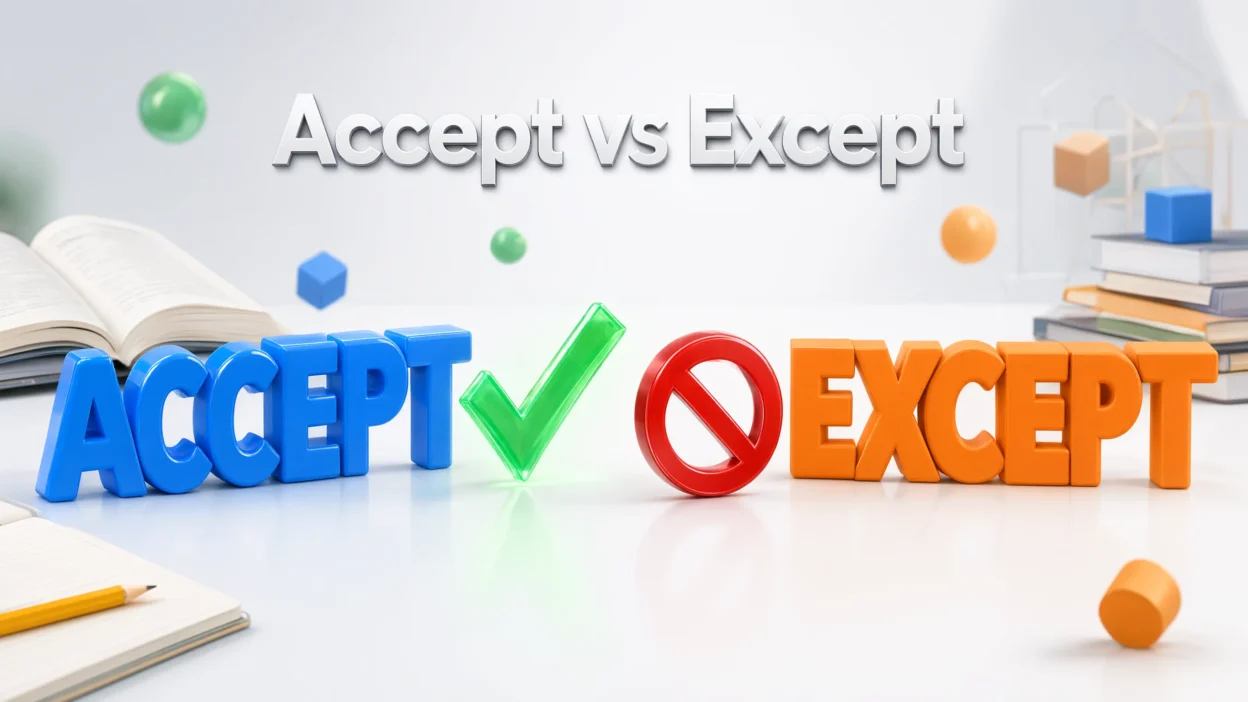
The words accept and except look and sound similar, but they have completely different meanings. Because their pronunciation is almost identical, many English learners, students, and even experienced writers sometimes confuse them. Knowing when to use each word can help you write clearer sentences and avoid common grammar mistakes.
The easiest way to understand the difference is to remember that accept means to receive, agree to, or say yes to something, while except means excluding someone or something. For example, you can accept an invitation, accept an apology, or accept a job offer. However, you can say, “Everyone came to the party except John,” because John was not included.
Although these words have similar sounds, their meanings, grammatical roles, and uses are different. In this guide, you will learn their definitions, differences, examples, common mistakes, and simple memory tricks to use accept and except correctly in everyday English.
Quick Answer: Accept vs Except
Accept means to receive, agree to, or willingly take something. Except means excluding someone or something. Accept is usually a verb, while except is most commonly a preposition or conjunction. For example, “I accept your offer” shows agreement, while “Everyone attended except Tom” shows exclusion.
Why Do People Confuse Accept and Except?
People often confuse accept and except because they have similar spellings and nearly identical pronunciations in many English accents.
Both words begin with the letter combination “ac” or “ex” and contain similar sounds. However, their meanings are entirely different.
There are three main reasons for this confusion:
- Similar pronunciation: Both words can sound almost identical when spoken quickly.
- Similar spelling: Their letters look alike, especially to beginner English learners.
- Different grammatical uses: Accept is generally an action word, while except usually introduces an exclusion.
The best way to avoid confusion is to understand what each word communicates in a sentence rather than relying only on its pronunciation.
1. Accept: Meaning, Definition, and Usage
Accept is a verb that means to receive something willingly, agree to something, or consider something as true or satisfactory.
It describes an action or decision. When you accept something, you are generally saying yes, receiving it, or recognizing it.
Simple definition: Accept means to receive, agree to, approve of, or take something willingly.
Different Meanings of Accept
Accept can be used in several situations.
1. To receive something
When you receive something willingly, you accept it.
- She accepted the gift from her friend.
- He accepted the award with a smile.
2. To agree to an offer or invitation
Accept can describe agreeing to an opportunity, invitation, or proposal.
- I accepted the job offer.
- They accepted our invitation to dinner.
3. To admit or recognize something as true
It can also mean acknowledging a fact or situation.
- You must accept the truth.
- She finally accepted her mistake.
4. To approve or allow something
Accept can mean considering something suitable or agreeing to it.
- The school accepts applications online.
- This store accepts credit cards.
Synonyms of Accept
Some common synonyms include:
- Receive
- Agree
- Approve
- Welcome
- Admit
- Embrace
- Acknowledge
- Consent to
- Take
- Recognize
The correct synonym depends on the context. For example, receive works when talking about a gift, while agree is more suitable when talking about a proposal.
Example Sentences with Accept
- I gladly accept your invitation.
- She accepted the responsibility for the project.
- He could not accept the difficult situation.
- The company accepts online payments.
- They accepted our proposal without hesitation.
2. Except: Meaning, Definition, and Usage
Except is most commonly a preposition or conjunction that means excluding, leaving out, or not including someone or something.
It identifies a person, object, or thing that is not part of a group or situation.
Simple definition: Except means excluding someone or something from a group, statement, or situation.
Different Meanings of Except
Except is commonly used in the following situations.
1. To exclude someone or something
It shows that a particular person or thing is not included.
- Everyone attended the meeting except Sarah.
- All the students passed except one.
2. To show an exception to a general statement
It identifies something that does not follow a general rule.
- I like all fruits except bananas.
- The shop is open every day except Sunday.
3. To introduce an exception in a sentence
Except can also introduce a clause explaining what is different.
- I would help you, except I am busy.
- Everything went well, except that we arrived late.
Synonyms of Except
Common alternatives include:
- Excluding
- Apart from
- Other than
- Leaving out
- With the exception of
- Save for
- But
These expressions are not interchangeable in every sentence, so choose one that fits the grammatical structure.
Example Sentences with Except
- Everyone enjoyed the movie except me.
- I work every day except Friday.
- All the rooms are clean except the kitchen.
- She likes every subject except mathematics.
- We have everything except enough time.
Accept vs Except: Comparison Table
The following table highlights the main differences between accept and except.
| Feature | Accept | Except |
| Meaning | To receive or agree | To exclude or leave out |
| Part of speech | Verb | Preposition or conjunction |
| Main purpose | Shows agreement or receiving | Shows exclusion |
| Usage | Offers, gifts, invitations, facts | Groups, lists, exceptions |
| Example | I accept your offer. | Everyone came except Ali. |
| Opposite idea | Reject | Include |
| Common phrase | Accept responsibility | Except for one person |
The easiest distinction is that accept describes receiving or agreeing, whereas except identifies something that is excluded.
When Should You Use Accept or Except?
Choosing the correct word becomes easier when you understand the meaning of your sentence.
When to Use Accept
Use accept when you are describing an action involving receiving, agreeing, approving, or recognizing something.
Examples:
- Accept an invitation.
- Accept a gift.
- Accept an apology.
- Accept responsibility.
- Accept the truth.
- Accept a job offer.
Ask yourself: Does the sentence describe receiving something or agreeing to something?
If the answer is yes, accept is probably the correct choice.
When to Use Except
Use except when you want to exclude someone or something from a group, list, or general statement.
Examples:
- Everyone except John.
- All days except Monday.
- Every color except black.
- All students except two.
- Everything except the final chapter.
Ask yourself: Does the sentence mean leaving someone or something out?
If the answer is yes, except is probably the correct choice.
15 Examples of Accept vs Except in Sentences
Here are practical examples that show how these two words work in everyday English.
Examples Using Accept
- I accept your apology because I know you are sorry.
- She decided to accept the new job opportunity.
- My parents accepted my decision to study abroad.
- He happily accepted the birthday present.
- We should accept people for who they are.
- The restaurant accepts online reservations.
- They accepted our invitation to the wedding.
- You must accept responsibility for your actions.
Examples Using Except
- Everyone attended the event except my brother.
- I enjoy all sports except cricket.
- The library is open every day except Sunday.
- All the questions were easy except the last one.
- Nobody knows the answer except the teacher.
- She bought everything except milk.
- The entire team was present except two players.
Accept vs Except in Similar Sentences
Comparing both words in similar situations can make their meanings even clearer.
| Accept Sentence | Except Sentence |
| I accept everyone. | Everyone came except Ali. |
| She accepted the invitation. | Everyone accepted the invitation except John. |
| He accepts my ideas. | All my ideas were approved except one. |
| We accept cash payments. | We accept all payments except checks. |
| They accepted the rules. | Everyone followed the rules except Tom. |
Notice how accept describes an action, while except identifies an exclusion.
Common Mistakes When Using Accept and Except
Even though the difference is simple, these words are frequently used incorrectly.
Here are some mistakes to avoid.
Mistake 1: Using Accept Instead of Except
Incorrect: Everyone attended the party accept Sarah.
Correct: Everyone attended the party except Sarah.
Why? Sarah was excluded from the group, so except is the correct word.
Mistake 2: Using Except Instead of Accept
Incorrect: I except your apology.
Correct: I accept your apology.
Why? The sentence describes receiving or agreeing to an apology, so accept is correct.
Mistake 3: Confusing Agreement with Exclusion
Incorrect: She excepted the job offer.
Correct: She accepted the job offer.
Why? Accept means agreeing to take the job.
Mistake 4: Using Accept in a List of Exclusions
Incorrect: I like every subject accept science.
Correct: I like every subject except science.
Why? Science is the subject being excluded.
Mistake 5: Forgetting the Meaning of Each Word
Do not choose a word simply because it sounds right. Think about the message you want to communicate.
- If you mean receive or agree, use accept.
- If you mean exclude or leave out, use except.
Easy Memory Trick to Remember Accept vs Except
If you frequently mix up these words, try these simple memory tricks.
1. Accept = Agree
Remember that accept begins with the same letter as agree.
Both words can describe saying yes to something.
Example: I accept your invitation.
2. Except = Exclude
Think of except as a word that identifies something excluded from a group.
Example: Everyone came except David.
3. Remember Their Opposites
Another useful way to remember these words is to connect them with their opposite meanings.
- Accept = Reject (opposite)
- Except = Include (opposite)
These simple associations can help you choose the correct word quickly.
4. Use the Sentence Test
Before writing accept or except, ask yourself:
- Am I receiving or agreeing to something? Use accept.
- Am I leaving something or someone out? Use except.
This quick test works for most everyday sentences.
Accept vs Except in American and British English
There is no major difference between accept and except in American and British English.
Both varieties of English use these words with the same basic meanings, spellings, and grammatical functions.
| Feature | American English | British English |
| Accept | Same meaning | Same meaning |
| Except | Same meaning | Same meaning |
| Spelling | Accept / Except | Accept / Except |
| Grammar | Same basic usage | Same basic usage |
| Pronunciation | May vary by accent | May vary by accent |
For example:
- American English: I accept your offer.
- British English: I accept your offer.
- American English: Everyone came except James.
- British English: Everyone came except James.
The main differences you may notice are related to regional accents and pronunciation, not meaning or spelling.
Similar Words That People Often Confuse
Accept and except are not the only English words that cause confusion. Several other word pairs have similar spellings or sounds but different meanings.
Here are some useful examples:
| Word Pair | Difference |
| Affect vs Effect | Affect is usually a verb; effect is usually a noun. |
| Advice vs Advise | Advice is a noun; advise is a verb. |
| Then vs Than | Then relates to time; than makes comparisons. |
| Their vs There | Their shows possession; there refers to a place or introduces a statement. |
| Lose vs Loose | Lose means to misplace; loose means not tight. |
| Principal vs Principle | Principal means main or a school leader; principle means a rule or belief. |
| Your vs You’re | Your shows possession; you’re means you are. |
| Complement vs Compliment | Complement means something that completes; compliment means praise. |
Learning these differences can improve your vocabulary, spelling, and everyday writing.
Final Verdict: Accept or Except?
The difference between accept and except is simple once you understand their meanings.
- Accept is a verb meaning to receive, agree to, approve of, or recognize something.
- Except means excluding or leaving someone or something out.
Use accept when talking about gifts, invitations, apologies, offers, and responsibilities. Use except when identifying something that is not included in a group or situation.
Remember that accept is about saying yes, while except is about leaving something out.
FAQs:
1. What is the main difference between accept and except?
Accept means to receive or agree to something, while except means excluding someone or something. For example, “I accept your offer” means you agree to it, whereas “Everyone came except John” means John was not included.
2. Is accept a verb or a noun?
Accept is a verb. It describes an action such as receiving, agreeing to, or approving something. For example, “She accepts the invitation” uses accept as a verb.
3. Is except a preposition or a conjunction?
Except is commonly used as a preposition or conjunction. As a preposition, it introduces an excluded person or thing. As a conjunction, it can introduce an exception or contrasting condition.
4. How do you remember accept vs except?
Remember that accept means agree or receive, while except means exclude or leave out. You can also remember their opposite ideas: reject is the opposite of accept, and include is the opposite of except.
5. Can accept and except be used in the same sentence?
Yes. Both words can appear in one sentence because they have different meanings.
Example: “I accept everyone’s opinion except the one that is based on false information.”
Here, accept means acknowledge or receive, while except identifies what is excluded.
6. What is an example of accept in a sentence?
An example is: “I happily accept your invitation to the birthday party.”
In this sentence, accept means agreeing to attend the event.
7. What is an example of except in a sentence?
An example is: “Everyone passed the examination except Mark.”
In this sentence, except means Mark was excluded from the group of students who passed.
8. Do accept and except sound the same?
They sound very similar and are often pronounced identically or nearly identically in everyday speech. However, their meanings, spellings, and grammatical uses are different.
Remember This
- Accept = Receive or Agree
- Except = Exclude or Leave Out
If you remember these two simple meanings, you can avoid most accept vs except mistakes.
Conclusion
Understanding the difference between accept and except is important for clear and correct English communication. Although these words look and sound similar, they serve different purposes. Accept is a verb that means receiving, agreeing to, or approving something. Except is used to show that someone or something is excluded from a group, list, or situation. Learning these basic meanings will help you recognize the correct word when reading, speaking, or writing.
The best way to remember the difference is to connect accept with agreeing and except with excluding. Practice using both words in everyday sentences, such as accepting an invitation or excluding someone from a list. With a little practice, you will become more confident about using accept and except correctly.

I’m Nathan Collins, a language enthusiast passionate about exploring synonyms and improving everyday writing. I create clear, accurate, and helpful content that helps readers expand vocabulary and communicate with confidence.