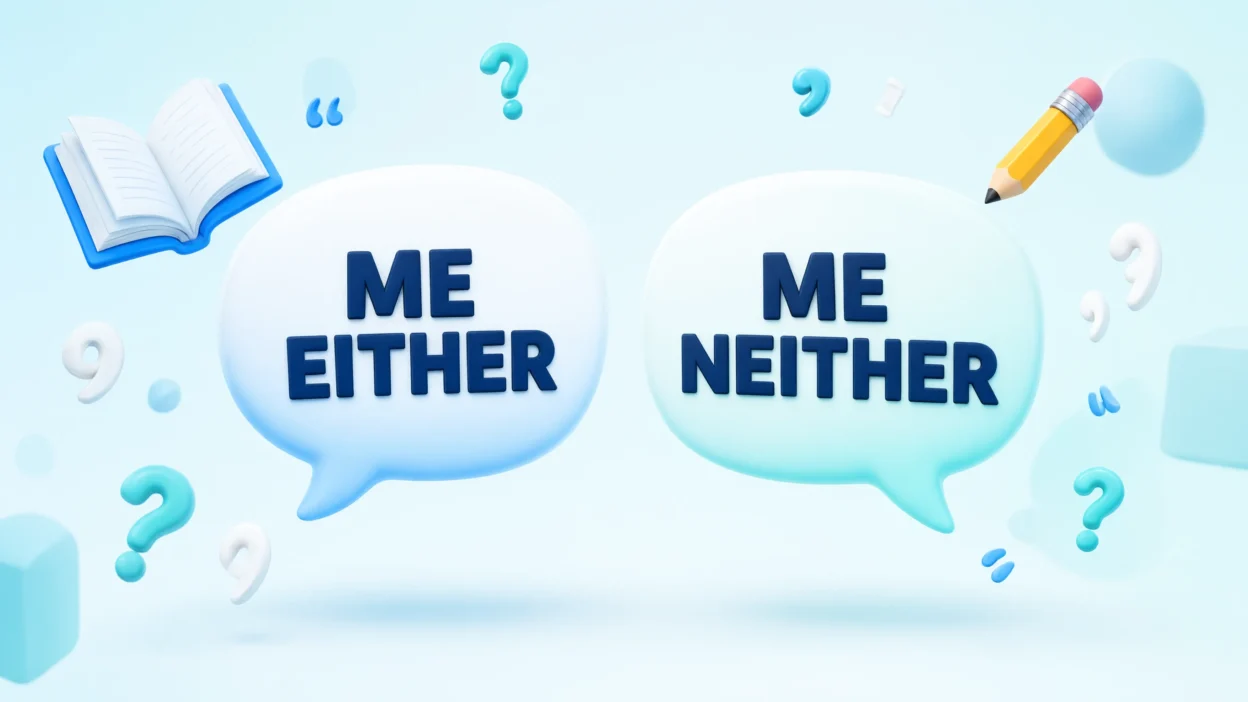
Have you ever wondered If to say “me either” or “me neither” when agreeing with someone who makes a negative statement? Both expressions are commonly heard in everyday English, but they are not always used in the same way. Understanding the difference can help you speak more naturally and avoid common grammar mistakes.
The main difference is that “me neither” is the standard grammatical expression for agreeing with a negative statement, while “me either” is an informal expression commonly used in casual conversation, particularly in American English.
For example, if someone says, “I don’t like cold weather,” you can respond, “Me neither.” You may also hear people say, “Me either,” with the same intended meaning. In this guide, we will explain both expressions, their meanings, grammatical differences, and practical examples so you can confidently choose the right one.
Quick Answer: Me Either vs Me Neither
“Me neither” is the standard and grammatically preferred expression when agreeing with a negative statement. For example, if someone says, “I don’t enjoy horror movies,” you can reply, “Me neither.” “Me either” is also used informally, especially in American conversational English, but “me neither” is the safer choice in formal and standard English.
Why Do People Confuse Me Either and Me Neither?
People often confuse these expressions because both communicate agreement with something negative.
For example:
- Person A: I don’t like coffee.
- Person B: Me neither.
- Person B: Me either.
Both responses communicate that the second person also does not like coffee.
The confusion comes from the different roles of either and neither in English grammar.
- Neither already carries a negative meaning.
- Either is commonly used with negative statements to express an additional negative idea.
Because both words can appear in negative contexts, English speakers sometimes use them interchangeably in casual conversations.
However, their grammatical patterns are different.
What Does Me Neither Mean?
Me neither is an informal but grammatically standard response used to agree with a negative statement.
It means that you also do not experience, like, want, or do something that another person has mentioned.
It is a shortened form of a sentence such as:
- I don’t like it either.
- I don’t want to go either.
- I haven’t seen that movie either.
Instead of repeating the complete sentence, you can simply say, “Me neither.”
Examples of Me Neither
1. Person A: I don’t like spicy food.
Person B: Me neither.
2. Person A: I haven’t finished my homework.
Person B: Me neither.
3. Person A: I can’t swim.
Person B: Me neither.
4. Person A: I don’t watch television.
Person B: Me neither.
5. Person A: I wasn’t invited to the party.
Person B: Me neither.
6. Person A: I don’t understand this question.
Person B: Me neither.
When should you use me neither?
Use it when someone makes a negative statement and you want to express that the same situation applies to you.
It works naturally in everyday conversations and is generally the preferred choice in standard English.
What Does Me Either Mean?
Me either is an informal conversational expression used to agree with a negative statement.
It communicates the same general idea as “me neither”: you also do not do, like, have, or experience something.
For example:
- Person A: I don’t like horror movies.
- Person B: Me either.
Although many native English speakers use this expression in casual speech, it is less widely accepted as the standard grammatical response.
The expression is influenced by the common use of either in negative sentences, such as “I don’t like horror movies either.”
Examples of Me Either
1. Person A: I don’t like rainy days.
Person B: Me either.
2. Person A: I can’t drive.
Person B: Me either.
3. Person A: I haven’t eaten breakfast.
Person B: Me either.
4. Person A: I don’t enjoy crowded places.
Person B: Me either.
5. Person A: I wasn’t ready for the test.
Person B: Me either.
6. Person A: I don’t remember his name.
Person B: Me either.
When should you use me either?
You may hear it in relaxed conversations, text messages, and informal communication, especially in American English.
However, if you are learning English or writing in a professional or academic setting, “me neither” is the better option.
Me Either vs Me Neither: Comparison Table
The following table highlights the main differences between these two expressions.
| Feature | Me Either | Me Neither |
| Meaning | I also do not | I also do not |
| Usage | Informal and conversational | Standard and conversational |
| Grammar | Less standard as a standalone response | Standard as a standalone response |
| Common context | Casual conversations | Everyday and formal learning contexts |
| Negative agreement | Yes, informally | Yes |
| Best choice for learners | Less preferred | Recommended |
| Example | Me either, I don’t like it. | Me neither. |
The most important point is that both expressions can communicate negative agreement, but “me neither” is the more reliable grammatical choice.
When Should You Use Me Either or Me Neither?
Choosing between these expressions becomes easier when you understand the situation and level of formality.
1. Use Me Neither for Standard English
When someone makes a negative statement, “me neither” is generally the best short response.
Example:
- Person A: I don’t like waking up early.
- Person B: Me neither.
This response is natural and grammatically accepted.
2. Use Me Either in Casual Conversations
You may hear “me either” among friends, family members, or people communicating informally.
Example:
- Person A: I don’t want to go shopping.
- Person B: Me either.
It is understandable in casual conversation, but “me neither” is preferable in standard English.
3. Use Neither Do I for More Formal Agreement
If you want to sound more formal or construct a complete grammatical response, use an auxiliary verb with “neither.”
Example:
- Person A: I don’t like loud music.
- Person B: Neither do I.
This is a particularly useful structure for formal conversations and writing.
4. Use Either in a Complete Negative Sentence
You can also use “either” at the end of a negative sentence.
Example:
- Person A: I don’t like this restaurant.
- Person B: I don’t like it either.
This is another standard way to express negative agreement.
15 Examples of Me Either vs Me Neither in Everyday English
Here are practical examples that show how these expressions work in everyday conversations.
| Situation | First Person | Natural Response |
| Food preference | I don’t like onions. | Me neither. |
| Weather | I don’t enjoy cold weather. | Me neither. |
| Education | I haven’t completed my assignment. | Me neither. |
| Sports | I don’t play basketball. | Me neither. |
| Entertainment | I haven’t watched that show. | Me neither. |
| Travel | I don’t like long flights. | Me neither. |
| Work | I don’t work on Sundays. | Me neither. |
| Health-related activity | I can’t run very fast. | Me neither. |
| Music | I don’t listen to jazz. | Me neither. |
| Shopping | I don’t need anything. | Me neither. |
| Sleep | I didn’t sleep well last night. | Me neither. |
| Movies | I haven’t seen that film. | Me neither. |
| Social activities | I don’t enjoy big parties. | Me neither. |
| Technology | I don’t understand this software. | Me neither. |
| Personal preferences | I don’t like waiting. | Me neither. |
Notice that “me neither” works with different negative structures, including don’t, doesn’t, didn’t, haven’t, and can’t.
Common Mistakes When Using Me Either and Me Neither
English learners sometimes make mistakes because they focus on the meaning of these expressions rather than their grammatical structure.
Here are some common errors to avoid.
Mistake 1: Using Me Neither to Agree With a Positive Statement
Incorrect:
- Person A: I love chocolate.
- Person B: Me neither.
Correct:
- Person A: I love chocolate.
- Person B: Me too.
Use “me too” when agreeing with a positive statement.
Mistake 2: Using Me Either in Formal Writing
Less suitable:
- I don’t understand the instructions.
- Me either.
Better:
- I don’t understand the instructions.
- Neither do I.
“Me either” is informal, so avoid it in academic essays and professional writing.
Mistake 3: Confusing Neither Do I With Either Do I
Incorrect:
- Person A: I don’t like coffee.
- Person B: Either do I.
Correct:
- Person A: I don’t like coffee.
- Person B: Neither do I.
The correct expression is “neither do I.”
Mistake 4: Using Me Neither With a Positive Meaning
Incorrect:
- Person A: I enjoy reading books.
- Person B: Me neither.
Correct:
- Person A: I enjoy reading books.
- Person B: Me too.
Remember that “neither” is associated with negative agreement.
Mistake 5: Forgetting the Auxiliary Verb in Formal Agreement
Incorrect:
– Neither I do.
Correct:
– Neither do I.
When using “neither” with an auxiliary verb, follow the structure:
Neither + auxiliary verb + subject.
Examples:
- Neither can I.
- Neither have I.
- Neither am I.
- Neither will I.
What Is an Easy Memory Trick for Me Either vs Me Neither?
A simple way to remember the difference is to associate “neither” with negative agreement.
Think of these two expressions:
- Me too: I also agree with a positive statement.
- Me neither: I also agree with a negative statement.
For example:
Positive statement:
- I like ice cream.
- Me too.
Negative statement:
- I don’t like ice cream.
- Me neither.
Another helpful trick is to remember that “neither” already has a negative meaning, so it naturally fits a negative response.
If you are unsure which expression to choose, use “me neither.”
Is Me Either or Me Neither Different in American and British English?
Both expressions may be understood in English-speaking countries, but their acceptance and conversational use can vary.
American English
In American English, “me either” is commonly heard in informal conversations.
Some speakers use it naturally when agreeing with negative statements.
Example:
- I don’t like horror movies.
- Me either.
However, “me neither” is also widely used and remains the standard choice.
British English
In British English, “me neither” is a familiar and natural expression.
Example:
- I don’t like getting up early.
- Me neither.
“Me either” may also be understood, particularly through exposure to international and American English, but it is not the preferred standard expression.
Which expression should English learners choose?
Regardless of whether you are learning American or British English, “me neither” is the safest choice for standard communication.
Similar Words and Expressions You Should Know
Understanding related expressions can help you agree with people more naturally.
Here are some useful alternatives.
1. Me Too
Used to agree with a positive statement.
Example:
- I love reading novels.
- Me too.
2. Neither Do I
A standard expression for agreeing with a negative statement.
Example:
- I don’t like loud music.
- Neither do I.
3. I Don’t Either
A complete sentence used to express the same negative opinion.
Example:
- I don’t watch television.
- I don’t either.
4. Same Here
An informal expression used to show that you share someone’s situation, feeling, or opinion.
Example:
- I’m really tired today.
- Same here.
5. Nor Do I
A slightly more formal way to agree with a negative statement.
Example:
- I don’t enjoy driving at night.
- Nor do I.
6. Me As Well
An expression used to agree with a positive statement, although “me too” is more natural in everyday conversation.
Example:
- I enjoy learning languages.
- Me as well.
Final Verdict: Is Me Either or Me Neither Correct?
Both “me either” and “me neither” are used to express agreement with negative statements, but they do not have the same level of grammatical acceptance.
“Me neither” is the standard and recommended expression. It is suitable for everyday conversations and is the better choice for students, ESL learners, academic communication, and professional situations.
“Me either” is an informal expression that you may hear in casual American English. Although people generally understand what it means, it is less preferred in standard English.
If you want to communicate clearly and confidently, choose “me neither” when agreeing with a negative statement.
FAQs:
1. Is It Me Either or Me Neither?
“Me neither” is the standard expression when agreeing with a negative statement. “Me either” is also used informally, especially in American English, but “me neither” is the safer grammatical choice.
Example:
- I don’t like coffee.
- Me neither.
2. Is Me Either Grammatically Correct?
“Me either” is a common informal expression, but it is not generally preferred in standard English as a standalone response. In formal and academic communication, use “me neither” or “neither do I.”
3. Can I Say Me Neither in Everyday Conversation?
Yes. “Me neither” is completely natural in everyday English conversations. You can use it with friends, classmates, colleagues, and family members when agreeing with a negative statement.
Example:
- I don’t enjoy rainy weather.
- Me neither.
4. Is Me Either More Common in American English?
“Me either” is commonly heard in informal American English. However, “me neither” is also widely used by American speakers and remains the standard choice.
5. What Is the Difference Between Me Neither and Neither Do I?
Both expressions communicate negative agreement, but their grammatical structures are different.
- Me neither: A short, informal response.
- Neither do I: A complete grammatical construction using an auxiliary verb.
Example:
- I don’t like spicy food.
- Me neither.
- Neither do I.
6. Can I Use Me Neither With Positive Sentences?
No. “Me neither” is used to agree with negative statements, not positive ones.
Incorrect:
- I love music.
- Me neither.
Correct:
- I love music.
- Me too.
7. What Is the Opposite of Me Neither?
The common positive equivalent of “me neither” is “me too.”
For example:
- I enjoy swimming. → Me too.
- I don’t enjoy swimming. → Me neither.
Remember This
- Me neither: The standard choice for agreeing with a negative statement.
- Me either: An informal alternative heard in casual conversations.
- Me too: Used to agree with a positive statement.
- Neither do I: A grammatically standard alternative to “me neither.
- I don’t either: A complete sentence expressing negative agreement.
The easiest rule is to use “me neither” for negative agreement and “me too” for positive agreement.
Conclusion
Understanding the difference between “me either” and “me neither” can make your English conversations clearer and more natural. Both expressions are used when agreeing with negative statements, but “me neither” is the standard and grammatically preferred option. Although “me either” appears in informal conversations, especially in American English, it is better to avoid it in formal communication.
Remember that small grammar differences can make a noticeable improvement in your English skills. Practice using “me neither,” “neither do I,” and “me too” in everyday conversations. With regular practice, you will find it easier to express agreement correctly and confidently.

I’m James Parker, Administrator at SynonymsHive. I oversee content quality, improve user experience, and ensure reliable synonym resources. My passion is making language learning simple, accurate, and accessible for everyone.