
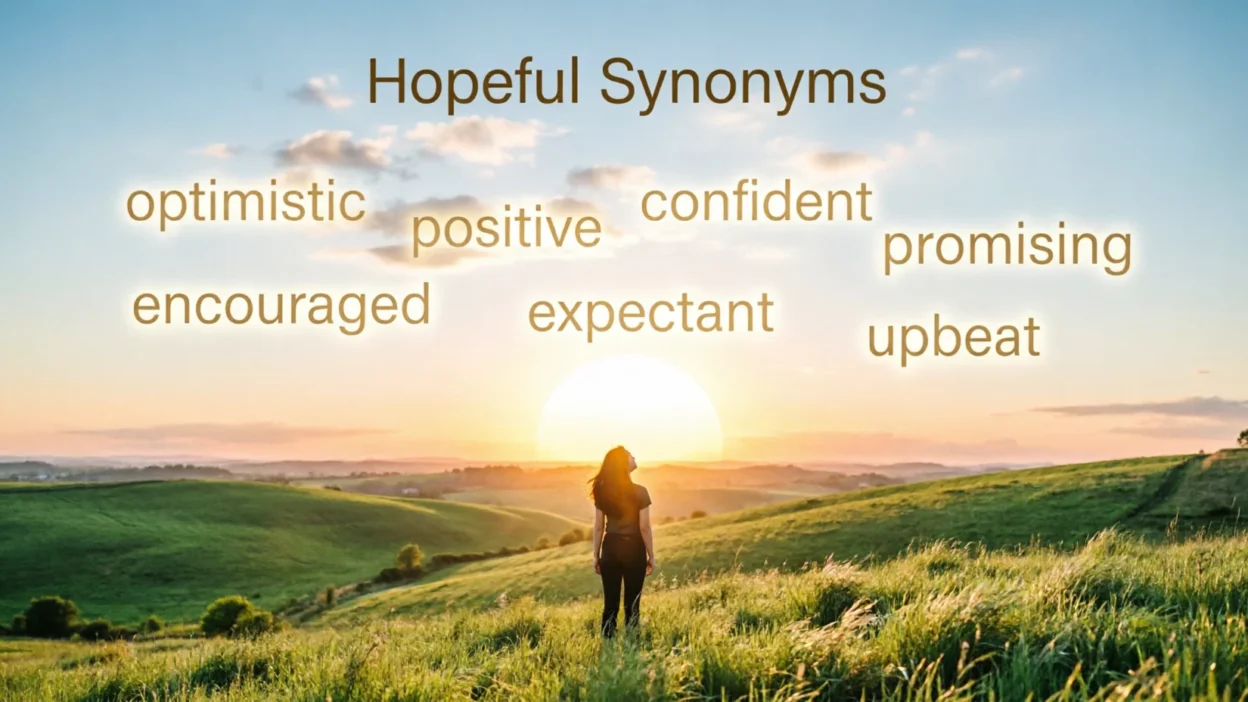
When you need a hopeful synonym, the best choice depends on what kind of hope you want to express. Words such as optimistic, positive, confident, encouraging, promising, expectant, and upbeat can all relate to hope, but they are not interchangeable in every situation. Choosing the right word can make your writing clearer and more natural.
If you are a student, ESL learner, writer, or content creator, understanding these differences can help you describe a positive outlook, a desired future result, or a feeling of encouragement more precisely.
Quick Answer
The best common synonyms for hopeful include optimistic, positive, confident, encouraged, promising, expectant, upbeat, aspiring, enthusiastic, and encouraging.
- Hopeful = believing or feeling that something good may happen.
- Optimistic = expecting a positive outcome.
- Promising = showing signs that something good is likely to happen.
- Confident = having strong belief that something will succeed.
- Encouraging = giving someone reason to feel hopeful.
- Expectant = waiting with hope or expectation.
The right synonym depends on whether you are describing a person, feeling, situation, possibility, result, or future event.
What Does Hopeful Mean?
Hopeful is an adjective that describes someone who expects or wishes for a positive outcome.
For example:
She is hopeful about getting the job.
This means she believes there is a good possibility that she will get the job.
Hopeful can also describe something that gives people a reason to expect a good result:
The early test results were hopeful.
In this context, hopeful means encouraging or showing signs of improvement.
Hopeful as a Feeling
When a person feels hopeful, they believe that circumstances can improve.
Example:
After several difficult months, he finally felt hopeful about the future.
Hopeful as an Expectation
Hopeful can also describe a positive expectation.
Example:
The team is hopeful of winning the championship.
Hopeful as a Description of Something Positive
A situation can be hopeful when it suggests a favorable outcome.
Example:
The latest economic figures are hopeful signs for the country.
30 Synonyms for Hopeful
The following words are useful alternatives to hopeful, but each has its own shade of meaning and preferred context.
1. Optimistic
Simple meaning: Expecting good things to happen.
Example:
Maria is optimistic about her chances of passing the exam.
Best usage/context: Use optimistic when someone has a generally positive view of the future or expects a favorable result.
2. Positive
Simple meaning: Thinking about or expecting good possibilities.
Example:
He remains positive despite the difficulties.
Best usage/context: A broad, natural alternative for attitudes, outlooks, reactions, and expectations.
3. Confident
Simple meaning: Feeling sure that something will succeed.
Example:
The coach is confident that the team can win.
Best usage/context: Best when hope is supported by strong belief, ability, evidence, or experience.
4. Encouraged
Simple meaning: Feeling more hopeful because something has improved or gone well.
Example:
She felt encouraged after receiving positive feedback.
Best usage/context: Use it when an event or result has increased someone’s hope.
5. Promising
Simple meaning: Showing signs that something good may happen.
Example:
The young scientist has a promising career ahead.
Best usage/context: Excellent for opportunities, results, developments, careers, treatments, plans, and early signs of success.
6. Expectant
Simple meaning: Waiting for something to happen with hope or anticipation.
Example:
The expectant crowd waited for the announcement.
Best usage/context: Use it when someone is waiting for a particular event or outcome.
7. Upbeat
Simple meaning: Cheerful and positive.
Example:
Despite the setback, she remained upbeat.
Best usage/context: Common in conversational English when describing someone’s mood, attitude, or outlook.
8. Encouraging
Simple meaning: Giving people a reason to feel hopeful.
Example:
The latest results are encouraging.
Best usage/context: Best for news, signs, evidence, results, developments, and situations that increase confidence.
9. Positive-minded
Simple meaning: Inclined to focus on good possibilities.
Example:
His positive-minded approach helped the team stay motivated.
Best usage/context: Useful when describing a person’s general mental attitude.
10. Assured
Simple meaning: Certain or confident about an outcome.
Example:
She sounded assured when discussing the future.
Best usage/context: Better than hopeful when the person sounds calm and certain rather than simply wishing for something.
11. Enthusiastic
Simple meaning: Very excited and positive about something.
Example:
The students were enthusiastic about the new project.
Best usage/context: Use it when hope is connected with excitement, energy, and strong interest.
12. Eager
Simple meaning: Very interested and excited about something that may happen.
Example:
The applicants were eager to hear the final decision.
Best usage/context: Suitable when someone strongly wants an event or opportunity to happen.
13. Aspiring
Simple meaning: Wanting to achieve something in the future.
Example:
She is an aspiring novelist.
Best usage/context: Use it for ambitions, goals, careers, achievements, and people working toward a desired future.
14. Expecting
Simple meaning: Believing that something is likely to happen.
Example:
We are expecting a successful outcome.
Best usage/context: Use it when there is a specific anticipated result. It can sound more certain than hopeful.
15. Reassured
Simple meaning: Made to feel less worried and more confident.
Example:
The doctor’s explanation left the family reassured.
Best usage/context: Use it when hope comes from receiving information, support, or evidence that reduces concern.
16. Cheerful
Simple meaning: Happy and positive.
Example:
She maintained a cheerful attitude throughout the difficult period.
Best usage/context: Primarily describes mood or personality rather than a specific expectation about the future.
17. Buoyant
Simple meaning: Cheerful, confident, and able to recover from difficulties.
Example:
The company remained buoyant despite a challenging year.
Best usage/context: Useful in formal or journalistic writing about moods, economies, markets, businesses, or people’s spirits.
18. Sanguine
Simple meaning: Calmly confident that things will turn out well.
Example:
The manager remained sanguine about the company’s future.
Best usage/context: A more advanced and formal synonym, especially useful in sophisticated writing.
19. Heartening
Simple meaning: Making people feel more hopeful or encouraged.
Example:
The community’s response was heartening.
Best usage/context: Best for actions, news, developments, or events that raise people’s spirits.
20. Reassuring
Simple meaning: Making someone feel calmer and more hopeful.
Example:
The doctor’s reassuring words helped the patient relax.
Best usage/context: Useful when something reduces fear or uncertainty.
21. Favorable
Simple meaning: Positive or likely to produce a good result.
Example:
The candidate received favorable feedback.
Best usage/context: Common in formal writing about conditions, opinions, results, circumstances, or decisions.
22. Propitious
Simple meaning: Showing that something good is likely to happen.
Example:
The clear skies were a propitious sign for the journey.
Best usage/context: A formal word for favorable conditions or signs, especially in literary or sophisticated writing.
23. Auspicious
Simple meaning: Suggesting future success or good fortune.
Example:
The project began under auspicious circumstances.
Best usage/context: Particularly useful for beginnings, occasions, signs, events, and circumstances associated with future success.
24. Receptive
Simple meaning: Open and willing to consider something positively.
Example:
The committee was receptive to the proposed changes.
Best usage/context: Not a direct synonym in every situation, but useful when hopeful expectations involve openness to an idea, opportunity, or proposal.
25. Constructive
Simple meaning: Helpful and likely to produce improvement.
Example:
The meeting ended with constructive suggestions for the future.
Best usage/context: Best when hope is connected with practical improvement, solutions, or progress.
26. Forward-looking
Simple meaning: Focused on future possibilities and progress.
Example:
The organization has developed a forward-looking strategy.
Best usage/context: Excellent for plans, policies, strategies, businesses, leaders, and people focused on future development.
27. Visionary
Simple meaning: Having imaginative ideas about a better future.
Example:
The visionary leader introduced ambitious plans for the community.
Best usage/context: Use it when hope involves imagination, ambition, innovation, or a strong picture of the future.
28. Expectant
Simple meaning: Full of anticipation about what is going to happen.
Example:
The expectant audience waited quietly for the results.
Best usage/context: Particularly useful for anticipation surrounding an upcoming event.
29. Positive-thinking
Simple meaning: Focusing on favorable possibilities rather than negative ones.
Example:
Positive-thinking helped him stay focused during the competition.
Best usage/context: Use it when discussing an attitude or approach to challenges.
30. Idealistic
Simple meaning: Believing strongly in a better or more perfect future.
Example:
Her idealistic vision inspired many young people.
Best usage/context: Useful when hope is connected with high ideals, dreams, social change, or ambitious goals. It can sometimes suggest that an idea is unrealistic.
Hopeful Synonyms Comparison Table
| Synonym | Main Meaning | Tone | Best Context |
| Hopeful | Expecting a good possibility | Neutral | General situations |
| Optimistic | Expecting a positive outcome | Positive | Future expectations |
| Positive | Focusing on good possibilities | Neutral/positive | General attitudes |
| Confident | Strongly believing in success | Strong | Performance and results |
| Encouraged | More hopeful because of good signs | Positive | Progress and feedback |
| Promising | Showing potential for success | Positive | Opportunities and results |
| Expectant | Waiting with anticipation | Neutral | Future events |
| Upbeat | Cheerful and positive | Informal | Mood and attitude |
| Encouraging | Giving reason for hope | Positive | News and evidence |
| Eager | Very interested in something happening | Positive | Opportunities and events |
| Aspiring | Working toward a desired goal | Positive | Careers and ambitions |
| Sanguine | Calmly confident | Formal | Professional writing |
| Auspicious | Suggesting future success | Formal | Events and beginnings |
| Idealistic | Hoping for an improved future | Mixed/positive | Dreams and ideals |
| Forward-looking | Focused on future progress | Formal | Plans and strategies |
Hopeful vs. Optimistic
Hopeful and optimistic are closely related, but there is an important difference.
Someone who is hopeful wants or expects something good to happen, even when the outcome is uncertain.
Someone who is optimistic generally expects a positive result or tends to see situations positively.
Hopeful:
I am hopeful that I will get the job.
Optimistic:
I am optimistic about my career prospects.
Hope can exist even when success is uncertain. Optimism often suggests a broader positive outlook.
Hopeful vs. Positive
Positive is broader than hopeful.
A person can have a positive attitude without specifically expecting something to happen.
Positive:
She has a positive attitude toward challenges.
Hopeful:
She is hopeful that the situation will improve.
Use hopeful when the idea of future possibility is important.
Hopeful vs. Confident
These words differ mainly in the level of certainty.
Hopeful suggests possibility.
Confident suggests stronger belief.
Compare:
I am hopeful that I can finish the project.
I am confident that I can finish the project.
The second sentence expresses greater certainty.
Hopeful vs. Promising
These words can both relate to positive possibilities, but they usually describe different things.
A person can be hopeful:
The student is hopeful about her results.
A situation or opportunity can be promising:
The student’s early results are promising.
Promising often describes evidence that something may succeed.
Hopeful vs. Encouraging
Hopeful usually describes someone’s feeling or expectation.
Encouraging often describes something that creates or strengthens hope.
We are hopeful about the treatment.
The treatment results are encouraging.
This distinction is especially useful in academic, professional, and informational writing.
How to Choose the Right Synonym for Hopeful
The best synonym depends on your intended meaning.
For General Hope
Choose:
- Hopeful
- Positive
- Optimistic
Example:
She remains optimistic about the future.
For Strong Belief in Success
Choose:
- Confident
- Assured
- Expecting
Example:
The team is confident about its chances.
These words are stronger than simply saying someone is hopeful.
For Positive Signs
Choose:
- Encouraging
- Promising
- Heartening
- Reassuring
Example:
The latest test results are encouraging.
These words work particularly well when evidence gives people more reason to expect improvement.
For Cheerful Attitudes
Choose:
- Upbeat
- Cheerful
- Buoyant
- Positive
Example:
He remained upbeat despite the setback.
For Ambitions and Dreams
Choose:
- Aspiring
- Idealistic
- Visionary
- Forward-looking
Example:
She has a forward-looking vision for the organization.
For Formal Writing
Choose:
- Sanguine
- Auspicious
- Propitious
- Favorable
- Reassuring
Example:
The project began under auspicious circumstances.
These choices can make formal writing more precise, although simpler words are often better when clarity is the priority.
For Anticipation
Choose:
- Expectant
- Eager
- Expecting
Example:
The audience was expectant as the results were announced.
Common Usage Mistakes
1. Treating Every Synonym as Exactly the Same
Not every synonym can replace hopeful in every sentence.
For example:
She is hopeful about her future.
Changing it to:
She is promising about her future.
does not work naturally.
Promising generally describes a person, thing, opportunity, or result as showing potential—not simply someone who feels hope.
2. Using Confident When You Mean Uncertain
Confident usually communicates a stronger belief than hopeful.
If you are unsure about the outcome, hopeful may be more accurate.
3. Confusing Positive With Hopeful
Someone can be positive without hoping for a particular outcome.
He has a positive personality.
This does not necessarily mean:
He is hopeful about the result.
Use hopeful when there is a connection to a desired future possibility.
4. Using Formal Words in Casual Conversations
Words such as propitious, auspicious, and sanguine are more formal.
In everyday conversation, hopeful, optimistic, positive, or upbeat usually sound more natural.
5. Confusing Eager With Hopeful
Eager emphasizes strong interest or excitement.
Hopeful emphasizes the possibility of a desired outcome.
She is eager to start the new job.
She is hopeful that she will get the new job.
The meanings overlap, but they are not identical.
FAQs:
What is the best synonym for hopeful?
Optimistic is one of the closest general synonyms for hopeful. However, positive, confident, encouraged, promising, and expectant may be better depending on the sentence.
What is a stronger word than hopeful?
Confident can be stronger than hopeful because it suggests a higher level of certainty. Assured can also express strong confidence.
What is a positive synonym for hopeful?
Common positive alternatives include optimistic, upbeat, encouraged, promising, positive, heartening, and reassuring.
What is the opposite of hopeful?
Common opposites include hopeless, pessimistic, doubtful, discouraged, despairing, and uncertain, depending on the context.
Is optimistic the same as hopeful?
They are closely related but not exactly identical. Hopeful often refers to wanting or expecting a particular positive outcome, while optimistic can describe a broader tendency to expect good results.
What is a formal synonym for hopeful?
Depending on the context, formal alternatives include sanguine, auspicious, propitious, favorable, and expectant. The most suitable choice depends on the exact meaning.
What is a synonym for hopeful in a professional context?
Optimistic, confident, encouraged, promising, favorable, and forward-looking can work well in professional writing. Choose the word that accurately matches the intended meaning.
Can hopeful describe a situation?
Yes. Hopeful can describe a situation, sign, development, or result when it gives people reason to expect improvement or success.
For example:
The latest developments are hopeful signs for the community.
Final Thoughts
The word hopeful expresses a positive expectation that something good may happen. Its closest alternatives include optimistic, positive, confident, encouraged, promising, expectant, and upbeat, but each carries a slightly different meaning.
For general future expectations, optimistic is often a natural choice. For strong certainty, use confident. For positive evidence, choose encouraging or promising. For ambition, aspiring may be more precise, while upbeat works well for a cheerful attitude.
Understanding these small differences allows you to choose words that communicate your meaning more accurately and naturally.

I’m Nathan Collins, a language enthusiast passionate about exploring synonyms and improving everyday writing. I create clear, accurate, and helpful content that helps readers expand vocabulary and communicate with confidence.