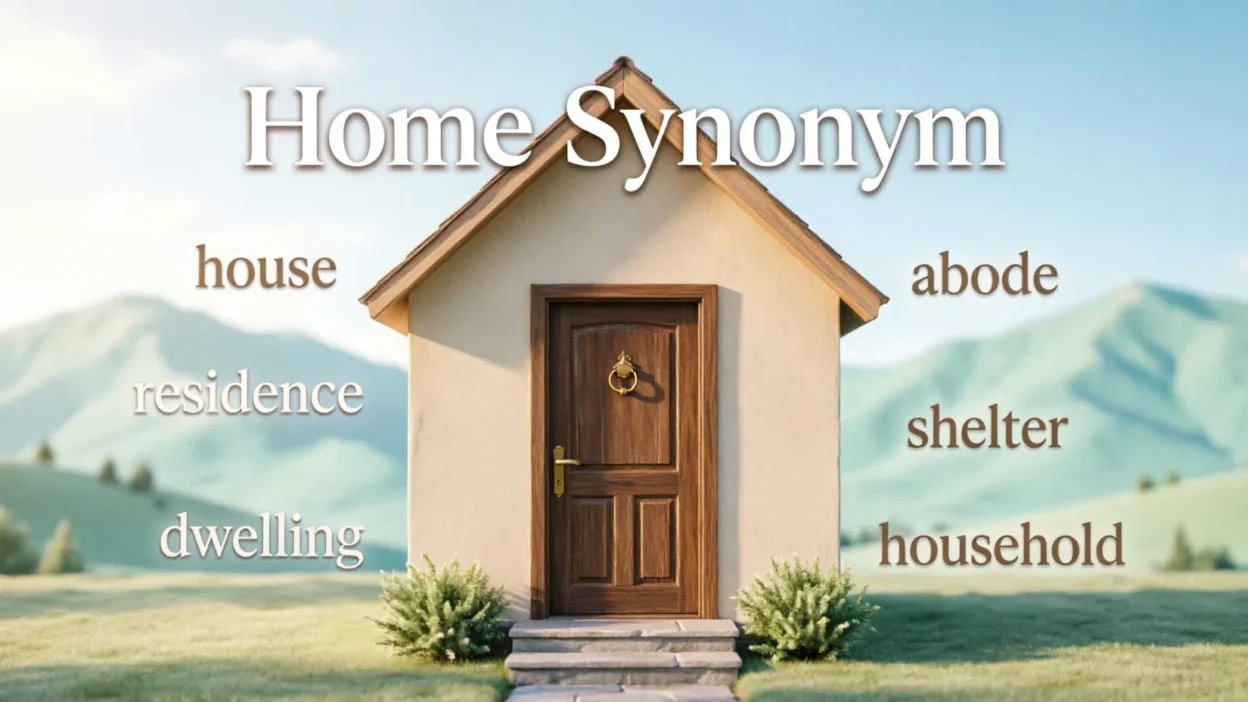
The word home can mean the place where someone lives, a family household, a safe and comfortable place, or even a place that feels familiar and meaningful. Common home synonyms include house, residence, dwelling, abode, household, domicile, shelter, and homestead. The best synonym depends on whether you are talking about a building, a family, a permanent residence, or an emotional sense of belonging.
Quick Answer: What Is a Synonym for Home?
Some of the most useful synonyms for home are:
- House – a building where people live
- Residence – a formal word for a place where someone lives
- Dwelling – a place used as a home
- Abode – a somewhat literary word for a home
- Domicile – a person’s permanent or official home
- Household – the people living together in a home
- Homestead – a home and the surrounding land
- Haven – a safe and peaceful place
- Shelter – a place providing protection
- Lodging – temporary accommodation
- Quarters – living or sleeping accommodation
- Pad – an informal word for someone’s home
- Place – an informal way to refer to someone’s home
- Residence – a place where a person lives
- Accommodation – a place provided for living
The right choice depends on your intended meaning and tone.
What Does Home Mean?
Home usually refers to the place where a person lives. It can be a house, apartment, room, flat, or another type of residence.
For example:
I am going home after work.
However, home has a deeper meaning than simply a building. It can describe a place where someone feels comfortable, safe, accepted, or connected.
After years abroad, she finally felt that the city was home.
The word can also refer to a person’s family or household:
Everyone at home is excited about the celebration.
Because home has several meanings, its synonym should be chosen according to context.
30 Synonyms for Home
1. House
Simple meaning: A building where people live.
Example:
We bought a small house near the park.
Best usage/context: Use house when you specifically mean a residential building. Unlike home, it usually focuses more on the physical structure.
2. Residence
Simple meaning: A place where someone lives.
Example:
The president’s official residence is heavily protected.
Best usage/context: Residence works well in formal, professional, legal, and official writing.
3. Dwelling
Simple meaning: A place where people live.
Example:
The village contains hundreds of traditional dwellings.
Best usage/context: Use dwelling when referring generally to a living space or residential structure, especially in formal or descriptive writing.
4. Abode
Simple meaning: A person’s home or place of residence.
Example:
The traveler returned to his peaceful abode after a long journey.
Best usage/context: Abode has a literary, old-fashioned, or elegant tone. It can add character to creative writing.
5. Domicile
Simple meaning: A person’s permanent or official home.
Example:
The form requires the applicant’s current domicile.
Best usage/context: Use domicile mainly in legal, administrative, tax, or highly formal contexts.
6. Household
Simple meaning: The people who live together in one home, or the home and family unit itself.
Example:
Everyone in the household helped prepare dinner.
Best usage/context: Choose household when your focus is on the people living together rather than the physical building.
7. Homestead
Simple meaning: A home, often with land around it.
Example:
Their family homestead has been in the countryside for generations.
Best usage/context: Homestead is useful for rural homes, family properties, farms, and places connected with family history.
8. Haven
Simple meaning: A safe, peaceful, or comfortable place.
Example:
Her apartment became a quiet haven after a stressful day.
Best usage/context: Use haven when emphasizing safety, peace, comfort, or emotional security.
9. Shelter
Simple meaning: A place that protects someone from danger or bad weather.
Example:
The hikers found shelter from the heavy rain.
Best usage/context: Shelter emphasizes protection rather than comfort or ownership. It can also refer to temporary housing.
10. Accommodation
Simple meaning: A place where someone can live or stay.
Example:
The university provides accommodation for international students.
Best usage/context: Common in British English and formal contexts when discussing housing, hotels, student housing, or temporary places to stay.
11. Lodging
Simple meaning: A temporary place to stay.
Example:
We found affordable lodging near the train station.
Best usage/context: Use lodging when talking about temporary accommodation, especially while traveling.
12. Quarters
Simple meaning: A place where someone lives or stays.
Example:
The workers returned to their quarters after the shift.
Best usage/context: Quarters is often used for military personnel, workers, servants, or people staying in assigned accommodation.
13. Pad
Simple meaning: A person’s home or apartment.
Example:
Come over to my pad this weekend.
Best usage/context: Pad is informal and conversational. It is suitable for casual speech rather than formal writing.
14. Place
Simple meaning: An informal way of referring to someone’s home.
Example:
Would you like to come over to my place?
Best usage/context: Place is extremely common in everyday English when the exact type of home does not matter.
15. Flat
Simple meaning: An apartment, especially in British English.
Example:
She rents a comfortable flat in the city center.
Best usage/context: Use flat when referring to an apartment, particularly in British English.
16. Apartment
Simple meaning: A set of rooms for living in, usually within a larger building.
Example:
They moved into a modern apartment downtown.
Best usage/context: Apartment is a precise choice when you mean a residential unit in a building.
17. Cottage
Simple meaning: A small, usually cozy house.
Example:
They spent the weekend in a charming cottage by the lake.
Best usage/context: Use cottage for a small house, often in a rural or picturesque setting.
18. Manor
Simple meaning: A large country house or estate.
Example:
The historic manor overlooks the surrounding fields.
Best usage/context: Manor is appropriate for large, traditional, or historically significant houses, especially in British contexts.
19. Villa
Simple meaning: A large or attractive house, often located in a warm or resort area.
Example:
They rented a beautiful villa near the coast.
Best usage/context: Use villa for spacious private houses, particularly vacation properties or homes in Mediterranean-style settings.
20. Estate
Simple meaning: A large property that may include a house and surrounding land.
Example:
The family owns a large estate in the countryside.
Best usage/context: Estate is useful when the property includes substantial land or multiple buildings.
21. Household Residence
Simple meaning: A place where a household lives.
Example:
The family moved their household residence to a quieter neighborhood.
Best usage/context: This phrase is more formal and should be used when discussing a household’s residential location. In everyday English, home or residence is usually more natural.
22. Retreat
Simple meaning: A peaceful place where someone goes to relax or escape from daily pressures.
Example:
Their mountain cabin became a peaceful retreat.
Best usage/context: Use retreat when emphasizing privacy, rest, peace, or escape rather than simply describing where someone permanently lives.
23. Refuge
Simple meaning: A safe place where someone can escape danger or difficulty.
Example:
The small house became a refuge for the family during the storm.
Best usage/context: Refuge emphasizes safety and protection. It is stronger and more serious than the everyday word home.
24. Sanctuary
Simple meaning: A place offering safety, peace, or comfort.
Example:
Her garden was a sanctuary from the noise of the city.
Best usage/context: Use sanctuary when describing a home or place as emotionally peaceful, protected, or restorative.
25. Base
Simple meaning: A place where someone normally lives, works, or operates.
Example:
London is currently her home base.
Best usage/context: Base is useful when someone travels frequently or has a main location from which they operate.
26. Hearth
Simple meaning: The fireplace or home that represents family and domestic life.
Example:
They gathered around the hearth on a cold winter evening.
Best usage/context: Hearth has a warm, traditional, and literary feeling. It often symbolizes family life rather than simply a building.
27. Nest
Simple meaning: An informal or affectionate word for a comfortable home.
Example:
After months of traveling, she was happy to return to her little nest.
Best usage/context: Nest is often used affectionately to describe a cozy, comfortable, private home.
28. Family Home
Simple meaning: A home shared by or associated with a family.
Example:
They decided to renovate their old family home.
Best usage/context: Use family home when the emotional or family connection to the property is important.
29. Permanent Residence
Simple meaning: The place where someone lives permanently.
Example:
The country became his permanent residence after several years.
Best usage/context: This phrase is useful in formal, legal, immigration, administrative, and official contexts.
30. Living Quarters
Simple meaning: Rooms or spaces where someone lives.
Example:
The building provides separate living quarters for staff.
Best usage/context: Use living quarters when referring to designated residential spaces, particularly in institutional, military, workplace, or formal settings.
Home Synonyms Comparison Table
| Synonym | Main Meaning | Tone | Best Context |
| House | Residential building | Neutral | Everyday English |
| Residence | Place where someone lives | Formal | Official writing |
| Dwelling | Living structure | Formal/neutral | General descriptions |
| Abode | Home | Literary | Creative writing |
| Domicile | Permanent home | Very formal | Legal/official |
| Household | People living together | Neutral | Family and domestic contexts |
| Homestead | Home with land | Traditional | Rural/family property |
| Haven | Safe, peaceful place | Positive | Emotional/descriptive |
| Shelter | Protected place | Neutral/serious | Safety and housing |
| Accommodation | Place to live/stay | Formal | Travel, study, housing |
| Lodging | Temporary accommodation | Neutral | Travel |
| Quarters | Assigned living space | Formal | Military/workplace |
| Pad | Home/apartment | Informal | Casual conversation |
| Place | Someone’s home | Informal/neutral | Everyday speech |
| Flat | Apartment | Neutral | British English |
| Apartment | Residential unit | Neutral | Urban housing |
| Cottage | Small cozy house | Warm | Rural/picturesque settings |
| Manor | Large country house | Formal/literary | Historic properties |
| Villa | Large attractive house | Neutral | Vacation/resort homes |
| Estate | Property with land | Formal | Large properties |
| Retreat | Peaceful place | Positive | Relaxation/escape |
| Refuge | Safe place | Serious | Protection |
| Sanctuary | Safe, peaceful place | Emotional | Comfort and security |
| Base | Main place of operation | Neutral | Travel/work |
| Hearth | Symbolic home | Literary | Family/tradition |
| Nest | Cozy home | Affectionate | Informal descriptions |
| Family home | Family-associated home | Warm | Family contexts |
| Permanent residence | Permanent living place | Formal | Legal/official use |
| Living quarters | Residential space | Formal | Work/institutional settings |
How to Choose the Right Synonym for Home
Not every synonym for home can replace the word in every sentence. The best choice depends on what you want to emphasize.
For Everyday Meaning
Use:
- House
- Place
- Home
- Apartment
- Flat
Example:
I left my house at 8 a.m.
Here, house focuses on the physical building.
Come to my place tonight.
Here, place is casual and natural.
For Formal Writing
Use:
- Residence
- Domicile
- Dwelling
- Permanent residence
- Accommodation
Example:
The applicant must provide proof of residence.
Residence sounds much more appropriate than home in this formal context.
For a Safe or Peaceful Home
Use:
- Haven
- Sanctuary
- Refuge
- Retreat
Example:
Her home was a haven after a difficult day.
These words highlight the emotional experience of being at home.
For a Rural or Traditional Home
Use:
- Homestead
- Cottage
- Manor
- Estate
- Hearth
Example:
The old homestead has remained in the family for generations.
For Temporary Housing
Use:
- Lodging
- Accommodation
- Quarters
- Shelter
Example:
The travelers arranged lodging before leaving the city.
For Informal Conversation
Use:
- Place
- Pad
- Nest
Example:
Want to come over to my place?
This sounds natural and conversational.
Home vs. House: What Is the Difference?
Home and house are related, but they are not always interchangeable.
A house is usually a physical building.
A home is the place where someone lives and may also carry emotional meaning.
Compare:
They bought a new house.
This tells us about a physical property.
They finally found a new home.
This can suggest not only a building but also a place where they feel they belong.
A person can live in an apartment and still call it their home. Therefore, home is broader than house.
Common Mistakes When Using Home Synonyms
Mistake 1: Using “Domicile” in Casual Conversation
Although domicile means a home or permanent residence, it sounds highly formal.
Unnatural for everyday conversation:
Come to my domicile for dinner.
Natural:
Come to my place for dinner.
Mistake 2: Treating “House” and “Home” as Exactly the Same
A house describes a type of building, while home can describe a place of belonging.
This house is beautiful.
focuses on the building.
This feels like home.
focuses on comfort and belonging.
Mistake 3: Using “Lodging” for a Permanent Home
Lodging usually suggests temporary accommodation.
Better:
We found lodging for the weekend.
Not:
This is my permanent lodging.
For permanent living, home, residence, or dwelling may be more appropriate.
Mistake 4: Using “Shelter” When You Mean a Comfortable Family Home
Shelter focuses on protection.
The roof provided shelter from the rain.
It does not necessarily communicate the warmth or emotional connection associated with home.
Mistake 5: Using “Abode” Everywhere
Abode is understandable, but it can sound literary or old-fashioned.
For everyday English, home, house, or place will usually sound more natural.
FAQs:
What is the best synonym for home?
The best synonym depends on the context. House is useful for a physical building, residence for formal writing, dwelling for a general residential place, and haven when emphasizing safety and comfort.
What is a formal synonym for home?
Common formal synonyms include residence, domicile, dwelling, accommodation, and permanent residence. Domicile is especially formal and is often used in legal or administrative contexts.
What is a simple synonym for home?
House, place, residence, and dwelling can all work, depending on the sentence. For everyday conversation, place and house are especially common.
What is a synonym for home in a poetic sense?
Poetic or literary alternatives include abode, hearth, haven, sanctuary, nest, and homestead. These words can create a stronger emotional or traditional feeling.
What is another word for a place where someone lives?
You can use residence, dwelling, house, apartment, flat, abode, domicile, or living quarters. The most suitable word depends on whether the setting is casual, formal, temporary, or permanent.
What is a synonym for home that means a safe place?
Haven, refuge, sanctuary, and shelter can describe a safe place. Haven often has a positive and peaceful feeling, while refuge and shelter can suggest protection from danger or hardship.
Is “residence” the same as “home”?
They are closely related, but residence is more formal and usually refers to the place where someone lives. Home can carry additional emotional meanings such as comfort, belonging, family, and security.
What is an informal word for home?
Place and pad are common informal alternatives. For example, “Come over to my place” sounds natural in casual conversation.
Conclusion
There are many useful home synonyms, but each one carries a slightly different meaning or tone. House describes a physical building, while residence and domicile are more formal. Dwelling is a broad term for a place where people live, while abode has a literary quality.
If you want to emphasize comfort and safety, words such as haven, sanctuary, refuge, and retreat can be effective. For rural or traditional settings, homestead, cottage, manor, and hearth may be more appropriate. In casual conversation, place and pad are natural choices.
The key is to choose a word that matches both the meaning you want to express and the tone of your sentence. Understanding these differences can make your English more precise, natural, and expressive.

I’m James Parker, Administrator at SynonymsHive. I oversee content quality, improve user experience, and ensure reliable synonym resources. My passion is making language learning simple, accurate, and accessible for everyone.