English has many words that look or sound similar but have different levels of acceptance in everyday communication. Indecisive vs undecisive is one such confusing word pair. Both words seem logical because they describe someone who struggles to make decisions. However, they are not equally common or natural in modern English.
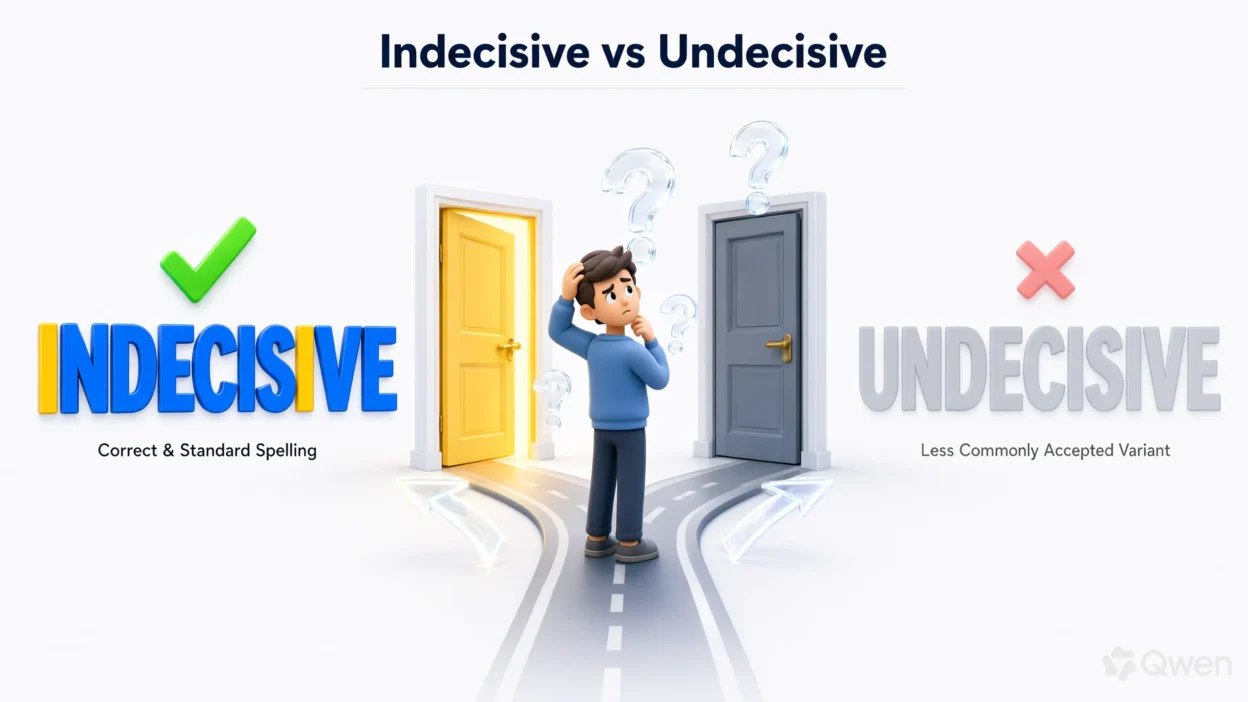
The main difference is that indecisive is the standard and widely accepted English word, while undecisive is uncommon and generally considered nonstandard or an incorrect alternative in most contexts.
If you want to describe someone who cannot make up their mind, indecisive is the word you should choose. Understanding this distinction can help you improve your vocabulary, write more naturally, and avoid mistakes in school assignments, professional communication, and everyday conversations. In this guide, you will learn what each word means, how they differ, when to use them, and how to remember the correct choice.
Quick Answer
Indecisive is the correct and standard word for someone who struggles to make decisions or has difficulty choosing between options. Undecisive is rarely used and is generally not recommended in standard English. For clear, natural communication, always choose indecisive.
Why Do People Confuse Indecisive and Undecisive?
People confuse these words because both contain the word decisive, which relates to making decisions.
The confusion also comes from English prefixes:
- In- often means not or the opposite of something.
- Un- can also mean not or the opposite of something.
Since both prefixes can create negative meanings, people may assume that indecisive and undecisive are equally correct.
However, English does not always allow two negative prefixes to be used interchangeably. Some word combinations become established through common usage, while others remain uncommon or nonstandard.
In this case, indecisive is the established adjective used in modern English.
1. What Does Indecisive Mean?
Indecisive is an adjective that describes someone who has difficulty making decisions, choosing between alternatives, or reaching a final conclusion.
An indecisive person may spend a long time thinking about different possibilities because they are unsure which option is best.
Simple Meaning: Unable to make decisions easily.
Examples:
- She is indecisive when choosing what to wear.
- My brother is too indecisive to select a restaurant.
- The manager seemed indecisive during the meeting.
- I became indecisive when I had to choose between two job offers.
Synonyms of Indecisive
Here are some useful words with similar meanings:
- Hesitant
- Uncertain
- Unsure
- Doubtful
- Vacillating
- Wavering
- Reluctant
- Inconsistent
- Undetermined
- Irresolute
These synonyms have slightly different meanings, so choose one according to the situation.
Is Indecisive a Positive or Negative Word?
Indecisive usually has a negative meaning because it suggests difficulty making choices or taking action.
However, it is not always an insult. It can simply describe someone’s behavior in a particular situation.
For example:
“My friend is indecisive about which movie to watch.”
This sentence describes a temporary difficulty rather than criticizing someone’s entire personality.
2. What Does Undecisive Mean?
Undecisive is an uncommon adjective formed by adding the prefix un- to decisive. It may be understood as describing someone who is not decisive or does not make decisions confidently.
However, it is not the standard word used for this meaning in modern English.
In most situations, writers and speakers should use indecisive instead.
Simple Meaning: An uncommon or nonstandard alternative intended to describe someone who is not decisive.
Examples of the intended meaning:
- He was undecisive about his career choice.
- The team appeared undecisive during the discussion.
- She seemed undecisive when selecting a dress.
Although readers may understand these sentences, they sound unnatural in standard English.
Better versions:
- He was indecisive about his career choice.
- The team appeared indecisive during the discussion.
- She seemed indecisive when selecting a dress.
Is Undecisive a Real Word?
Undecisive can occasionally appear in informal writing or as an unusual word formation. However, it is not the conventional choice in standard English.
If you are writing an essay, academic assignment, professional email, or formal document, use indecisive.
3. Indecisive vs Undecisive: Comparison Table
The following table highlights the main differences between these two words.
| Feature | Indecisive | Undecisive |
| Part of speech | Adjective | Adjective |
| Meaning | Unable to make decisions easily | Intended to mean not decisive |
| Standard usage | Yes | Generally nonstandard |
| Commonness | Very common | Very rare |
| Formal writing | Recommended | Avoid |
| Everyday English | Natural | Unnatural |
| Dictionary recognition | Established word | Limited recognition |
| Best choice | Correct option | Not recommended |
Key Difference: Indecisive is the established English adjective for someone who struggles to make decisions. Undecisive is an uncommon alternative that should generally be avoided.
4. When Should You Use Indecisive or Undecisive?
Knowing the appropriate context makes it easier to choose the correct word.
When to Use Indecisive
Use indecisive when describing a person who struggles to choose between different options or make a final decision.
It is appropriate in:
- Everyday conversations
- Academic writing
- Professional communication
- Essays and assignments
- Personal descriptions
- Workplace discussions
Examples:
- My sister is indecisive about buying a new phone.
- The director appeared indecisive during the meeting.
- I feel indecisive about my future career.
When to Use Undecisive
In standard modern English, there is generally no reason to choose undecisive instead of indecisive.
If you want to express that someone is unable to make decisions, use indecisive.
If you mean that someone lacks confidence or is uncertain, you can also use:
- Uncertain
- Hesitant
- Unsure
- Doubtful
- Irresolute
These alternatives may communicate your intended meaning more naturally.
5. Indecisive vs Undecisive: 12 Example Sentences
Examples make it easier to understand how these words work in real-life situations.
Here are 12 examples showing the correct usage of indecisive.
1. Choosing clothes: She is indecisive about what to wear to the party.
2. Making plans: I became indecisive when my friends suggested three different vacation destinations.
3. Career decisions: He feels indecisive about choosing between medicine and engineering.
4. Shopping: My mother is indecisive whenever she buys new furniture.
5. Workplace decisions: The manager seemed indecisive when discussing the company’s future.
6. Relationships: She was indecisive about whether to accept his proposal.
7. Education: Students sometimes feel indecisive when selecting their university majors.
8. Food choices: My brother is so indecisive that ordering dinner takes him half an hour.
9. Travel: We were indecisive about which country to visit during our holidays.
10. Personal goals: Being indecisive can make it difficult to achieve important goals.
11. Teamwork: The committee appeared indecisive while discussing the new project.
12. Everyday life: I am indecisive when choosing between two equally attractive options.
Incorrect vs Correct Examples
| Incorrect | Correct |
| She is undecisive. | She is indecisive. |
| He seems undecisive today. | He seems indecisive today. |
| I am feeling undecisive. | I am feeling indecisive. |
| The manager was undecisive. | The manager was indecisive. |
| They are undecisive about the plan. | They are indecisive about the plan. |
6. Common Mistakes When Using Indecisive and Undecisive
English learners sometimes make mistakes when choosing between these words.
Here are some common errors to avoid.
Mistake 1: Assuming Both Words Are Equally Correct
Because both prefixes can express negative meanings, people sometimes think the words are interchangeable.
Incorrect assumption: Indecisive and undecisive are equally accepted.
Correct understanding: Indecisive is the standard word.
Mistake 2: Using Undecisive in Formal Writing
Using undecisive in an academic essay or professional document may make your writing sound unnatural.
Better choice: Use indecisive.
Mistake 3: Confusing Indecisive With Indecision
These words are related but have different grammatical functions.
- Indecisive: An adjective describing someone who struggles to make decisions.
- Indecision: A noun describing the inability or difficulty to make a decision.
Examples:
- She is indecisive about her career.
- Her indecision delayed the project.
Mistake 4: Thinking Indecisive Always Describes a Weak Person
Being indecisive does not necessarily mean someone is weak.
A person may struggle to decide because they have several good options, lack information, or want to avoid making the wrong choice.
7. Memory Trick: How to Remember the Correct Word
A simple memory trick can help you remember which word to use.
Remember: INDECISIVE = INABILITY TO DECIDE.
Think of the word indecisive whenever someone cannot make up their mind.
For example:
- Cannot choose a dress? Indecisive.
- Cannot select a restaurant? Indecisive.
- Cannot decide which job to accept? Indecisive.
Another helpful trick is to remember this sentence:
“If you cannot decide, you are indecisive.”
Avoid creating undecisive when you want to describe someone who struggles with decisions.
8. American vs British English: Indecisive vs Undecisive
Is there any difference between American and British English when using these words?
No significant difference exists.
Both American English and British English use indecisive as the standard adjective for someone who has difficulty making decisions.
| English Variety | Preferred Word | Example |
| American English | Indecisive | He is indecisive about his career. |
| British English | Indecisive | He is indecisive about his career. |
| Australian English | Indecisive | She is indecisive about the offer. |
| Canadian English | Indecisive | They are indecisive about their plans. |
Undecisive is not the preferred standard form in these varieties.
Therefore, you can confidently use indecisive regardless of whether you are writing in American or British English.
9. Similar Words Related to Indecisive
Several English words describe uncertainty, hesitation, or difficulty making decisions.
Understanding their meanings can help you expand your vocabulary.
| Word | Simple Meaning | Example |
| Hesitant | Slow or unsure about acting | She was hesitant to answer. |
| Uncertain | Not completely sure | He is uncertain about his future. |
| Doubtful | Having doubts | I am doubtful about the plan. |
| Irresolute | Unable to make a firm decision | The leader seemed irresolute. |
| Vacillating | Frequently changing opinions | He is vacillating between two choices. |
| Wavering | Not firm or certain | She remained wavering about her decision. |
| Undecided | Not having made a choice yet | I am undecided about the offer. |
| Reluctant | Unwilling or hesitant | He was reluctant to participate. |
Indecisive vs Undecided
These words are closely related but have slightly different meanings.
- Indecisive describes a person’s tendency or difficulty in making decisions.
- Undecided describes a situation in which a decision has not yet been made.
Examples:
- She is indecisive when choosing clothes.
- She is still undecided about which dress to buy.
Both are correct, but they are not always interchangeable.
10. Final Verdict: Which Word Should You Use?
The correct choice is indecisive.
It is the standard English adjective used to describe someone who struggles to make decisions, feels uncertain about choices, or has difficulty reaching a conclusion.
Undecisive is an uncommon formation and is generally not accepted as the natural alternative in standard English.
Remember these points:
- Use indecisive in everyday conversations.
- Use indecisive in academic and professional writing.
- Use undecided when a choice has not yet been made.
- Use hesitation or uncertainty when describing a lack of confidence.
Choosing the established word will make your writing clearer and more natural.
FAQs:
1. Is it indecisive or undecisive?
Indecisive is the standard and correct word in modern English. It describes someone who struggles to make decisions. Undecisive is uncommon and generally not recommended.
2. Is undecisive a real English word?
Undecisive occasionally appears as an unusual word formation, but it is not the standard adjective for describing someone who cannot make decisions. Indecisive is the preferred choice.
3. What does indecisive mean in simple words?
Indecisive means having difficulty choosing between different options or making a final decision. An indecisive person may take a long time to decide what they want.
4. What is the opposite of indecisive?
The opposite of indecisive is decisive. A decisive person can make decisions confidently and firmly.
Example: She is decisive and always knows what she wants.
5. Is indecisive a negative word?
Yes, indecisive usually has a negative meaning because it suggests difficulty making choices. However, it can also be a neutral description of someone’s behavior in a particular situation.
6. What is the difference between indecisive and undecided?
Indecisive describes someone who has difficulty making decisions, while undecided means that a final choice has not yet been made.
Example:
- He is indecisive about everything.
- He is undecided about which university to attend.
7. Is indecisive used in both American and British English?
Yes. Indecisive is the standard word in both American and British English. There is no meaningful spelling difference between the two varieties.
12. Remember This
INDECISIVE
Correct choice
Indecisive
Someone who struggles to make decisions.
Example: She is indecisive about her future.
UNDECISIVE
Avoid
Undecisive
An uncommon, generally nonstandard alternative.
Better: She is indecisive about her future.
Easy rule: If someone cannot make up their mind, use indecisive.
Conclusion
Understanding the difference between indecisive and undecisive is simple once you know which word is accepted in standard English. Although both words may seem grammatically possible, indecisive is the established adjective used to describe someone who has difficulty making decisions. Undecisive is uncommon and should generally be avoided in everyday and formal writing.
Whenever you describe someone who struggles to choose between different options, remember to use indecisive. Practicing the examples and remembering the simple rule will help you use the word confidently in conversations, academic assignments, and professional communication.

I’m James Parker, Administrator at SynonymsHive. I oversee content quality, improve user experience, and ensure reliable synonym resources. My passion is making language learning simple, accurate, and accessible for everyone.