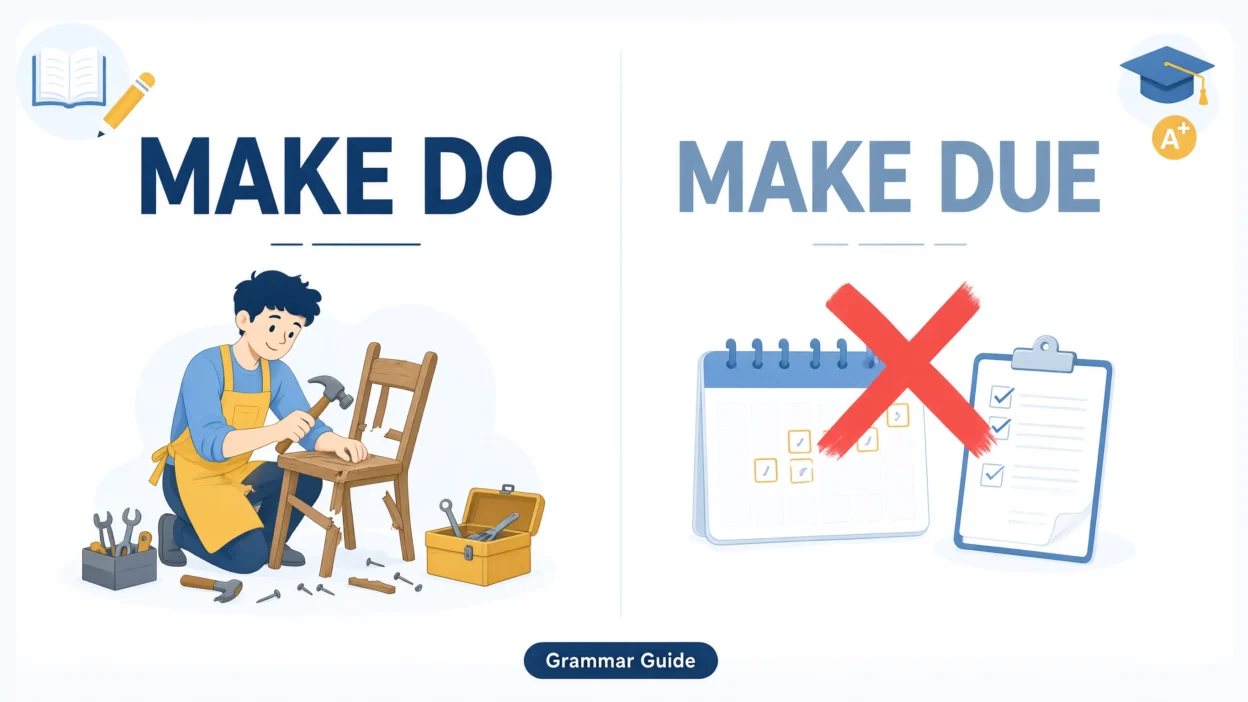
The phrases “make do” and “make due” sound exactly alike, but only one is correct when you mean managing with what you have. If you have ever wondered whether to write “make do with what you have” or “make due with what you have,” the correct expression is make do. It means to manage with limited resources, accept what is available, or find a practical solution when something better is unavailable.
The confusion happens because “do” and “due” are pronounced the same way in many varieties of English. However, their meanings and grammatical uses are different. “Do” is a verb associated with performing an action, while “due” commonly refers to something expected, owed, or scheduled.
Although “make due” may appear in informal writing or as a spelling mistake, it is not the standard expression for coping with limited options. Understanding the difference will help you write more clearly in emails, school assignments, professional documents, and everyday conversations.
Quick Answer
Make do is the correct expression when you must manage with what is available instead of what you want or need. For example, “We didn’t have enough chairs, so we made do with benches.” Make due is not the standard phrase for this meaning. The word “due” is used separately in expressions such as “The payment is due tomorrow.”
Why Do People Confuse Make Do and Make Due?
People often confuse these expressions because they are homophones: words or expressions that sound alike but have different meanings or spellings.
Both phrases can sound identical in everyday conversation, making it difficult to recognize the correct spelling by listening alone.
There is also a connection between the meaning of “make do” and situations involving deadlines or obligations. Someone might mistakenly use “make due” when talking about managing a difficult situation, even though “due” does not carry that meaning.
The easiest way to avoid the mistake is to remember that make do means manage with what you have.
1. What Does Make Do Mean?
Make do is an English expression that means to manage with whatever is available, especially when you do not have the ideal tools, money, time, or resources.
It often describes a temporary solution or a practical response to an inconvenient situation.
Examples of Make Do
- We had no fresh vegetables, so we made do with canned food.
- She forgot her notebook and had to make do with a few sheets of paper.
- The hotel was fully booked, so we made do with a smaller room.
- I don’t have my usual computer, but I can make do with this laptop.
How to Use Make Do in a Sentence
The expression usually appears as “make do with” when you mention the available resource.
Examples:
- We will have to make do with the equipment we have.
- He made do with an old bicycle until he could afford a new one.
- They are making do with a limited budget.
The verb “make” changes according to the tense, but “do” remains part of the expression.
| Tense | Example |
| Present | I make do with simple tools. |
| Past | We made do with what we had. |
| Future | They will make do until help arrives. |
| Present continuous | She is making do with an older phone. |
| Present perfect | We have made do for several weeks. |
2. What Does Make Due Mean?
Make due is not the standard English idiom for managing with limited resources. In ordinary writing, if you mean finding a way to manage with what is available, use “make do.”
The word “due” is nevertheless a valid English word with several common meanings.
Common Uses of Due
1. Something that must be paid
- My rent is due on the first day of the month.
- The final payment is due tomorrow.
2. Something expected to happen
- The train is due to arrive at noon.
- Her baby is due next month.
3. Something deserved or owed
- The team received the credit it was due.
- Everyone deserves their due respect.
4. A deadline or required date
- The assignment is due on Friday.
- The report is due by the end of the week.
These examples show why “due” is useful in English, but they do not make “make due” a substitute for “make do.”
Make Do vs. Make Due: Comparison Table
| Feature | Make do | Make due |
| Standard expression for coping with limited resources | Yes | No |
| Meaning | Manage with what is available | Not the standard idiom for this meaning |
| Correct example | We made do with a small budget. | We made due with a small budget. (Incorrect for this meaning) |
| Main word meaning | “Do” relates to acting or managing | “Due” relates to what is owed or expected |
| Common context | Limited money, tools, time, or supplies | Payments, deadlines, expected events |
| Recommended usage | Use when adapting to limitations | Use “due” in its appropriate grammatical context |
When Should You Use Make Do or Due?
Choosing the right expression becomes easier when you focus on the meaning of your sentence.
Use Make Do When You Must Manage
Use “make do” when you do not have the ideal option and need to work with what is available.
Examples:
- We had to make do without electricity.
- I will make do with my old shoes for another month.
- The school made do with its limited supplies.
In each example, someone is adapting to a shortage or limitation.
Use Due When Something Is Owed or Expected
Use “due” when discussing a payment, deadline, expected arrival, or something someone deserves.
Examples:
- My electricity bill is due today.
- The package is due to arrive tomorrow.
- The employee received the recognition she was due.
- Our project is due next Monday.
Remember that these uses of “due” do not require the phrase “make due.”
12 Examples of Make Do vs. Make Due
The following examples show how to distinguish the correct expression in common situations.
Example 1: Limited Supplies
Correct: We had to make do with the supplies left in the cupboard.
Incorrect: We had to make due with the supplies left in the cupboard.
Why? The sentence describes managing with limited supplies.
Example 2: A Tight Budget
Correct: Our family learned to make do with a smaller budget.
Incorrect: Our family learned to make due with a smaller budget.
Why? “Make do” describes adapting to financial limitations.
Example 3: A Payment Deadline
Correct: The payment is due on Friday.
Incorrect: The payment is make do on Friday.
Why? “Due” indicates when the payment must be made.
Example 4: Missing Equipment
Correct: The workers had to make do without their usual equipment.
Incorrect: The workers had to make due without their usual equipment.
Why? They are finding a way to work despite missing equipment.
Example 5: An Assignment
Correct: My assignment is due tomorrow.
Incorrect: My assignment is make do tomorrow.
Why? “Due” identifies the deadline.
Example 6: An Old Phone
Correct: I will make do with my old phone until I can afford a new one.
Incorrect: I will make due with my old phone until I can afford a new one.
Why? The sentence describes using an available alternative.
Example 7: A Scheduled Arrival
Correct: The bus is due to arrive in ten minutes.
Incorrect: The bus is make do to arrive in ten minutes.
Why? “Due to arrive” describes an expected arrival time.
Example 8: A Temporary Kitchen
Correct: We are making do with a small kitchen while our house is being renovated.
Incorrect: We are making due with a small kitchen while our house is being renovated.
Why? The family is adapting to temporary conditions.
Example 9: A Work Deadline
Correct: The report is due at the end of the month.
Incorrect: The report is make do at the end of the month.
Why? The sentence refers to a deadline.
Example 10: A School Project
Correct: The students had to make do with recycled materials.
Incorrect: The students had to make due with recycled materials.
Why? They are using available materials instead of preferred ones.
Example 11: An Expected Event
Correct: The meeting is due to begin at 9 a.m.
Incorrect: The meeting is make do to begin at 9 a.m.
Why? “Due to begin” means the meeting is expected to start at that time.
Example 12: A Lack of Space
Correct: We will make do with one table until the new furniture arrives.
Incorrect: We will make due with one table until the new furniture arrives.
Why? The sentence describes accepting a temporary alternative.
Common Mistakes to Avoid
Even confident English speakers can confuse these expressions, particularly when writing quickly. Here are some mistakes to watch for.
1. Writing Make Due With
Incorrect: We will make due with what we have.
Correct: We will make do with what we have.
The phrase “make do with” is the standard expression.
2. Assuming Due Means Manage
“Due” does not mean coping with a difficult situation. It refers to concepts such as deadlines, obligations, expectations, and what is deserved.
Incorrect: She made due with an old computer.
Correct: She made do with an old computer.
3. Confusing Due With Do To
The phrase “due to” often means “because of” or indicates an expected event, depending on the sentence.
Examples:
- The flight was delayed due to bad weather.
- The flight is due to depart at noon.
Neither example uses “make do.”
4. Thinking Make Due Is an Alternative Spelling
“Make due” is not an accepted alternative spelling of “make do” in standard contemporary English. In most cases where a writer uses it to mean managing with limited resources, it should be corrected to “make do.”
Memory Trick: How to Remember Make Do vs. Make Due
Use this simple memory trick:
Make DO = DO what you can with what you have.
The word “do” connects naturally with taking action and managing a situation.
For “due,” think of a deadline:
DUE = payment, deadline, or something expected.
For example:
- We will make do with the food available.
- The food delivery is due at 6 p.m.
If you remember these two ideas, you can usually choose the correct word without hesitation.
American vs. British English: Is There a Difference?
There is no meaningful difference between American and British English in this usage. Both varieties use “make do” to mean managing with limited resources.
| Variety | Standard expression | Example |
| American English | Make do | We made do with what we had. |
| British English | Make do | We had to make do until Monday. |
| American English | Due | The bill is due tomorrow. |
| British English | Due | The bill is due tomorrow. |
Pronunciation can vary slightly by accent, but “do” and “due” are commonly pronounced alike or very similarly. That is why spelling the expression correctly matters in both varieties.
Similar Words and Expressions
Several English expressions are related to “make do,” but each has a slightly different meaning.
1. Get By
To manage to live or function, often with limited money or resources.
Example: We can get by until payday.
2. Make the Best of It
To respond positively to a situation that is not ideal.
Example: The weather ruined our picnic, but we made the best of it indoors.
3. Get Along With
To manage using something or someone, depending on context.
Example: I can get along with this older computer for now.
4. Manage With
To succeed using the resources available.
Example: We can manage with two volunteers today.
5. Cope With
To deal with a difficult situation.
Example: She learned to cope with a demanding schedule.
6. Improvise
To create a solution using whatever is available.
Example: We improvised a desk using two boxes and a wooden board.
These expressions can sometimes replace “make do,” but the best choice depends on the exact meaning you want to convey.
Final Verdict: Make Do or Make Due?
The correct expression is make do when you mean managing with what is available, especially when resources are limited.
Use “due” for deadlines, payments, expected events, and things that are owed or deserved. Although “make due” sometimes appears in writing, it is not the standard idiom for coping with a difficult situation.
For clear, correct English, write “make do with what you have,” not “make due with what you have.”
FAQs:
1. Is it make do or make due?
“Make do” is correct when you mean managing with limited resources. “Make due” is not the standard expression for this meaning.
Example: We had to make do with the food available.
2. What does make do mean?
“Make do” means to manage with what is available instead of what would be ideal.
Example: I will make do with my old laptop until I can buy a new one.
3. Is make due ever correct?
“Make due” is generally considered incorrect when used to mean coping with limited resources. The standard idiom is “make do.” The word “due” is correct in other expressions, such as “the payment is due.”
4. Why do people write make due instead of make do?
People often confuse the phrases because “do” and “due” sound alike in many English accents. They may also mistakenly associate “due” with handling obligations or difficult situations.
5. What is an example of make do in a sentence?
“We had to make do with a small apartment until we found a larger home.”
This sentence means that the people accepted the smaller apartment as a temporary solution.
6. What does due mean in English?
“Due” can mean owed, expected, scheduled, or deserved.
Examples include “The bill is due tomorrow,” “The train is due at noon,” and “She received the credit due to her.”
7. Is make do used in both American and British English?
Yes. “Make do” is standard in both American and British English. Both varieties use it to describe managing with limited resources.
Remember This
- Make do: Manage with what you have.
- Due: Owed, expected, scheduled, or deserved.
- Make do with: The standard expression for accepting or using an available alternative.
- Due tomorrow: A common expression for a deadline or expected event.
The simplest rule is to use make do when talking about making a situation work and due when talking about something owed or expected.
Conclusion
Understanding the difference between “make do” and “make due” is simple once you connect each word with its meaning. “Make do” is the correct idiom for managing with limited resources, accepting an imperfect alternative, or finding a practical solution. If you are talking about money, equipment, time, or everyday necessities, this expression helps communicate the idea clearly.
On the other hand, “due” is used for deadlines, payments, expected events, and things someone deserves. Although the two expressions may sound alike, they are not interchangeable. Remember the simple rule: make do with what you have, and pay what is due when it is required. Using this distinction will help you avoid a common spelling mistake and write more confidently in everyday, academic, and professional English.

I’m James Parker, Administrator at SynonymsHive. I oversee content quality, improve user experience, and ensure reliable synonym resources. My passion is making language learning simple, accurate, and accessible for everyone.