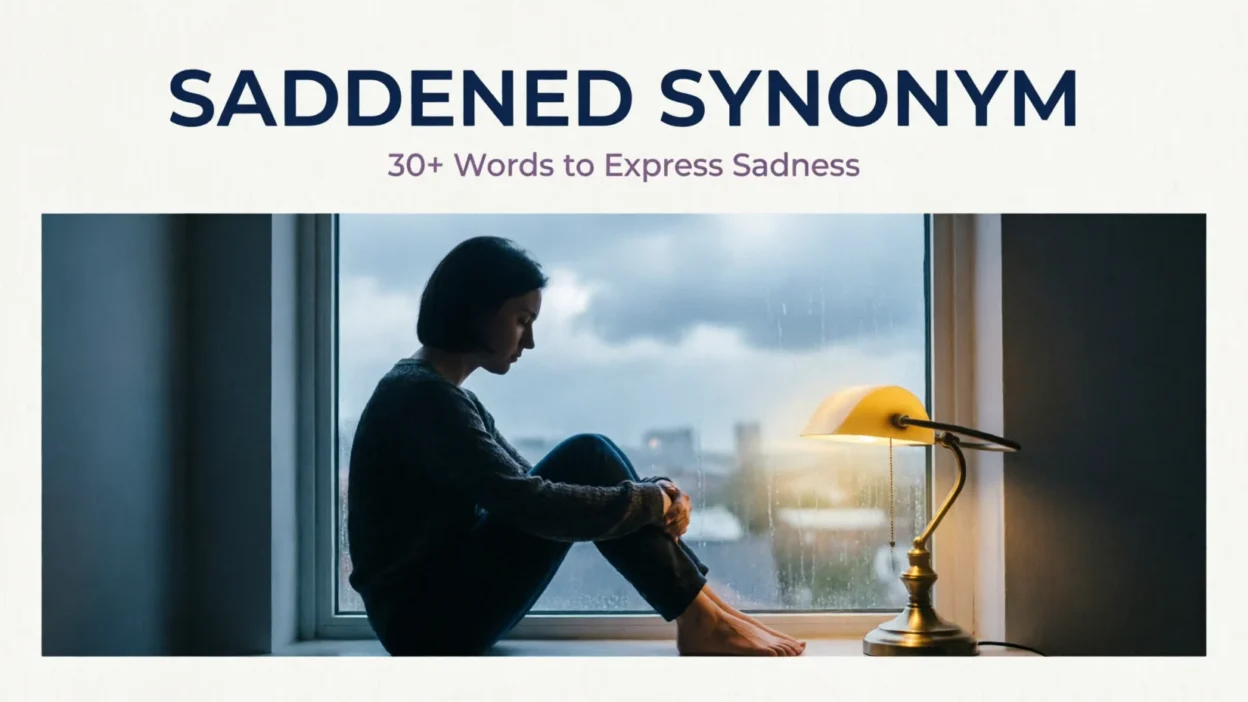
The best synonyms for saddened include upset, unhappy, sorrowful, distressed, heartbroken, disappointed, and grieved. Each word expresses sadness in a slightly different way. Some describe mild disappointment, while others communicate deep emotional pain or grief. Choosing the right synonym helps you express your feelings more accurately in everyday conversations, academic writing, personal messages, and creative work.
If you are a student, an English learner, a writer, or a content creator, understanding these alternatives can improve your vocabulary and help you communicate emotions naturally.
Quick Answer: What Are the Best Synonyms for Saddened?
The most useful synonyms for saddened are:
- Upset: Feeling unhappy or worried.
- Unhappy: Experiencing sadness or dissatisfaction.
- Sorrowful: Feeling deep sadness.
- Distressed: Experiencing strong emotional pain or worry.
- Heartbroken: Feeling overwhelming sadness, often after a loss.
- Disappointed: Feeling sad because expectations were not met.
- Grieved: Feeling deep sorrow, especially after a death or serious loss.
- Melancholy: Experiencing a quiet, thoughtful sadness.
The best choice depends on the situation, the intensity of the emotion, and the tone you want to convey.
What Does Saddened Mean?
Saddened means made sad or caused to feel unhappy, disappointed, or sorrowful. It is the past participle of the verb sadden, which means to make someone feel sadness.
For example:
- The news saddened everyone in the room.
- She felt saddened by her friend’s departure.
- I was saddened to hear about the community’s difficulties.
The word often describes an emotional reaction to disappointing news, a painful experience, a personal loss, or another person’s suffering.
How Is Saddened Used in Everyday English?
Saddened is commonly used when something causes a person to feel sad. It is slightly more formal and thoughtful than words such as upset or bummed out.
For example, you might say, “I was saddened by the announcement” in a professional email, while “I was upset about the announcement” sounds more conversational.
Saddened can also express sympathy without sounding overly dramatic. It is useful in condolences, personal reflections, news reports, and formal statements.
30 Synonyms for Saddened With Meanings and Examples
Below are 30 useful alternatives to saddened, along with simple definitions, example sentences, and the situations in which each word works best.
1. Upset
Simple meaning: Feeling unhappy, worried, or emotionally disturbed.
Example: She was upset when she learned that her application had been rejected.
Best usage/context: Everyday conversations, personal messages, and situations involving disappointment or emotional discomfort.
2. Unhappy
Simple meaning: Not feeling happy; experiencing sadness or dissatisfaction.
Example: He felt unhappy about the changes to his work schedule.
Best usage/context: General situations where you want to express sadness without suggesting intense emotional pain.
3. Sorrowful
Simple meaning: Feeling or showing deep sadness.
Example: The family shared a sorrowful moment as they remembered their loved one.
Best usage/context: Emotional writing, reflective passages, serious conversations, and descriptions of grief.
4. Distressed
Simple meaning: Feeling very worried, upset, or emotionally troubled.
Example: She was distressed by the sudden news about her friend.
Best usage/context: Serious situations involving emotional pain, anxiety, worry, or difficult circumstances.
5. Heartbroken
Simple meaning: Experiencing extremely deep sadness.
Example: He was heartbroken when his closest friend moved away.
Best usage/context: Personal loss, separation, relationship problems, and emotionally painful experiences.
6. Disappointed
Simple meaning: Feeling unhappy because something did not happen as expected.
Example: I was disappointed when the event was canceled.
Best usage/context: Unmet expectations, unsuccessful plans, missed opportunities, and personal setbacks.
7. Grieved
Simple meaning: Experienced deep sorrow, especially after a significant loss.
Example: The entire community grieved the loss of a respected teacher.
Best usage/context: Death, bereavement, serious losses, and formal descriptions of mourning.
8. Melancholy
Simple meaning: A quiet, thoughtful, or lingering feeling of sadness.
Example: A melancholy mood settled over her as she looked through old photographs.
Best usage/context: Literature, poetry, reflective writing, and descriptions of subdued sadness.
9. Mournful
Simple meaning: Showing or expressing sorrow, especially after a loss.
Example: A mournful song filled the quiet room.
Best usage/context: Describing voices, music, expressions, atmospheres, or people displaying grief.
10. Dejected
Simple meaning: Feeling low in spirits because of failure or disappointment.
Example: The players looked dejected after losing the final match.
Best usage/context: Rejection, failure, setbacks, and situations where someone has lost confidence or hope.
11. Gloomy
Simple meaning: Sad, pessimistic, or lacking cheerfulness.
Example: He felt gloomy after hearing that the trip had been postponed.
Best usage/context: Casual conversation and descriptions of moods, outlooks, or atmospheres.
12. Disheartened
Simple meaning: Losing confidence, enthusiasm, or hope.
Example: She felt disheartened after receiving several negative responses.
Best usage/context: Professional setbacks, academic challenges, repeated failures, and discouraging experiences.
13. Downcast
Simple meaning: Looking or feeling sad and discouraged.
Example: His downcast expression revealed how much the criticism had hurt him.
Best usage/context: Describing someone’s appearance, facial expression, mood, or reaction to bad news.
14. Grief-stricken
Simple meaning: Overwhelmed by deep sorrow, usually because of a major loss.
Example: The grief-stricken family gathered to remember their grandmother.
Best usage/context: Death, bereavement, tragedy, and other profoundly painful losses.
15. Woeful
Simple meaning: Very sad or full of sorrow; sometimes meaning very poor or unfortunate.
Example: She gave a woeful account of everything that had gone wrong.
Best usage/context: Literary writing, dramatic descriptions, and situations where sadness is especially noticeable.
16. Dispirited
Simple meaning: Having little energy, hope, or enthusiasm.
Example: The volunteers felt dispirited when their hard work went unrecognized.
Best usage/context: Describing discouragement after setbacks or situations that reduce motivation.
17. Dejectedly
Simple meaning: In a sad, discouraged, or disappointed manner.
Example: He walked dejectedly toward the exit after the interview.
Best usage/context: When you need an adverb to describe how someone acts rather than an adjective describing how someone feels.
Note: Dejectedly is not a direct grammatical substitute for saddened because it is an adverb.
18. Forlorn
Simple meaning: Feeling lonely, abandoned, or hopelessly sad.
Example: The forlorn child waited quietly for someone to come and collect him.
Best usage/context: Creative writing and descriptions of loneliness, abandonment, or lost hope.
19. Wistful
Simple meaning: Feeling a gentle sadness while wishing for something from the past or something unattainable.
Example: She gave a wistful smile as she remembered her childhood home.
Best usage/context: Nostalgia, memories, lost opportunities, and thoughtful longing.
20. Blue
Simple meaning: Feeling sad or low in spirits.
Example: I felt a little blue after my friends left town.
Best usage/context: Informal conversations, friendly messages, and mild sadness.
21. Crestfallen
Simple meaning: Suddenly disappointed or embarrassed, often after a failure.
Example: He looked crestfallen when he discovered that he had missed the deadline.
Best usage/context: Unexpected disappointment, failed expectations, and moments when enthusiasm quickly disappears.
22. Morose
Simple meaning: Unhappy, gloomy, and often unwilling to speak or socialize.
Example: He became morose after the argument and spent the evening alone.
Best usage/context: Describing a persistently gloomy mood or a person’s withdrawn behavior.
23. Lugubrious
Simple meaning: Looking or sounding extremely sad, sometimes in an exaggerated way.
Example: His lugubrious expression made the otherwise ordinary announcement seem tragic.
Best usage/context: Formal or literary writing, humorous exaggeration, and descriptions of excessively mournful behavior.
24. Pained
Simple meaning: Showing or experiencing emotional or physical suffering.
Example: She gave a pained smile when the conversation turned to her failed relationship.
Best usage/context: Emotional reactions to hurtful remarks, painful memories, or difficult experiences.
25. Troubled
Simple meaning: Feeling worried, unhappy, or mentally unsettled.
Example: He seemed troubled by the news about his family’s situation.
Best usage/context: Situations involving sadness mixed with worry, uncertainty, or concern.
26. Aggrieved
Simple meaning: Feeling that you have been treated unfairly or wronged.
Example: The aggrieved employee explained why the decision seemed unfair.
Best usage/context: Workplace disputes, disagreements, injustice, and formal complaints.
27. Regretful
Simple meaning: Feeling sad or sorry about something that happened or something you did.
Example: She felt regretful about missing her friend’s important celebration.
Best usage/context: Mistakes, missed opportunities, past decisions, and expressions of remorse.
28. Heart-sore
Simple meaning: Experiencing deep emotional sadness or pain.
Example: He felt heart-sore after saying goodbye to his childhood friends.
Best usage/context: Poetic, literary, or expressive writing. This is a less common alternative than heartbroken.
29. Bereaved
Simple meaning: Having lost a loved one through death.
Example: The bereaved husband received support from friends and relatives.
Best usage/context: Bereavement, condolences, funeral notices, and formal descriptions of someone who has experienced a death.
Important distinction: Bereaved describes a person who has suffered a death-related loss; it does not simply mean sad.
30. Saddening
Simple meaning: Causing sadness or making someone feel unhappy.
Example: It was saddening to see the historic building fall into disrepair.
Best usage/context: Describing events, facts, or situations that cause sadness.
Important distinction: Saddening describes something that causes sadness, while saddened generally describes someone who has been made sad.
Comparison Table: Which Saddened Synonym Should You Use?
The following table compares common alternatives by emotional intensity and appropriate context.
| Synonym | Emotional intensity | Best context |
| Upset | Mild to moderate | Everyday problems |
| Unhappy | Mild to moderate | General dissatisfaction |
| Disappointed | Mild to moderate | Unmet expectations |
| Blue | Mild | Informal conversations |
| Wistful | Mild to moderate | Nostalgia and longing |
| Melancholy | Moderate | Reflective or literary writing |
| Dejected | Moderate | Failure or rejection |
| Disheartened | Moderate | Loss of confidence |
| Distressed | Moderate to strong | Worry and emotional strain |
| Heartbroken | Very strong | Deep personal pain |
| Grief-stricken | Very strong | Major loss or bereavement |
| Mournful | Moderate to strong | Expressions of grief |
| Aggrieved | Variable | Perceived unfair treatment |
| Regretful | Variable | Past actions or missed opportunities |
| Saddening | Not a feeling state | Events that cause sadness |
These intensity levels are approximate. Context, sentence structure, and the person’s experience can change how strongly a word is understood.
How to Choose the Right Synonym for Saddened
The best synonym communicates not only sadness but also its cause, intensity, and emotional tone.
1. Choose a Synonym for Mild Sadness
Use unhappy, upset, or blue when describing ordinary disappointment or a temporary low mood.
Examples:
- I felt unhappy about the delay.
- She was upset by the misunderstanding.
- He felt blue on a rainy afternoon.
These words sound natural in everyday conversations.
2. Choose a Synonym for Deep Emotional Pain
Use heartbroken, sorrowful, grief-stricken, or grieved when the sadness is intense.
Examples:
- She was heartbroken after the separation.
- The family was grief-stricken after the loss.
- The town grieved the death of its founder.
These terms communicate stronger emotions than unhappy or upset.
3. Choose a Synonym for Disappointment
Use disappointed, crestfallen, dejected, or disheartened when someone feels sad because something did not go as hoped.
Examples:
- I was disappointed by the result.
- The student looked crestfallen after the announcement.
- The team felt disheartened after another defeat.
Use disappointed for a straightforward statement, crestfallen for a visible reaction, and disheartened when confidence or motivation has weakened.
4. Choose a Synonym for Formal or Academic Writing
Use distressed, sorrowful, aggrieved, or bereaved when the context requires precision and a more formal tone.
Examples:
- The announcement left several residents distressed.
- The bereaved family received assistance.
- The aggrieved residents submitted a formal complaint.
Remember that these words have different meanings. Aggrieved suggests perceived unfairness, while bereaved specifically concerns the death of a loved one.
5. Choose a Synonym for Creative Writing
Use melancholy, wistful, forlorn, mournful, or lugubrious to create a particular atmosphere or emotional effect.
Examples:
- A melancholy melody drifted through the empty house.
- She cast a wistful glance at the old photograph.
- A mournful silence followed the announcement.
These alternatives can make descriptions more vivid, but the best choice should fit the scene rather than simply sound sophisticated.
6. Choose a Synonym for Sympathy and Condolences
Use saddened, sorrowful, or deeply grieved when expressing sympathy for another person’s loss.
Examples:
- I was deeply saddened to hear about your loss.
- We are sorrowful over this tragic event.
- Our community grieves with everyone affected.
For a condolence message, saddened is often a gentle and respectful choice because it expresses sympathy without overstating your own feelings.
Common Mistakes When Using Saddened Synonyms
1. Treating Every Synonym as an Exact Replacement
Not all synonyms have identical meanings.
For example, disappointed usually relates to unmet expectations, while grief-stricken suggests overwhelming sorrow after a major loss.
Incorrect: “I was grief-stricken because my food arrived five minutes late.”
More natural: “I was disappointed because my food arrived late.”
2. Confusing Saddened With Saddening
These words perform different grammatical roles.
- Saddened: Describes someone who has been made sad.
- Saddening: Describes something that causes sadness.
Examples:
- The report saddened the readers.
- The report contained saddening details.
3. Using an Adverb as an Adjective
Dejectedly describes an action, while dejected describes a person or their emotional state.
Incorrect: “She felt dejectedly.”
Correct: “She felt dejected.”
Another correct sentence is: “She walked dejectedly toward the door.”
4. Using Bereaved for Ordinary Disappointment
Bereaved refers to losing someone through death. It should not be used as a general synonym for being unhappy.
Incorrect: “He was bereaved when his team lost.”
Correct: “He was disappointed when his team lost.”
5. Choosing Words That Are Too Dramatic
Words such as heartbroken and grief-stricken express powerful emotions. Using them for minor inconveniences may make a sentence sound exaggerated.
Choose upset or disappointed when the situation involves relatively mild sadness.
6. Repeating the Same Word Too Often
Repeatedly using sad or saddened can make writing monotonous. Select alternatives according to the specific emotion you want to describe.
For instance, a character might feel disappointed after failing an exam, disheartened after repeated failures, and hopeful after receiving encouragement.
This approach creates more natural and expressive writing.
FAQs:
1. What is the closest synonym for saddened?
Upset is a common, versatile alternative to saddened. However, sorrowful may be more suitable for deeper sadness, while disappointed is better when sadness results from unmet expectations.
2. What is a stronger word for saddened?
Heartbroken, grief-stricken, and devastated are stronger alternatives that communicate intense emotional pain. Use them when the situation involves a significant loss or deeply upsetting experience.
3. What is a formal synonym for saddened?
Sorrowful, distressed, and deeply grieved can work in formal contexts. The most appropriate option depends on whether the situation involves general sadness, emotional distress, or bereavement.
4. What is a simple synonym for saddened for students?
Unhappy, upset, and disappointed are easy alternatives for students and English learners. They are common, understandable, and useful in everyday sentences.
5. What is the difference between saddened and disappointed?
Saddened means made sad by something, while disappointed means unhappy because an expectation, hope, or plan was not fulfilled.
For example, “I was saddened by the news” expresses sadness, whereas “I was disappointed by the result” emphasizes an outcome that did not meet expectations.
6. Can saddened be used in a professional email?
Yes. Saddened is appropriate for professional emails, especially when expressing sympathy or responding to unfortunate news.
For example: “I was saddened to learn about the recent events and extend my sincere sympathy to everyone affected.”
7. What is the opposite of saddened?
Common antonyms include cheered, delighted, pleased, encouraged, and comforted. The best opposite depends on the context. Delighted suggests great happiness, while comforted means feeling less distressed because of support or reassurance.
8. What is the difference between saddened and sorrowful?
Saddened usually describes someone who has been made sad by an event or experience. Sorrowful describes a person, expression, or mood that shows or contains sorrow.
Examples:
- “I was saddened by the announcement.”
- “She wore a sorrowful expression.”
Conclusion
Choosing the right synonym for saddened helps you communicate emotions with greater clarity and accuracy. Words such as upset, unhappy, and disappointed work well for everyday situations, while sorrowful, melancholy, and mournful add depth to descriptive writing. For intense emotional pain, heartbroken and grief-stricken are more suitable.
Always consider the cause of the sadness, its intensity, and your audience before selecting an alternative. By understanding these differences, students, English learners, and writers can build a stronger vocabulary and express feelings more naturally.

I’m Nathan Collins, a language enthusiast passionate about exploring synonyms and improving everyday writing. I create clear, accurate, and helpful content that helps readers expand vocabulary and communicate with confidence.