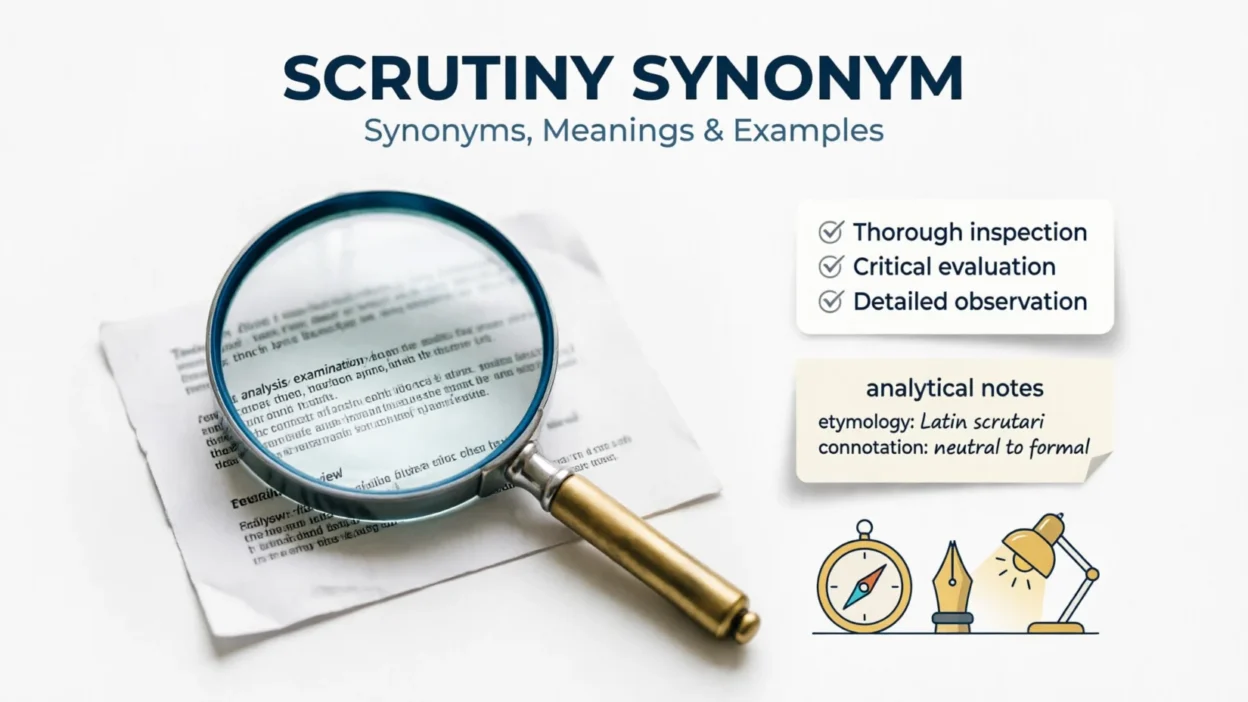
The best scrutiny synonyms include examination, inspection, investigation, analysis, review, assessment, and close observation. These words describe looking at something carefully to understand it, check its accuracy, or discover problems. However, each synonym has a slightly different meaning and works best in a particular context. Choosing the right word can make your writing clearer, more natural, and more precise.
If you are writing an academic essay, preparing a professional report, studying English, or improving your vocabulary, understanding synonyms for scrutiny will help you express careful examination in the right way.
Quick Answer: What Is a Synonym for Scrutiny?
A synonym for scrutiny is a word that means careful examination or close inspection of something. The most common alternatives are examination, inspection, investigation, analysis, review, assessment, and observation.
- Examination: Careful study of something.
- Inspection: Checking something for quality, safety, or problems.
- Investigation: Searching for facts or evidence.
- Analysis: Studying details to understand something.
- Review: Looking over something to evaluate it.
- Assessment: Judging the quality, value, or importance of something.
The best choice depends on whether you mean checking details, finding evidence, evaluating quality, or studying information.
What Does Scrutiny Mean?
Scrutiny is the careful and detailed examination of a person, object, document, decision, or situation. It often involves paying close attention to details to identify mistakes, understand facts, or judge whether something is correct.
For example, a financial report may undergo scrutiny before a company approves its budget. This means the report is examined carefully to check its figures and identify possible errors.
Scrutiny can be used in both formal and everyday English. It frequently appears in academic writing, business reports, journalism, law, politics, and discussions about public decisions.
Different Uses of Scrutiny
- Academic: A researcher examines evidence carefully.
- Professional: An employer checks a proposal before approving it.
- Legal: Investigators examine documents for relevant evidence.
- Public: Citizens closely examine a politician’s decisions.
- Personal: Someone carefully considers another person’s explanation.
Scrutiny can be neutral or critical. It does not always mean that something is wrong; it simply means that something is being examined closely.
30 Synonyms for Scrutiny With Meanings and Examples
The following words are useful alternatives to scrutiny. Each has a slightly different meaning, so consider the situation before choosing one.
1. Examination
Simple meaning: A careful study of something to understand it or check its condition.
Example: The committee conducted a thorough examination of the proposal.
Best usage/context: Academic writing, formal reports, medical settings, and situations requiring detailed study.
2. Inspection
Simple meaning: A careful check to find problems or confirm that something meets certain standards.
Example: The building passed its safety inspection.
Best usage/context: Quality control, safety checks, equipment, buildings, and official procedures.
3. Investigation
Simple meaning: A systematic search for facts or evidence about a situation.
Example: The journalist began an investigation into the financial irregularities.
Best usage/context: Legal cases, research, journalism, workplace complaints, and suspected wrongdoing.
4. Analysis
Simple meaning: A detailed study of information to understand its parts, patterns, or meaning.
Example: Her analysis of the report revealed several important weaknesses.
Best usage/context: Academic essays, data interpretation, research papers, and business decisions.
5. Review
Simple meaning: A careful look at something to check or evaluate it.
Example: The manager requested a review of the company’s spending plan.
Best usage/context: Reports, policies, documents, performance evaluations, and professional discussions.
6. Assessment
Simple meaning: A judgment about the quality, value, ability, or importance of something.
Example: The teacher completed an assessment of each student’s progress.
Best usage/context: Education, workplace performance, risks, projects, and decision-making.
7. Evaluation
Simple meaning: A careful judgment of how good, useful, or successful something is.
Example: The team carried out an evaluation of the new training program.
Best usage/context: Academic research, business performance, programs, services, and outcomes.
8. Observation
Simple meaning: The act of watching or noticing something carefully.
Example: Careful observation of the experiment helped the students understand the results.
Best usage/context: Scientific studies, behavior, classroom learning, and everyday situations.
9. Reviewal
Simple meaning: The act of reviewing or reconsidering something.
Example: The policy underwent a reviewal before the final decision was made.
Best usage/context: Formal or specialized contexts where the term is appropriate. In most everyday and professional writing, review is more natural and widely used.
10. Audit
Simple meaning: A formal examination of financial records, systems, or procedures.
Example: The organization conducted an audit of its annual accounts.
Best usage/context: Accounting, finance, compliance, internal controls, and organizational accountability.
11. Inquiry
Simple meaning: An attempt to discover information by asking questions or examining facts.
Example: The school launched an inquiry into the incident.
Best usage/context: Formal investigations, public affairs, workplace concerns, and information gathering.
12. Probe
Simple meaning: A close examination intended to uncover hidden facts or details.
Example: The committee launched a probe into the allegations.
Best usage/context: Journalism, official investigations, controversial issues, and suspected misconduct.
13. Assessment of Evidence
Simple meaning: A careful examination of facts or information to determine how convincing or reliable they are.
Example: The court required a careful assessment of the evidence.
Best usage/context: Legal writing, research, critical thinking, and evidence-based decisions. This is a phrase rather than a single-word synonym.
14. Appraisal
Simple meaning: An evaluation of the value, quality, or performance of something.
Example: The property underwent an appraisal before it was sold.
Best usage/context: Property valuation, employee performance, professional judgments, and estimating worth.
15. Review of Details
Simple meaning: A careful check of individual facts or parts of something.
Example: A review of the details revealed an error in the application.
Best usage/context: Editing, proofreading, applications, contracts, and administrative work. This is a phrase that describes one form of scrutiny.
16. Dissection
Simple meaning: The close examination of something by separating it into smaller parts.
Example: The critic offered a detailed dissection of the novel’s main themes.
Best usage/context: Biology, literary criticism, complex arguments, and detailed explanations.
17. Inspectional Review
Simple meaning: A review that focuses on checking the condition, details, or compliance of something.
Example: The equipment received an inspectional review before it was used.
Best usage/context: Specialized technical writing. In most situations, inspection or detailed review sounds more natural.
18. Examination of Evidence
Simple meaning: A close study of facts, records, or information to determine what they show.
Example: The lawyer requested a careful examination of the evidence.
Best usage/context: Legal proceedings, academic research, investigations, and fact-checking. This is a phrase rather than a single-word synonym.
19. Verification
Simple meaning: The process of checking whether something is accurate, true, or valid.
Example: The figures required verification before the report could be published.
Best usage/context: Fact-checking, research, identity checks, calculations, and official records.
20. Cross-Examination
Simple meaning: Questioning a witness in a legal proceeding to test the reliability of their statements.
Example: The lawyer used cross-examination to challenge the witness’s account.
Best usage/context: Courtrooms and legal discussions. It is a specialized term, not a general replacement for scrutiny.
21. Deliberation
Simple meaning: Careful thought and discussion before making a decision.
Example: After considerable deliberation, the panel approved the proposal.
Best usage/context: Decision-making, meetings, formal discussions, and situations requiring thoughtful judgment.
22. Consideration
Simple meaning: Careful thought about something before reaching a decision.
Example: The application received careful consideration from the selection committee.
Best usage/context: Applications, proposals, personal decisions, and professional communication.
23. Study
Simple meaning: The process of examining or learning about something carefully.
Example: The team conducted a detailed study of customer behavior.
Best usage/context: Education, scientific research, social sciences, and general learning.
24. Assessment of Quality
Simple meaning: An examination intended to judge how good something is.
Example: The assessment of quality identified several manufacturing problems.
Best usage/context: Product testing, manufacturing, services, and performance reviews. This is a descriptive phrase rather than a single-word synonym.
25. Scrutinization
Simple meaning: The act of examining something closely and carefully.
Example: The proposal underwent further scrutinization before approval.
Best usage/context: Formal or technical writing. Scrutiny is usually the simpler and more natural choice.
26. Surveillance
Simple meaning: The close and often continuous observation of people, places, or activities.
Example: The authorities increased surveillance around the restricted area.
Best usage/context: Security, monitoring, public safety, and situations involving ongoing observation. Surveillance emphasizes watching over time rather than examining a document or argument.
27. Monitoring
Simple meaning: Watching or checking something regularly to track its condition or progress.
Example: Regular monitoring helped the team identify changes in water quality.
Best usage/context: Health and safety systems, project management, environmental studies, and ongoing processes.
28. Critical Review
Simple meaning: A careful examination that considers strengths, weaknesses, and possible problems.
Example: The professor wrote a critical review of the research paper.
Best usage/context: Academic writing, literature reviews, policy evaluation, and professional feedback. This is a phrase rather than a single-word synonym.
29. Close Examination
Simple meaning: A detailed look at something to understand it or identify important details.
Example: The document required close examination before it was signed.
Best usage/context: Contracts, research, proofreading, and situations where accuracy matters. This is a phrase that closely captures the meaning of scrutiny.
30. Critical Analysis
Simple meaning: A detailed study that examines information, evidence, strengths, and weaknesses.
Example: Her critical analysis of the proposal highlighted several practical concerns.
Best usage/context: Academic essays, research papers, debates, policy discussions, and complex decision-making.
Comparison Table: Which Scrutiny Synonym Is Best?
Different synonyms emphasize different kinds of careful examination. Use this table to select a word that matches your intended meaning.
| Synonym | Main emphasis | Best context |
| Examination | Careful study | General or academic |
| Inspection | Checking condition or standards | Safety and quality |
| Investigation | Finding facts | Legal or workplace matters |
| Analysis | Understanding details | Research and data |
| Review | Looking over something | Reports and documents |
| Assessment | Judging value or condition | Education and risk |
| Evaluation | Measuring effectiveness or quality | Programs and performance |
| Observation | Watching carefully | Science and behavior |
| Audit | Formal verification of records | Finance and compliance |
| Inquiry | Asking questions to find facts | Official or public matters |
| Probe | Uncovering hidden details | Controversial issues |
| Verification | Confirming accuracy | Fact-checking and records |
| Appraisal | Estimating worth or performance | Property and employment |
| Deliberation | Careful thought before a decision | Meetings and decisions |
| Monitoring | Checking continuously or regularly | Ongoing processes |
| Critical analysis | Examining strengths and weaknesses | Academic and professional work |
Scrutiny vs. Examination
Scrutiny often suggests particularly close attention to details, while examination is a broader term for studying something carefully.
Example:
- The contract came under public scrutiny.
- The doctor conducted an examination of the patient.
Both terms involve careful attention, but their typical contexts differ.
Scrutiny vs. Investigation
Scrutiny means close examination, whereas investigation usually involves actively gathering facts to discover what happened or why.
Example:
- The proposal faced scrutiny from the board.
- The police opened an investigation into the incident.
Scrutiny vs. Analysis
Scrutiny focuses on examining something closely. Analysis emphasizes breaking information into parts and understanding how those parts relate to one another.
Example:
- The editor subjected the article to close scrutiny.
- The researcher presented an analysis of the survey results.
Scrutiny vs. Inspection
Scrutiny can apply to ideas, decisions, documents, or actions. Inspection usually means checking the condition, quality, safety, or compliance of something.
Example:
- The policy faced scrutiny from lawmakers.
- The inspector examined the factory’s safety equipment.
How to Choose the Right Synonym for Scrutiny
The best synonym depends on your intended meaning, the tone of your writing, and the situation you are describing.
1. For Formal and Academic Writing
Choose words that communicate careful, systematic examination.
Useful alternatives:
- Examination
- Analysis
- Evaluation
- Critical analysis
- Assessment
Example: Instead of writing, “The study received scrutiny,” you could write, “The study underwent a detailed critical analysis.”
This version is especially suitable when you mean that researchers examined the study’s reasoning, evidence, and conclusions.
2. For Business and Professional Writing
Use words that clearly describe checking, reviewing, or judging work.
Useful alternatives:
- Review
- Audit
- Assessment
- Appraisal
- Inspection
Example: “The finance team conducted an audit of the annual accounts.”
Use audit when the examination follows a formal process, particularly for financial records or compliance.
3. For Investigations and Legal Contexts
Choose words that emphasize evidence, questioning, and fact-finding.
Useful alternatives:
- Investigation
- Inquiry
- Probe
- Verification
- Examination of evidence
Example: “The allegations prompted an independent investigation.”
Avoid using investigation when you simply mean that someone read a document carefully. The word usually suggests a more active search for facts.
4. For Checking Accuracy or Quality
Choose a word that describes the specific purpose of the examination.
Useful alternatives:
- Inspection
- Verification
- Review
- Assessment
- Audit
Example: “The figures were checked through independent verification.”
Use verification when the goal is to confirm that information is correct.
5. For Critical or Public Attention
When someone or something receives close attention from the public, media, or authorities, the following alternatives may work:
- Close examination
- Critical review
- Investigation
- Public examination
- Analysis
Example: “The mayor’s decision came under intense public scrutiny.”
In this context, scrutiny suggests that people are examining the decision closely and may question its fairness or reasoning.
6. For Everyday English
Choose familiar words that readers can understand quickly.
Useful alternatives:
- Careful check
- Close look
- Examination
- Review
- Study
Example: “Please take a close look at the document before submitting it.”
Simple phrases often sound more natural than technical words in casual conversations.
Common Mistakes When Using Scrutiny Synonyms
Even words with similar meanings cannot always replace one another. Understanding their differences will help you avoid awkward or inaccurate sentences.
1. Using Investigation When You Mean a Simple Check
Incorrect or unnatural: “I conducted an investigation of my homework.”
Better: “I checked my homework carefully.”
Why: Investigation usually implies a search for facts about a question, problem, or suspected event.
2. Confusing Scrutiny With Surveillance
Incorrect: “The editor placed the essay under surveillance.”
Better: “The editor examined the essay closely.”
Why: Surveillance generally means watching people, places, or activities over time. Scrutiny usually means examining something carefully.
3. Using Audit for Every Type of Examination
Unnatural: “The teacher conducted an audit of the student’s poem.”
Better: “The teacher conducted a detailed review of the student’s poem.”
Why: Audit is most appropriate for formal checks of records, systems, and compliance.
4. Assuming Scrutiny Always Means Criticism
Incorrect assumption: “The report faced scrutiny, so it must have been wrong.”
Better understanding: “The report faced scrutiny before approval.”
Why: Scrutiny means careful examination. It may reveal problems, but it can also confirm that something is accurate or reliable.
5. Choosing Complex Words When Simple Ones Work Better
Unnatural: “The team performed a scrutinization of the schedule.”
Better: “The team reviewed the schedule carefully.”
Why: Clear and familiar wording is often more effective than unnecessarily complicated vocabulary.
6. Ignoring Grammar and Word Forms
The noun scrutiny appears in phrases such as “under scrutiny” and “subject to scrutiny.” Some alternatives require different grammatical structures.
Examples:
- The proposal came under scrutiny.
- The proposal underwent examination.
- The proposal was reviewed carefully.
- The proposal was subjected to a critical analysis.
Tip: When replacing scrutiny, adjust the entire sentence if necessary rather than changing just one word.
FAQs:
1. What is the closest synonym for scrutiny?
Examination is one of the closest general synonyms for scrutiny. Both describe looking at something carefully. However, scrutiny often emphasizes particularly close attention to details, while examination has a wider range of uses.
2. What is another word for close scrutiny?
Useful alternatives include close examination, careful inspection, detailed review, critical analysis, and thorough investigation. The best option depends on whether you are studying information, checking quality, or searching for evidence.
3. What is a formal synonym for scrutiny?
Formal alternatives include examination, assessment, evaluation, analysis, and inspection. In legal or financial contexts, investigation and audit may also be appropriate when they accurately describe the process.
4. What is the difference between scrutiny and inspection?
Scrutiny is a broad term for careful examination, including the examination of ideas, decisions, documents, and behavior. Inspection more often refers to checking an object’s condition, safety, quality, or compliance with standards.
5. Is analysis a synonym for scrutiny?
Yes, in some contexts. Both can describe a detailed examination. However, analysis specifically involves studying parts, relationships, or patterns to understand something, while scrutiny emphasizes close attention and careful checking.
6. What does it mean when something comes under scrutiny?
When something comes under scrutiny, people examine it closely. They may check its accuracy, question its fairness, or evaluate its quality. For example, a company’s spending may come under scrutiny when its financial decisions are reviewed.
7. What is the opposite of scrutiny?
Possible opposites include neglect, inattention, disregard, oversight, and superficial examination, depending on the intended meaning. These terms describe failing to examine something carefully or paying insufficient attention to details.
Conclusion
Scrutiny means the careful and detailed examination of something to understand it, verify its accuracy, or identify possible problems. Its most useful synonyms include examination, inspection, investigation, analysis, review, assessment, evaluation, and observation.
Although these words are related, they have different purposes. Use examination for a general close study, inspection for checking condition or quality, investigation for finding facts, analysis for understanding details, and evaluation for judging effectiveness or value.
The key to choosing the right scrutiny synonym is to consider what you want to communicate. By selecting words that match your meaning and context, you can make your writing clearer, more precise, and easier to understand.

I’m James Parker, Administrator at SynonymsHive. I oversee content quality, improve user experience, and ensure reliable synonym resources. My passion is making language learning simple, accurate, and accessible for everyone.